

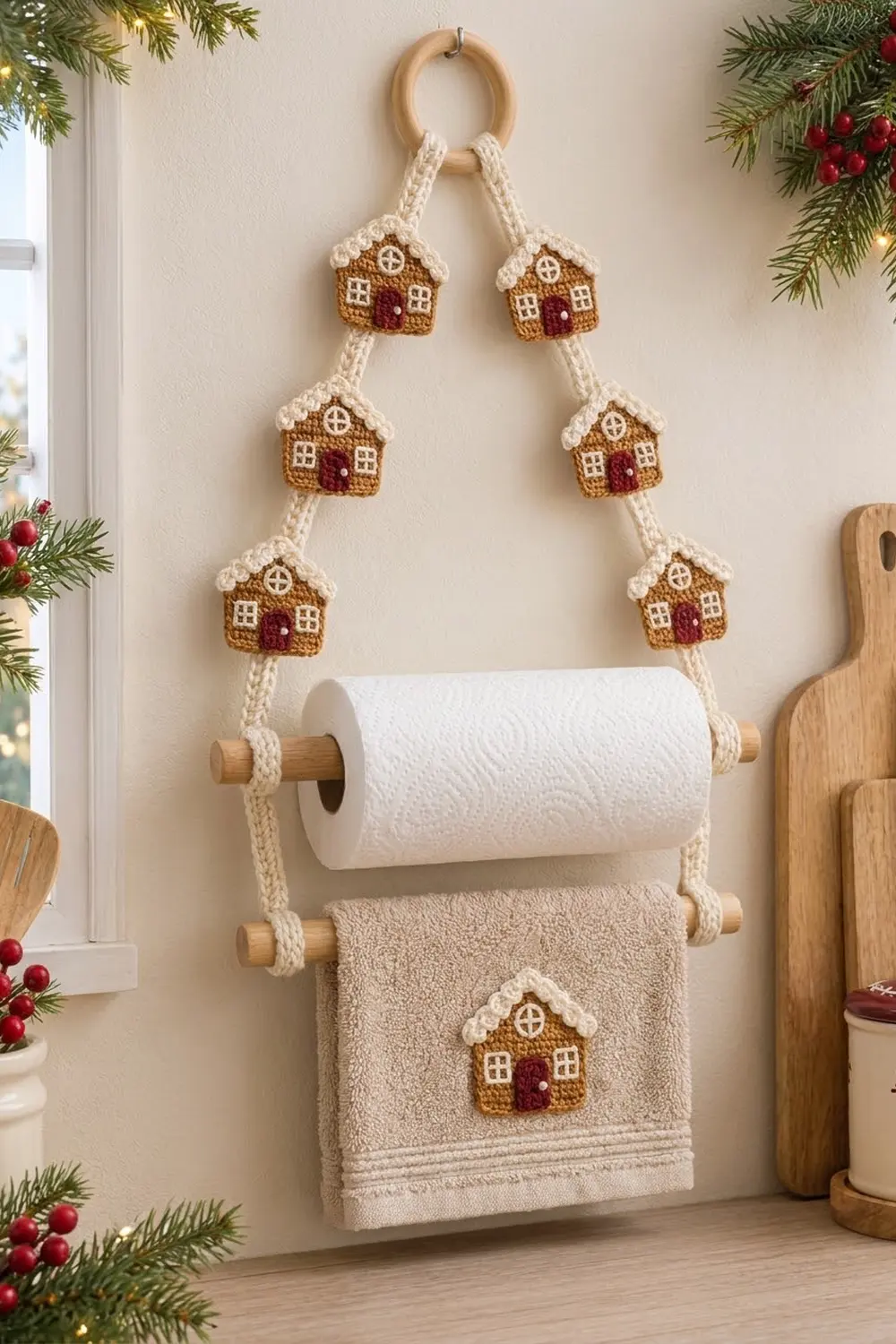
Gingerbread Lane is a hanging holder for a paper towel roll and a tea towel. Two chunky cream cords drop from a wooden ring, and three little gingerbread houses climb each cord like a row of cottages on a snowy hill. A seventh house is sewn to the tea towel so the set matches.
The colors are warm and simple: caramel brown for the walls, cream for the icing, windows and cords, and deep cranberry red for the doors. The style is cozy farmhouse Christmas. The houses are flat and tidy, with no stuffing.
This pattern uses US crochet terms. The finished holder is about 14 in (35.6 cm) wide and 24 in (61.0 cm) tall. Each finished house is 3.5 in (8.9 cm) wide and 3.75 in (9.5 cm) tall.
You will crochet each house flat in rows, add the cream icing edging, embroider the windows, and sew on a separate door and ring window. Then you make two I-cords, sew three houses to each one, and fasten the cords around a ring and two dowels.
Finished Size and Construction
- Finished holder: about 14 in (35.6 cm) wide x 24 in (61.0 cm) tall
- Skill level: Easy+
- Terminology: US
- Yarn weight: worsted (#4)
- Hooks: 4.0 mm (G-6) for the houses, 5.0 mm (H-8) for the cords
- Number of pieces: 7 houses, 7 doors, 7 ring windows, 2 cords
- Layout: 3 houses on each cord, 1 house on the towel
- House size: 3.5 in (8.9 cm) wide x 3.75 in (9.5 cm) tall
- House size before border: 3 in (7.6 cm) wide at the eaves x 3.5 in (8.9 cm) tall
- Border depth: about 0.25 in (0.6 cm) along each roof edge
Materials
Choose a smooth worsted yarn in acrylic or cotton. Smooth yarn shows the embroidered windows clearly, and cotton keeps a crisp shape near a busy kitchen counter.
- Caramel brown: 30 g, about 52 m (57 yd)
- Cream: 60 g, about 104 m (114 yd)
- Cranberry red: 10 g, about 17 m (19 yd)
These amounts include an extra margin of about 20 percent.
Tools and hardware:
- 4.0 mm (G-6) and 5.0 mm (H-8) crochet hooks
- Yarn needle
- Stitch markers and rust-proof pins
- Tape measure
- 1 wooden ring, 2.5 in (6.4 cm) across
- 2 wooden dowels, each 14 in (35.6 cm) long and 0.75 in (1.9 cm) thick
- 7 cream beads, 4 mm, or cream yarn for French knots
- 1 plain tea towel (optional)
Abbreviations (US Terms)
- ch – chain
- sc – single crochet
- hdc – half double crochet
- dc – double crochet
- sl st – slip stitch
- sc2tog – single crochet 2 together
- yo – yarn over
- st(s) – stitch(es)
Shell: 3 hdc in the same stitch.
Crochet I-cord: Ch 3. Insert hook in 2nd ch from hook, yo, draw up a loop. Insert hook in next ch, yo, draw up a loop (3 loops on hook). Keep the first loop on the hook and slip the other 2 loops off, pinching them so they don’t come undone. Yo and draw through the loop on the hook. Insert hook into the next dropped loop, yo, draw up a loop; repeat once more (3 loops on hook). One repeat is 1 round. Tug the cord down every few rounds so it closes into a tube.
Gauge and Checkpoints
House gauge: 16 sc and 16 rows = 4 in (10.2 cm) with the 4.0 mm hook. Work firmly so the houses stay flat and stiff.
Cord gauge: With cream held double and the 5.0 mm hook, 4 rounds = 1 in (2.5 cm). The cord is about 0.5 in (1.3 cm) thick.
Make one complete house before anything else and check it at each stage:
- After Row 7: the body is 2.5 in (6.4 cm) wide x 1.75 in (4.4 cm) tall.
- After Row 8: the eave row is 3 in (7.6 cm) wide.
- After Row 14: the house is 3.5 in (8.9 cm) tall.
- After the icing: the house is 3.5 in (8.9 cm) wide x 3.75 in (9.5 cm) tall.
If your house is too big, go down a hook size. If it is too small, go up a hook size. Small errors matter here, because an extra 0.25 in (0.6 cm) per house adds up along each cord.
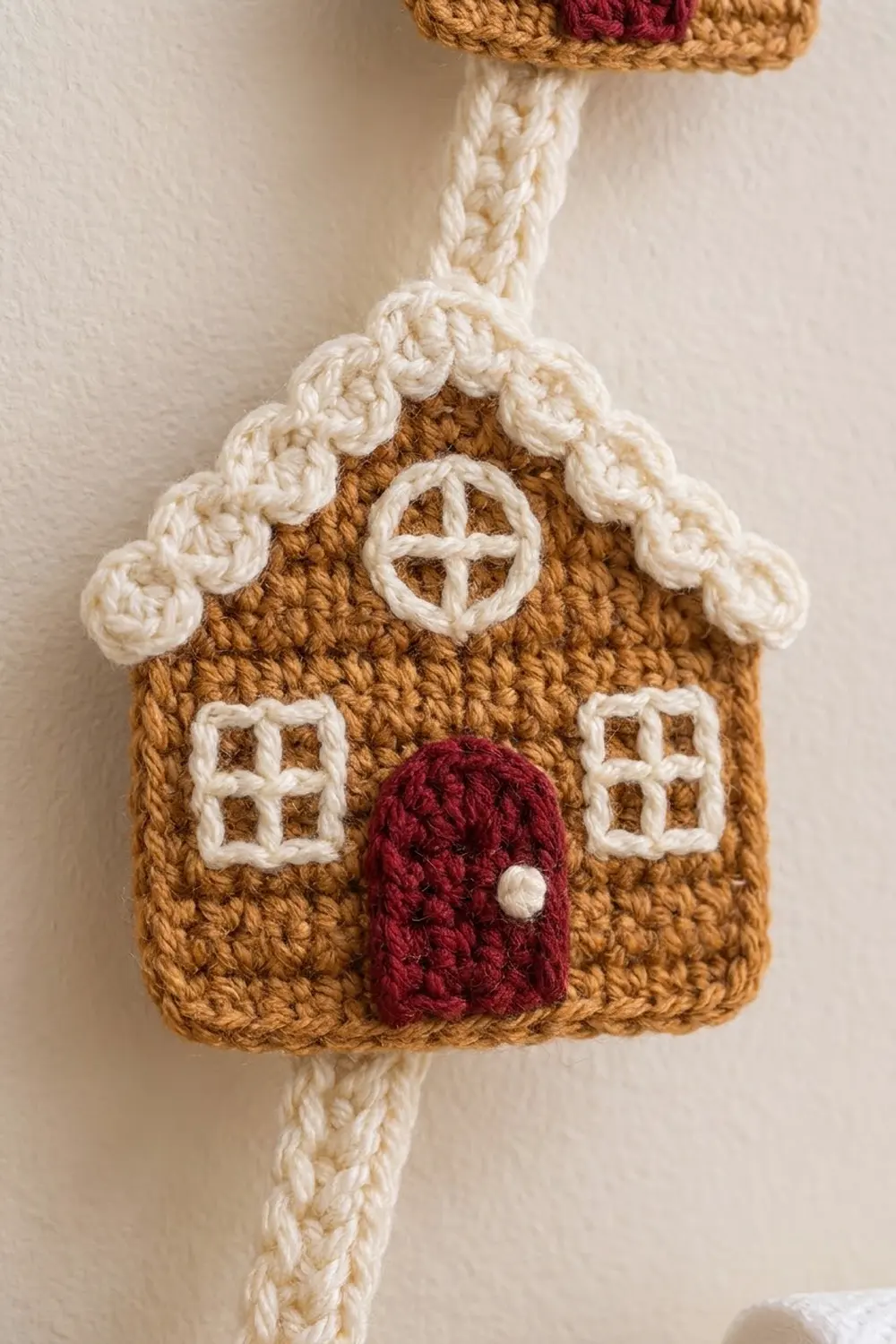
House (Make 7)
With caramel brown and the 4.0 mm hook, ch 11.
Row 1: Sc in 2nd ch from hook and in each ch across. Turn. (10 sc)
Rows 2–7: Ch 1, sc in each st across. Turn. (10 sc)
The body is now a rectangle 2.5 in (6.4 cm) wide x 1.75 in (4.4 cm) tall.
Row 8 (eaves): Ch 1, 2 sc in first st, sc in next 8 sts, 2 sc in last st. Turn. (12 sc: 10 worked into existing sts + 2 added)
This row makes the small overhang where the roof meets the walls.
Row 9: Ch 1, sc2tog, sc in next 8 sts, sc2tog. Turn. (10 sc)
Row 10: Ch 1, sc2tog, sc in next 6 sts, sc2tog. Turn. (8 sc)
Row 11: Ch 1, sc2tog, sc in next 4 sts, sc2tog. Turn. (6 sc)
Row 12: Ch 1, sc2tog, sc in next 2 sts, sc2tog. Turn. (4 sc)
Row 13: Ch 1, sc2tog twice. Turn. (2 sc)
Row 14: Ch 1, sc2tog. (1 sc)
Fasten off and weave in the ends. Each roof slope now has 7 row-ends (Rows 8–14), and the peak is a single stitch. Each roof row loses one stitch at each edge, so the roof rises at a clean 45-degree angle.
Door (Make 7)
With cranberry red and the 4.0 mm hook, ch 4.
Row 1: Sc in 2nd ch from hook and in next 2 ch. Turn. (3 sc)
Rows 2–4: Ch 1, sc in each st across. Turn. (3 sc)
Row 5 (arch): Ch 1, sc in first st, (hdc, dc, hdc) in next st, sc in last st. (5 sts: 3 worked into existing sts + 2 added)
Fasten off, leaving a 10 in (25.4 cm) tail. The door is 0.75 in (1.9 cm) wide x 1.25 in (3.2 cm) tall, with a rounded top.
Ring Window (Make 7)
With cream and the 4.0 mm hook, ch 8. Sl st in the first ch to form a ring. Fasten off, leaving an 8 in (20.3 cm) tail. The ring is about 0.5 in (1.3 cm) across.
Icing Border
Work the icing on every house before adding the details.
Border gauge: 1 sc per row-end along each slope, which gives 7 sc per slope.
With the right side facing, join cream with a sl st in the row-end of Row 8 at the right eave.
Row A: Ch 1. Sc in the same row-end and in each of the next 6 row-ends up the slope (7 sc). Work 3 sc in the peak st. Sc in each of the 7 row-ends down the other slope (7 sc). Turn. (17 sc: 7 + 3 + 7)
Row B: Ch 1, sc in first st, shell in next st, sc in next st; repeat from * 7 more times. (33 sts: 9 sc + 8 shells of 3 hdc = 24 hdc)
Fasten off and weave in the ends.
Why the math works: Each repeat (shell, then sc) uses 2 stitches, plus there is 1 starting sc, so the row needs an odd count. 17 = 2 x 8 + 1, which gives exactly 8 shells. The 9th stitch of Row A is the middle of the 3 peak stitches, and a sc lands on it. That puts a neat dip right at the top, with 4 shells on each slope. The shells sit side by side with no skipped stitches, so the edge puffs a little, just like piped icing.
House Details
Windows: Thread a yarn needle with cream. On Rows 4–5, backstitch a square outline 2 sts wide x 2 rows tall over sts 2–3. Add one vertical and one horizontal straight stitch through the center to make four panes. Repeat over sts 8–9. Each window is 0.5 in (1.3 cm) square.
Door: Center the door at the bottom of the body, with its lower edge on Row 1. Whipstitch around its edges with the red tail. Sew on a cream bead, or work a cream French knot, on the right side of the door, halfway up.
Ring window: Center the ring over Rows 9–11. Whipstitch it down with the cream tail, then work one vertical and one horizontal straight stitch across the center.
Cords (Make 2)
With cream held double and the 5.0 mm hook, work the crochet I-cord until it measures 30 in (76.2 cm), about 120 rounds. Fasten off, leaving a 12 in (30.5 cm) tail. Thread the tail through all 3 loops and pull tight.
Each cord is used like this:
- 2 in (5.1 cm) folded over the ring
- 18 in (45.7 cm) from the ring to the upper dowel
- 3 in (7.6 cm) wrapped around the upper dowel
- 4 in (10.2 cm) between the dowels
- 3 in (7.6 cm) wrapped around the lower dowel
2 + 18 + 3 + 4 + 3 = 30 in (76.2 cm).
Make All Pieces
- Caramel brown: 7 houses
- Cranberry red: 7 doors
- Cream: 7 icing borders, 7 ring windows, window embroidery, 2 cords
Layout along each cord (measured from the ring fold):
        [ RING ]
       /        \
   House 1    House 1   1.5–5 in   (3.8–12.7 cm)
   House 2    House 2   6.5–10 in  (16.5–25.4 cm)
   House 3    House 3   11.5–15 in (29.2–38.1 cm)
     |            |     bare cord to 18 in (45.7 cm)
 ==[ upper dowel: paper towel ]==
     |            |     4 in (10.2 cm)
 ==[ lower dowel: tea towel   ]==
        Towel: House 7
Each house covers 3.5 in (8.9 cm) of cord, with 1.5 in (3.8 cm) gaps between houses.
Joining
Ring: Fold the first 2 in (5.1 cm) of each cord over the ring. Whipstitch the end flat against the cord with cream.
Houses: Mark the house positions on each cord. Lay each house face down and upright, with the cord behind it. The cord hangs at about 19 degrees from vertical, so it crosses the back of the house at an angle. It shifts about 1.2 in (3.0 cm) sideways from the bottom of the house to the top, which still fits inside the 2.5 in (6.4 cm) wall width.
Stitch-to-stitch logic: The house has 14 rows at 4 rows per inch, and the cord has 4 rounds per inch, so each house row sits over one cord round. With cream, tack each of the 14 rows to the cord round behind it. Catch only the back of the house so nothing shows on the front.
Tension: Pull each tack just snug. Tight tacks pucker the house, and loose tacks let it flop forward.
Dowels: At 18 in (45.7 cm) from the ring fold, wrap the cord once around the upper dowel, 1 in (2.5 cm) from its end. Sew the cord to itself where it meets. Measure 4 in (10.2 cm) farther down and wrap the lower dowel the same way. Secure the tail on the back. Repeat on the other side.
Size checkpoint: The cords should sit 12 in (30.5 cm) apart on the dowels, and the holder should hang about 24 in (61.0 cm) tall.
Towel house: Center the seventh house on the front of the towel, 2 in (5.1 cm) above the hem. Whipstitch it down around the walls and icing.
Final Blocking
- Lightly mist each house with water.
- Pin it face up to 3.5 in (8.9 cm) wide x 3.75 in (9.5 cm) tall.
- Push the shells into even bumps with your fingertips.
- Keep the walls square and the roof slopes straight.
- Let it dry completely before you unpin it.
- Hang the finished holder and gently roll each cord to straighten any twist.
Final Quality-Control Checklist
- Every house measures 3.5 in (8.9 cm) x 3.75 in (9.5 cm).
- Each icing border has 8 shells, with a sc at the peak.
- The windows are square and evenly placed.
- The doors are centered, with their bottom edges on Row 1.
- The houses sit upright and level with their partners on the other cord.
- Both cords are 30 in (76.2 cm) long and both sides hang evenly.
- All tails are woven in, and no tacks show from the front.
Troubleshooting
The roof is lopsided. Check that each roof row has a sc2tog at both ends.
The icing ruffles too much. Work the shells with a 3.5 mm hook, or use 3 sc instead of 3 hdc.
The icing peak is off-center. Recount Row A. It must be 7 + 3 + 7 = 17.
The cord twists. Tug it down every few rounds, and block it hanging.
The houses lean forward. Add tacks near the roof peak.
The holder hangs crooked. Re-measure both cords from the ring fold to the upper dowel.
Care
Spot clean the holder with a damp cloth and let it air dry. Hand wash the towel gently and reshape the house while it is damp.
Final Notes
Every measurement builds on the one before. At 16 sc and 16 rows per 4 in (10.2 cm), each house has a body 2.5 in (6.4 cm) wide, eaves 3 in (7.6 cm) wide, and a height of 3.5 in (8.9 cm). Seventeen icing stitches become 8 shells, bringing each house to 3.5 in (8.9 cm) x 3.75 in (9.5 cm). Three houses with 1.5 in (3.8 cm) gaps fit within the 18 in (45.7 cm) between the ring and the upper dowel. Two 30 in (76.2 cm) cords finish the 14 in (35.6 cm) x 24 in (61.0 cm) holder.
Happy crocheting!