

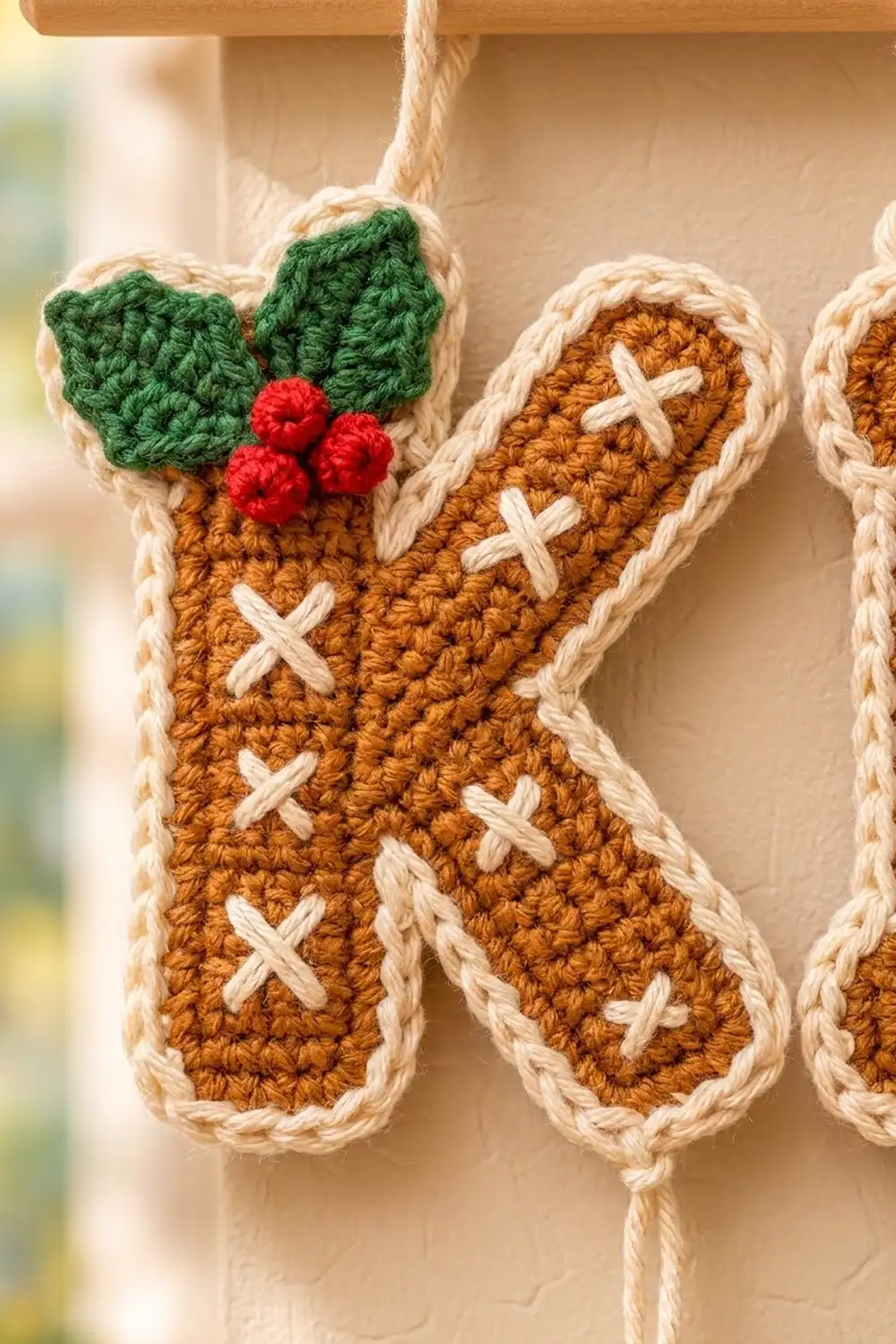
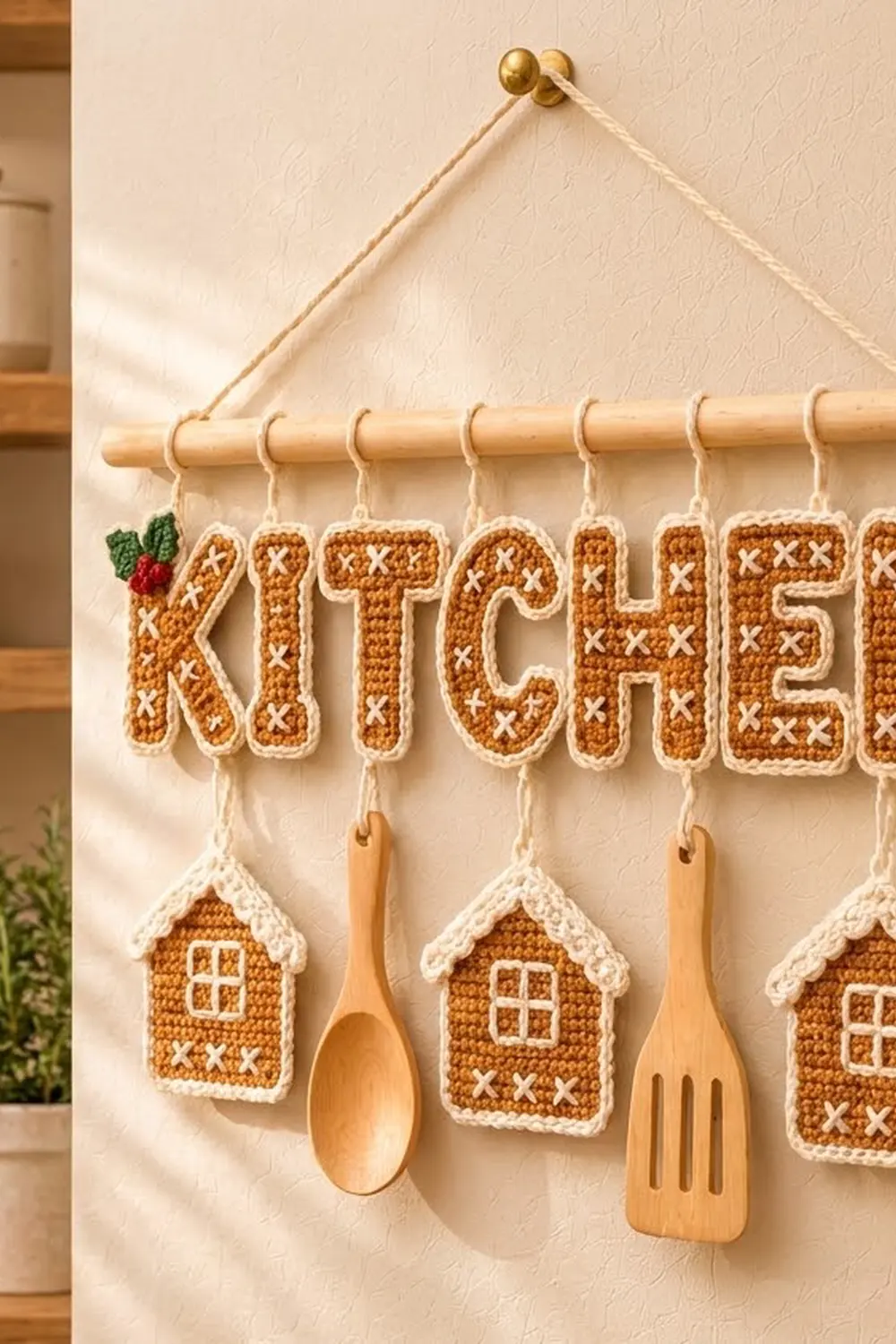
This cozy wall hanging spells KITCHEN in chunky gingerbread letters. Each letter has a cream rope-style outline and cream cross-stitches that look like piped icing. Three little gingerbread houses with snowy scalloped roofs hang below the word. Holly sprigs sit on the outer top corners of the K and the N.
The palette is warm and simple: caramel gingerbread brown, creamy white, holly green and berry red. The style is bakery-sweet and rustic. It looks at home in a kitchen from late November through the New Year.
The pattern uses US crochet terms. The letters span 24 in (61.0 cm) across a 26 in (66.0 cm) dowel. From the dowel to the bottom of the houses, the hanging measures about 13.75 in (34.9 cm).
Every letter and house is worked flat in single crochet rows on a square grid of 4 stitches and 4 rows per inch. The diagonal strokes of the K and the N are separate bias strips that you seam on. Each piece then gets a two-round cream border and its embroidery. Last, the pieces are hung on the dowel with chain loops and cords.
Finished Size and Construction
- Finished size: 24 in (61.0 cm) wide across the letters; about 13.75 in (34.9 cm) from the dowel to the bottom of the houses
- Skill level: Intermediate (shaping, seaming, surface embroidery)
- Terminology: US
- Yarn weight: Worsted (#4)
- Hook: 4.0 mm (US G-6)
- Number of crocheted pieces: 7 letters, 3 houses, 4 holly leaves, 6 berries
- Layout: one row of letters with houses hanging below on chain cords; the pieces are hung, not joined edge to edge
- Letter size before border: 5 in (12.7 cm) tall; 1 in to 4 in (2.5 cm to 10.2 cm) wide
- Letter size after border: 5.5 in (14.0 cm) tall
- House size before border: 3.75 in (9.5 cm) wide × 4.75 in (12.1 cm) tall
- House size after border: about 4.25 in (10.8 cm) × 5.75 in (14.6 cm), including the frosting
- Border depth: 0.25 in (0.6 cm) on each side
Materials
Choose a smooth worsted cotton or acrylic so the single crochet grid and the cross-stitches stay crisp. Avoid fuzzy or heathered yarns, because the cream embroidery needs a clean background. The quantities below assume about 170 m per 100 g.
- Gingerbread brown: 50 g (85 m)
- Cream: 35 g (60 m)
- Holly green: 5 g (9 m)
- Berry red: 3 g (5 m)
All quantities include a margin of about 25 percent for your test piece, seaming and tails.
Tools:
- 4.0 mm (US G-6) crochet hook
- Tapestry needle
- Stitch markers
- Scissors
- Wooden dowel, 26 in (66.0 cm) long and about 0.5 in (1.3 cm) thick
- Cream cotton cord, 36 in (91.4 cm), for the hanging triangle
- Blocking mat, pins and a spray bottle
- Optional: a small wooden spoon and a slotted wooden spatula
Abbreviations (US Terms)
- ch: chain
- sl st: slip stitch
- sc: single crochet
- hdc: half double crochet
- dc: double crochet
- sc2tog: single crochet 2 together
- sc3tog: single crochet 3 together
- BLO: back loop only
- st(s): stitch(es)
Special stitches
- Shift row (on 4 sts): 2 sc in first st, sc in next st, sc2tog over last 2 sts. (4 sts) The strip moves 1 st sideways.
- Picot: ch 3, sl st in 3rd ch from hook.
- Berry bobble: Yarn over, insert hook in ring, pull up a loop, yarn over, pull through 2 loops; repeat from * 4 more times in the ring (6 loops on hook). Yarn over and pull through all 6 loops.
Gauge and Checkpoints
Gauge is 16 sc and 16 rows = 4 in (10.2 cm), worked firmly. That gives 4 sts and 4 rows per inch, so every 4-st × 4-row block is a 1 in (2.5 cm) square. Every shape and border count in this pattern depends on that square grid.
Make the letter I first as your test piece. It is only 4 sts × 20 rows, so it tells you both your stitch gauge and your row gauge.
Checkpoints:
- The I before border: 1 × 5 in (2.5 × 12.7 cm).
- A house at Row 12: 3.75 in (9.5 cm) wide and 3 in (7.6 cm) tall.
- Any letter after border: 5.5 in (14.0 cm) tall.
If your I is too big, change to a 3.5 mm hook. If it is too small, change to a 4.5 mm hook. If the width is correct but the height is short, keep the hook and lift each loop slightly taller before you finish the stitch.
Letters
Work all letters in gingerbread brown. Every row begins with ch 1 (this does not count as a st), and you turn at the end of each row. Every stroke is 4 sts = 1 in (2.5 cm) wide.
I (make 1)
Row 1: Ch 5, sc in 2nd ch from hook and in each ch across. (4 sts)
Rows 2–20: Sc in each st. (4 sts)
Fasten off. The I measures 1 × 5 in (2.5 × 12.7 cm).
T (make 1)
Row 1: Ch 13, sc in 2nd ch from hook and in each ch across. (12 sts)
Rows 2–4: Sc in each st. (12 sts) This is the crossbar.
Fasten off, then join yarn in st 5 of Row 4.
Row 5: Sc in sts 5–8. (4 sts)
Rows 6–20: Sc in each st. (4 sts)
Fasten off. Turn the piece so the crossbar is at the top. The T measures 3 × 5 in (7.6 × 12.7 cm).
H (make 1)
First leg: Ch 5, sc in 2nd ch from hook and in each ch across. (4 sts) Work Rows 2–8 as sc in each st. (4 sts) Fasten off.
Second leg: Work the same as the first leg, but do not fasten off.
Row 9: Sc in 4 sts of the second leg, ch 4, sc in 4 sts of the first leg. (8 sc + 4 ch)
Row 10: Sc in each sc and in each ch. (12 sts)
Rows 11–12: Sc in each st. (12 sts)
Rows 13–20: Sc in the first 4 sts only, and work those 4 sts for 8 rows. Fasten off. Join yarn in st 9 of Row 12 and work 8 rows on sts 9–12. (4 sts each leg)
The H measures 3 × 5 in (7.6 × 12.7 cm). The openings above and below the crossbar are 1 in (2.5 cm) wide.
E (make 1, worked sideways)
Row 1: Ch 21, sc in 2nd ch from hook and in each ch across. (20 sts)
Rows 2–4: Sc in each st. (20 sts) This is the spine.
Bottom arm: Work Rows 5–10 on sts 1–4. (4 sts) Fasten off.
Middle arm: Join in st 9 of Row 4 and work Rows 5–8 on sts 9–12. (4 sts) Fasten off.
Top arm: Join in st 17 of Row 4 and work Rows 5–10 on sts 17–20. (4 sts) Fasten off.
The E measures 2.5 × 5 in (6.4 × 12.7 cm). The two openings are 1 in (2.5 cm) tall.
C (make 1, worked sideways)
Row 1: Ch 17, sc in 2nd ch from hook and in each ch across. (16 sts)
Row 2: 2 sc in first st, sc in next 14 sts, 2 sc in last st. (18 sts)
Row 3: 2 sc in first st, sc in next 16 sts, 2 sc in last st. (20 sts)
Row 4: Sc in each st. (20 sts)
Arms: Work Rows 5–10 on sts 1–4, then fasten off. Join in st 17 of Row 4 and work Rows 5–10 on sts 17–20. (4 sts each)
Rows 1–3 round the outer back corners. The C measures 2.5 × 5 in (6.4 × 12.7 cm).
K (make 1)
Stem: Work the same as the I. (4 sts × 20 rows)
Bias strips (make 2): Ch 5, sc in 2nd ch from hook and in each ch across. (4 sts) For Rows 2–10, sc in each st, but work Rows 3, 5, 7 and 9 as Shift rows. (4 sts)
Each strip moves 4 sts sideways over its 10 rows.
Assemble:
- Lay the stem flat.
- Upper arm: Place the first strip with its Rows 1–2 against the stem’s right edge at stem rows 11–12, leaning up and to the right. Its Rows 9–10 sit at the top right.
- Lower leg: Flip the second strip over so it mirrors the first. Place its Rows 9–10 against stem rows 9–10, with its Rows 1–2 at the bottom right.
- Whipstitch the strips to the stem where they touch, and to each other where their ends meet.
The K measures 3 × 5 in (7.6 × 12.7 cm).
N (make 1)
Stems (make 2): Work the same as the I.
Diagonal: Work as a K bias strip for 20 rows, with Shift rows on Rows 5, 9, 13 and 17. (4 sts)
Assemble: Place the stems 8 sts, or 2 in (5.1 cm), apart. Lay the diagonal between them so its Rows 17–20 touch the top of the left stem and its Rows 1–4 touch the bottom of the right stem. Whipstitch along both contacts.
The N measures 4 × 5 in (10.2 × 12.7 cm).
Gingerbread Houses (make 3)
Use gingerbread brown.
Row 1: Ch 16, sc in 2nd ch from hook and in each ch across. (15 sts)
Rows 2–12: Sc in each st. (15 sts) The walls measure 3.75 × 3 in (9.5 × 7.6 cm).
Rows 13–18: Sc2tog, sc in each st to the last 2 sts, sc2tog. Row 13: 13 sts. Row 14: 11 sts. Row 15: 9 sts. Row 16: 7 sts. Row 17: 5 sts. Row 18: 3 sts.
Row 19: Sc3tog. (1 st)
Fasten off. The house measures 3.75 × 4.75 in (9.5 × 12.1 cm), and the roof is 1.75 in (4.4 cm) tall.
Holly
Leaf (make 4, green):
- Ch 8.
- Working in the back bumps: sl st in 2nd ch from hook, sc in next ch, hdc in next ch, picot, dc in next ch, hdc in next ch, picot, sc in next ch, sl st in last ch.
- Ch 1, rotate, and work the same sequence along the other side of the chain.
- Sl st in the tip and fasten off.
Each leaf is about 1.75 in (4.4 cm) long, with four picot points.
Berry (make 6, red): Make a magic ring and work 1 berry bobble. Ch 1, pull the ring tight, and fasten off. Leave a 6 in (15.2 cm) tail.
Make All Pieces
- Brown: 7 letters (with 3 bias strips and 2 extra stems) and 3 houses
- Cream: all borders, embroidery, loops and cords
- Green: 4 leaves
- Red: 6 berries
Layout (front view):
[=================== dowel 26 in ===================]
  K     I     T     C     H     E     N
  house       spoon       house       spatula     house
  (K/I)       (T)         (C/H)       (E)         (N)
Joining: Hanging Assembly
The pieces are not seamed to each other. They are joined to the dowel and to each other with cream chains, so the chain lengths control the alignment.
Loops: Join cream at the top edge of the border, ch 16, and sl st in the same st. Each loop folds over the dowel and drops about 1.5 in (3.8 cm).
- I, T, C and E: 1 centered loop each.
- K, H and N: 1 loop on each top stroke, because their top centers are open.
That makes 10 loops. Keep every loop at exactly 16 ch so the letters hang level.
House cords: Join cream at the bottom border under the K/I gap, the C/H gap and the center of the N. Ch 6 (about 1 in / 2.5 cm) and sl st into the tip of the house’s center roof scallop. The tension should be firm but not tight; the chains must not pucker the borders.
Utensils (optional): Hang the spoon from the bottom of the T and the spatula from the bottom of the E, each with a ch 10 loop.
Size checkpoint: The bordered letters total 22.5 in (57.2 cm) across: 3.5 + 1.5 + 3.5 + 3 + 3.5 + 3 + 4.5 in. With six 0.25 in (0.6 cm) gaps, the span is 24 in (61.0 cm). Tie the cord to both dowel ends to make the hanging triangle.
Border
Border gauge: 4 sc per inch along stitch edges and row-ends alike, because the gauge is square. That means you work 1 sc per stitch and 1 sc per row-end, with no skipping.
Work every piece in cream:
- Rnd 1: Sc in each st and in each row-end. Work 3 sc in each outer corner st and sc2tog across each inner corner. On stepped bias edges, work 1 sc per row-end plus 1 extra sc at each step.
- Rnd 2: Sl st in BLO of each st around. This makes the raised rope ridge and adds no width.
Letter I border
Rnd 1:
- Each short end: 3 sc in the corner st, sc in the 2 middle sts, 3 sc in the next corner st. (8 sts, including both corner groups)
- Each long side: sc in the row-ends of Rows 2–19. (18 sts)
- Total: 8 + 8 + 18 + 18 = 52 sts
Rnd 2: Sl st in BLO of each st around. (52 sl sts)
The I now measures 1.5 × 5.5 in (3.8 × 14.0 cm). The math works because the corner sts already sit on the ends of Rows 1 and 20, so those row-ends are not worked again. Border the other letters with the same rules, checking that each lies flat and grows by 0.25 in (0.6 cm) on every side.
House border
Rnd 1:
- Bottom: 3 sc in st 1, sc in sts 2–14, 3 sc in st 15. (19 sts, including both corner groups)
- Each wall: 1 sc in each row-end of Rows 2–12. (11 sts per wall)
- Each roof slope: work the row-ends of Rows 13–18 as 2 sc, 1 sc, 2 sc, 1 sc, 2 sc, 1 sc, working from the eave up. Reverse the order on the way down the second slope. (9 sts per slope)
- Peak: 3 sc in the single st of Row 19. (3 sts)
- Total: 19 + 11 + 11 + 9 + 9 + 3 = 62 sts
Each roof row-end is a diagonal step about 0.35 in (0.9 cm) long. That is why the slope takes about 1.5 sc per row-end instead of 1.
Rnd 2:
- Sl st in BLO across the bottom and both walls. (19 + 11 + 11 = 41 sl sts)
- Roof frosting: Work over the 21 roof sts (9 + 3 + 9). Sl st in the first roof st, skip 1, 5 dc in next st, skip 1, sl st in next st; repeat from * 4 more times. (1 + 30 = 31 sts, 5 scallops)
The total for Rnd 2 is 72 sts. The 5 dc groups land on roof sts 3, 7, 11, 15 and 19, so the center scallop sits on st 11, the middle st of the peak. That keeps the roof symmetrical.
Embroidery
Use cream yarn and a tapestry needle.
- Letters: Work one cross-stitch over 2 sts × 2 rows in alternate 1 in (2.5 cm) blocks along each stroke. That gives K 6, I 3, T 4, C 5, H 6, E 6 and N 7.
- House window: Backstitch a square over sts 6–10 and Rows 6–10. Add a vertical line through st 8 and a horizontal line through Row 8 to make four panes.
- House base: Work three crosses across Rows 2–3, over sts 3–5, 7–9 and 11–13.
Sew 2 leaves and 3 berries to the top-left corner of the K and to the top-right corner of the N. Let them overlap the border slightly.
Final Blocking
- Pin each letter to 5.5 in (14.0 cm) tall, with its strokes straight.
- Pin each house to 4.25 in (10.8 cm) wide, with the roof slopes straight.
- Mist with water. For acrylic, steam lightly from above without touching the yarn.
- Lift the roof scallops with your fingertips so they stand up like frosting.
- Let everything dry completely before you hang it.
Final Quality-Control Checklist
- [ ] All letters are 5.5 in (14.0 cm) tall.
- [ ] The I border is 52 sts; each house has 62 sts in Rnd 1 and 72 in Rnd 2.
- [ ] Each roof has 5 scallops, with the center one on the peak.
- [ ] The seams on the K and N are invisible from the front.
- [ ] All cross-stitches slant the same way on top.
- [ ] All 10 loops are 16 ch, and the letters hang level.
- [ ] The word spans 24 in (61.0 cm).
Troubleshooting
- Letters are different heights: Every letter needs 20 rows, or 20 sts on the sideways letters. Recount.
- The roof border ruffles: Change the slope rhythm to 1 sc in every row-end except Rows 13 and 17.
- A bias strip leans the wrong way: Flip it over before seaming.
- The openings fill in after the border: Your border is loose. Work Rnd 1 with a 3.5 mm hook.
- A letter tilts: Make its loops equal in length, or add a second loop.
Care
Spot clean with mild soap and cool water, press out the moisture in a towel and lay flat to dry. Store the hanging flat, or rolled loosely around the dowel.
Final Notes
The measurement chain works like this:
- Gauge is 4 sts and 4 rows per inch, so 20-row letters are 5 in (12.7 cm) tall.
- A 0.25 in (0.6 cm) cream border brings each letter to 5.5 in (14.0 cm).
- The seven bordered letters total 22.5 in (57.2 cm). With six 0.25 in (0.6 cm) gaps, they span 24 in (61.0 cm) on a 26 in (66.0 cm) dowel.
- The houses hang 1 in (2.5 cm) below the letters and finish about 4.25 in (10.8 cm) wide.
Check the I first, and every other piece will follow.
Happy crocheting!