

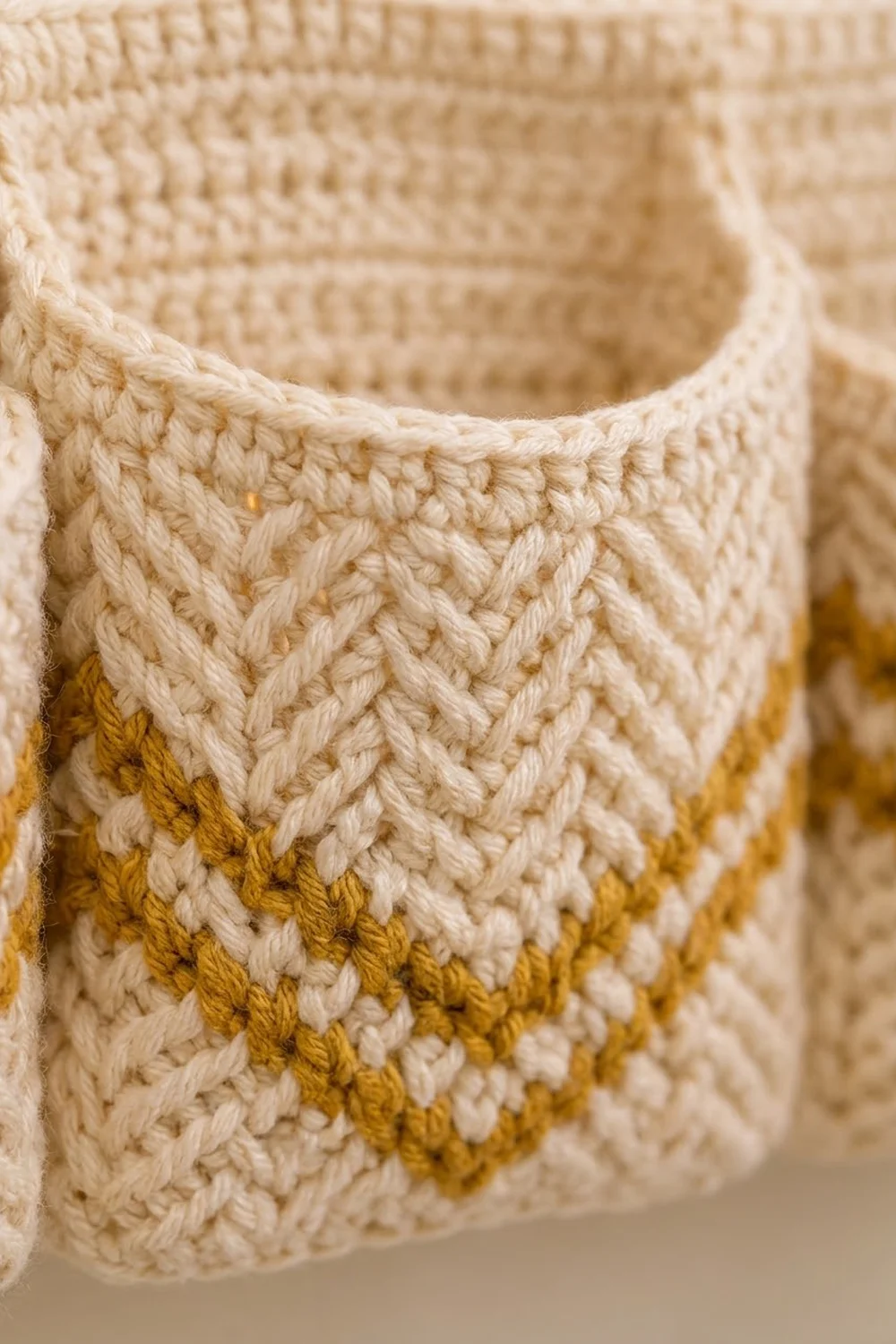
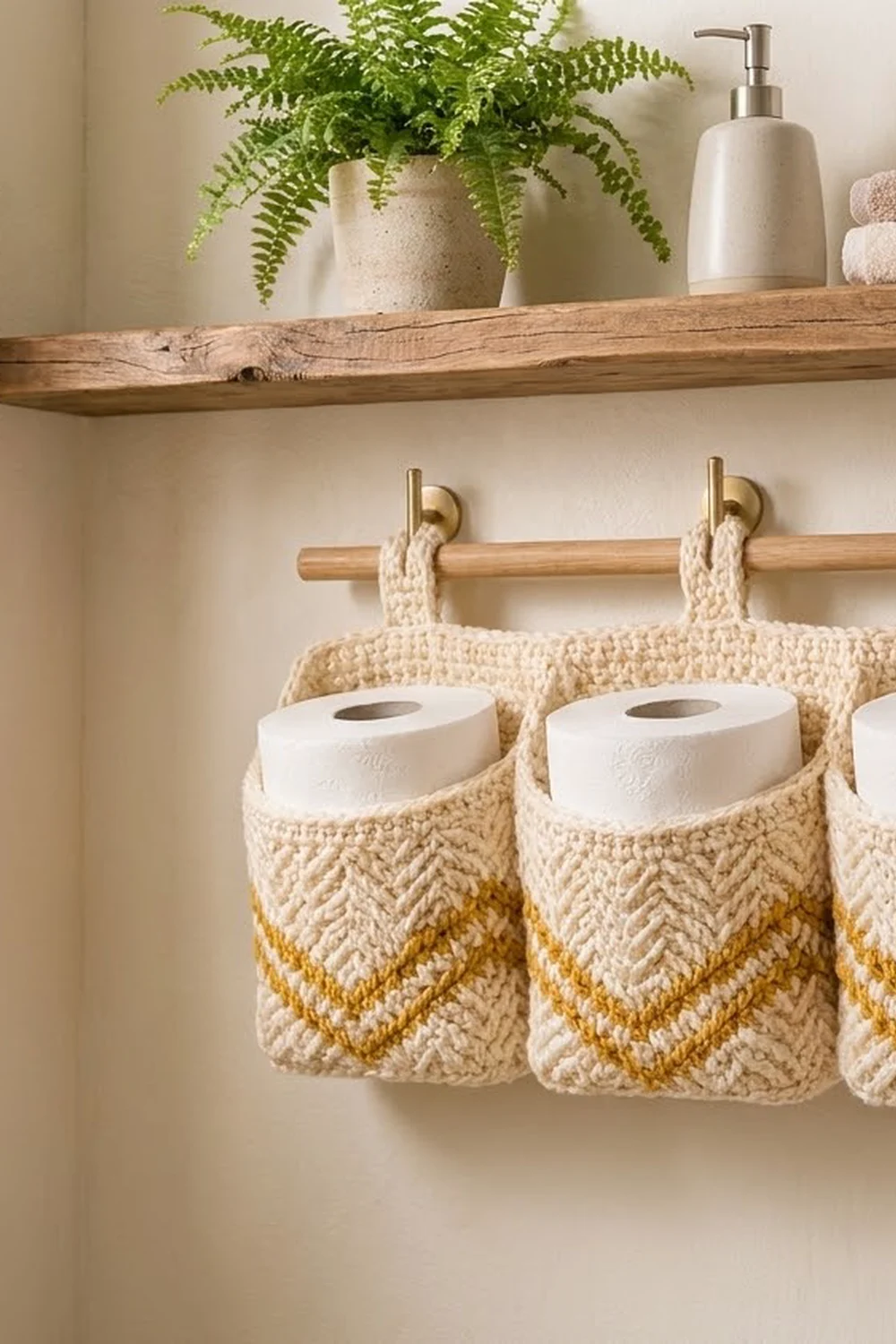
This hanging holder keeps three spare rolls tidy and within reach. A plain cream back panel hangs from a wooden dowel by three loop tabs, and three deep pockets sit across its front. Each pocket has two mustard chevron lines that point downward.
The pockets use waistcoat stitch, which is a single crochet worked through the center of the stitch below. It looks like knitting and makes a firm fabric, so the pockets keep their shape. The colors are cream and mustard gold, which suit a warm, natural bathroom.
This pattern uses US crochet terms. Before the tabs are added, the finished holder measures 19.5 in wide x 8.5 in tall (49.5 cm x 21.6 cm). The tab loops add another 1.25 in (3.2 cm) above the top edge.
You work the back panel flat in rows and then add a crab-stitch border. The three pockets are small rectangular baskets worked in rounds, with the chevrons worked in tapestry crochet. Last, you sew the back wall of each pocket to the panel and add three folded tabs.
Finished Size and Construction
- Finished size: 19.5 in x 8.5 in (49.5 cm x 21.6 cm), plus 1.25 in (3.2 cm) tab loops
- Skill level: Intermediate
- Terminology: US
- Yarn weight: Worsted (#4), cotton or cotton blend
- Hook: 4.5 mm (US 7)
- Number of pieces: 7 (1 panel, 3 pockets, 3 tabs)
- Layout: 3 pockets in one row, 3 tabs above them
- Pocket size: 5.5 in wide x 3.5 in deep x 4.5 in tall (14.0 cm x 8.9 cm x 11.4 cm)
- Panel size before border: 18 in x 7 in (45.7 cm x 17.8 cm)
- Border depth: 0.75 in (1.9 cm) on every side
Materials
Choose a smooth, firm cotton or cotton-blend worsted yarn. Cotton holds its shape in a damp room and shows the V stitches clearly. Avoid fuzzy or very stretchy yarns, because they make the pockets sag.
- Cream (main color): 400 g, about 680 m
- Mustard gold (contrast color): 50 g, about 85 m
Tools:
- 4.5 mm (US 7) crochet hook
- Tapestry needle
- 10 stitch markers
- Scissors
- Measuring tape
- Wooden dowel, 22 in (55.9 cm) long and 0.75 in (1.9 cm) in diameter
- 3 wall hooks
- Blocking mats and rustproof pins
The quantities include a margin of about 15%. That covers your gauge swatch and the strand you carry through the colorwork rounds.
Abbreviations (US Terms)
- ch – chain
- sc – single crochet
- sl st – slip stitch
- st(s) – stitch(es)
- BLO – back loop only
- rnd(s) – round(s)
- ws – waistcoat stitch
- crab st – crab stitch (reverse single crochet)
- CC – contrast color (mustard)
- MC – main color (cream)
Waistcoat stitch (ws): Look at the sc below and find the “V” on its front. Insert your hook straight through the center of that V, between its two vertical legs, so the hook comes out the back of the work. Yarn over, pull up a loop, yarn over and pull through both loops.
Crab stitch: Work single crochet from left to right (right-handed). Insert the hook into the next stitch to the right, pull up a loop, yarn over and pull through both loops.
Color change: Work the stitch before the color change until 2 loops remain on the hook. Finish it with the new color. Carry the unused strand along the top of the round below and work over it.
Gauge and Checkpoints
Gauge: 16 sts x 16 rows = 4 in (10.2 cm) in sc worked in rows. Waistcoat stitch worked in rounds should give the same gauge.
Make a swatch first, then make one complete pocket and measure it before you make the other two. Every size in this pattern depends on 4 sts and 4 rows to the inch (2.5 cm).
Checkpoints:
- Pocket base: 5.5 in x 3.5 in (14.0 cm x 8.9 cm).
- Pocket after Wall Rnd 11: 2.75 in (7.0 cm) tall, and the front measures 5.5 in (14.0 cm) across.
- Finished pocket: 4.5 in (11.4 cm) tall.
- Panel before border: 18 in x 7 in (45.7 cm x 17.8 cm).
- Panel after border: 19.5 in x 8.5 in (49.5 cm x 21.6 cm).
If your piece is too big: go down to a 4 mm hook. If it is too small: go up to a 5 mm hook. Waistcoat stitch often comes out tighter than plain sc. If your pocket is narrower than the base, use a hook one size larger for the walls only.
Pocket (Make 3)
Each pocket is a small basket with a flat rectangular base. In every round, sts 1–22 are the back wall, sts 23–36 are the first side, sts 37–58 are the front and sts 59–72 are the second side. Putting the beginning of each round at a back corner hides the joins against the panel.
Base
With MC, ch 23.
Row 1: Sc in 2nd ch from hook and in each ch across, turn. (22 sts)
Rows 2–14: Ch 1, sc in each st across, turn. (22 sts)
Check that the base measures 5.5 in x 3.5 in (14.0 cm x 8.9 cm).
Base Edging Rnd: Do not turn. Work this round around all four sides:
- ch 1, sc in each st of Row 14 (22 sc, back)
- 14 sc along the row ends, 1 sc per row (side)
- 22 sc in the free loops of the foundation ch (front)
- 14 sc along the other row ends (side)
- sl st to first sc
(72 sts: 22 + 14 + 22 + 14)
Do not add extra stitches at the corners. Keeping the count at 72 makes the walls stand straight up from the base.
Walls
Rnd 1: Ch 1, sc in BLO of each st around, sl st to first sc. (72 sts)
Working in the back loop leaves a ridge that makes a crisp fold where the base meets the walls.
Rnd 2: Ch 1, ws in each st around, sl st to first st. (72 sts)
Place markers at sts 37 and 58 to mark the edges of the front.
Chevron Rounds
In Rnds 3–11, join CC at the start of Rnd 3. Carry it all the way around every round, including the sides and back. Carrying it the whole way makes the walls equally thick and firm. Work every stitch as ws.
Every color block on the front is the mirror image of another, so the chevrons stay centered on the front.
Rnd 3: MC in sts 1–44, CC in sts 45–50, MC in sts 51–72. (72 sts: 6 CC)
Rnd 4: MC in sts 1–42, CC in sts 43–45, MC in sts 46–49, CC in sts 50–52, MC in sts 53–72. (72 sts: 6 CC)
Rnd 5: MC in sts 1–40, CC in sts 41–43, MC in sts 44–51, CC in sts 52–54, MC in sts 55–72. (72 sts: 6 CC)
Rnd 6: MC in sts 1–38, CC in sts 39–41, MC in sts 42–53, CC in sts 54–56, MC in sts 57–72. (72 sts: 6 CC)
Rnd 7: MC in sts 1–36, CC in sts 37–39, MC in sts 40–44, CC in sts 45–50, MC in sts 51–55, CC in sts 56–58, MC in sts 59–72. (72 sts: 12 CC)
In Rnd 7, the first chevron reaches the corners of the front and the second chevron starts at the center.
Rnd 8: Repeat Rnd 4.
Rnd 9: Repeat Rnd 5.
Rnd 10: Repeat Rnd 6.
Rnd 11: MC in sts 1–36, CC in sts 37–39, MC in sts 40–55, CC in sts 56–58, MC in sts 59–72. Fasten off CC. (72 sts: 6 CC)
The blocks move 2 sts outward each round and overlap the block below by 1 st. That makes a solid diagonal line. The second chevron starts 4 rounds above the first, which leaves a cream gap about the same width as each chevron line.
Finishing the Walls
Rnds 12–16: With MC only, ch 1, ws in each st around, sl st to first st. (72 sts)
Rnd 17: Ch 1, sc in each st around, sl st to first sc. (72 sts)
Rnd 18: Ch 1, crab st in each st around, sl st to first st. Fasten off, leaving a 40 in (101.6 cm) tail for sewing. (72 sts)
The pocket walls are 18 rounds tall, which is 4.5 in (11.4 cm).
Back Panel
With MC, ch 73.
Row 1: Sc in 2nd ch from hook and in each ch across, turn. (72 sts)
Rows 2–28: Ch 1, sc in each st across, turn. (72 sts)
Do not fasten off. Check that the panel measures 18 in x 7 in (45.7 cm x 17.8 cm).
Tabs (Make 3)
With MC, ch 7.
Row 1: Sc in 2nd ch from hook and in each ch across, turn. (6 sts)
Rows 2–24: Ch 1, sc in each st across, turn. (6 sts)
Fasten off, leaving a 16 in (40.6 cm) tail. Each tab measures 1.5 in x 6 in (3.8 cm x 15.2 cm).
Make All Pieces
- Cream only: 1 back panel and 3 tabs
- Cream and mustard: 3 pockets
Layout, seen from the front:
     [Tab]            [Tab]            [Tab]
+--------------------------------------------------+
|  [Pocket A]  |  [Pocket B]  |  [Pocket C]  |
|  sts 2–23    |  sts 26–47   |  sts 50–71   |
+--------------------------------------------------+
Check the panel sts across one row: 1 edge st + 22 + 2 gap sts + 22 + 2 gap sts + 22 + 1 edge st = 72.
Border
Work the border on the panel before you attach anything. That keeps the edge even and easy to measure. The border uses only the panel’s own stitch counts.
Border gauge: Each border round adds about 0.25 in (0.6 cm) to every side. The 3 rounds add 0.75 in (1.9 cm) per side.
Rnd 1: You are still on the panel, and Row 28 is the top edge. Ch 1 and work around the panel:
- sc in each of the 72 sts across the top, ch 1 at the corner
- 28 sc down the side, 1 per row end, ch 1 at the corner
- 72 sc in the free loops of the foundation ch, ch 1 at the corner
- 28 sc up the other side, ch 1
- sl st to first sc
The count per side is 72 / 28 / 72 / 28, which is 200 sc plus 4 corner ch-1 spaces. The ch-1 spaces are not counted as stitches.
Rnd 2: Ch 1, sc in each sc. Work 2 sc into each corner ch-1 space, with no chain between them. Sl st to first sc.
Each corner’s 2 sc are split between the sides, 1 on each side. The count per side is 74 / 30 / 74 / 30. (208 sts total: 200 + 8)
Leaving out the corner chains in this round softly rounds the corners.
Rnd 3: Ch 1, crab st in each st around, sl st to first st. Fasten off. (208 sts)
Why the math works: The sc rows have the same gauge as the stitches, at 4 per inch each way. So 1 sc per stitch, chain or row end keeps every edge flat. The only extra stitches are the 2 sc per corner in Rnd 2, which turn the corner. Crab stitch is worked 1 per stitch, so it adds no width.
The panel now measures 19.5 in x 8.5 in (49.5 cm x 21.6 cm).
Joining
Method: Whipstitch with MC through both layers.
Pocket placement: Count the stitches inside the border. Pocket A sits over sts 2–23, Pocket B over sts 26–47 and Pocket C over sts 50–71. In every pocket, Base Edging sts 1–22 line up with panel Row 2. The 18 wall rounds cover panel Rows 3–20.
Stitch-to-stitch logic:
- Bottom: Each of the 22 back-edge stitches of the pocket base matches 1 panel stitch on Row 2.
- Sides: Each wall round matches 1 panel row, because both have 18 rows/rounds in 4.5 in (11.4 cm). Sew the corner columns (sts 1 and 22 of each round) to the panel, 1 round to 1 row.
- Top: Sew the back wall’s Rnd 18 to panel Row 20.
Pin each pocket at its four corners first. Then sew the bottom, then both sides, and the top last.
Tension: Pull each stitch snug, but not so tight that the panel puckers. The panel should stay flat behind the pocket.
Tabs: Center each tab over a pocket at panel sts 10–15, 34–39 and 58–63. Fold the tab in half to make a loop. Lay both ends on the back of the panel so they cover Rows 25–28 and the border behind them. Sew around both ends through all layers.
The 1.5 in (3.8 cm) stitched to the panel and border leaves a loop 1.25 in (3.2 cm) above the top edge.
Size checkpoint: The front is 19.5 in (49.5 cm) wide. The height is 8.5 in (21.6 cm) to the top border and 9.75 in (24.8 cm) to the top of the tabs.
Final Blocking
- Fill each pocket with a paper roll wrapped in plastic.
- Lightly mist the whole piece with water, especially the panel and the pocket walls.
- Pin the panel flat at 19.5 in x 8.5 in (49.5 cm x 21.6 cm), with pins along the border.
- Shape the pocket corners and rims with your fingers. Make sure each chevron’s point is centered on the front.
- Let it dry completely, usually 24 hours.
- Remove the pins and the rolls. Slide the dowel through the tabs and hang it on the hooks.
Final Quality-Control Checklist
- Every pocket has 72 sts in every wall round.
- Each pocket has exactly two chevrons, both centered and pointing down.
- The mustard carry does not show through the cream stitches.
- The panel was 18 in x 7 in (45.7 cm x 17.8 cm) before the border and 19.5 in x 8.5 in (49.5 cm x 21.6 cm) after it.
- The border has 208 sts and gently rounded corners.
- The pocket gaps are equal, at 2 panel sts each.
- Each tab is centered over its pocket and sewn securely.
- All ends are woven in.
Troubleshooting
Pockets lean or twist: Waistcoat stitch slants a little in joined rounds. Join with a sl st at the end of every round, and keep the start of each round at the back corner.
Mustard peeks through: Keep the carried strand loose and on top of the round below. If it still shows, take it under the cream yarn when you change colors.
Chevrons off center: Recount the front: it must be sts 37–58. Check your markers after Rnd 2.
Panel puckers behind pockets: You sewed too tightly or skipped a row. Undo the seam and sew 1 round to 1 row.
Border ruffles: Your hook is too large or you added stitches. Recount and use the 4.5 mm hook.
Sagging pockets: Use a firmer cotton yarn, or go down a hook size for the walls.
Care
Hand wash in cool water with a mild soap, gently press out the water and dry flat with the pockets shaped. Do not tumble dry, because it can shrink cotton and pull the chevrons out of shape.
Final Notes
Every size in this pattern comes from the same gauge of 4 sts and 4 rows per inch. Each pocket base has 22 x 14 sts, which gives 72 sts per wall round and 5.5 in x 3.5 in x 4.5 in (14.0 cm x 8.9 cm x 11.4 cm) pockets. The panel has 72 x 28 sts, which is 18 in x 7 in (45.7 cm x 17.8 cm). The three pockets and their gaps add up to exactly 72 sts across.
The border goes from 200 to 208 sts and adds 0.75 in (1.9 cm) on each side, for 19.5 in x 8.5 in (49.5 cm x 21.6 cm). Check every stage against these numbers and the holder will hang straight and square.
Happy crocheting!