
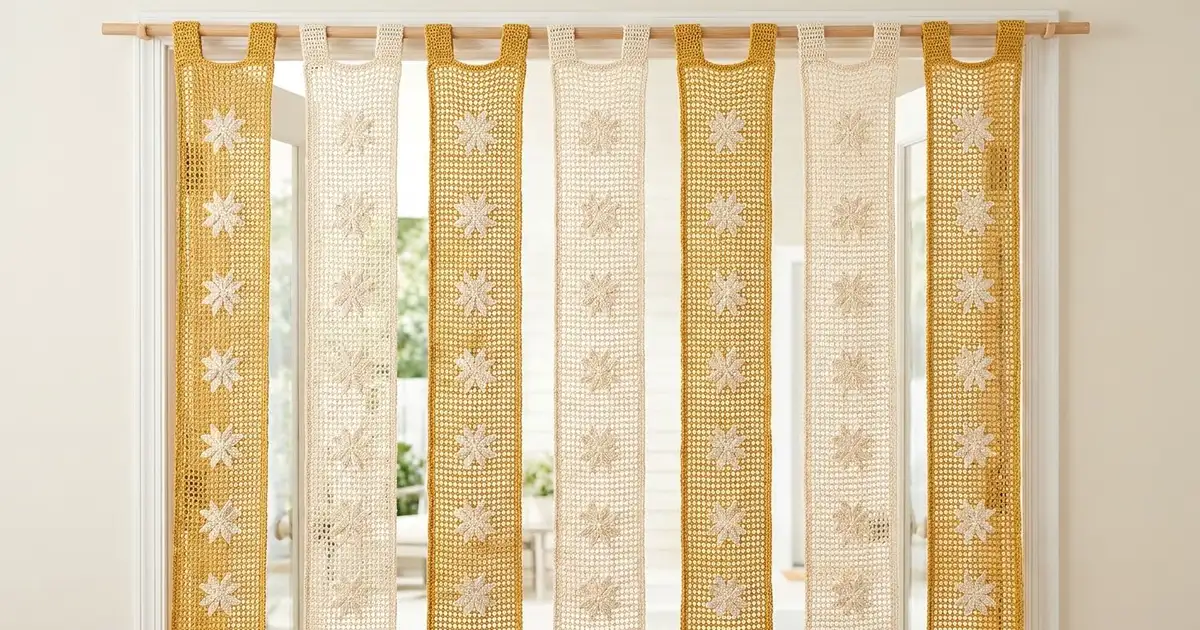
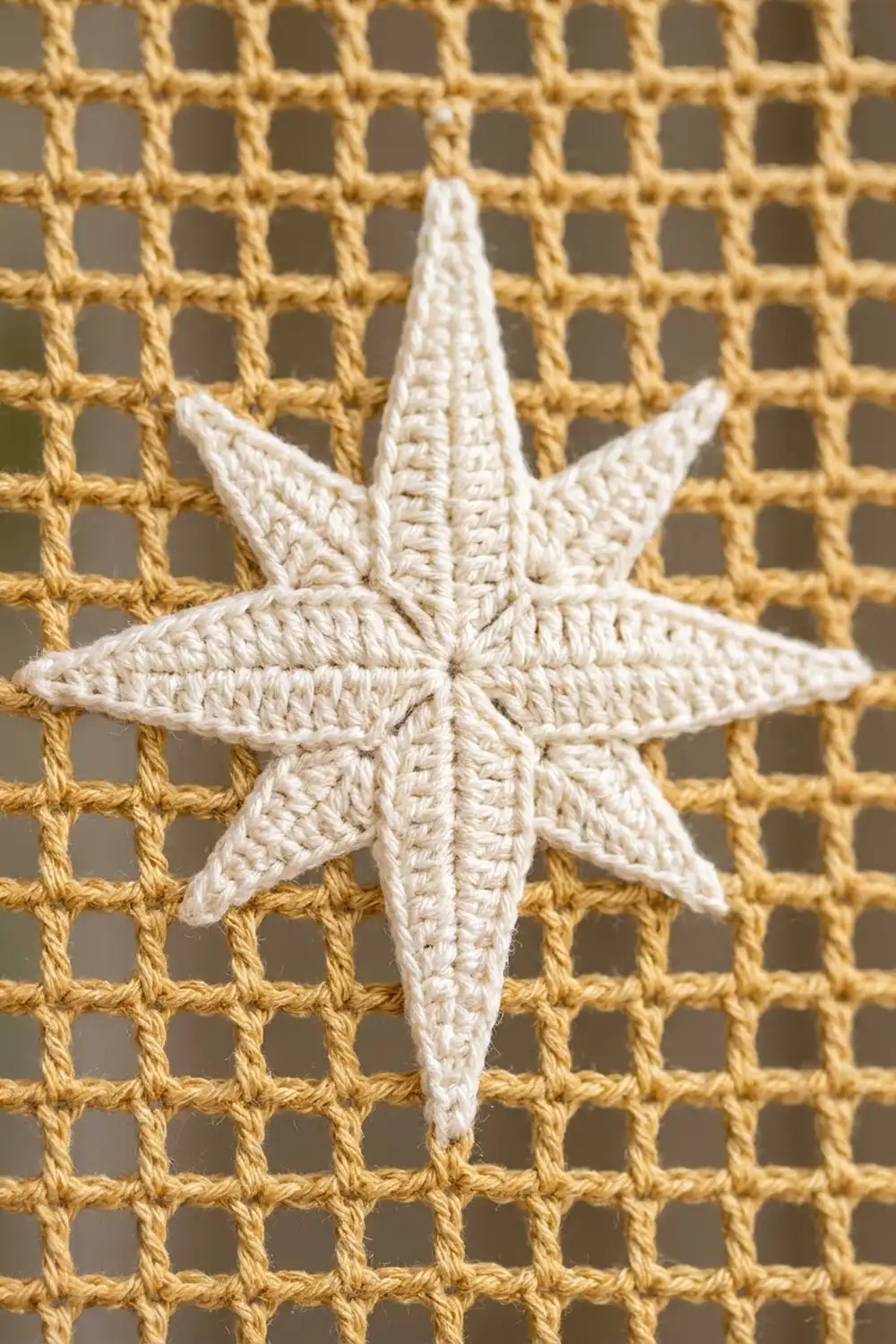
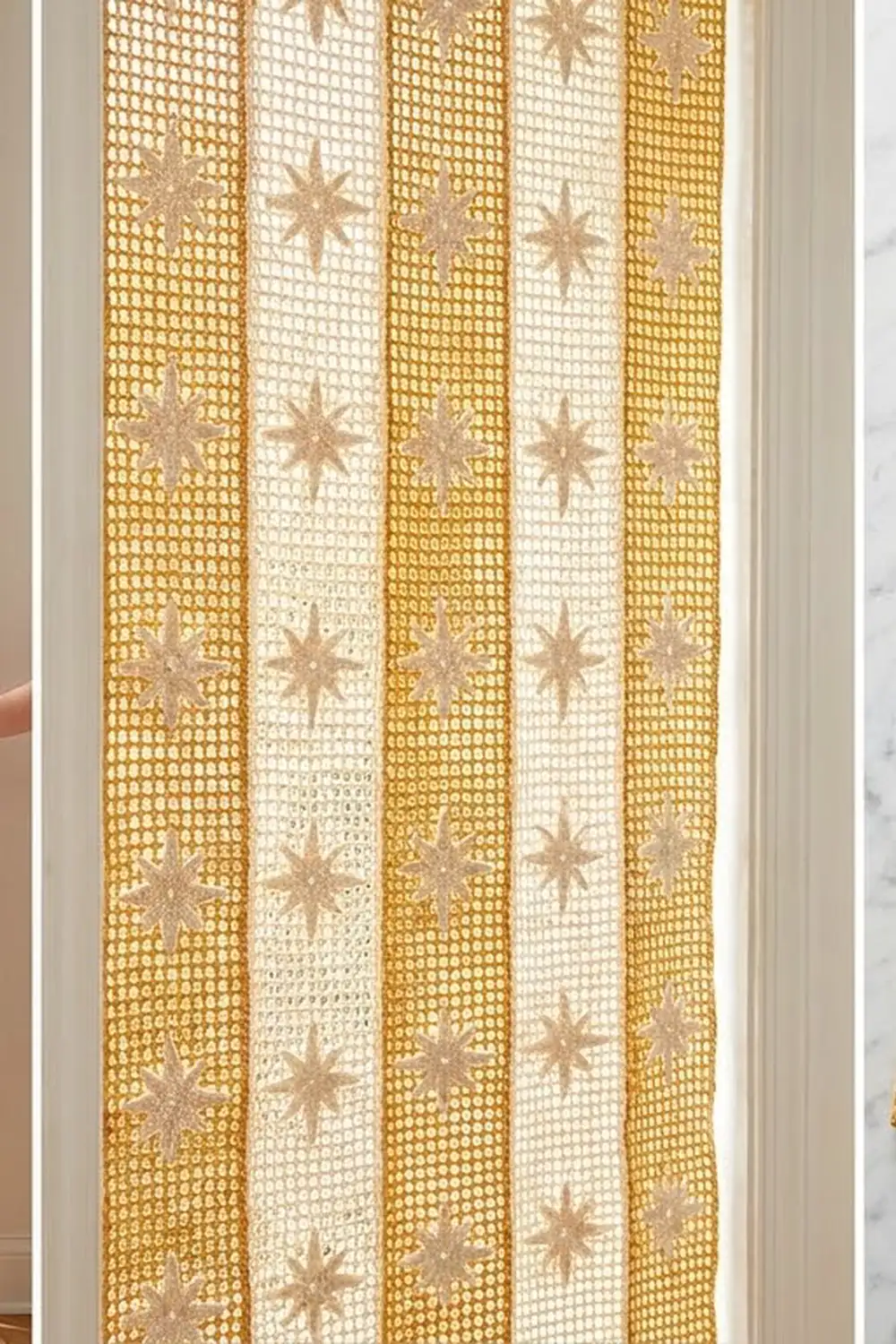
This curtain is made of seven long filet-mesh strips that hang side by side from a rod. Each strip is an open grid of square mesh with a column of ten eight-pointed compass stars running down the center. The stars are separate appliqués with four long points and four short points, sewn on top so they sit slightly raised.
The colors alternate: four warm honey-gold strips and three soft cream strips, in the order gold, cream, gold, cream, gold, cream, gold. All seventy stars are cream. On the gold strips they stand out clearly. On the cream strips they make a quiet tone-on-tone texture. Light comes through the mesh, and you can push the strips aside one at a time to walk through.
The pattern uses US crochet terms. Each finished strip measures 4.9 in (12.4 cm) wide by 80.5 in (204.5 cm) long, not counting the tabs. With the tabs, each strip is 82.25 in (208.9 cm) long. Hung with 0.5 in (1.3 cm) gaps, the seven strips span about 37.3 in (94.7 cm).
Construction is simple and repetitive. Work each strip from the bottom up in filet mesh, add two rounds of single crochet border, then work two folded hanging tabs on the top edge. Make the stars in three rounds and sew ten onto each strip. The strips are never seamed to each other. They hang side by side on the rod.
Finished Size and Construction
- Finished strip size: 4.9 in x 80.5 in (12.4 cm x 204.5 cm), plus 1.75 in (4.4 cm) tabs
- Full curtain width: about 37.3 in (94.7 cm) with 0.5 in (1.3 cm) gaps
- Skill level: Easy-intermediate
- Terminology: US
- Yarn weight: Sport (#2) cotton
- Hook: 2.75 mm (C-2)
- Number of pieces: 7 strips (4 gold, 3 cream) and 70 star appliqués (all cream)
- Layout: 7 strips in one row, alternating colors, not seamed together
- Strip size before border: 11 mesh x 200 rows, 4.4 in x 80 in (11.2 cm x 203.2 cm)
- Star size: 3 in (7.6 cm) across the long points, 2 in (5.1 cm) across the short points
- Border depth: 2 rounds of sc, 0.25 in (0.6 cm) per side
Materials
Use a smooth mercerized cotton in sport weight, about 155 m per 50 g. Cotton has crisp stitch definition, keeps the mesh square, and holds up to the weight of a long hanging strip without much stretch. Avoid acrylic. It stretches over time and the strips will grow.
- Honey gold: 250 g (775 m), for 4 strips and their tabs
- Cream: 300 g (930 m), for 3 strips, their tabs, and all 70 stars
These amounts include a margin of about 20% for your gauge swatch and for differences in tension.
Tools:
- 2.75 mm (C-2) crochet hook
- Tapestry needle
- Locking stitch markers (at least 12)
- Rust-proof pins
- Measuring tape
- Spray bottle and a blocking surface long enough for 80 in (203.2 cm), or a clean floor with towels
- Curtain rod up to 1 in (2.5 cm) in diameter
Abbreviations (US Terms)
- ch: chain
- sl st: slip stitch
- sc: single crochet
- hdc: half double crochet
- dc: double crochet
- tr: treble crochet
- sk: skip
- sp: space
- st(s): stitch(es)
- RS: right side
Special stitch: Mesh (filet open square). One mesh is (ch 2, dc in next dc). Each mesh is 3 stitches wide: 1 dc post and 2 chains.
Gauge and Checkpoints
Mesh gauge: 10 mesh x 10 rows = 4 in x 4 in (10.2 cm x 10.2 cm), blocked.
Single crochet gauge: 7.5 sc and 8 rows = 1 in (2.5 cm).
Before you start, make one star and the first 20 rows of one strip. That test covers every technique in the pattern, and you can measure everything else against it.
Checkpoints:
- Row 1 (11 mesh): 4.4 in (11.2 cm) wide
- After Row 20: 8 in (20.3 cm) long
- After Row 100: 40 in (101.6 cm) long
- After Row 200: 80 in (203.2 cm) long
- Star after Round 2: 0.9 in (2.3 cm) across
- Star after Round 3: 3 in (7.6 cm) across the long points
If your swatch is too big, go down a hook size. If it’s too small, go up one. If only the height is off, change how far you pull up your dc loops rather than changing hooks. Square mesh is the goal, because square mesh is what makes the border math work.
Strip (Make 7: 4 Gold, 3 Cream)
Work from the bottom edge up. Row 1 is the bottom of the strip.
Foundation: Ch 38.
Row 1 (RS): Dc in 8th ch from hook. The skipped chains count as the first dc and ch 2. Ch 2, sk 2 ch, dc in next ch. Repeat from * 9 more times. Turn.
(11 mesh: 12 dc posts and 11 ch-2 sps)
The foundation math: 7 skipped ch + 1 dc = 8 ch for the first mesh, plus 10 more mesh x 3 ch = 30. That gives 38 ch in total.
Row 2: Ch 5 (counts as dc and ch 2). Sk first ch-2 sp, dc in next dc. Ch 2, dc in next dc. Repeat from * across. Work the last dc into the 3rd ch of the turning chain. Turn.
(11 mesh)
Rows 3–200: Repeat Row 2.
(11 mesh in every row)
Keep the dc posts lined up straight above each other. Count your mesh at the end of each row, because one skipped space changes the strip width.
Placement markers: Count from the bottom. Put a marker on the edge at Rows 10, 30, 50, 70, 90, 110, 130, 150, 170, and 190. Each star will be centered between its marked row and the row above it, on the 6th (center) mesh. That puts the stars 8 in (20.3 cm) apart, center to center, with 4 in (10.2 cm) above the top star and below the bottom star.
Don’t fasten off. Go straight on to the border.
Star Appliqué (Make 70, All Cream)
Round 1: Make a magic ring, ch 1, work 8 sc in the ring. Join with sl st to first sc. Pull the ring closed.
(8 sc)
Round 2: Ch 1, 2 sc in each sc around. Join with sl st to first sc.
(16 sc)
Checkpoint: 0.9 in (2.3 cm) across.
Round 3 (points): Start from the joining stitch.
Long point: ch 8, sc in 2nd ch from hook, hdc in next 2 ch, dc in next 2 ch, tr in last 2 ch (7 sts). Sk next sc of Round 2, sl st in next sc.
Short point: ch 5, sc in 2nd ch from hook, hdc in next ch, dc in last 2 ch (4 sts). Sk next sc of Round 2, sl st in next sc.
Repeat from * 3 more times. The final sl st goes into the same stitch as the Round 2 join.
(8 points: 4 long, 4 short)
Each point uses 2 stitches of Round 2: 8 points x 2 = 16. The math closes exactly.
Fasten off and leave a 16 in (40.6 cm) tail for sewing. Steam lightly or pin each point straight before sewing it on.
Make All Pieces
- Gold: 4 strips, each with 2 gold tabs
- Cream: 3 strips, each with 2 cream tabs, plus 70 stars
Hanging layout (left to right):
| G | C | G | C | G | C | G |
  1   2   3   4   5   6   7
G = gold strip, C = cream strip
Each strip carries 10 cream stars, centered top to bottom
Joining
The strips are never sewn to each other. They’re held together by the rod. This lets each strip move on its own, so you can part the curtain to walk through.
Sewing on the stars: With RS facing, center a star over the 6th mesh at a marked row. Rotate it so one long point points straight up. Its tip lands about 1.5 in (3.8 cm) above the center, which is just under 4 mesh rows. Whipstitch around the outer edge of the star with the tail, catching the dc posts and chains underneath. Keep each stitch snug but not tight. If you pull too hard, the mesh puckers and the star cups. Repeat at every marker, 10 stars per strip.
Hanging: Slide the tabs onto the rod in the layout order, and leave about 0.5 in (1.3 cm) between strips.
Size check: 7 strips x 4.9 in = 34.3 in (87.1 cm), plus 6 gaps x 0.5 in = 3 in (7.6 cm), for a total of 37.3 in (94.7 cm). For a wider doorway, make the gaps bigger. Don’t add mesh to the strips, because that changes the border counts.
Border
Border gauge: 7.5 sc per 1 in (2.5 cm), the same as the sc gauge. Every edge is worked at that rate.
Round 1: After Row 200, don’t turn. Ch 1. Work along the top edge: sc in each dc and 2 sc in each ch-2 sp. That’s 12 + 22 = 34 sc. Ch 1 for the corner. Work down the side with 3 sc in each row-end: 200 rows x 3 = 600 sc. Ch 1 for the corner. Along the bottom, work into the foundation chain: sc in the base of each dc and 2 sc in each ch-2 sp, for 34 sc. Ch 1 for the corner. Work up the second side with 3 sc per row-end, 600 sc. Ch 1 and join with sl st to first sc.
(34 + 600 + 34 + 600 = 1268 sc, plus 4 corner ch-1 sps)
Round 2: Ch 1, sc in each sc. In each corner ch-1 sp, work (sc, ch 1, sc). Join.
(Short sides: 34 + 2 = 36 sc. Long sides: 600 + 2 = 602 sc. Total: 2 x 36 + 2 x 602 = 1276 sc, plus 4 corner ch-1 sps)
The corner sc are counted inside each side’s total, and the corner ch-1 sps sit between the sides. Nothing is counted twice.
Why the math works: Each row is 0.4 in (1.0 cm) tall, so 3 sc per row-end gives 7.5 sc per inch, which matches the sc gauge. The side lies flat without ruffling or pulling in. The short edges have 34 sc over 4.4 in (11.2 cm), about 7.7 per inch. That’s close enough to stay flat.
Hanging tabs (2 per strip, in the strip color): With RS facing, the top short side has 36 sc between the corner spaces. Join yarn in sc 2.
Row 1: Ch 1, sc in sc 2–6, turn. (5 sc)
Rows 2–28: Ch 1, sc in each sc, turn. (5 sc)
Fasten off with a 12 in (30.5 cm) tail. Fold the tab toward the back and sew Row 28 to the back of Round 1 of the border, directly behind the tab’s base. This makes a loop that stands 1.75 in (4.4 cm) high.
Repeat over sc 31–35 for the second tab. Each tab sits 1 sc in from its corner, so the two tabs mirror each other.
Final Blocking
- Weave in all ends along the dc posts or inside the border. Avoid weaving through open mesh.
- Soak each strip in cool water for 10 minutes. Press out the water. Don’t wring.
- Roll the strip in a towel to take out the extra moisture.
- Lay it flat and pin both long edges straight, 4.9 in (12.4 cm) apart.
- Check the length: 80.5 in (204.5 cm) without the tabs.
- Run a ruler down the mesh columns and nudge each square back to shape.
- Pin each star point flat and straight.
- Let it dry completely, at least 24 hours, before taking out the pins.
Final Quality-Control Checklist
- Every row has exactly 11 mesh.
- Each strip has exactly 200 rows.
- The border has 36 sc on each short side and 602 sc on each long side.
- There are 10 stars per strip, 8 in (20.3 cm) apart and centered on mesh 6.
- Every star has its long point facing straight up.
- The tabs are matched in height and sewn securely.
- Strip widths match within 0.25 in (0.6 cm).
- The colors hang in order: G, C, G, C, G, C, G.
Troubleshooting
- Strip slants or narrows: You probably skipped the last dc into the turning chain. Count 12 posts per row.
- Mesh is taller than it is wide: Pull up shorter dc loops, or go down half a hook size.
- Border ripples: Work 2 sc per row-end on some rows instead of 3. Check that your sc gauge is 7.5 per inch.
- Border pulls the edges in: Your tension is too tight. Work the border with a 3 mm hook.
- Star cups or curls: The sewing stitches are too tight. Steam the star and sew it again more loosely.
- Strips hang at different lengths: Wet-block them all together and pin to the same length.
- Tabs stretch: Sew the folded end through both border rounds.
Care
Hand wash in cool water with a mild detergent and dry flat, pinned to the blocked measurements. Don’t tumble dry, and don’t hang the strips to dry while they’re wet.
Final Notes
The measurement chain is short and reliable. 10 mesh = 4 in (10.2 cm). That gives 11 mesh = 4.4 in (11.2 cm) wide and 200 rows = 80 in (203.2 cm) long. The 2 border rounds add 0.25 in (0.6 cm) on every side, for 4.9 in x 80.5 in (12.4 cm x 204.5 cm). Seven strips with 0.5 in (1.3 cm) gaps span 37.3 in (94.7 cm). Check your gauge once, count every row, and the curtain will hang straight and even.
Happy crocheting!