

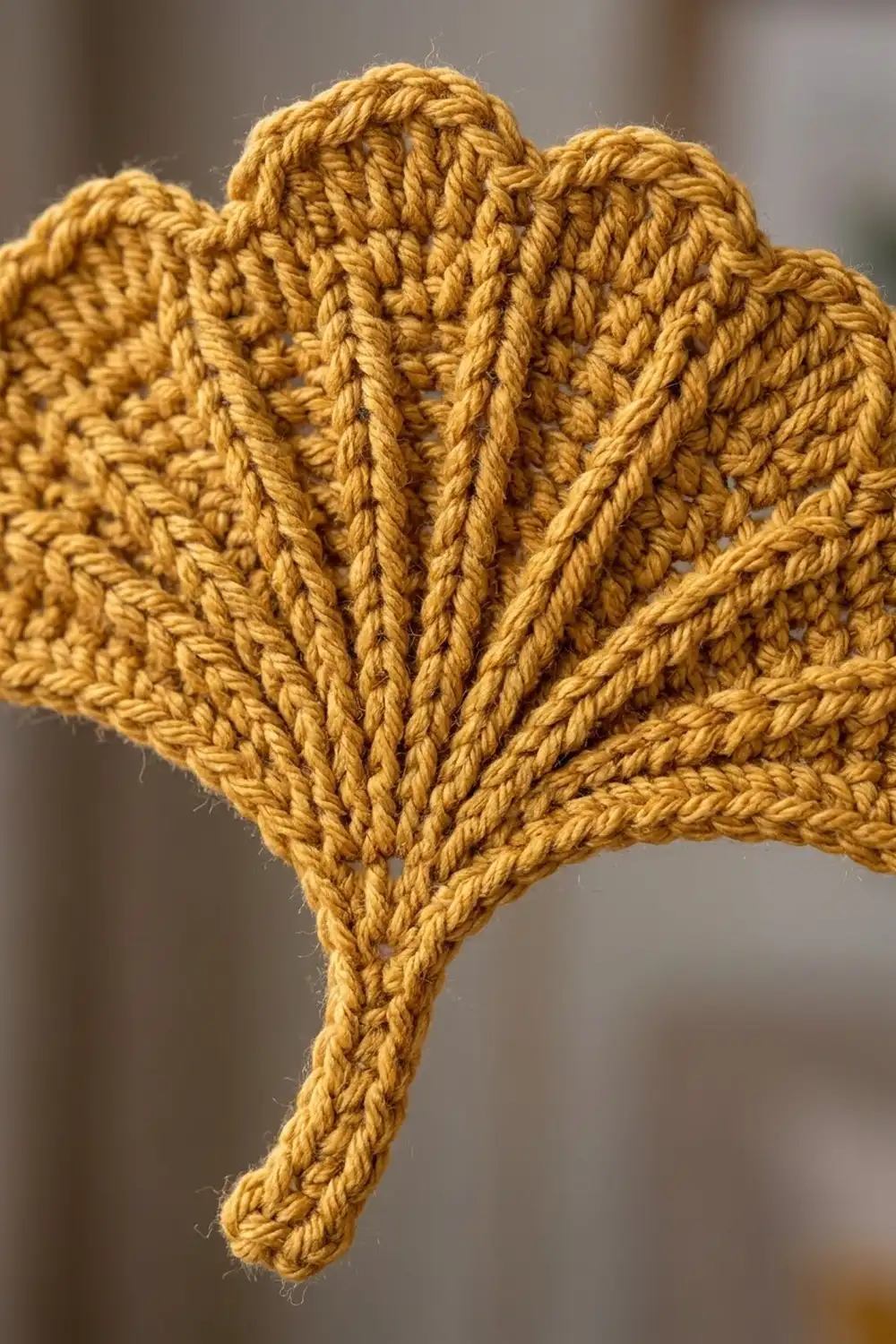
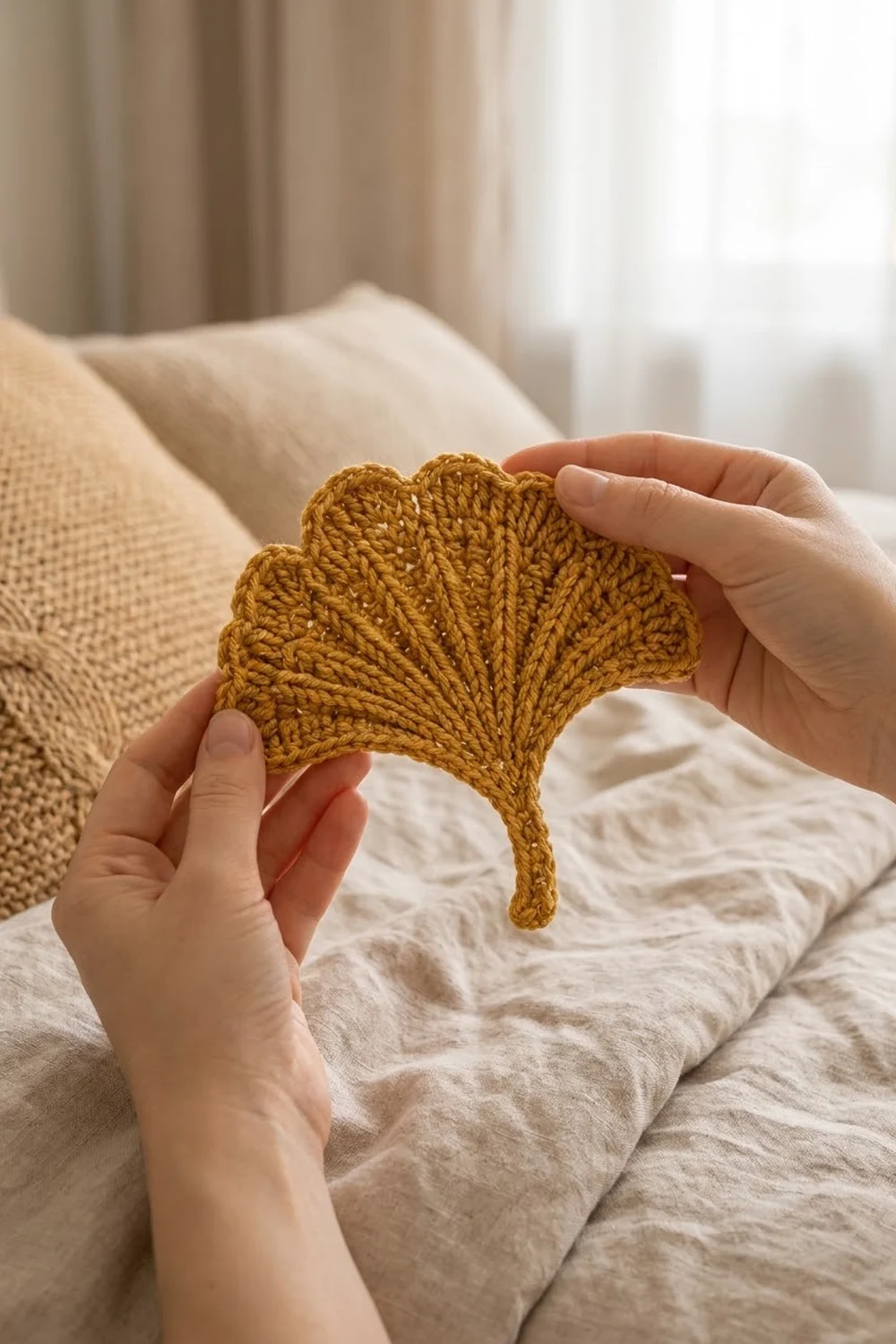
The Golden Ginkgo Leaf is a single fan-shaped motif with a scalloped top edge and a short, slightly curved stem. Raised ribs spread out from the base like the veins of a real ginkgo leaf, and a corded edge outlines the whole shape.
It is worked in one warm mustard gold, so the texture does all the work. Each rib is a post stitch stacked on the rib below it, which gives clean, raised lines from the stem to the lobes. The style is natural and a little vintage. Use it as an appliqué, a coaster-sized accent, or a bookmark-style ornament.
This pattern uses US crochet terms. The finished leaf is about 6 in (15.2 cm) wide and 5 in (12.7 cm) tall, including a 2 in (5.1 cm) stem.
Construction is simple. You work a half-circle fan in rows from a small chain center, adding stitches between seven post-stitch ribs on every row. A scallop row forms five lobes. Then one sc round outlines the leaf and builds the stem, and a reverse sc round gives the corded edge.
Finished Size and Construction
- Finished size: 6 in (15.2 cm) wide x 5 in (12.7 cm) tall
- Skill level: Easy-intermediate (post stitches, reverse sc)
- Terminology: US crochet terms
- Yarn weight: Worsted (#4)
- Hook: 5.0 mm (H-8)
- Number of pieces: 1
- Layout: Single motif, no assembly
- Piece size: Fan 6 in (15.2 cm) wide x 3 in (7.6 cm) tall, plus a 2 in (5.1 cm) stem
- Size before border: 5.5 in (14.0 cm) wide x 2.75 in (7.0 cm) tall, no stem yet
- Border depth: 0.25 in (0.6 cm), 2 rounds
Materials
Choose a smooth worsted-weight yarn so the ribs and the corded edge show clearly. Mercerized cotton or a cotton blend gives the crispest ribs and blocks very flat. Soft acrylic also works but may need steam blocking to hold the lobes open.
- Mustard gold: 10 g, about 20 m (22 yd)
This amount includes about 25% extra for checking gauge and weaving in ends.
Tools:
- 5.0 mm (H-8) crochet hook
- Tapestry needle
- Scissors
- Rust-proof pins
- Blocking mat or folded towel
- Spray bottle
- Ruler or tape measure
Abbreviations (US Terms)
- ch: chain
- sl st: slip stitch
- sc: single crochet
- hdc: half double crochet
- dc: double crochet
- st(s): stitch(es)
- rep: repeat
- RS / WS: right side / wrong side
- FPdc: front post double crochet
- BPdc: back post double crochet
- rev sc: reverse single crochet
Special stitches:
- FPdc: Yo, insert hook from front to back to front around the post of the stitch named, yo and pull up a loop, [yo, pull through 2 loops] twice.
- BPdc: Yo, insert hook from back to front to back around the post of the stitch named, yo and pull up a loop, [yo, pull through 2 loops] twice.
- Rev sc (crab stitch): Working from left to right (if you’re right-handed), insert hook into the next st to the right, yo and pull up a loop, yo and pull through both loops.
Notes:
- The beginning ch-3 of every row counts as 1 dc. “Dc in same st” at the start of a row means a dc into the base of that ch-3.
- On WS rows the ribs are BPdc, and on RS rows they are FPdc. Both push the rib toward the RS, so every rib shows as a raised line on the front.
- The rib is always the post st directly above the rib of the row before. A group is the run of plain dc between two ribs, or between a rib and the row edge.
Gauge and Checkpoints
Gauge: 16 dc and 8 rows = 4 in (10.2 cm) in plain dc rows.
Since this is one small piece, Rows 1–3 can serve as your gauge test. Stop and measure at each checkpoint below. Lay the piece flat without stretching and measure straight across the bottom edge, tip to tip.
- After Row 1: 1.25 in (3.2 cm) across
- After Row 3: 3.25 in (8.3 cm) across
- After Row 5: 5.25 in (13.3 cm) across, and 2.6 in (6.6 cm) tall from the center ch to the top edge
- After Row 6: 5.5 in (14.0 cm) across, and 2.75 in (7.0 cm) tall at the lobe peaks
- After border: 6 in (15.2 cm) across, and 5 in (12.7 cm) tall including the stem
If your leaf is too big: switch to a 4.5 mm (US 7) hook. If it is too small: switch to a 5.5 mm (I-9) hook. If only the height is off, check that you pull each dc up to full height and don’t pull the ch-3 tight.
A slight cup after Row 5 is normal. The post stitches pull the fabric in, and the scallop row and blocking flatten the fan.
Pattern: The Fan
Foundation: Ch 4.
Row 1 (RS): 14 dc in 4th ch from hook (the 3 skipped ch count as 1 dc). Turn. (15 sts)
You now have a small half circle. In Row 2, the 2nd, 4th, 6th, 8th, 10th, 12th and 14th stitches become the seven ribs.
Row 2 (WS): Ch 3 (counts as dc), dc in same st, BPdc around next st, 2 dc in next st; rep from * 6 more times, working the last 2 dc into the top of the beginning ch-3. Turn. (23 sts: 7 BPdc ribs + 8 groups of 2 dc)*
Row 3 (RS): Ch 3 (counts as dc), dc in same st, dc in next dc, FPdc around next BPdc, 2 dc in next dc, dc in next dc; rep from * 6 more times, working the last dc into the top of the beginning ch-3. Turn. (31 sts: 7 ribs + 8 groups of 3 dc)*
Row 4 (WS): Ch 3 (counts as dc), dc in same st, dc in next 2 dc, BPdc around next FPdc, 2 dc in next dc, dc in next 2 dc; rep from * 6 more times. Turn. (39 sts: 7 ribs + 8 groups of 4 dc)*
Row 5 (RS): Ch 3 (counts as dc), dc in same st, dc in next 3 dc, FPdc around next BPdc, 2 dc in next dc, dc in next 3 dc; rep from * 6 more times. Turn. (47 sts: 7 ribs + 8 groups of 5 dc)*
Every growth row adds exactly 1 stitch to each of the 8 groups, so each row has 8 more stitches than the last: 15, 23, 31, 39, 47. There are always 7 ribs, and they stay in line from row to row.
On Row 5, the ribs are stitches 6, 12, 18, 24, 30, 36 and 42, counting from either end.
Pattern: Scallop Row (Five Lobes)
This row turns the straight top edge into five lobes: a small wing lobe at each end and three broad lobes across the top. The dips between lobes fall on ribs 1, 3, 5 and 7 (stitches 6, 18, 30 and 42). Ribs 2, 4 and 6 run up into the middle of each broad lobe.
Row 6 (WS):
- Wing lobe: Ch 1, sc in first st, hdc in next st, 2 dc in next st, hdc in next st, sc in next st. (Uses 5 sts, makes 6 sts)
- Dip: Sl st in top of next rib. (1 st)
- Broad lobe: Sc in next st, hdc in next st, dc in next 2 sts, 2 dc in each of next 3 sts, dc in next 2 sts, hdc in next st, sc in next st. (Uses 11 sts, makes 14 sts)
- Dip: Sl st in top of next rib.
- Broad lobe as above.
- Dip: Sl st in top of next rib.
- Broad lobe as above.
- Dip: Sl st in top of next rib.
- Wing lobe: Sc in next st, hdc in next st, 2 dc in next st, hdc in next st, sc in last st (top of beginning ch-3). Do not fasten off.
Stitches used: 5 + 1 + 11 + 1 + 11 + 1 + 11 + 1 + 5 = 47, which matches Row 5.
Stitches made: 6 + 1 + 14 + 1 + 14 + 1 + 14 + 1 + 6 = 58 sts.
Checkpoint: 5.5 in (14.0 cm) across and 2.75 in (7.0 cm) tall at the peaks. Each dip should sit about 0.4 in (1.0 cm) below the lobes on either side.
Border
Border gauge: 4 sc = 1 in (2.5 cm) along the edges. Each dc row end is 0.5 in (1.3 cm) long, so 2 sc per dc row end keeps the sides flat.
Round 1 (RS): Turn so the RS faces you. Ch 1.
- Top edge: Sc in each st across Row 6, including each sl st. (58 sc)
- First side: Turn the work and go down the row ends: 1 sc in the end of Row 6, then 2 sc in the end of each of Rows 5, 4, 3, 2 and 1. (11 sc)
- Base and stem: Sc in the foundation ch at the center base (1 sc). Ch 9, sc in 2nd ch from hook and in each of the next 7 ch (8 sc). Sc again in the same foundation ch (1 sc).
- Second side: Go up the row ends: 2 sc in the end of each of Rows 1, 2, 3, 4 and 5, then 1 sc in the end of Row 6. (11 sc)
- Sl st to first sc to join.
Round 1 total: 58 + 11 + 1 + 8 + 1 + 11 = 90 sc. The skipped ch at the stem tip is not counted.
Round 2 (RS): Do not turn. Ch 1, rev sc in each sc around. Sl st to first st to join. (90 rev sc) Fasten off, leaving a 6 in (15.2 cm) tail.
Why the math works: The top edge gets exactly 1 sc per st, so the lobes keep their shape without being stretched or gathered. Each side has 5 dc rows at 0.5 in (1.3 cm) each, plus the short sc end of Row 6. At 4 sc per inch, 2 sc per dc row matches the side length. The two base sc anchor the stem on both sides of the center chain, so it stays centered. The rev sc round also uses 1 st per st, so it adds the cord without adding fullness. That keeps the outline smooth and lets the stem curl gently.
The two border rounds add about 0.25 in (0.6 cm) on each side: 5.5 in + 0.25 in + 0.25 in = 6 in (15.2 cm) wide. The fan height becomes 2.75 in + 0.25 in = 3 in (7.6 cm), and the 2 in (5.1 cm) stem brings the total to 5 in (12.7 cm).
Final Blocking
- Weave in both ends along the border on the WS. Don’t trim them short yet.
- Lay the leaf RS up on a blocking mat.
- Spray it until it’s evenly damp but not dripping. For acrylic, hold a steam iron just above the leaf instead, without touching it.
- Pin the center base and the stem tip first. Keep the stem 2 in (5.1 cm) long with a slight curve.
- Pin the two wing tips 6 in (15.2 cm) apart.
- Pin the peak of each broad lobe so the top of the fan is 3 in (7.6 cm) above the base.
- Pin into each of the four dips so they stay sharp.
- Run a fingertip along each rib to straighten it from base to lobe.
- Let it dry completely, then unpin and trim the ends.
Final Quality-Control Checklist
- 7 raised ribs run straight from the base to the top edge
- Row counts are 15, 23, 31, 39 and 47
- Row 6 has 58 sts and five lobes: 2 wings and 3 broad lobes
- The dips fall on ribs 1, 3, 5 and 7
- Border Round 1 has 90 sc, and Round 2 has 90 rev sc
- The corded edge is even all the way around, including the stem
- Finished size is 6 in (15.2 cm) x 5 in (12.7 cm)
- The leaf lies flat, with no ruffling at the lobes
- All ends are woven in securely
Troubleshooting
Ribs zigzag instead of running straight. You worked a post stitch around a plain dc. Each rib must go around the rib of the row before. Count the dc in each group before you work the post stitch.
Fan ruffles after Row 5. Your dc are too loose or too tall. Go down a hook size, or block firmly. The scallop row also takes up some of the extra fabric.
Fan cups and won’t lie flat. Your tension is too tight. Go up a hook size and loosen your grip on the yarn, especially on the post stitches.
Lobes look uneven. Recount Row 6 against the 5 + 1 + 11 + 1 + 11 + 1 + 11 + 1 + 5 = 47 layout. A missing stitch usually happens at the beginning ch-3.
Sides flare or pucker. Check that each dc row end has exactly 2 sc and the Row 6 end has 1 sc, for 11 per side.
Stem twists too much. The rev sc pulls on the stem. Pin it straight along its length while blocking, or work the rev sc on the stem a little looser.
Care
Hand wash in cool water with mild soap, press the water out in a towel, and dry flat, reshaping the lobes. Don’t tumble dry, because it can soften the ribs and the cord.
Final Notes
The size checks are short and easy to follow. Row 1 measures 1.25 in (3.2 cm), Row 3 measures 3.25 in (8.3 cm), and Row 5 measures 5.25 in (13.3 cm). The scallop row brings the fan to 5.5 in (14.0 cm) wide and 2.75 in (7.0 cm) tall. The two-round border adds 0.25 in (0.6 cm) all around and builds the 2 in (5.1 cm) stem, for a finished leaf of 6 in (15.2 cm) by 5 in (12.7 cm).
If you match the gauge and the stitch counts, every leaf you make will come out the same size. Happy crocheting!