

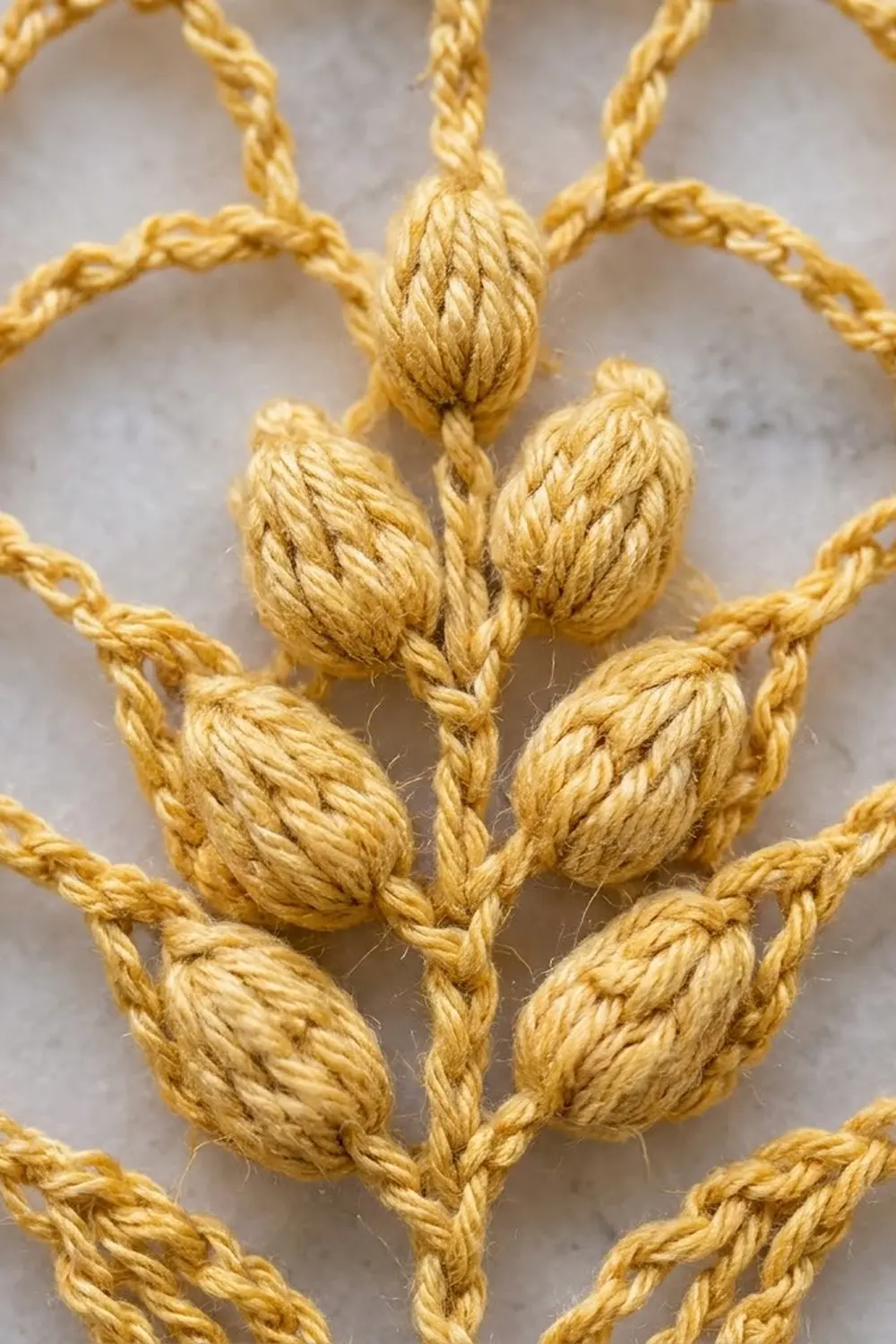
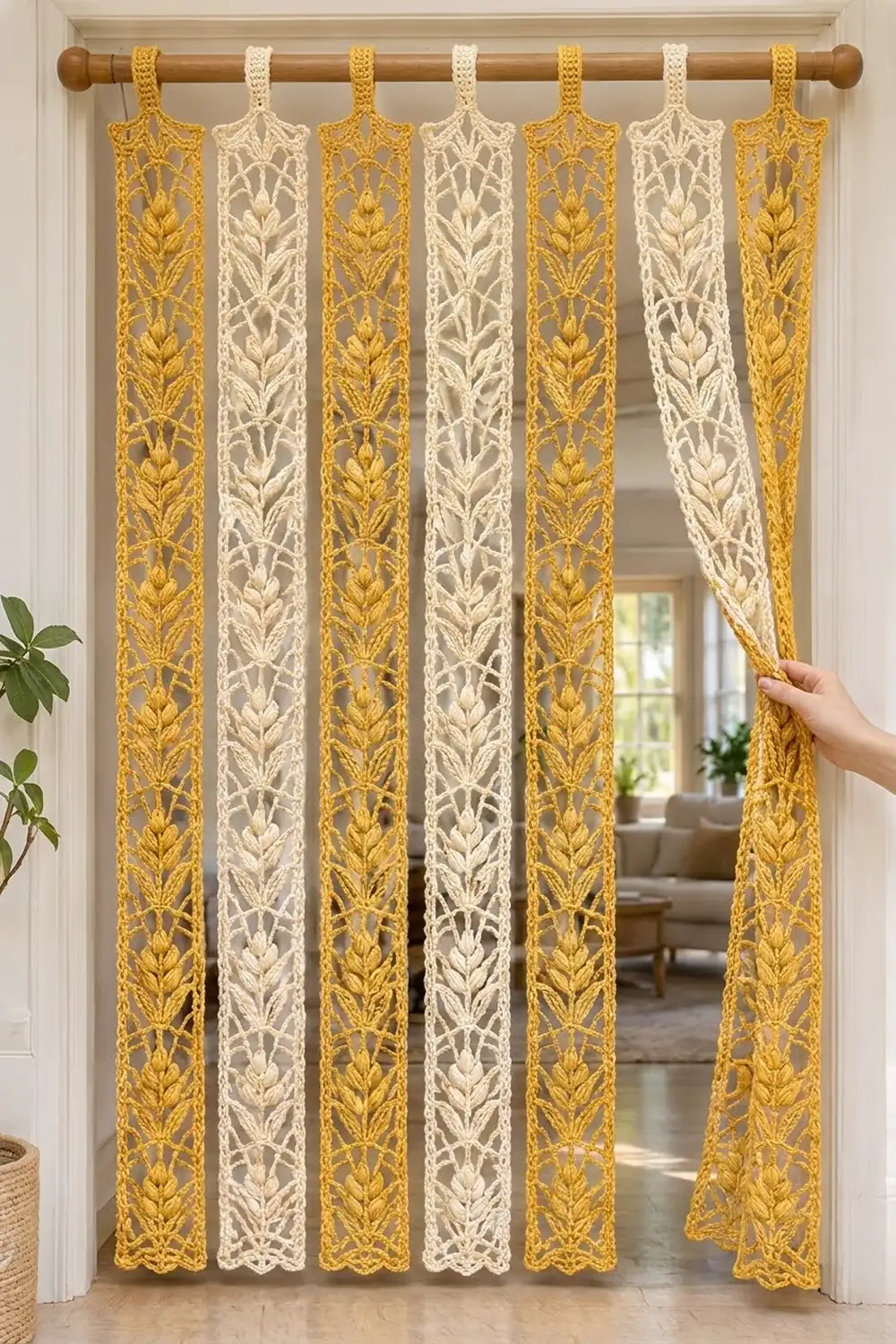
This door curtain is made of seven long, narrow lace strips. Each one has a wheat ear running up its center. Plump puff stitches form the grains, pointed clusters form the leaves, and open chain arches fill the lace on both sides. A solid double crochet rail runs along each edge, so the strips hang straight.
Four strips are worked in warm mustard yellow and three in soft cream. They alternate across a wooden rod, with mustard at both ends. Light shows through the arches, and the gaps between strips let you walk through easily.
The pattern uses US crochet terms. Each finished strip measures 4.7 in (11.9 cm) wide by 78.9 in (200.4 cm) long. The full curtain is about 35.9 in (91.2 cm) wide on the rod.
Each strip is worked flat in rows from the bottom up. Every row is 21 stitch positions wide, and an 8-row wheat motif repeats along the length. A two-round single crochet border neatens the edges. Last, a hanging tab is worked off the top of each strip and folded over the rod. The strips are never sewn to one another.
Finished Size and Construction
- Finished strip size: 4.7 in x 78.9 in (11.9 cm x 200.4 cm)
- Curtain width on rod: about 35.9 in (91.2 cm) with 0.5 in (1.3 cm) gaps
- Skill level: Intermediate
- Terminology: US
- Yarn weight: DK / light (3), cotton or cotton blend
- Hook: 4.0 mm (G-6)
- Number of pieces: 7 separate strips (4 mustard, 3 cream)
- Layout: one row of 7 strips side by side, colors alternating
- Strip size before border: 4.2 in x 78.4 in (10.7 cm x 199.1 cm)
- Border depth: 0.25 in (0.6 cm) on every edge
- Hanging tab: 1.4 in (3.6 cm) wide; it sits about 1.5 in (3.8 cm) above the strip when hung
Materials
Choose a smooth, mercerized or combed DK cotton. Cotton keeps the puffs crisp, and it stretches very little under the weight of a strip nearly 79 in (200.7 cm) long. Avoid fuzzy or very stretchy yarns. The amounts below assume about 110 m per 50 g.
- Mustard yellow: 750 g (about 1,650 m) for 4 strips
- Cream: 550 g (about 1,210 m) for 3 strips
One strip uses about 170 g (about 374 m), including its border and tab. The quantities above include a margin of about 8–10% for swatching and differences in tension. Buy each color from a single dye lot.
Tools:
- 4.0 mm (G-6) crochet hook
- Tapestry needle
- Stitch markers
- Tape measure
- Rustproof pins and a long blocking surface
- Spray bottle
- Wooden curtain rod, up to 1 in (2.5 cm) in diameter and at least 38 in (96.5 cm) long
Abbreviations (US Terms)
- ch – chain
- sc – single crochet
- dc – double crochet
- sk – skip
- st(s) – stitch(es)
- sp – space
- yo – yarn over
- RS / WS – right side / wrong side
Special stitches:
- Puff: (yo, insert hook in indicated st, yo and pull up a loop to dc height) 4 times (9 loops on hook), yo and draw through all 9 loops, ch 1 to close. The closing ch does not count as a stitch.
- 3-dc cluster (cl): (yo, insert hook in indicated st, yo and pull up a loop, yo and draw through 2 loops) 3 times in the same st (4 loops on hook), yo and draw through all 4 loops.
Counting note: every chain counts as one stitch position. A row always has 21 positions. “Sk next st” means skip one position of the row below, whether that position is a chain or a stitch.
Gauge and Checkpoints
Gauge: 20 dc and 10 rows = 4 in (10.2 cm) in solid dc. A lace row is also 0.4 in (1.0 cm) tall, and one 8-row wheat repeat measures 3.2 in (8.1 cm).
Test your gauge on the first strip before you make the rest. Check these measurements:
- After Row 1: width 4.2 in (10.7 cm).
- After Row 9: length 3.6 in (9.1 cm).
- After Row 97 (12 repeats): length 38.8 in (98.6 cm).
- After Row 196: 4.2 in x 78.4 in (10.7 cm x 199.1 cm), laid flat.
- After the border: 4.7 in x 78.9 in (11.9 cm x 200.4 cm).
Too big: go down to a 3.75 mm hook. Too small: go up to a 4.5 mm hook. You can also change the length in whole repeats; each repeat adds or removes 3.2 in (8.1 cm). Every strip must have the same number of repeats.
The Strip
The row framework is the same on every lace row. Only the 5-position center column changes. The design is symmetrical, so RS and WS rows are worked the same way.
Row Framework
Ch 3 (counts as dc), dc in next st, ch 3, sk next 3 sts, sc in next st, ch 2, sk next 2 sts, [work Column over next 5 sts], ch 2, sk next 2 sts, sc in next st, ch 3, sk next 3 sts, dc in next st, dc in top of turning ch. Turn.
Position map: 2 rail dc + 6 left lace + 5 column + 6 right lace + 2 rail dc = 21 positions. The sc always lands on the sc below (positions 6 and 16). The chain arches stack into an open ladder of arcs on each side of the stem.
Center Columns (5 positions each)
- Stem: dc in next st, ch 1, sk next st, dc in next st, ch 1, sk next st, dc in next st.
- Leaf: cl in next st, ch 1, sk next st, dc in next st, ch 1, sk next st, cl in next st.
- Grain: dc in next st, puff in next st, dc in next st, puff in next st, dc in next st.
- Tip: dc in next st, ch 1, sk next st, puff in next st, ch 1, sk next st, dc in next st.
Row Counts
- Stem row: 7 dc + 2 sc + 12 ch = 21 positions
- Leaf row: 5 dc + 2 cl + 2 sc + 12 ch = 21 positions
- Grain row: 7 dc + 2 puffs + 2 sc + 10 ch = 21 positions
- Tip row: 6 dc + 1 puff + 2 sc + 12 ch = 21 positions
Foundation
Ch 23.
Row 1 (RS): Dc in 4th ch from hook (the skipped 3 ch count as the first dc) and in each ch across. Turn. (21 dc)
Checkpoint: the row should be 4.2 in (10.7 cm) wide.
Wheat Repeat (8 rows)
- R1: Row Framework, Stem column. (21)
- R2: Row Framework, Leaf column. (21)
- R3: Row Framework, Stem column. (21)
- R4: Row Framework, Grain column. (21)
- R5: Row Framework, Grain column. (21)
- R6: Row Framework, Grain column. (21)
- R7: Row Framework, Tip column. (21)
- R8: Row Framework, Stem column. (21)
When you work a puff over a puff, insert the hook under the top two loops of the puff below, not into its closing ch. Each ear has 7 grains: 2 puffs in each of R4–R6, plus the tip puff in R7. The leaf clusters in R2 sit below the ear and lean outward. R8 and the next R1 leave an open gap between ears.
Rows 2–193: Work R1–R8 a total of 24 times. (21 positions per row; 24 wheat ears)
Top Rows
- Row 194: Row Framework, Stem column. (21)
- Row 195: Ch 3 (counts as dc), dc in each st and ch across. Count: 21 worked 1-per-existing-position + 0 added = 21 dc.
- Row 196: Ch 3, dc in each dc across. (21 dc)
Fasten off. These two solid rows carry the weight of the strip. Checkpoint: 196 rows x 0.4 in = 78.4 in (199.1 cm).
Make All Pieces
Make 7 strips. Each strip has exactly 196 rows and 24 wheat ears.
- Mustard: 4 strips
- Cream: 3 strips
Layout on the rod, left to right:
| M | C | M | C | M | C | M |
M = mustard, C = cream. Weave in the ends as you finish each strip, but don’t trim them until after blocking.
Joining
The strips are not stitched together. Each one hangs from its own tab, so the curtain parts when someone walks through. Each strip gets its own border, so every border count comes from a single strip’s edge.
Hanging tab (work this after the Border section below): With RS facing, count 8 sc in from the right-hand corner sp along the top edge. Join yarn in the 9th sc.
- Tab Row 1: Ch 1, sc in same st and in next 6 sts. Turn. (7 sc)
- Tab Rows 2–16: Ch 1, sc in each st across. Turn. (7 sc)
Fasten off, leaving a 12 in (30.5 cm) tail. The tab is centered on the top edge: 8 + 7 + 8 = 23 border sc. It measures 1.4 in (3.6 cm) wide by 4 in (10.2 cm) long.
Fold the tab to the back and whipstitch its last row behind Tab Row 1, going through both loops. Keep the tension firm but not tight so the top edge doesn’t pucker.
Size checkpoint: 7 strips x 4.7 in = 32.9 in (83.6 cm). Add 6 gaps of 0.5 in (1.3 cm) for a total of 35.9 in (91.2 cm) on the rod.
Border
Border gauge matches the body: 5 sc per inch (2.5 cm). The corners are ch-1 spaces and are not included in the side counts.
Rnd 1 (RS): Join yarn in the top right corner st. Ch 1.
- Top: sc in each of 21 sts (21 sc), ch 1.
- Side: 2 sc in each row end, 196 x 2 = 392 sc, ch 1.
- Bottom: sc in each of 21 foundation ch loops (21 sc), ch 1.
- Side: 392 sc, ch 1.
Join with sl st to the first sc. (826 sc + 4 corner ch-1 sps)
Rnd 2: Ch 1, sc in each sc around, working (sc, ch 1, sc) in each corner ch-1 sp. Join.
- Top and bottom: 21 worked 1-per-stitch + 2 added at corners = 23 sc each
- Long sides: 392 worked 1-per-stitch + 2 added at corners = 394 sc each
- Total: 23 + 394 + 23 + 394 = 834 sc + 4 corner ch-1 sps
Fasten off, then work the hanging tab.
Why the math works: One row is 0.4 in (1.0 cm) tall. At 5 sc per inch, 2 sc also span 0.4 in, so 392 sc lie flat along the 78.4 in (199.1 cm) side. Across the top, 21 sc match the 21 positions. The two rounds add 0.25 in (0.6 cm) to each edge. That takes the strip from 4.2 in to 4.7 in (10.7 cm to 11.9 cm) wide and from 78.4 in to 78.9 in (199.1 cm to 200.4 cm) long.
Final Blocking
- Weave in the ends, but don’t trim them yet.
- Soak one strip in cool water for 10 minutes. Roll it in a towel and press to remove water; don’t wring it.
- Lay the strip flat. If your blocking surface is too short, block the strip in two halves.
- Pin the rails straight to 4.7 in (11.9 cm) wide, checking every 10 in (25.4 cm).
- Ease the length to 78.9 in (200.4 cm). Don’t overstretch it, because cotton lace drops a little more once it hangs.
- Pin the arches open and plump each puff with your fingertips.
- Let the strip dry completely, then unpin it and trim the tails.
- Repeat for every strip, then compare the lengths side by side.
Final Quality-Control Checklist
- Every strip has 196 rows and 24 wheat ears.
- Every row has 21 positions, with sc stacked at positions 6 and 16.
- Each ear has 7 grains and 2 leaf clusters.
- Border Rnd 2 has 23 sc on each short side and 394 sc on each long side.
- Each tab is centered, with 8 sc on each side.
- All strips measure 4.7 in x 78.9 in (11.9 cm x 200.4 cm).
- Colors alternate M-C-M-C-M-C-M.
Troubleshooting
- Strip slants: a rail dc was dropped or added. Recount the first 2 and last 2 positions of each row.
- Flat puffs: pull each loop up to full dc height before closing the puff.
- Puckered arches: your chains are too tight. Chain more loosely.
- Ruffled long edges: work 2 sc per row end, never 3.
- Uneven lengths: count repeats rather than measuring, then even out the lengths during blocking.
- Stretched tab: add a second line of whipstitches across the fold.
Care
Hand wash in cool water with mild soap and dry flat. Never hang the strips while they’re wet, because the weight of the water will stretch them.
Final Notes
Each measurement builds on the one before. Row 1 sets the width at 4.2 in (10.7 cm). Each row adds 0.4 in (1.0 cm), so 196 rows give 78.4 in (199.1 cm). The border adds 0.25 in (0.6 cm) to every edge, for a finished strip of 4.7 in x 78.9 in (11.9 cm x 200.4 cm). Seven strips with 0.5 in (1.3 cm) gaps fill 35.9 in (91.2 cm) of rod. If each checkpoint matches, the curtain will hang evenly.
Happy crocheting!