

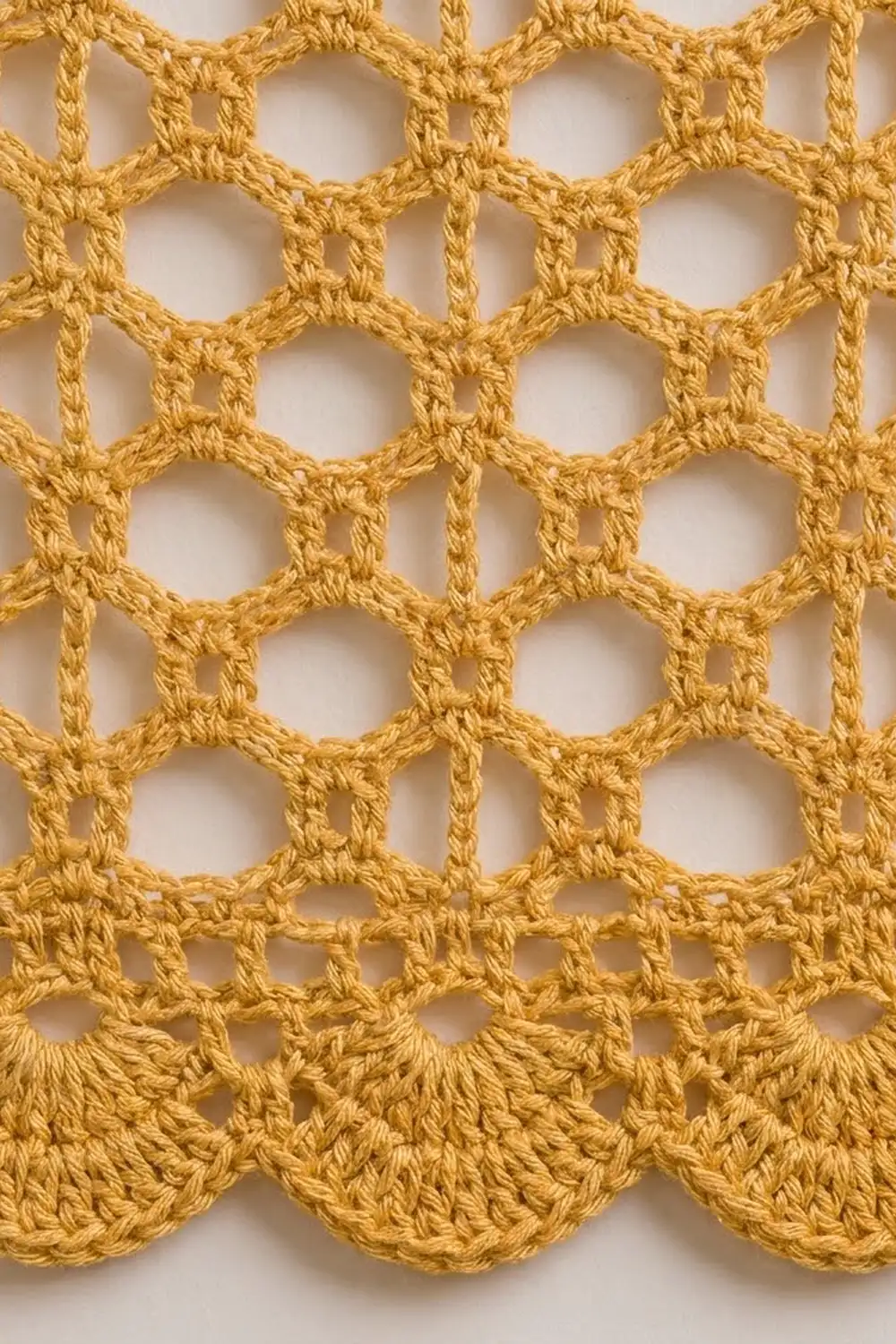
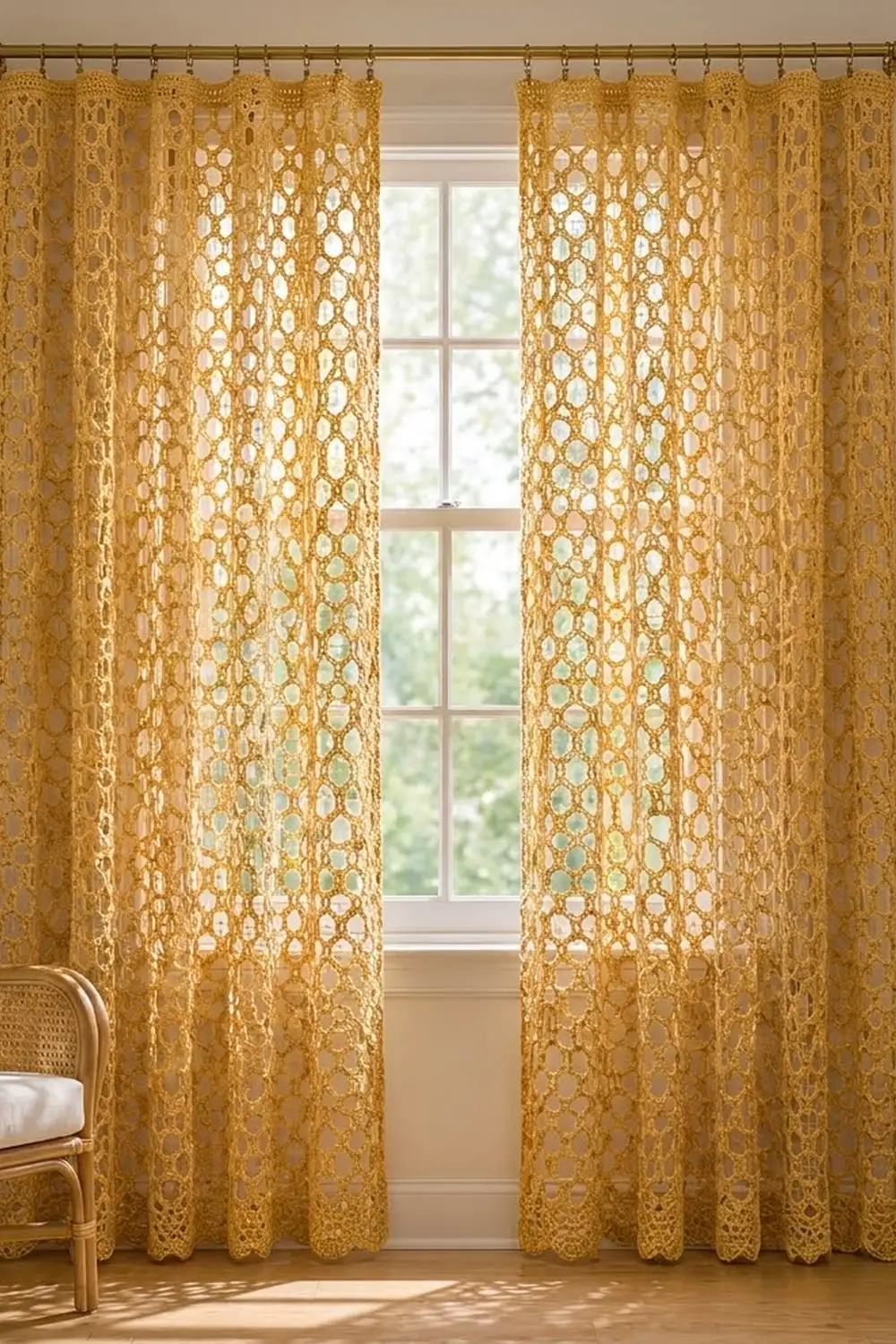
These curtain panels are worked in an open honeycomb mesh. Rows of three-double-crochet blocks join with chain bars and small chain diagonals to make a field of six-sided openings. Light comes straight through, and the panel still reads as a textured surface instead of a plain net.
The panel is worked in one warm mustard-gold cotton, so all of the interest comes from the structure. The top has a solid single crochet heading for clip rings. The bottom has a scalloped border of shells and wide fans, and two narrow rows of single crochet finish each long side.
This pattern uses US crochet terms. Each finished panel measures 39.75 in wide x 84 in long (101.0 x 213.4 cm) after blocking. Make two identical panels for a pair. The panels are never joined to each other.
The construction is simple. You chain a foundation and work the honeycomb mesh in rows from the bottom up, then finish with a 5-row heading. After that, you turn the panel upside down and work the scalloped border into the foundation chain. Side edging goes on last.
Finished Size and Construction
- Finished size (one panel): 39.75 x 84 in (101.0 x 213.4 cm)
- Skill level: Intermediate
- Terminology: US crochet terms
- Yarn weight: Worsted (#4) cotton or cotton blend
- Hook: 5.0 mm (H-8)
- Number of pieces: 1 per panel (make 2 identical, unjoined panels for a pair)
- Layout: Single rectangular panel worked in rows
- Piece size: 39.75 x 84 in (101.0 x 213.4 cm)
- Size before border (mesh body plus heading): 38.75 x 80 in (98.4 x 203.2 cm)
- Border depth: 4 in (10.2 cm) along the bottom; 0.5 in (1.3 cm) on each long side
Materials
Yarn: Use a smooth, mercerized or combed worsted-weight cotton. Cotton holds the hexagon shapes crisply, resists stretching better than acrylic, and handles window sunlight well. Avoid fuzzy or very splitty yarn, because it clouds the openings.
- Mustard gold: 1,300 g / approx. 2,470 m (2,700 yd) per panel
- For a pair: 2,600 g / approx. 4,940 m (5,400 yd)
These amounts assume about 190 m per 100 g (208 yd per 3.5 oz) and include roughly a 10% margin for swatching and blocking. Buy all of it from one dye lot.
Tools:
- 5.0 mm (H-8) crochet hook
- Tapestry needle
- Stitch markers
- Measuring tape (at least 60 in / 152.4 cm)
- Rustproof pins and blocking mats or a clean sheet on the floor
- Spray bottle
- Optional for hanging: 12 clip rings per panel
Abbreviations (US Terms)
- ch – chain
- sc – single crochet
- dc – double crochet
- tr – treble crochet
- sk – skip
- sp – space
- st(s) – stitch(es)
- tch – turning chain
- RS / WS – right side / wrong side
Special stitches:
- Block: 3 dc side by side, worked either into 3 consecutive sts or all into one ch-5 sp.
- Shell: 7 dc worked into the same stitch.
- Fan: 9 dc worked into the same ch-5 sp.
Gauge and Checkpoints
Mesh gauge: 2 pattern repeats (16 sts) = 4 in (10.2 cm) wide. 4 rows (one full honeycomb repeat) = 2.5 in (6.4 cm) tall. That works out to 4 sts per inch and 0.625 in (1.6 cm) per row.
Sc gauge (heading and borders): 16 sc = 4 in (10.2 cm). 4 sc rows = 1 in (2.5 cm).
Test first: Ch 37. Work Rows 1–10 below, using 4 repeats instead of 19 (and 3 instead of 18) wherever a repeat count appears. You get 35 sts across. Block the swatch, let it dry, then measure: it should be 8.75 in (22.2 cm) wide and 6.25 in (15.9 cm) tall.
- Too big: Go down 0.5 mm, or tighten your chains. Loose ch-5 bars are the most common reason a panel ends up too wide.
- Too small: Go up 0.5 mm. Keep your dc relaxed and don’t pull the ch-2 diagonals tight.
Panel checkpoints (measured flat, unstretched):
- After Row 1: 38.75 in (98.4 cm) wide
- After Row 26: 16.25 in (41.3 cm) tall
- After Row 66: 41.25 in (104.8 cm) tall
- After Row 126: 78.75 in (200.0 cm) tall
- After the heading: 80 in (203.2 cm) tall
- After the bottom border: 84 in (213.4 cm) tall
- After side edging: 39.75 in (101.0 cm) wide
Mesh Body
The body is a multiple of 8 sts + 3. Each full-width row has 20 blocks and 19 ch-5 spaces.
Foundation: Ch 157.
Row 1 (RS): Dc in 4th ch from hook (the skipped 3 ch count as a dc) and in the next ch. Ch 5, sk 5 ch, dc in next 3 ch 19 times. Turn.
Count: 20 blocks, 19 ch-5 sps = 155 sts.
Row 2: Ch 3 (counts as dc), dc in next 2 dc. Ch 5, sk ch-5 sp, dc in next 3 dc 19 times, working the last dc in the top of the tch. Turn.
Count: 155 sts (20 blocks, 19 ch-5 sps).
These two rows of stacked blocks form the first vertical sides of the hexagons.
Row 3 (shift row): Ch 3 (counts as dc), ch 1, sc in center dc of first block. Ch 2, block in next ch-5 sp, ch 2, sc in center dc of next block 19 times. Ch 1, dc in top of tch. Turn.
Count: 19 blocks, 20 sc, 2 edge dc.
The new blocks sit centered over the spaces below. The ch-2 / sc / ch-2 sections form the slanted sides of the hexagons.
Row 4: Ch 3 (counts as dc), ch 3. Dc in each of next 3 dc, ch 5 18 times. Dc in each of next 3 dc, ch 3, dc in top of tch. Turn.
Count: 19 blocks, 18 ch-5 sps, 2 edge ch-3 sps, 2 edge dc = 155 sts.
Each ch-5 bar crosses over one ch-2 / sc / ch-2 group, so the bar becomes the top or bottom of a hexagon.
Row 5 (shift row): Ch 3 (counts as dc), 2 dc in first ch-3 sp (edge block made), ch 2, sc in center dc of next block, ch 2. Block in next ch-5 sp, ch 2, sc in center dc of next block, ch 2 18 times. 2 dc in last ch-3 sp, dc in top of tch. Turn.
Count: 20 blocks (including both edge blocks), 19 sc.
Row 6: Work as Row 2.
Count: 155 sts (20 blocks, 19 ch-5 sps).
Rows 7–126: Repeat Rows 3–6 thirty more times. That makes 31 repeats of Rows 3–6 in all, ending on a Row 6. Check the length at Rows 26 and 66.
Rows 1–2 plus 31 four-row repeats = 126 rows. At 0.625 in per row, that is 78.75 in (200.0 cm).
Heading
Keep working from the top of Row 126. The heading gives the clip rings a firm, even edge to grip.
Heading Row 1 (conversion row): Ch 1, sc in each dc and 5 sc in each ch-5 sp across. Turn.
Count: 60 sc (1 in each existing dc) + 95 sc (5 in each of 19 spaces) = 155 sc.
Heading Rows 2–5: Ch 1, sc in each sc across. Turn.
Count: 155 sc per row.
Fasten off. At 4 sc rows per inch, the 5 heading rows add 1.25 in (3.2 cm), so the panel now measures 80 in (203.2 cm) long.
Border
Border gauge: 16 sc = 4 in (10.2 cm). The fan border is 4 in (10.2 cm) deep. Each side edge is 0.5 in (1.3 cm) wide.
Bottom Scallop Border
Turn the panel upside down. With RS facing, join yarn in the first free loop of the foundation chain.
B1: Ch 1. Work 155 sc across the opposite side of the foundation chain, 1 at the base of each Row 1 stitch (including the skipped chains under each ch-5). Turn.
Count: 155 sc. Depth 0.25 in (0.6 cm).
B2: Ch 1, sc in first 2 sc. Sk 3 sc, shell in next sc, sk 3 sc, sc in next sc 19 times. Sc in last sc. Turn.
Count: 19 shells (133 dc) + 22 sc = 155 sts. Depth 1 in (2.5 cm).
B3: Ch 6 (counts as tr + ch 2), sc in center (4th) dc of first shell. Ch 5, sc in center dc of next shell 18 times. Ch 2, tr in last sc. Turn.
Count: 19 sc, 18 ch-5 arches, 2 edge ch-2 sps, 2 edge tr. Depth 0.75 in (1.9 cm).
B4: Ch 3 (counts as dc), 3 dc in first ch-2 sp, sc in next sc. Fan in next ch-5 arch, sc in next sc 18 times. 3 dc in last ch-2 sp, dc in 4th ch of tch. Turn.
Count: 1 + 3 + 1 + (18 x 10) + 3 + 1 = 189 sts (18 full fans, 2 half fans at the edges). Depth 1.5 in (3.8 cm).
B5 (trim row): Ch 1, sc in each st across, working 3 sc in the center (5th) dc of each fan. Fasten off.
Count: 189 sc (1 per existing st) + 36 extra (2 extra at each of 18 fan tips) = 225 sc. Depth 0.5 in (1.3 cm).
Why the math works: The 155-st foundation is 8 x 19 + 3. Each 8-st segment of B1 holds exactly one shell, so B2 has 19 shells. B3 links the 19 shell centers with 18 arches. B4 places one fan in each arch, so the fans fall between the shells and form scallops. The flare comes from extra dc inside each fan, not from extra repeats, so the bottom edge stays 38.75 in (98.4 cm) wide. Depth: 0.25 + 1 + 0.75 + 1.5 + 0.5 = 4 in (10.2 cm).
Side Edging
Work each long side separately with RS facing, from one corner to the other.
Side Row 1: Join yarn at the corner. Ch 1 and work evenly along the edge:
- Bottom border (5 rows): 16 sc total (1 in B1, 4 in B2, 3 in B3, 6 in B4, 2 in B5)
- Mesh body (126 rows): alternate 2 sc and 3 sc per row end = 63 x 5 = 315 sc
- Heading (5 rows): 1 sc per row end = 5 sc
Turn. Count: 16 + 315 + 5 = 336 sc.
Side Row 2: Ch 1, sc in each sc across. Fasten off.
Count: 336 sc.
336 sc at 4 sc per inch = 84 in (213.4 cm), the same as the panel length, so the edge neither ruffles nor pulls in. Each side adds 2 rows x 0.25 in = 0.5 in (1.3 cm), bringing the width to 38.75 + 1 = 39.75 in (101.0 cm). Repeat on the second long side.
Final Blocking
- Weave in all ends along block stitches or sc edges, never across an open chain bar.
- Soak the panel in cool water for 15 minutes. Press the water out gently; do not wring.
- Roll the panel in towels to remove the excess water.
- Lay it flat on mats or a sheet. Pin the four corners first to 39.75 x 84 in (101.0 x 213.4 cm).
- Pin along each side every 6 in (15.2 cm), keeping the edges straight.
- Pin the tip of every fan along the bottom to set the scallops.
- With your fingers, open any hexagons that collapsed so the rows line up.
- Let it dry completely, then unpin. Block the second panel to the same measurements.
Final Quality-Control Checklist
- Panel measures 39.75 x 84 in (101.0 x 213.4 cm)
- Full-width rows each count 20 blocks and 19 ch-5 sps
- Every shift row has its blocks centered over the spaces below
- Heading rows have 155 sc each
- The bottom border has 19 shells and 18 full fans
- Side edges count 336 sc per row and hang straight
- Both panels match in length to within 0.5 in (1.3 cm)
- All ends are secure and invisible from the RS
Troubleshooting
- Hexagons look slanted: You probably worked a shift-row block into a stitch instead of into the ch-5 sp. Always work blocks into the space.
- Edges wave in and out: Check the edge stitches in Rows 3–5. Row 3 starts and ends with ch 1, and Row 4 starts and ends with ch 3.
- Panel too long after hanging: Cotton mesh drops a little with weight. Leave out one 4-row repeat, which shortens the panel by 2.5 in (6.4 cm).
- Scallops flip up: Re-block with a pin in every fan tip, and check that B4 has 9 dc per fan.
- Heading ripples: You put more than 5 sc in a ch-5 sp. Rework Heading Row 1 to 155 sc.
Care
Hand wash or machine wash cold on a gentle cycle in a mesh laundry bag. Dry flat and re-pin the scallops if needed. Don’t hang the wet panel, because the weight will stretch it.
Final Notes
Here is the full measurement chain. Your swatch should give 4 sts per inch and 0.625 in (1.6 cm) per row. Row 1 is 155 sts, or 38.75 in (98.4 cm) wide. The body is 126 rows, or 78.75 in (200.0 cm) long. The heading brings the panel to 80 in (203.2 cm), and the 4 in (10.2 cm) border brings it to 84 in (213.4 cm). The side edging finishes the width at 39.75 in (101.0 cm). If each checkpoint matches, both panels will hang evenly side by side.
Happy crocheting!