

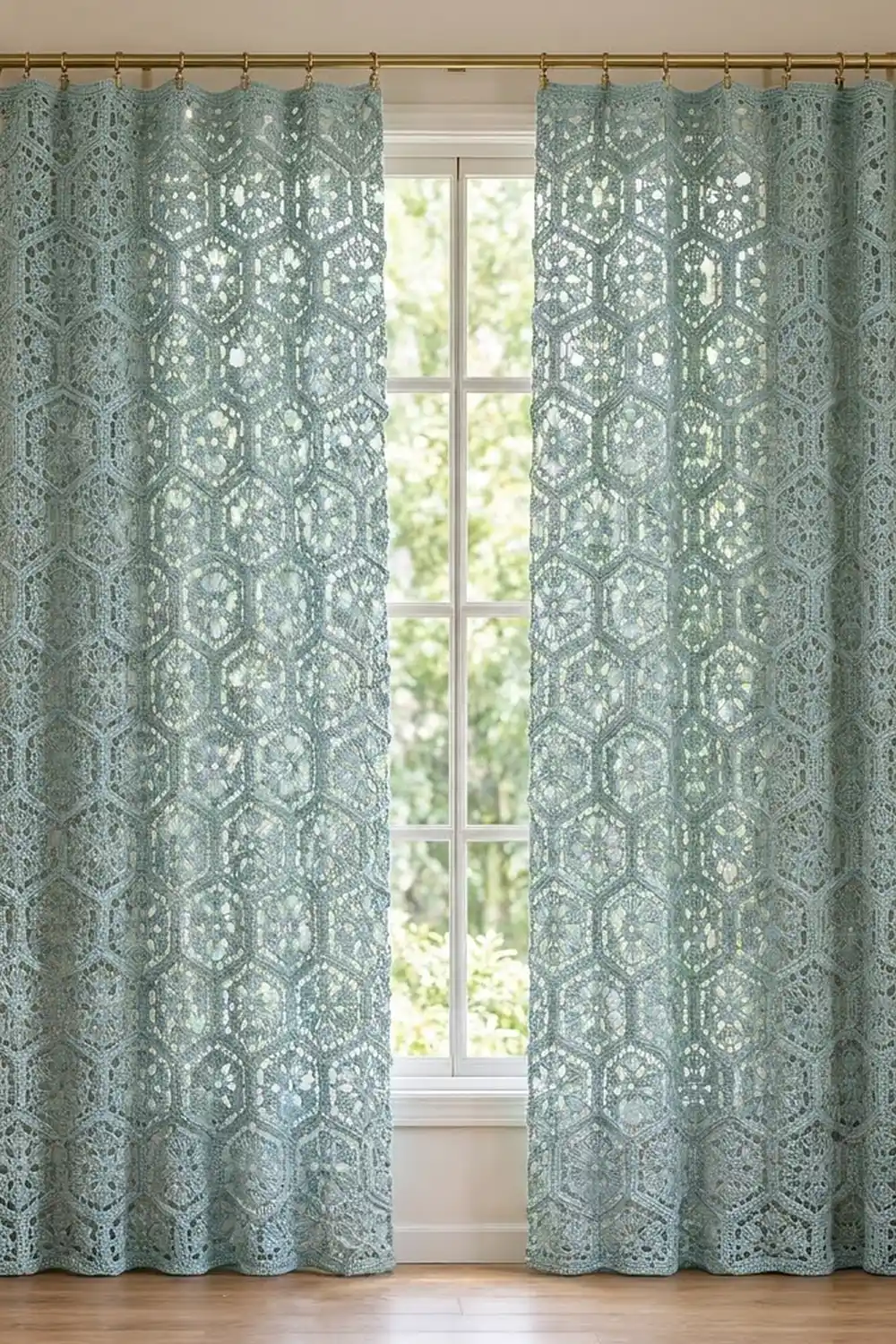
The Seaglass Hexagon Curtain Panel is a light, lacy window panel made from 68 hexagon motifs worked in one soft seaglass blue. Each hexagon has a small open ring at the center, a round of 12 cluster petals, two granny-style rounds of 3-dc groups that form six sharp corners, and a solid single crochet outline.
Once joined, the solid outlines form a raised honeycomb grid across the panel. The lacy centers let daylight through, and the scalloped top hangs neatly from clip rings. The look is calm and coastal, and it suits any window where you want privacy without blocking the light.
This pattern uses US crochet terms. One finished panel measures approximately 31.2 in (79.2 cm) wide by 81.7 in (207.5 cm) long, measured point to point after blocking. Make two panels for a pair, as shown.
Construction is modular. You crochet each hexagon in the round and then join them flat with a slip stitch seam, first into rows and then row to row. Last, you work a 3-round single crochet border that follows the outline.
Finished Size and Construction
- Finished panel size: 31.2 in x 81.7 in (79.2 cm x 207.5 cm)
- Skill level: Intermediate
- Terminology: US crochet terms
- Yarn weight: DK (#3 light), cotton or cotton blend
- Hook: 4.0 mm (G-6)
- Number of pieces: 68 hexagons per panel (136 for a pair)
- Layout: 15 horizontal rows, alternating 5 hexagons and 4 hexagons, points up
- Hexagon size: 6 in (15.2 cm) flat side to flat side, 7 in (17.8 cm) point to point, 3.5 in (8.9 cm) per side
- Size before border: 30 in x 80.5 in (76.2 cm x 204.5 cm)
- Border depth: 0.6 in (1.5 cm), 3 rounds of single crochet
Materials
Choose a smooth DK cotton or cotton-linen blend at about 230 m per 100 g. Cotton gives crisp stitch definition, holds the hexagon points well after blocking, and stands up to sunlight. Avoid fuzzy yarns, because they blur the lacy openings.
Yarn (one color):
- Seaglass blue (soft dusty aqua): 800 g / 1,840 m per panel
- For a pair of panels: 1,600 g / 3,680 m
Each hexagon uses about 10 g (23 m), and the border uses about 40 g (92 m) per panel. The quantities above include a margin of roughly 10% for gauge differences and your test hexagon. Buy all yarn from one dye lot.
Tools:
- 4.0 mm (G-6) crochet hook
- Tapestry needle
- Stitch markers
- Measuring tape
- Blocking mats and rust-proof pins
- Spray bottle
- Curtain rod with 7 clip rings per panel
Abbreviations (US Terms)
- ch – chain
- sl st – slip stitch
- sc – single crochet
- dc – double crochet
- sc2tog – single crochet 2 together
- sp(s) – space(s)
- st(s) – stitch(es)
- rep – repeat
- RS – right side
Special stitches:
- 3-dc cluster (cl): Yarn over, insert hook in st, yarn over and pull up a loop, yarn over and pull through 2 loops; rep from * 2 more times in the same st (4 loops on hook), yarn over and pull through all 4 loops.
- Beginning cluster (beg-cl): Ch 3, then work the cluster steps 2 times in the same st (3 loops on hook), yarn over and pull through all 3 loops.
Gauge and Checkpoints
Make one test hexagon first, block it, and measure it before you make the rest. Small errors multiply across 68 pieces.
Hexagon gauge: One blocked hexagon = 6 in (15.2 cm) flat side to flat side and 7 in (17.8 cm) point to point. Each side of Round 6 holds 17 sc and measures 3.5 in (8.9 cm) corner to corner.
Checkpoints (unblocked, lying flat):
- After Round 1: 1.25 in (3.2 cm) across
- After Round 2: 2.5 in (6.4 cm) across
- After Round 3: 3.5 in (8.9 cm) across
- After Round 4: 4.5 in (11.4 cm) flat to flat
- After Round 5: 5.5 in (14.0 cm) flat to flat
- After Round 6: 6 in (15.2 cm) flat to flat
If your hexagon is too big, change to a 3.75 mm (F-5) hook. If it is too small, change to a 4.5 mm (7) hook. An error of only 0.25 in (0.6 cm) per hexagon changes the panel width by 1.25 in (3.2 cm).
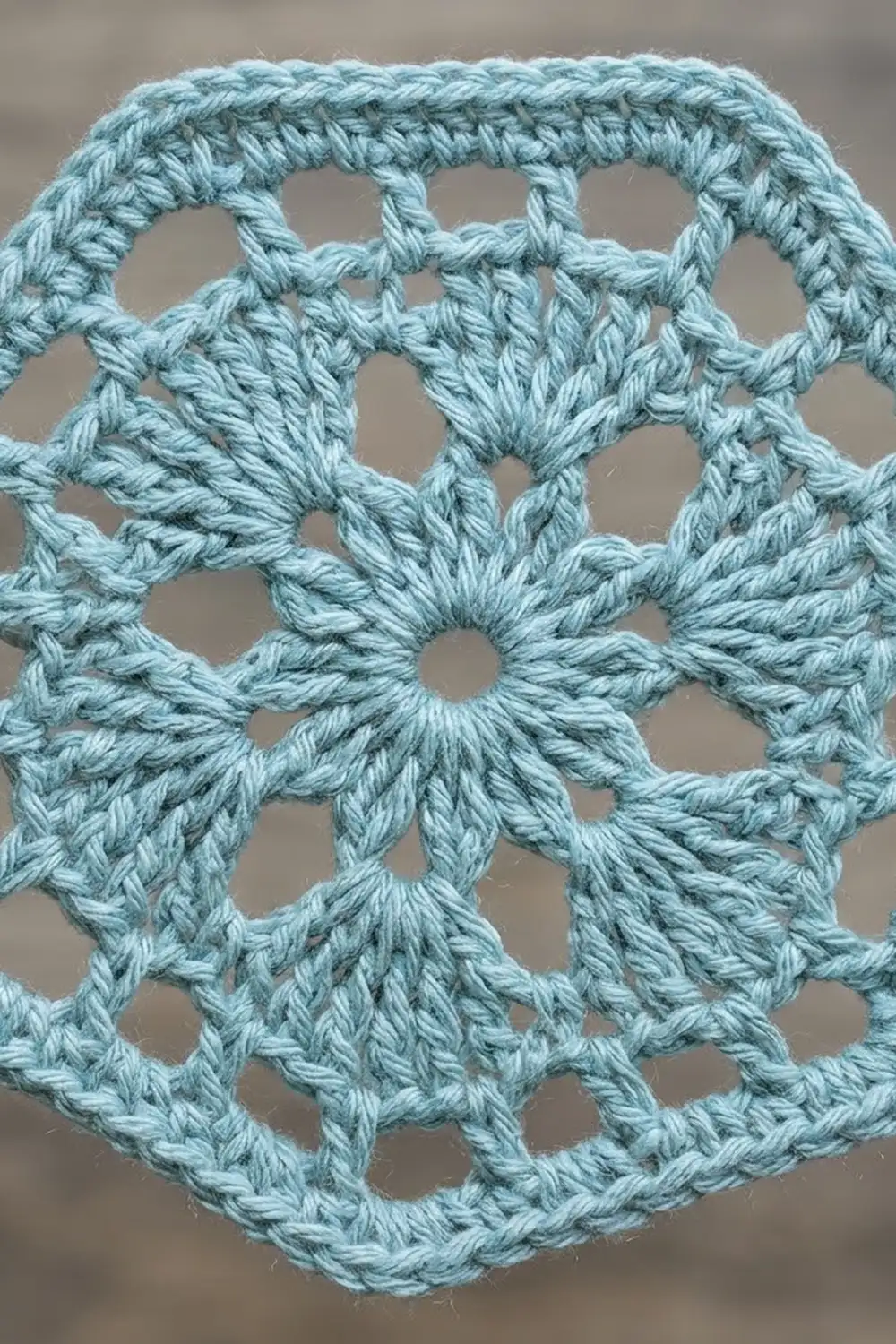
Hexagon Motif (make 68 per panel)
Work in joined rounds with the RS facing. Do not turn.
Round 1: Make a magic ring. Ch 3 (counts as dc), 11 dc in ring, join with sl st to top of ch-3. Close the ring, leaving a small open center. (12 dc)
Round 2 (petals): Beg-cl in same st as join, ch 2, cl in next dc, ch 2; rep from * 10 more times, join to top of beg-cl. (12 clusters, 12 ch-2 sps)
Round 3: Sl st into next ch-2 sp, ch 3 (counts as dc), 2 dc in same sp, ch 1, 3 dc in next ch-2 sp, ch 1; rep from * 10 more times, join to top of ch-3. (36 dc in 12 groups, 12 ch-1 sps)
Round 4 (corners form): Sl st in next 2 dc and into next ch-1 sp, ch 3, (2 dc, ch 2, 3 dc) in same sp, ch 1, 3 dc in next ch-1 sp, ch 1, (3 dc, ch 2, 3 dc) in next ch-1 sp, ch 1, 3 dc in next ch-1 sp, ch 1; rep from * 4 more times, join to top of ch-3. (54 dc, 6 ch-2 corner sps, 12 ch-1 sps)
Round 5: Sl st in next 2 dc and into corner ch-2 sp, ch 3, (2 dc, ch 2, 3 dc) in same sp, [ch 1, 3 dc in next ch-1 sp] 2 times, ch 1, (3 dc, ch 2, 3 dc) in next corner sp; rep from * 4 more times, [ch 1, 3 dc in next ch-1 sp] 2 times, ch 1, join to top of ch-3. (72 dc, 6 ch-2 corner sps, 18 ch-1 sps)
Each side now has 15 sts between corner sps: 3 dc, ch-1 sp, 3 dc, ch-1 sp, 3 dc, ch-1 sp, 3 dc.
Round 6 (solid outline): Sl st in next 2 dc and into corner ch-2 sp, ch 1, (sc, ch 2, sc) in same sp, sc in each of next 15 sts (each dc and each ch-1 sp), (sc, ch 2, sc) in next corner sp; rep from * 4 more times, sc in each of next 15 sts, join with sl st to first sc. Fasten off and weave in ends.
This is a conversion round: (15 sts worked 1 per existing st x 6 sides = 90 sc) + (2 corner sc x 6 corners = 12 sc) = 102 sc and 6 ch-2 corner sps.
Each side holds 17 sc: 1 corner sc + 15 sc + 1 corner sc. That count already includes both corner sc. The ch-2 corner sps sit outside the side count.
Make All Pieces
Seaglass blue: 68 hexagons per panel, 136 for a pair.
Place each hexagon with one point straight up, so two of its sides are vertical. Odd rows hold 5 hexagons. Even rows hold 4, nested into the valleys between the rows above and below.
Row 1:   H H H H H
Row 2:    H H H H
Row 3:   H H H H H
Row 4:    H H H H
 ...   (continue alternating)
Row 14:   H H H H
Row 15:  H H H H H
That gives 8 rows of 5 (40 hexagons) plus 7 rows of 4 (28 hexagons), for 68 in total. Block all the hexagons to 6 in (15.2 cm) flat to flat before joining.
Joining
Method: Slip stitch seam through the back loops, worked from the RS. It lies flat and leaves a fine ridge that turns the outlines into a raised honeycomb.
Stitch-to-stitch logic: Hold two hexagons RS up with the edges side by side. Sl st through both corner ch-2 sps. Then sl st through the back loop of each pair of matching sc, 17 pairs in total. Finish with a sl st through the next pair of corner sps. The seam is exactly 17 to 17.
Order:
- Join each row with vertical seams: 4 seams in each 5-hexagon row and 3 seams in each 4-hexagon row.
- Join row 2 to row 1 along the zigzag. Each row-2 hexagon shares its upper-left and upper-right sides with the row above, so you work 8 sides in one continuous seam. Where three hexagons meet, catch all the corner sps in one sl st.
- Add the remaining rows one at a time.
Tension: Keep the seam stitches as loose as your sc. Tight seams pull the panel narrow and curl the points. Go up one hook size for joining if needed.
Size checkpoint: One joined 5-hexagon row measures 30 in (76.2 cm) wide. Rows 1 and 2 together measure 12.25 in (31.1 cm) tall, and each extra row adds 5.25 in (13.3 cm). All 15 rows give 7 in + (14 x 5.25 in) = 80.5 in (204.5 cm).
Border
Border gauge: 3 rounds of sc = 0.6 in (1.5 cm) deep, worked at 17 sc per 3.5 in (8.9 cm) side.
The outer edge has 78 open hexagon sides: 10 on the top (the upper-left and upper-right sides of the row 1 hexagons), 10 on the bottom, and 29 on each long side.
It also has two kinds of corner. Points are outward corners that belong to one hexagon: 5 on the top, 5 on the bottom, 14 on each long side, and 4 panel corners, for 42 in total. Valleys are inward corners where two hexagons meet: 4 on the top, 4 on the bottom, and 14 on each long side, for 36 in total.
Round 1: With RS facing, join yarn at the top-right panel corner. Work 1 sc in each sc of every open side. At each point, ch 2 over the old corner sp. At each valley, skip the joined corner sps and go straight to the next hexagon’s first sc. Join.
- Top: 10 x 17 = 170 sc; Bottom: 170 sc
- Left and right: 29 x 17 = 493 sc each
- Total: 1,326 sc and 42 ch-2 sps
Round 2: Ch 1. Sc in each sc. Work (sc, ch 2, sc) in each point sp. At each valley, sc2tog over the last sc before it and the first sc after it. Join.
- Top: 170 + (5 x 2) − 4 + 2 (one sc from each panel corner) = 178 sc; Bottom: 178 sc
- Left and right: 493 + (14 x 2) − 14 + 2 = 509 sc each
- Total: 1,374 sc and 42 ch-2 sps
Round 3: Rep Round 2. Fasten off.
- Top and bottom: 178 + 10 − 4 + 2 = 186 sc each
- Left and right: 509 + 28 − 14 + 2 = 525 sc each
- Total: 1,422 sc and 42 ch-2 sps
Why the math works: Round 1 picks up 78 sides x 17 sc on a 1-to-1 basis. Nothing is added at the seams, because the corner sc are already in each side’s 17. In Rounds 2 and 3, each point adds 2 sc and each valley removes 1. That is a net change of (42 x 2) − 36 = +48 per round, which matches the totals 1,326, 1,374, and 1,422. The border stays flat and keeps the scallops crisp.
Final Blocking
- Soak the panel in cool water for 15 minutes, then press out the water without wringing.
- Roll it in towels to remove extra moisture.
- Lay it flat on mats. If space is short, block it in halves.
- Pin the width to 31.2 in (79.2 cm) at rows 1, 8, and 15.
- Pin the length to 81.7 in (207.5 cm) along both sides.
- Pin each top and bottom point outward so the scallops are even.
- Straighten the honeycomb seams with your fingers.
- Let it dry fully, at least 24 hours, before unpinning.
Final Quality-Control Checklist
- Every hexagon has 102 sc and 6 ch-2 corner sps.
- Every hexagon blocks to 6 in (15.2 cm) flat to flat.
- There are 15 rows, alternating 5 and 4 hexagons.
- Every seam joins 17 sc to 17 sc.
- There are no holes at 3-way junctions.
- The border rounds total 1,326, 1,374, and 1,422 sc.
- The panel measures 31.2 in x 81.7 in (79.2 cm x 207.5 cm).
- All ends are hidden securely.
Troubleshooting
- Hexagon looks round: A corner is in the wrong sp. Recount: there should be 2 ch-1 sps between corners in Round 5.
- Hexagon cups: Your dc are tight. Go up a hook size.
- Hexagon ruffles: Recount your stitches, or go down a hook size.
- A side is not 17 sc: Make sure every ch-1 sp got 1 sc in Round 6.
- Holes at junctions: Catch all three corner sps in one sl st, or close the hole with the yarn tail.
- Panel pulls narrow: The seams are too tight. Rework them with a larger hook.
- Border waves: You missed a valley sc2tog. Border cups: A point is missing its (sc, ch 2, sc).
- Panels differ in length: Block both panels to the same pin marks.
Care
Machine wash cold on a gentle cycle in a mesh bag, or hand wash. Then reshape and dry flat. Never hang the panel while it is wet, because cotton lace stretches.
Final Notes
The measurement chain works like this. A 6 in (15.2 cm) hexagon with 17 sc per side makes a 30 in (76.2 cm) row. Fifteen rows give 80.5 in (204.5 cm). A 0.6 in (1.5 cm) border brings the finished panel to 31.2 in x 81.7 in (79.2 cm x 207.5 cm). Hang each panel with 7 clips, one at each top point and one at each top corner.
Happy crocheting!