

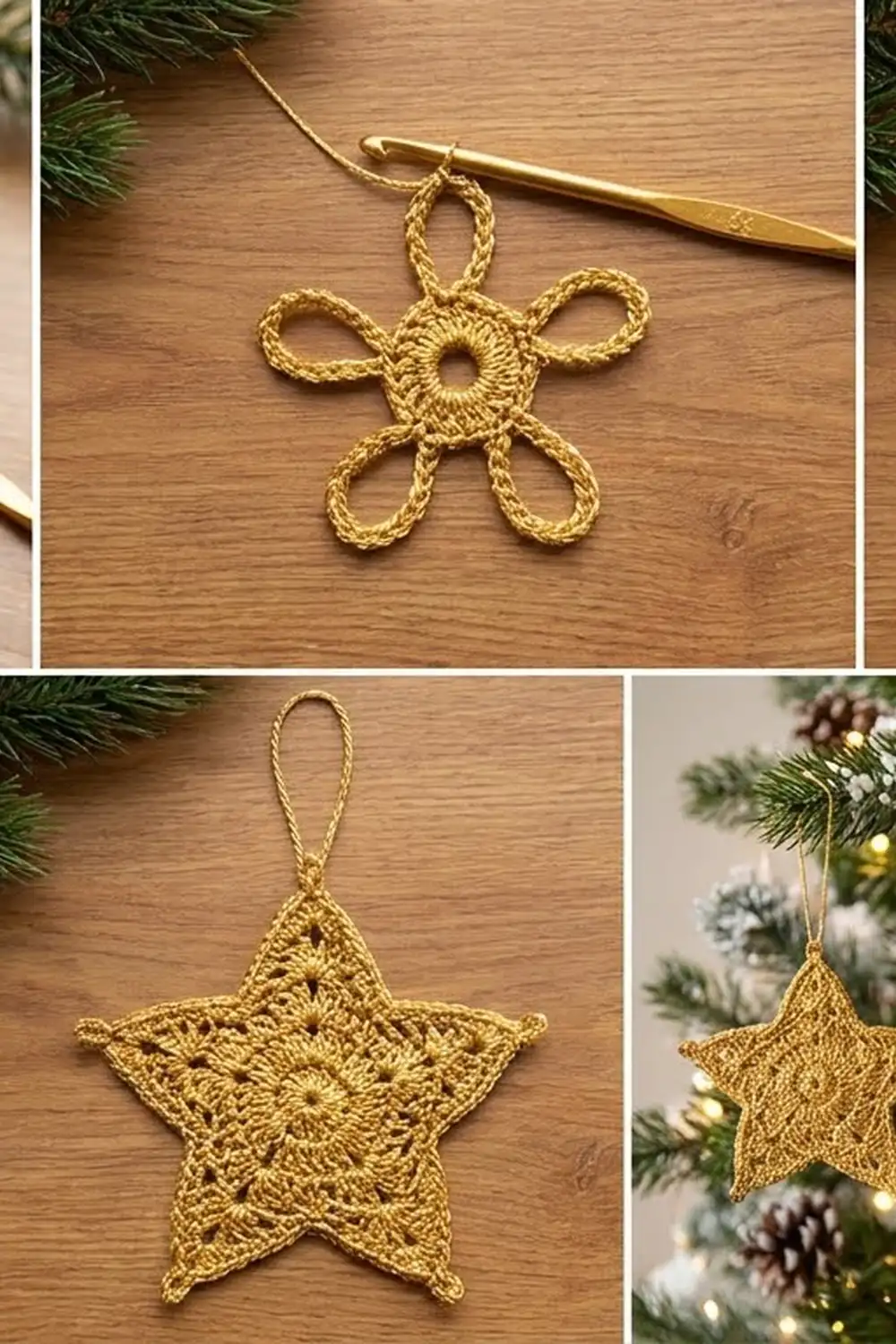
This little star is the kind of ornament that catches the tree lights from every angle. Worked in fine metallic gold thread, it has an open center ring, five lacy points built from graduated stitches, a crisp single crochet outline, and a tiny open loop at the end of each point. A long chain loop at the top makes it ready to hang.
The design looks delicate, but the construction is simple and logical. Gold is the classic choice, but the same star looks lovely in cream, soft pink, or lilac. Make a mixed set for the tree, tie one to a gift, or hang one in a window.
This pattern uses US crochet terms. The finished star measures about 3 in (7.6 cm) wide from point to point and 2.875 in (7.3 cm) tall, not counting the hanging loop. The hanging loop adds about 2 in (5.1 cm).
The star is worked in the round as one single piece. You start with a ring of double crochet, add five long chain “spoke” loops, fill each loop with a fan of stitches to form a point, and finish with a single crochet outline round. There is no sewing and no joining of separate pieces.
Finished Size and Construction
- Finished size: 3 in (7.6 cm) wide x 2.875 in (7.3 cm) tall
- Hanging loop: about 2 in (5.1 cm) long
- Skill level: Intermediate (fine thread, tall stitches into a chain loop)
- Terminology: US crochet terms
- Thread weight: Lace (0), size 10 crochet thread
- Hook: 1.75 mm (US steel 6)
- Number of pieces: 1
- Layout: single five-pointed star, worked in the round
- Piece size before outline round (after Round 3): 2.75 in (7.0 cm) wide
- Outline (border) depth: about 0.125 in (0.3 cm) on each side
Materials
Thread: Use a size 10 crochet thread with a metallic finish for the gold version. Metallic threads can be slippery, so choose one with a cotton or polyester core that holds a chain well. A plain mercerized size 10 cotton works beautifully for the pastel versions and is easier to handle if you are new to thread crochet.
- Main color, Gold: 5 g, about 25 m (27 yd) per star
- Optional colors, Cream, Pink, Lilac: 5 g, about 25 m (27 yd) each, per star
Quantities include a small margin for your gauge test, the hanging loop, and weaving in ends. One star actually uses about 4 g.
Tools:
- 1.75 mm (US steel 6) crochet hook
- Fine tapestry needle or small-eye beading needle
- Small scissors
- Blocking board or foam mat
- Rust-proof pins
- Spray starch or a fabric stiffener
- Ruler or tape measure
Abbreviations (US Terms)
- ch = chain
- sl st = slip stitch
- sc = single crochet
- sc2tog = single crochet 2 together
- hdc = half double crochet
- dc = double crochet
- tr = treble crochet
- sp = space
- st(s) = stitch(es)
- rnd = round
Special stitch, sc2tog across a valley: Insert hook in the next st, yarn over, pull up a loop (2 loops on hook). Skip the valley sl st. Insert hook in the next st, yarn over, pull up a loop (3 loops on hook). Yarn over and pull through all 3 loops. This pulls two points together and makes a sharp inner corner.
Gauge and Checkpoints
Thread crochet gauge is easiest to check in chains. With size 10 thread and a 1.75 mm hook, 12 ch = 1 in (2.5 cm). This matters because the spoke loops in Round 2 set the length of every point.
Make one test star before planning a set. Measure at each checkpoint below:
- After Round 1: the ring measures 0.75 in (1.9 cm) across.
- After Round 2: each spoke loop, laid flat, is about 1 in (2.5 cm) long from the ring to the fold. The loops are still floppy at this stage.
- After Round 3: the star measures 2.75 in (7.0 cm) wide from point to point.
- After Round 4: the star measures 3 in (7.6 cm) wide and 2.875 in (7.3 cm) tall.
If your star is too big: go down to a 1.5 mm hook, or tighten your chains. You can also shorten the spoke loops to ch 22.
If your star is too small: go up to a 2 mm hook, or lengthen the spoke loops to ch 26. Always change the spoke loops by an even number so they fold neatly.
Pattern
Round 1: Center Ring
Ch 8, sl st in first ch to form a ring.
Ch 3 (counts as first dc), work 19 dc into the ring, sl st in top of beginning ch-3 to join. (20 dc)
Keep the stitches packed tightly around the ring so the center hole stays small and round. Checkpoint: 0.75 in (1.9 cm) across.
Round 2: Spoke Loops
Ch 1, sc in same st as join, ch 24, sl st in top of the sc just made (first spoke loop made), sc in each of next 3 dc.
*Sc in next dc, ch 24, sl st in top of the sc just made, sc in each of next 3 dc. Repeat from * 3 more times.
Sl st in first sc to join. (20 sc and 5 ch-24 spoke loops)
Each repeat uses 4 dc of Round 1, and 5 repeats x 4 dc = 20 dc, so the spokes are evenly spaced around the ring. Each ch-24 loop folds into a doubled spoke about 12 ch long, or 1 in (2.5 cm).
Check that the loops are not twisted. Lay the piece flat: you should see five thin doubled spokes, evenly spaced like a flower.
Round 3: Lace Points
Sl st into the first ch-24 loop. Now work the whole point into this loop space, not into the individual chains:
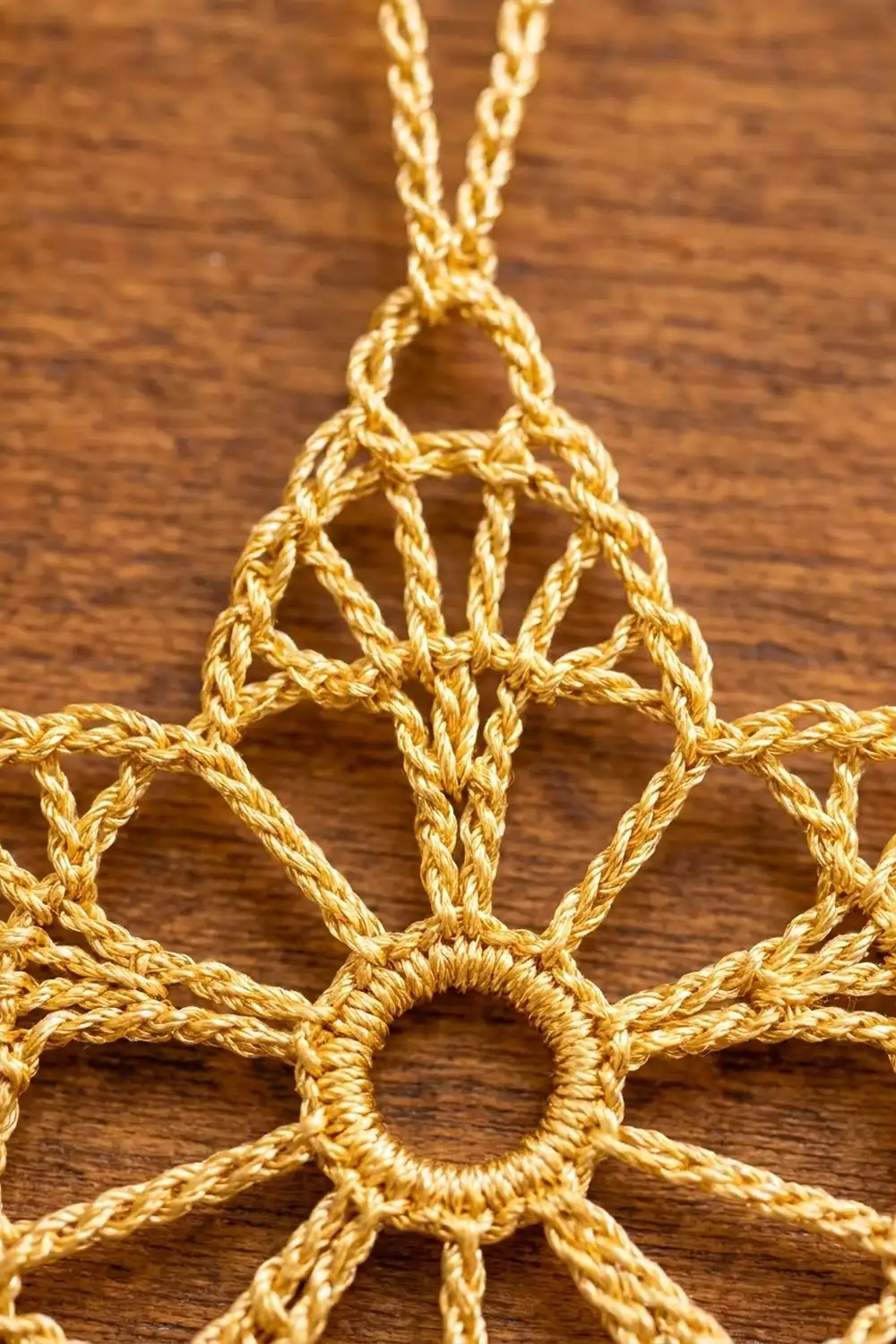
Point: (Sc, hdc, dc, [ch 1, tr] 3 times, ch 4, [tr, ch 1] 3 times, dc, hdc, sc) all into the ch-24 loop.
Push the stitches together as you go so they fan around the loop. The short stitches sit near the ring, and the tall trebles sit near the tip. The ch-4 lands right at the fold of the loop and becomes the tip of the point.
Valley: Skip the next sc of Round 2, sl st in the following sc. This is the middle of the 3 sc between spokes, and it anchors the inner corner of the star.
Work into the next ch-24 loop: Point, then Valley. Repeat until all 5 loops are filled. The last Valley sl st lands in the middle sc between the fifth and first spokes.
Round 3 count per point: 12 sts (2 sc, 2 hdc, 2 dc, 6 tr), 6 ch-1 sps, and 1 ch-4 tip sp.
Round 3 total: 60 sts, 30 ch-1 sps, 5 ch-4 tips, and 5 valley sl sts.
Checkpoint: 2.75 in (7.0 cm) wide from point to point. The points may cup slightly. That is normal and will flatten in the outline round and during blocking.
Round 4: Outline Round (Border)
This round gives the star its crisp edge, its sharp valleys, and the small open loops at the tips.
Border gauge: each edge of a point takes 10 sc over about 1.125 in (2.9 cm). The stitch count is fixed by the Round 3 stitches, so you do not need to stretch or ease anything.
Do not turn. Ch 1. Sc2tog across the valley, working the first leg into the last sc of the fifth point and the second leg into the first sc of the first point, skipping the valley sl st.
Up edge: Sc in hdc, sc in dc, (sc in ch-1 sp, sc in tr) 3 times. (8 sc)
Tip: In the ch-4 tip sp work (2 sc, ch 5, 2 sc).
Down edge: (Sc in tr, sc in ch-1 sp) 3 times, sc in dc, sc in hdc. (8 sc)
Valley: Sc2tog across the valley, working the first leg into the last sc of this point and the second leg into the first sc of the next point, skipping the valley sl st.
Repeat Up edge, Tip, Down edge, and Valley around. On the last repeat, skip the final Valley and sl st into the first sc2tog to join. Fasten off.
Round 4 count per edge: 8 sc along the edge plus the 2 sc at the tip on that side = 10 sc per edge. The 2 tip sc are already included in the 10, so they are not counted again.
Round 4 count per point: 10 sc + 10 sc + 1 sc2tog = 21 sts, plus 1 ch-5 tip loop.
Round 4 total: 5 points x 21 sts = 105 sts, plus 5 ch-5 tip loops.
Why the math works: In Round 3, each side of a point has 6 sts and 3 ch-1 sps. One sc into each of those would make 9 sc. The first sc of each side is not worked separately because it is used in a sc2tog, so 8 sc remain. Add the 2 sc at the tip and you have 10 sc per edge. Two edges plus one shared valley stitch gives 21 per point, and 5 x 21 = 105. Every point is identical, so the star stays symmetrical.
Checkpoint: 3 in (7.6 cm) wide and 2.875 in (7.3 cm) tall. The outline adds about 0.125 in (0.3 cm) on each side, so 2.75 in + 0.25 in = 3 in (7.0 cm + 0.6 cm = 7.6 cm).
Hanging Loop
Choose the top point. Join the thread with a sl st in the ch-5 tip loop of that point.
Ch 50, sl st in the same ch-5 tip loop. Fasten off.
The ch-50 loop folds to about 2 in (5.1 cm). For a longer loop, add 12 ch for every extra 0.5 in (1.3 cm) of hanging length.
Weave in all ends along the outline round, where they will hide inside the sc.
Final Blocking
Thread stars need firm blocking. Without it, the points curl and the tip loops close up.
- Lightly mist the star with water until it is just damp.
- Lay it face up on the blocking mat.
- Pin the center ring into a neat circle with 3 or 4 pins on the inside edge.
- Pin each tip by placing a pin through its ch-5 loop. Pull the points out evenly until the star is 3 in (7.6 cm) wide.
- Pin each valley so the inner corners are sharp and equal.
- Check that every edge is the same length, about 1.125 in (2.9 cm) from valley to tip.
- Spray with starch or brush on fabric stiffener.
- Let dry completely, at least 4 hours or overnight.
- Remove the pins. If the hanging loop has kinked, pin it straight for 30 minutes.
Metallic threads can lose their shine under a hot iron. Do not press them. Let the starch do the work.
Final Quality-Control Checklist
- [ ] Center ring is round and 0.75 in (1.9 cm) across.
- [ ] All 5 spokes are untwisted and evenly spaced.
- [ ] Each point has 12 sts and 6 ch-1 sps in Round 3.
- [ ] Each edge has 10 sc in Round 4.
- [ ] Round 4 totals 105 sts plus 5 ch-5 tip loops.
- [ ] All 5 valleys are sharp and equal.
- [ ] Each tip has a small open loop.
- [ ] Star is 3 in (7.6 cm) wide and 2.875 in (7.3 cm) tall.
- [ ] Hanging loop is secure and about 2 in (5.1 cm) long.
- [ ] All ends are woven in and trimmed.
Troubleshooting
The points are different lengths. One spoke loop has a different number of chains. Count each loop in Round 2 before you start Round 3.
The points are ruffled. The ch-24 loops are too short for your tension, so the stitches crowd. Go up a hook size or lengthen the loops to ch 26.
The points are floppy and gappy. The loops are too long. Use ch 22, or tighten your stitches.
The valleys are rounded. The sc2tog is missing, or you worked into the valley sl st. Skip the sl st and work both legs of the sc2tog firmly.
The center hole is large. Pull the beginning tail of Round 1 to tighten the ring before weaving it in.
Metallic thread is splitting. Use a hook with a smooth, rounded head and work a little slower. Leave 4 in (10.2 cm) tails and weave them in firmly so they do not fray.
The star curls after drying. Re-wet it, pin it again, and use a stronger stiffener.
Care
Spot clean gently with cool water and block again if needed. Store flat in a box between sheets of tissue paper so the points stay crisp from year to year.
Final Notes
Everything in this star follows one simple measurement chain. A gauge of 12 ch to 1 in (2.5 cm) gives a 0.75 in (1.9 cm) ring and 1 in (2.5 cm) spoke loops. The spokes become lace points that bring the star to 2.75 in (7.0 cm). The outline round, with 10 sc per edge and 105 sts in total, adds 0.125 in (0.3 cm) all around, so the star finishes at 3 in (7.6 cm) wide and 2.875 in (7.3 cm) tall. Check each stage, block firmly, and your star will hang flat and bright.
Make one in gold, then try cream, pink, and lilac for a full set.
Happy crocheting!