
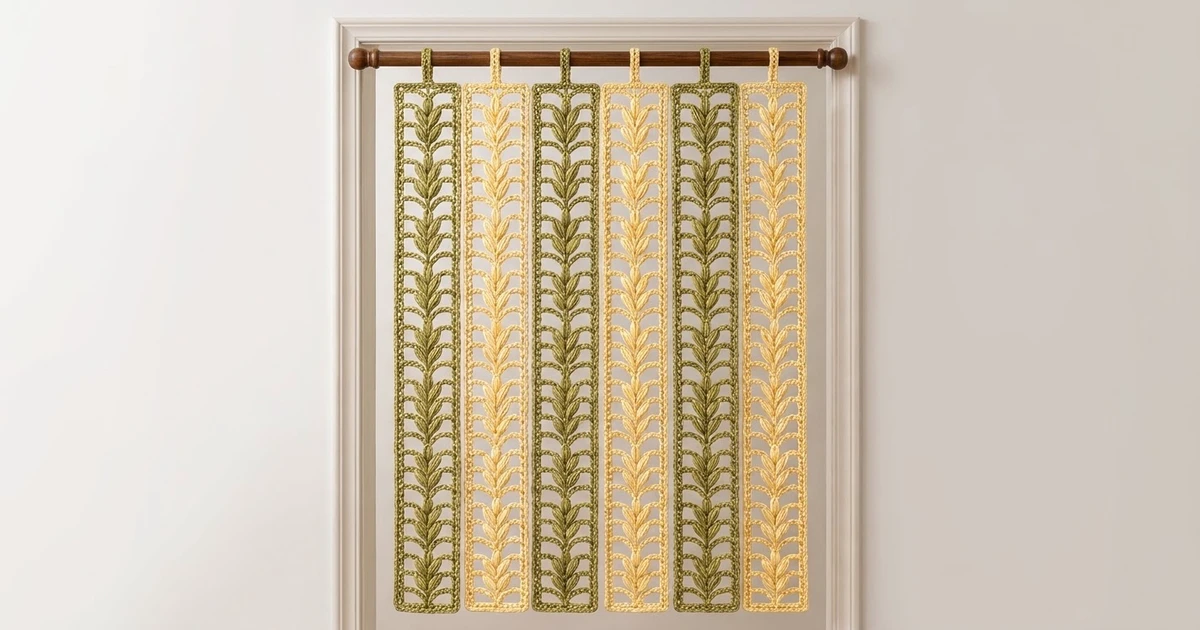
This curtain is made of six tall, airy strips. Each strip has a column of puffy leaves running up a central stem, which looks like a stalk of wheat. The strips alternate soft olive green and warm butter yellow, and each one hangs from its own loop on a rod. You can walk through the curtain easily, and it moves a little when air passes.
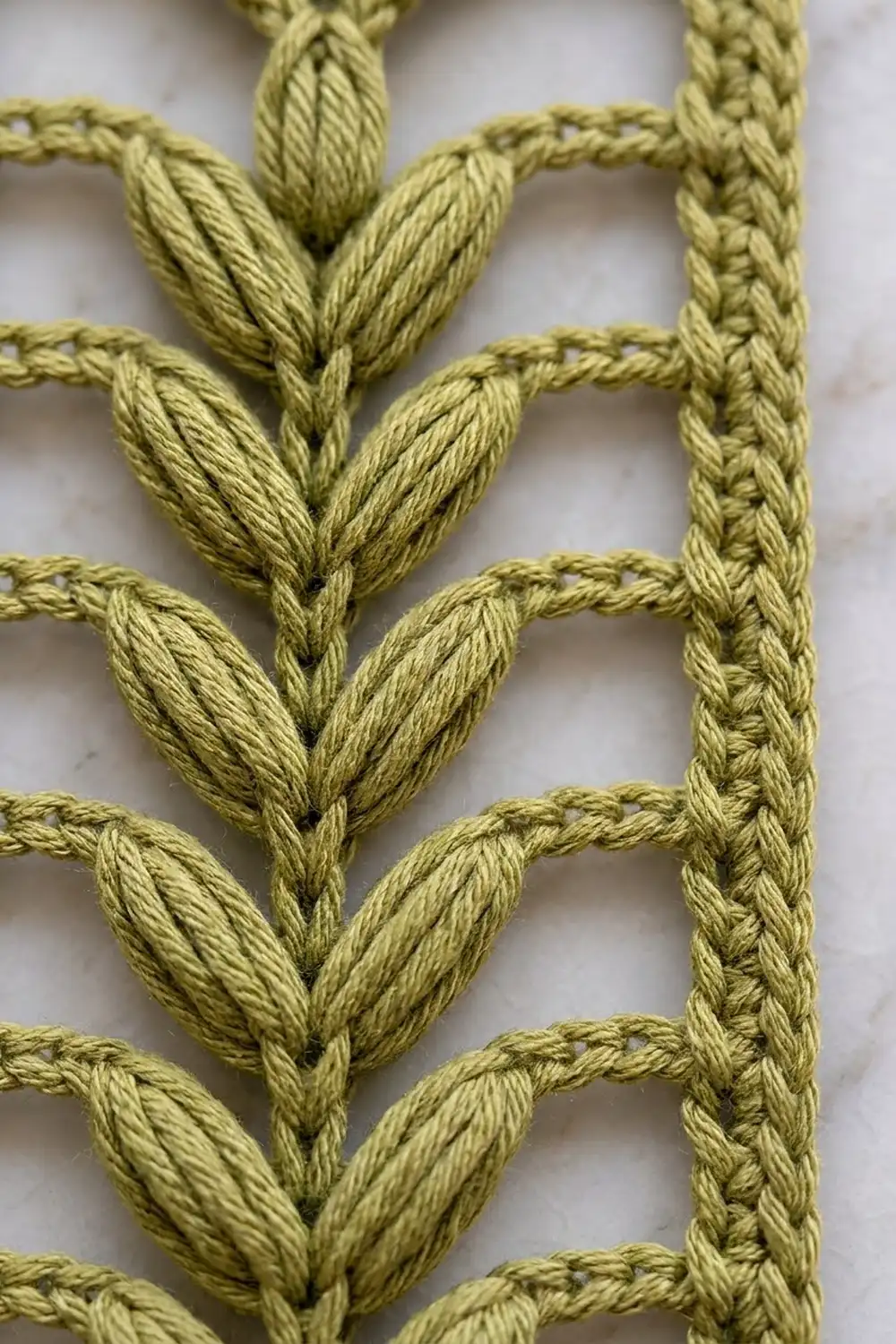
Each strip is one solid color, framed by a firm single crochet border. A narrow open ladder column runs inside each long edge, and the paired leaves lean outward from the stem to form stacked V shapes. One upright leaf finishes the top of each stalk.
This pattern uses US crochet terms. Each finished strip measures 5.75 in (14.6 cm) wide and 78 in (198.1 cm) long, not counting the hanging loop. Six strips hung edge to edge cover 34.5 in (87.6 cm), which suits a standard interior doorway.
Each strip is worked flat in rows from the bottom up. After the body, you add a two-round single crochet border and a reinforced hanging loop. The strips are never sewn together. They hang side by side on the rod.
Finished Size and Construction
- Finished strip size: 5.75 in × 78 in (14.6 cm × 198.1 cm), plus a loop of about 2 in (5.1 cm)
- Skill level: Intermediate (puff-style leaves, careful counting)
- Terminology: US crochet terms
- Yarn weight: Worsted / medium (#4), cotton or cotton blend
- Hook: 5.0 mm (US H-8)
- Number of pieces: 6 separate strips (3 olive, 3 butter yellow)
- Layout: 6 strips in one row, hung side by side, not joined
- Strip body size before border: 4.75 in × 77 in (12.1 cm × 195.6 cm)
- Border depth: 2 rounds of sc, 0.5 in (1.3 cm) on every side
- Total curtain width: 34.5 in (87.6 cm)
Materials
Yarn: Use a smooth worsted-weight cotton or cotton blend with about 200 yd (183 m) per 100 g. Cotton hangs straight, holds the puffs crisply, and resists stretching better than acrylic over a long drop. Avoid fuzzy yarns, because they blur the leaf shapes.
- Olive green: 450 g, about 900 yd (823 m), for 3 strips
- Butter yellow: 450 g, about 900 yd (823 m), for 3 strips
Each strip uses roughly 135 g. These quantities include a margin for your gauge swatch and small differences in tension.
Tools:
– 5.0 mm (US H-8) crochet hook
– Locking stitch markers (at least 4)
– Tapestry needle
– Scissors
– Measuring tape
– Blocking pins and a long blocking surface (foam mats or a clean bed)
– Spray bottle
Abbreviations (US Terms)
- ch – chain
- sl st – slip stitch
- sc – single crochet
- dc – double crochet
- sk – skip
- sp – space
- st(s) – stitch(es)
- tch – turning chain
- RS / WS – right side / wrong side
Special stitch – Leaf: (Yo, insert hook in the stated st or sp, yo, pull up a loop to about 0.75 in [1.9 cm]) 4 times; you now have 9 loops on the hook. Yo and draw through all 9 loops, then ch 1 to close. The closing ch does not count as a stitch. Each Leaf counts as 1 stitch.
Gauge and Checkpoints
Gauge: 16 dc and 8 dc rows = 4 in (10.2 cm). One dc row is 0.5 in (1.3 cm) tall.
Border gauge: 4 sc = 1 in (2.5 cm), along both the short and long edges.
Test one piece first. Before you start all six strips, work Rows 1–20 of your first strip as your gauge test. Do not fasten off. Lay it flat without stretching it and check:
- After Row 1: the width is 4.75 in (12.1 cm) across 19 dc.
- After Row 20: the length is 10 in (25.4 cm).
- Leaf check: each Leaf is about as tall as a dc and leans outward from the center stem.
If your piece is too big (wider than 4.75 in / 12.1 cm), go down to a 4.5 mm hook. If it is too small, go up to a 5.5 mm hook. Change hooks rather than tensioning harder. If the width is right but the rows are too short, pull your dc loops up a little taller. Row height decides how many leaf pairs fit in the final length.
Further checkpoints during the strip:
– Row 50: 25 in (63.5 cm)
– Row 81: 40.5 in (102.9 cm)
– Row 100: 50 in (127 cm)
– Row 154 (end of body): 77 in (195.6 cm)
Strip Pattern (Make 6)
Each strip is 19 stitches wide. The positions are:
- Position 1: edge dc
- Positions 2–3: left ladder window
- Position 4: left post
- Positions 5–15: center panel; position 10 is the stem
- Position 16: right post
- Positions 17–18: right ladder window
- Position 19: edge dc
Every ch counts as one position. Each row below must total 19.
Foundation: Ch 21.
Row 1 (RS, solid row): Dc in the 4th ch from the hook (the skipped 3 ch count as the first dc), then dc in each ch across. Turn. (19 dc)
Row 2 (mesh row): Ch 5 (this counts as dc + ch 2), sk the next 2 sts, dc in the next st (the left post). Ch 5, sk the next 5 sts, dc in the next st (the center stem). Ch 5, sk the next 5 sts, dc in the next st (the right post). Ch 2, sk the next 2 sts, dc in the top of the tch. Turn.
(5 dc + 14 ch = 19 positions)
The 5 dc are the two edges, two posts, and the stem. The 14 ch are 2 + 5 + 5 + 2.
Row 3 (leaf row): Ch 5 (this counts as dc + ch 2), dc in the left post. Ch 4, then work a Leaf in the next ch-5 sp, inserting the hook close to the stem. Dc in the center stem dc. Work a Leaf in the next ch-5 sp, again close to the stem, then ch 4. Dc in the right post, ch 2, dc in the 3rd ch of the tch. Turn.
(5 dc + 2 Leaves + 12 ch = 19 positions)
The center panel adds up to 11 positions: ch 4 + Leaf + stem dc + Leaf + ch 4. Both Leaves are worked into the side of the space next to the stem, so they hug the stem at their base and lean outward at the top. That makes one upward-pointing V.
Row 4 (mesh row): Ch 5 (counts as dc + ch 2), dc in the left post. Ch 5, sk the ch 4 and the Leaf, dc in the stem dc. Ch 5, sk the Leaf and the ch 4, dc in the right post. Ch 2, dc in the 3rd ch of the tch. Turn. (19 positions)
The ch-5 bars arch over the leaf tops. The ch-2 bars on each side become the ladder rungs.
Rows 5–151: Repeat Rows 3 and 4 in turn. Row 151 is a leaf row. Place a marker every 10 leaf rows to make counting easier.
At the end of Row 151 you have 75 leaf rows (Rows 3, 5, 7 … 151), which gives 75 leaf pairs. Each row still totals 19 positions.
Row 152 (mesh row): Work as Row 4. (19 positions)
Row 153 (tip row): Ch 5 (counts as dc + ch 2), dc in the left post. Ch 5, work a Leaf in the stem dc, then ch 5. Dc in the right post, ch 2, dc in the 3rd ch of the tch. Turn.
(1 + 2 + 1 + 5 + 1 + 5 + 1 + 2 + 1 = 19 positions)
This single Leaf stands upright and forms the tip of the stalk.
Row 154 (solid row): Ch 3 (counts as dc). Work 2 dc in the ch-2 sp, dc in the post, 5 dc in the ch-5 sp, dc in the top of the Leaf, 5 dc in the ch-5 sp, dc in the post, 2 dc in the ch-2 sp, and dc in the 3rd ch of the tch. Do not turn.
(19 dc)
Body checkpoint: 154 rows × 0.5 in = 77 in (195.6 cm) long, and 4.75 in (12.1 cm) wide.
Make All Pieces
Make 6 strips in total, each with its own border and hanging loop:
- Olive green: 3 strips (Strips 1, 3, 5)
- Butter yellow: 3 strips (Strips 2, 4, 6)
Layout from left to right on the rod:
| Strip 1 | Strip 2 | Strip 3 | Strip 4 | Strip 5 | Strip 6 |
|  OLIVE  | YELLOW  |  OLIVE  | YELLOW  |  OLIVE  | YELLOW  |
|  5.75"  |  5.75"  |  5.75"  |  5.75"  |  5.75"  |  5.75"  |
Total width: 6 × 5.75 in = 34.5 in (87.6 cm).
Joining (Hanging Method, No Seams)
The strips are not stitched together. This is what lets people walk through the curtain. Each strip hangs independently from its own loop.
Method: Slide the loops onto the rod in the order shown in the layout. Push the strips together so the long border edges just touch, with no overlap and no gap.
Stitch logic: Because nothing is joined, no stitches are added or shared between strips. The full width is simply 6 strips × 23 border stitches = 138 sc at 4 sc per inch, which is 34.5 in (87.6 cm).
Tension advice: All six strips must match in length. Hang them side by side before final blocking. If one strip is more than 0.5 in (1.3 cm) longer than the others, re-block it shorter. Don’t stretch the others to match it.
Size checkpoint: The hung curtain should measure 34.5 in (87.6 cm) wide. From the base of the loops to the hem it should be 78 in (198.1 cm).
Border
Work the border on each strip in the same color as that strip. Use the border gauge of 4 sc = 1 in (2.5 cm).
Corner definition: A corner is the middle sc of a 3-sc group. Each side count below includes both of its corner sts. The corners are shared between sides, so they are subtracted once when finding the round total.
Round 1: Continue from the end of Row 154. Ch 1 and turn the strip so you can work down the long side.
- Long side: Work 1 sc in the end of Row 154. Then work 2 sc in the end of each row from Row 153 down to Row 2 (152 rows), and 1 sc in the end of Row 1. That gives 1 + 304 + 1 = 306 sc.
- Bottom corner: Work 3 sc in the first foundation st.
- Bottom edge: Work 1 sc in each of the next 17 sts.
- Next corner: Work 3 sc in the last st.
- Second long side: Repeat the 306 sc on the other long side.
- Top edge: Work 3 sc in the first st of Row 154, 1 sc in each of the next 17 sts, and 3 sc in the last st.
Sl st to the first sc.
Per-side counts:
– Short sides: 21 sc each (1 corner + 1 + 17 + 1 + 1 corner)
– Long sides: 310 sc each (1 corner + 1 + 306 + 1 + 1 corner)
– Round total: 23 + 23 + 306 + 306 = 658 sc
You can check this with the side counts: 2 × 21 + 2 × 310 − 4 shared corners = 658.
The end rows get 1 sc instead of 2 because the corner groups already sit next to them. This keeps the corners from flaring.
Round 2: Ch 1. Sc in each sc around, working 3 sc in each corner sc. Sl st to the first sc. Do not fasten off.
Per-side counts:
– Short sides: 23 sc each
– Long sides: 312 sc each
– Round total: 658 + 8 = 666 sc (check: 2 × 23 + 2 × 312 − 4 = 666)
Why the math works: At 4 sc per inch, 23 sc = 5.75 in (14.6 cm). That matches the body width of 4.75 in plus 0.5 in of border on each side. Likewise, 312 sc = 78 in (198.1 cm), which matches the 77 in body plus 0.5 in at each end.
Hanging loop: Sl st along the top edge to its 12th sc, the center of the 23. Ch 18, then sl st into the same sc. Work 24 sc into the ch-18 loop and sl st to the base. Fasten off and weave in the end through the border.
The loop’s inner circumference is about 4.5 in (11.4 cm). It fits rods up to about 1.25 in (3.2 cm) in diameter.
Final Blocking
- Weave in all ends along the border or the ladder posts, never through the Leaves.
- Lay the strip flat on your blocking surface, RS up.
- Pin the four corners to 5.75 in × 78 in (14.6 cm × 198.1 cm).
- Pin along the long sides every 6 in (15.2 cm) so the edges are straight.
- Shape each Leaf with your fingertips so it leans outward from the stem and the V shapes are even.
- Straighten the ladder rungs so they lie horizontal.
- Mist the strip evenly until it is damp, not soaked.
- Let it dry completely before unpinning, usually 12–24 hours.
- Repeat for all six strips, checking that each matches the first.
Final Quality-Control Checklist
- Each strip is 5.75 in (14.6 cm) wide and 78 in (198.1 cm) long.
- Each strip has 75 leaf pairs plus 1 tip Leaf.
- The center stem runs straight from Row 1 to the tip.
- The ladder columns are open on both sides, with even ch-2 rungs.
- Border Round 2 has 666 sc, with 23 on each short side and 312 on each long side.
- Each hanging loop is centered on the 12th sc of the top edge.
- There are 3 olive and 3 yellow strips, alternating on the rod.
- All six strips hang to the same length.
Troubleshooting
- The strip is getting narrower: You may be skipping a ch at the post. Count 19 positions at the end of every row.
- The stem wanders sideways: Check that the stem dc is always worked into the stem dc of the row below, not into a ch.
- The Leaves stand straight instead of leaning: Insert the hook into the ch-5 space right next to the stem, not in the middle of the space.
- The Leaves look flat: Pull up taller loops, about 0.75 in (1.9 cm), before closing.
- The border ripples: You have too many sc on the long sides. Recount to 306 per side in Round 1.
- The border cups inward: You have too few sc. Use 2 sc per dc row end.
- The strips are different lengths: Re-block the longer strip to match.
Care
Hand wash in cool water with a mild detergent, or machine wash on a gentle cycle in a mesh bag. Roll the strips in a towel to remove water and dry them flat, pinning them back to size if needed.
Final Notes
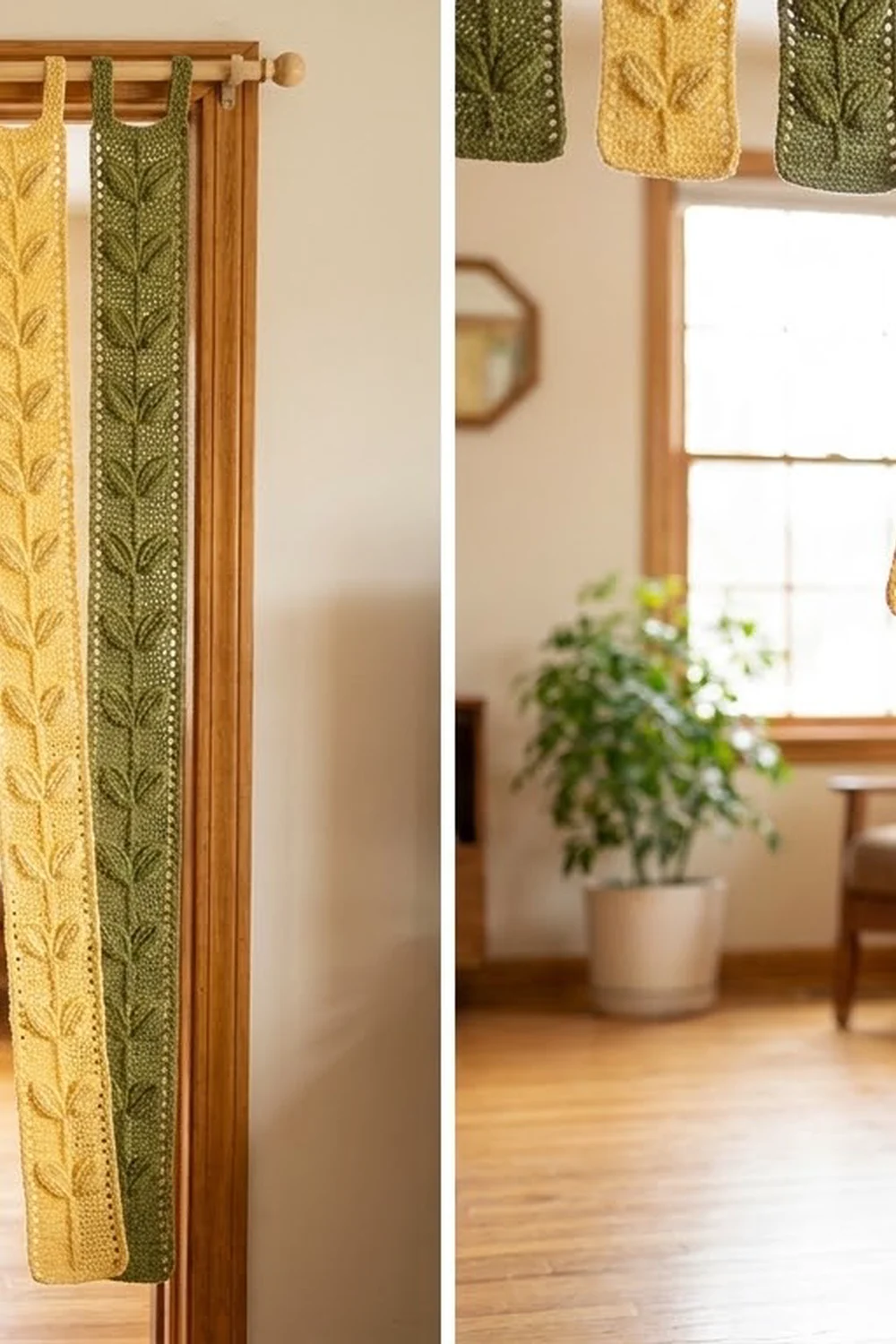
The measurement chain is simple, and every number follows from your gauge. 19 dc give a 4.75 in (12.1 cm) body width. 154 rows at 0.5 in each give 77 in (195.6 cm) of length. The two border rounds add 0.5 in (1.3 cm) on every side, bringing each strip to 5.75 in × 78 in (14.6 cm × 198.1 cm). Six unjoined strips hung side by side cover 34.5 in (87.6 cm). If you check your gauge on the first 20 rows, everything after that works out.
Happy crocheting!