

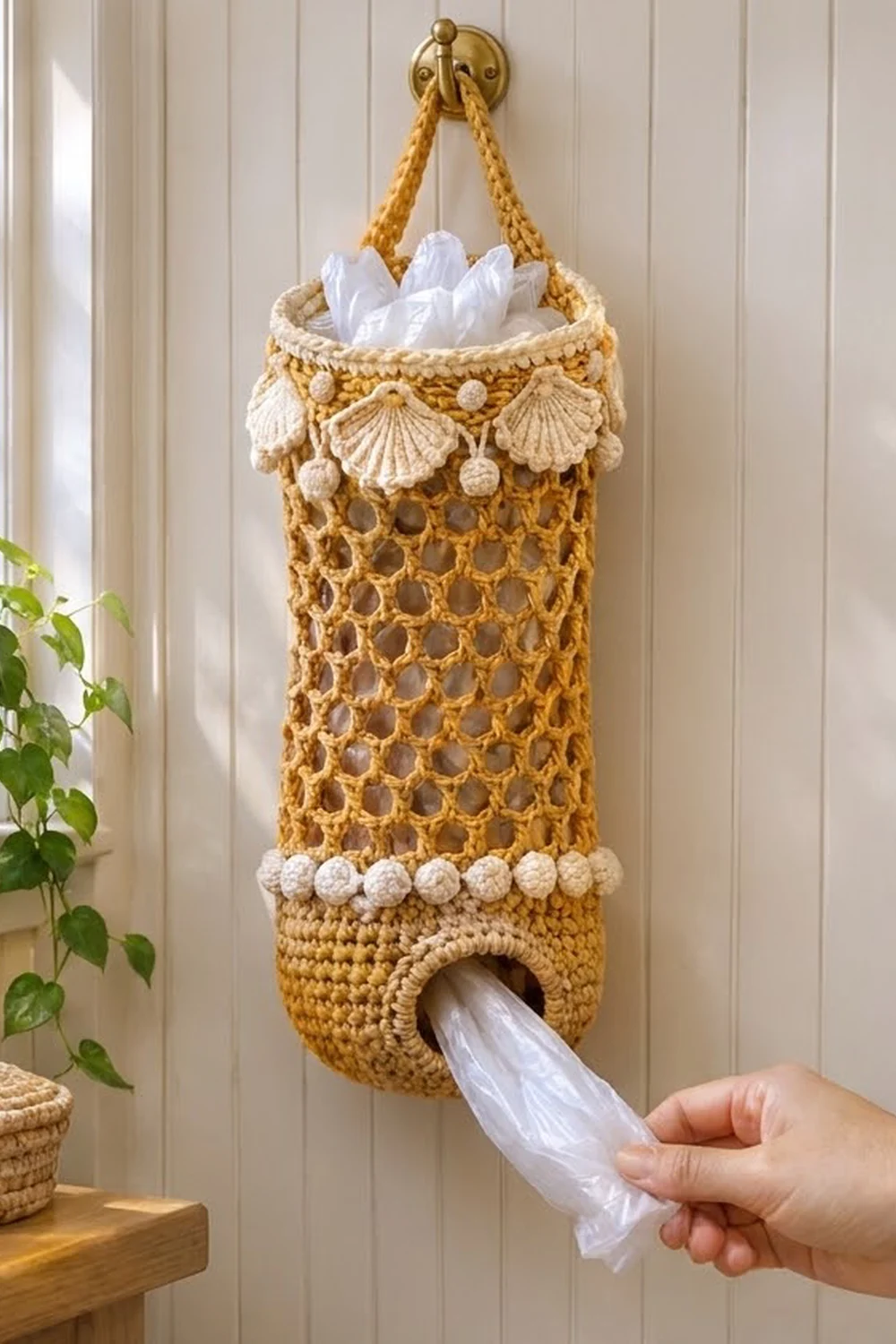
The Golden Seashell Bag Holder is a hanging tube that keeps plastic grocery bags out of sight but easy to reach. You stuff bags in at the top and pull them out, one at a time, through a round hole in the bottom.
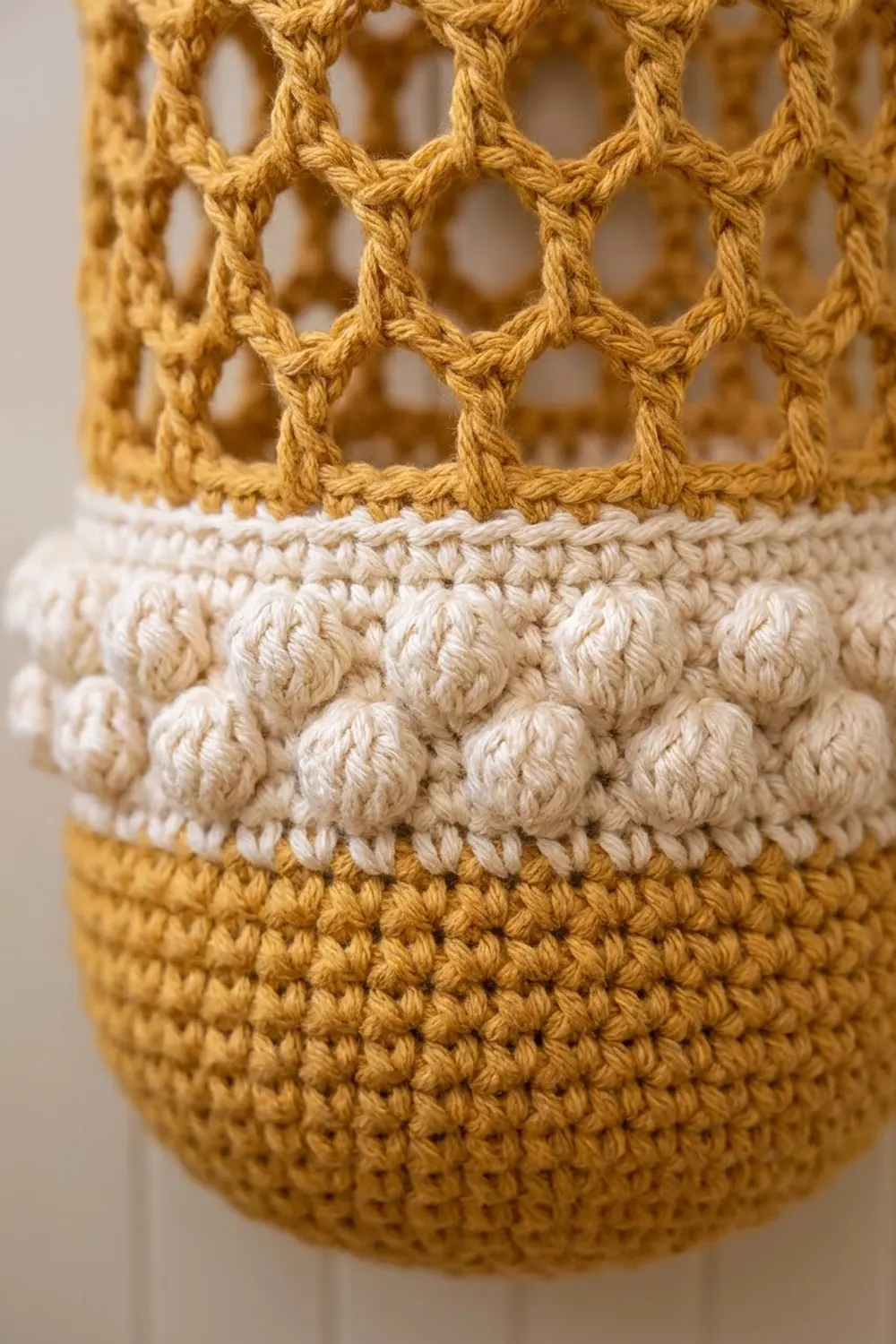
The body is warm mustard gold. Cream yarn picks out the details: a ring of popcorn bobbles above the solid base, a corded rim, six seashell appliqués, and six little balls sitting between the shells. It has a coastal, cottage look and suits a kitchen, pantry door or laundry room.
This pattern uses US crochet terms. The finished holder is about 7.5 in (19.1 cm) wide when flat and 16 in (40.6 cm) tall. With the handle, it hangs about 20 in (50.8 cm) from the hook.
You work the body in one piece from the bottom up, in joined rounds. It starts with a chain ring that becomes the dispensing hole. Then come the domed base, the popcorn band, the mesh and the rim. The handle is worked straight off the rim. Last, you make the shells and balls separately and sew them on.
Finished Size and Construction
- Finished size: 7.5 in (19.1 cm) wide flat × 16 in (40.6 cm) tall, body only
- Circumference: 15 in (38.1 cm), 60 stitches
- Skill level: Intermediate (easy) – popcorns, reverse single crochet, simple appliqués
- Terminology: US
- Yarn weight: Worsted (#4) cotton
- Hook: 5 mm (H-8)
- Number of pieces: 1 main body (handle worked on), plus 6 shell appliqués and 6 mini balls
- Layout: Single vertical tube; shells and balls alternate around the top
- Body size before rim: 15 in (38.1 cm) tall
- Rim (“border”) depth: about 1 in (2.5 cm), 4 rounds
- Handle: 1.25 in (3.2 cm) wide × 10 in (25.4 cm) long
Materials
Choose a smooth worsted-weight cotton or cotton blend, around 170 m per 100 g. Cotton holds its shape when the holder is full of bags and won’t stretch out the way acrylic does. If your yarn is thinner, the mesh will look lacier and the holder will come out smaller. Check gauge before you start.
- Mustard gold: 150 g, about 255 m (279 yd)
- Cream: 50 g, about 85 m (93 yd)
Both amounts include roughly a 15% margin for your gauge swatch and any ripping back.
Tools:
– 5 mm (H-8) crochet hook
– Tapestry needle
– 4 stitch markers
– Scissors
– A small pinch of fiberfill or cream yarn scraps to stuff the balls
– Rust-proof pins, and a cylinder about 4.75 in (12.1 cm) across for blocking (a large bottle or a rolled towel)
Abbreviations (US Terms)
- ch – chain
- sl st – slip stitch
- sc – single crochet
- hdc – half double crochet
- dc – double crochet
- inc – 2 sc in the same stitch
- sc2tog – single crochet 2 together
- sk – skip
- sp – space
- rev sc – reverse single crochet (crab stitch): work sc from left to right (right-handed)
- st(s) – stitch(es)
Popcorn (pc): Work 5 dc in the same stitch. Take the hook out of the loop. Put the hook from front to back through the top of the first dc, catch the dropped loop and pull it through. Ch 1 to lock. A popcorn counts as 1 stitch, and it pops toward you, onto the right side.
Gauge and Checkpoints
Gauge: 16 sc × 18 rounds = 4 in (10.2 cm) in sc worked in rounds.
Mesh gauge: 2 mesh rounds = 1 in (2.5 cm) tall, relaxed. Each ch-5 loop spans about 1.25 in (3.2 cm) around the tube.
Before you start the holder, make one test piece: the base, Rounds 1 to 8. It takes only a few minutes, and it shows you both your gauge and how the dome forms. Then check:
- After Round 1: the ring measures 9 in (22.9 cm) around, which gives a hole about 3 in (7.6 cm) across.
- After Round 5: 60 sts. Laid flat, the piece is about 7.5 in (19.1 cm) wide.
- After Round 18: the base is 4 in (10.2 cm) tall.
- After Round 21: the body is 5 in (12.7 cm) tall.
- After Round 41: the body is 15 in (38.1 cm) tall.
- After Round 45: the body is 16 in (40.6 cm) tall.
Too big? Go down to a 4.5 mm hook. Too small? Go up to a 5.5 mm hook. Keep the stitch counts as written. They are what make the shells line up.
Pattern
Join every round with a sl st to the first st. Turning chains do not count as stitches unless the pattern says so. Keep the right side facing out and do not turn.
Base (Mustard)
Foundation: Ch 36. Without twisting the chain, sl st into the first ch to make a ring.
Rnd 1: Ch 1, sc in each ch around. (36 sts)
Rnd 2: Ch 1, (sc 5, inc) 6 times. (42 sts)
Rnd 3: Ch 1, (sc 6, inc) 6 times. (48 sts)
Rnd 4: Ch 1, (sc 7, inc) 6 times. (54 sts)
Rnd 5: Ch 1, (sc 8, inc) 6 times. (60 sts)
You only add 6 stitches per round, which is fewer than a flat circle needs. That shortfall is what makes the base cup upward into a dome, leaving the hole in the middle of the bottom.
Rnds 6–18: Ch 1, sc in each st around. (60 sts)
Checkpoint: the base is 4 in (10.2 cm) tall and 7.5 in (19.1 cm) wide when flat. On the last sl st of Rnd 18, change to cream.
Hole edge: Turn the base upside down and join mustard in any free loop of the foundation chain. Ch 1, then sc in each free loop around. Join. (36 sts) Fasten off. This round firms up the hole so it doesn’t stretch when you pull bags out.
Popcorn Band (Cream)
Rnd 19: Ch 1, sc in each st around. (60 sts)
Rnd 20: Ch 1, (pc in next st, sc in next 2 sts) 20 times. (60 sts: 20 popcorns + 40 sc)
Rnd 21: Ch 1, sc in each st around. Work the sc into the top of each popcorn, not into its locking chain. (60 sts) On the last sl st, change to mustard. Leave cream attached inside the tube or fasten it off.
The popcorns sit 3 sts apart, which is about 0.75 in (1.9 cm). Checkpoint: the body is 5 in (12.7 cm) tall.
Honeycomb Mesh (Mustard)
Rnd 22: Ch 1, sc in the first st. (Ch 5, sk 4, sc in next st) 11 times. Ch 5, sk the last 4 sts, then sl st to the first sc. (12 sc + 12 ch-5 loops)
Rnds 23–41: Sl st in each of the next 2 ch, then sl st into the ch-5 loop. Ch 1, sc in the same loop. (Ch 5, sc in next loop) 11 times. Ch 5, sl st to the first sc. (12 sc + 12 ch-5 loops)
Each new sc sits in the middle of a loop from the round below, so the openings offset and form the honeycomb. The sl sts keep the start of the round from drifting. Count your loops at the end of every round. If you have 11 or 13, the tube will narrow or flare.
Checkpoint: 20 mesh rounds measure 10 in (25.4 cm), and the body is 15 in (38.1 cm) tall. On the last sl st of Rnd 41, change to cream.
Handle (Mustard)
You’ll work the handle after the rim (see Border below). The handle starts on rev sc 1–5 and is sewn to rev sc 31–35. Those two spots are directly opposite each other, at the two sides of the holder.
Row 1: Join mustard in rev sc 1. Ch 1, then sc in the same st and the next 4 sts. (5 sts)
Rows 2–45: Ch 1, turn, sc in each st across. (5 sts)
The handle is 10 in (25.4 cm) long and 1.25 in (3.2 cm) wide. Fasten off, leaving a 12 in (30.5 cm) tail. Without twisting the strap, whipstitch Row 45 to the inside of rev sc 31–35. The strap is 10 in long and spans a tube about 4.75 in (12.1 cm) across, so it rises about 4.4 in (11.2 cm) above the rim. That’s enough room for a wall hook.
Shell Appliqué (Cream, make 6)
Row 1: Magic ring. Ch 3 (counts as dc), then 6 dc in the ring. Pull the ring snug but leave it open in a fan shape. Turn. (7 dc)
Row 2: Ch 3 (counts as dc), dc in the same st. (Ch 1, 2 dc in next dc) 6 times. Turn. (14 dc in 7 pairs + 6 ch-1 sps)
Row 3: Ch 1. (Sc, hdc) in the next dc, (hdc, sc) in the next dc, sl st in the next ch-1 sp. Repeat from * to * 5 more times. Then (sc, hdc) in the next dc and (hdc, sc) in the last dc. (7 scallops of 4 sts + 6 sl sts = 34 sts)
Each sl st pulls the edge into a dip right above a ch-1 gap, so you get ribs that fan out from the ring and a scalloped edge. Fasten off and leave a 10 in (25.4 cm) tail for sewing. Each shell measures 2 in (5.1 cm) wide by 1.5 in (3.8 cm) tall.
Mini Ball (Cream, make 6)
Rnd 1: Magic ring, 6 sc in ring. (6 sts)
Rnd 2: 2 sc in each st. (12 sts)
Rnd 3: Sc in each st. (12 sts)
Rnd 4: (Sc2tog) 6 times. (6 sts)
Stuff with a pinch of fiberfill or yarn scraps. Thread the tail through the front loops, pull the opening closed, and leave the tail long enough to sew with. Each ball is 0.75 in (1.9 cm) across.
Border (Rim, Cream)
Border gauge: the same as the base, 16 sc = 4 in (10.2 cm) and about 4.5 rounds = 1 in (2.5 cm).
Rnd 42 (conversion round): Ch 1. Sc in the anchoring sc, then 4 sc in the next ch-5 loop. Repeat from * around. (12 sc worked 1-per-existing-stitch + 48 sc added in loops = 60 sts)
Rnds 43–44: Ch 1, sc in each st around. (60 sts)
Rnd 45: Ch 1, rev sc in each st around. (60 sts) Fasten off.
Why the math works: The base has 60 sts and is 7.5 in (19.1 cm) wide flat. Mesh loops tend to pull in a little, so the rim brings the count back to exactly 60. That makes the top as wide as the bottom: 30 sts across the front and 30 across the back, which is 7.5 in (19.1 cm) when flat. Six shells divide 60 sts evenly, so each shell gets a 10-st section, or 2.5 in (6.4 cm). A 2 in (5.1 cm) shell in each section leaves a 0.5 in (1.3 cm) gap for a ball.
Now work the handle as described above.
Placing the appliqués: Put markers at sts 8, 18, 28, 38, 48 and 58 of Rnd 42. Center one shell under each marker, scalloped edge up against the lower edge of Rnd 42 and the ring end pointing down over the mesh. Sew around the scalloped edge into Rnd 42, then tack the ring end to a mesh strand. Sew one ball into each gap at sts 3, 13, 23, 33, 43 and 53, 0.5 in (1.3 cm) below the rim. The balls at sts 3 and 33 sit directly under the two ends of the handle.
Final Blocking
- Weave in all the ends, working each one along a solid sc round, not through the mesh.
- Spritz the holder with water until it is damp, not soaking.
- Slide it over a cylinder about 4.75 in (12.1 cm) across.
- Pull the mesh gently lengthwise until it measures 10 in (25.4 cm) and the honeycomb openings look even.
- Pin the rim so it stays round, and press each shell flat with your fingers.
- Leave it to dry completely, at least 24 hours.
- Check the measurements again: 16 in (40.6 cm) tall and 7.5 in (19.1 cm) wide flat.
Final Quality-Control Checklist
- The hole is about 3 in (7.6 cm) across and has a firm sc edge.
- The base has 60 sts and is 4 in (10.2 cm) tall.
- All 20 popcorns stand out on the right side.
- Every mesh round has 12 loops, and the openings are even.
- The rim has 60 sts and the rev sc edge is smooth.
- The handle is 10 in (25.4 cm) long, not twisted, and attached at opposite sides.
- The shells are evenly spaced at 10-st intervals and their scalloped edges sit against the rim.
- All 6 balls are firmly sewn on.
Troubleshooting
- The base is flat and not domed: Your stitches are too loose. Go down a hook size, or work Rounds 6–8 more tightly.
- The popcorns pop inside the tube: You inserted the hook from back to front during the closing step. It needs to go front to back.
- The mesh is spiraling: Make sure each round starts with the 2 sl sts and that each sc lands in the center of its loop.
- The tube flares at the top: Count your loops. You probably have 13. Rip back to the round where the count changed.
- The handle is stretching: Use a smaller hook for the handle, or add a row of sl st down each long edge.
- Bags fall out on their own: Work a second sc round around the hole to make it smaller.
Care
Hand wash in cool water and lay flat to dry, reshaping it over your blocking cylinder. Avoid hot tumble drying, which can shrink the cotton and flatten the popcorns.
Final Notes
All the measurements build on each other. A 9 in (22.9 cm) starting ring grows to a 60-st, 15 in (38.1 cm) tube. Then the 4 in (10.2 cm) base, the 1 in (2.5 cm) popcorn band, the 10 in (25.4 cm) mesh and the 1 in (2.5 cm) rim add up to 16 in (40.6 cm). The 10 in (25.4 cm) handle hangs it about 20 in (50.8 cm) from the hook. Keep 60 sts at the rim and 12 loops in the mesh, and your shells will space out evenly every time.
Happy crocheting!