

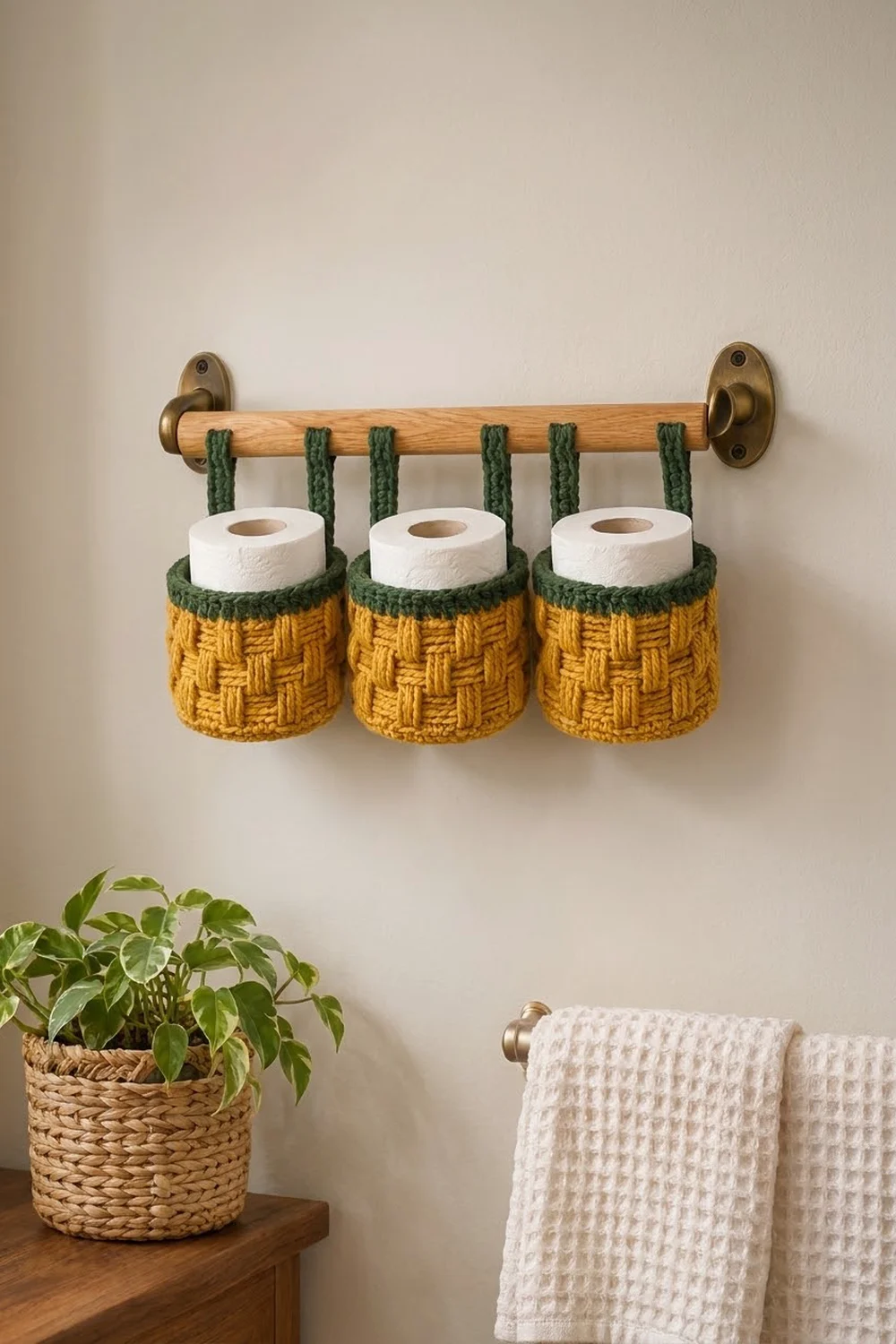
The Golden Weave Hanging Basket Set is three small round baskets with a basketweave texture. Each basket hangs from a wooden rod on two loop straps. The body is warm mustard yellow, and the forest-green rim and straps add a clean, earthy contrast.
The baskets are sized to hold a standard toilet paper roll, so they suit a bathroom wall. They also work well for washcloths, cotton pads, or small craft supplies. The texture comes from blocks of front post and back post double crochet that switch every two rounds.
This pattern uses US crochet terms. Each finished basket is about 5.5 in (14.0 cm) across and 4.25 in (10.8 cm) tall. Each strap is 10 in (25.4 cm) long before folding.
The construction is simple:
– Work a flat double crochet circle for the base.
– Turn the wall up with a back-loop round.
– Work the basketweave wall in joined rounds.
– Finish with a green rim.
The straps are short single crochet strips. You fold and seam each one into a teardrop loop, then sew it inside the rim.
Finished Size and Construction
- Finished basket size: 5.5 in (14.0 cm) diameter x 4.25 in (10.8 cm) tall
- Skill level: Intermediate (post stitches in the round)
- Terminology: US
- Yarn weight: Worsted (#4)
- Hook: 4.5 mm (US 7)
- Number of pieces: 9 (3 baskets and 6 straps), made separately
- Layout: 3 baskets side by side on one rod, 2 straps per basket
- Base size: 5.5 in (14.0 cm) diameter, 60 stitches
- Size before rim: 5.5 in (14.0 cm) diameter x 3.5 in (8.9 cm) tall
- Rim depth: 0.75 in (1.9 cm), 3 rounds
Materials
Choose a smooth, firm worsted weight yarn. Cotton or a cotton blend holds its shape best and stands up to a humid bathroom. Acrylic also works, but it gives a softer wall. Avoid fuzzy or brushed yarns, which blur the basketweave blocks. Use a tightly plied yarn so your hook doesn’t split it when you work around the posts.
- Mustard yellow (Color A): 160 g / 290 m
- Forest green (Color B): 75 g / 135 m
These amounts include a margin of about 15 percent. They assume a yarn of about 183 m per 100 g.
Tools:
- 4.5 mm (US 7) crochet hook
- Yarn needle
- 4 stitch markers
- Measuring tape
- Scissors
- Blocking pins and a spray bottle
- Optional: a wooden dowel 20–24 in (50.8–61.0 cm) long and up to 1 in (2.5 cm) thick, plus 2 wall brackets
Abbreviations (US Terms)
- ch: chain
- sl st: slip stitch
- sc: single crochet
- dc: double crochet
- BLO: back loop only
- FPdc: front post double crochet
- BPdc: back post double crochet
- rev sc: reverse single crochet (crab stitch)
- st(s): stitch(es)
- rep: repeat
Special stitches:
- FPdc: Yarn over. Insert the hook from front to back to front around the post of the stitch below. Yarn over and pull up a loop, then (yarn over, pull through 2) twice.
- BPdc: Yarn over. Insert the hook from back to front to back around the post of the stitch below, then finish as a dc.
- Rev sc: Work from left to right. Insert the hook into the next stitch to the right, pull up a loop, then yarn over and pull through both loops.
Round notes: The ch 2 at the start of a dc or post round does not count as a stitch. Join every round with a sl st to the first real stitch. Place a marker in the first stitch of each round.
Gauge and Checkpoints
- Dc gauge: 14 dc and 8 rounds = 4 in (10.2 cm)
- Sc gauge (straps): 16 sc and 18 rows = 4 in (10.2 cm)
Make one complete basket before you start the others. Its measurements tell you whether the set will fit a toilet paper roll.
Checkpoints:
- After base Round 3 (36 sts), the base is about 3.25 in (8.3 cm) across.
- After base Round 5 (60 sts), the base is 5.5 in (14.0 cm) across when it lies flat.
- After wall Round 12, the wall is 3.5 in (8.9 cm) tall from the fold ridge to the top edge.
- After the rim, the basket is 4.25 in (10.8 cm) tall in total.
If the base is larger than 5.5 in (14.0 cm), go down one hook size. If it’s smaller, go up one hook size. If the base cups or ruffles, the cause is tension, not size, so fix that before you go on. Stay within 0.25 in (0.6 cm) of each checkpoint.

Basket Base (make 3, Color A)
Round 1: Magic ring, ch 2, 12 dc in ring. Join. (12 sts)
Round 2: Ch 2, 2 dc in each st around. Join. (24 sts)
Round 3: Ch 2, dc in next st, 2 dc in next st, rep 12 times. Join. (36 sts)
Round 4: Ch 2, dc in next 2 sts, 2 dc in next st, rep 12 times. Join. (48 sts)
Round 5: Ch 2, dc in next 3 sts, 2 dc in next st, rep 12 times. Join. (60 sts)
Lay the base flat and check that it’s 5.5 in (14.0 cm) across. Don’t fasten off.
Basket Wall (Color A)
Round 6 (turning round): Ch 2, dc in BLO of each st around. Join. (60 sts)
The unused front loops form a ridge on the outside, and the wall starts to rise. This round also gives you tall dc posts for the first weave round. The wall may look loose for a round or two. It firms up once the post stitches build up.
Round 7: Ch 2, FPdc around next 3 sts, BPdc around next 3 sts, rep 10 times. Join. (60 sts: 30 FPdc, 30 BPdc)
Round 8: Ch 2, FPdc around next 3 sts, BPdc around next 3 sts, rep 10 times. Join. (60 sts)
Each FPdc sits on an FPdc, and each BPdc sits on a BPdc. This completes the first tier of 20 blocks: 10 raised and 10 recessed.
Round 9: Ch 2, BPdc around next 3 sts, FPdc around next 3 sts, rep 10 times. Join. (60 sts)
Round 10: Ch 2, BPdc around next 3 sts, FPdc around next 3 sts, rep 10 times. Join. (60 sts)
The blocks have now switched, so raised blocks sit above recessed ones. This creates the woven look.
Round 11: Rep Round 7. (60 sts)
Round 12: Rep Round 8. (60 sts)
You now have 3 tiers of blocks. Check that the wall is 3.5 in (8.9 cm) from the ridge to the top edge. Fasten off Color A.
Because 60 divides evenly into 10 repeats of 6, the pattern lines up at the join. There’s no half-block and no visible jog.
Make All Pieces
Totals:
- Baskets: 3 (Color A body, Color B rim)
- Straps: 6 (Color B), 2 per basket
Layout on the rod (front view):
  ===========================================  rod
     |    |         |    |         |    |      straps
   [Basket 1]     [Basket 2]     [Basket 3]
Leave about 0.5 in (1.3 cm) between baskets. Three baskets plus the gaps need about 18 in (45.7 cm) of rod between the brackets.
Rim (Border, Color B)
The rim works like a border. It firms up the top edge and frames the weave.
Rim gauge: 3 rounds of sc and rev sc = 0.75 in (1.9 cm) deep.
Join Color B with a sl st in any st of Round 12.
Round 13: Ch 1, sc in each st around. Join. (60 sts)
Round 14: Ch 1, sc in each st around. Join. (60 sts)
Round 15: Ch 1, rev sc in each st around. Join. (60 sts) Fasten off and weave in the ends.
Why the math works: Each rim round puts 1 stitch into each existing stitch, with no increases or decreases. The rim keeps the wall’s 60 stitches, so the top stays 5.5 in (14.0 cm) wide, the same as the base. It won’t flare or pull in. Sc is shorter and firmer than post stitches, so the rim tightens the top edge slightly. That helps the basket keep its round shape when it hangs.
Check that the total height is 4.25 in (10.8 cm).
Straps (make 6, Color B)
Foundation: Ch 4.
Row 1: Sc in 2nd ch from hook and in each ch across. (3 sts)
Rows 2–45: Ch 1, turn, sc in each st across. (3 sts)
Fasten off, leaving a 12 in (30.5 cm) tail.
The strip should be 0.75 in (1.9 cm) wide and 10 in (25.4 cm) long. If it’s short or long, add or remove rows in pairs. Keep all 6 straps the same length so the baskets hang level.
Forming the loop: Fold the strip in half so the two short ends meet. It now measures 5 in (12.7 cm). Use the tail to whipstitch the two layers together along both long edges. Start at the ends and sew 2.5 in (6.4 cm) toward the fold. This makes a solid stem. The upper 2.5 in (6.4 cm) stays open as a teardrop loop that slides over the rod.
Joining Straps to Baskets
The baskets aren’t joined to each other. Each basket is joined only to its own 2 straps.
Placement: Count the 60 sts around the rim, then mark st 1 and st 31. These two points are directly opposite each other, with 30 sts on each side, so the basket hangs evenly.
Method:
1. Slide the stem of one strap inside the basket at st 1, so that 1 in (2.5 cm) of the stem overlaps the inner wall. This leaves 1.5 in (3.8 cm) of stem and the 2.5 in (6.4 cm) loop above the rim.
2. With Color B and a yarn needle, whipstitch the stem to the inner wall. Work through the back bumps of rim Rounds 13 and 14 and the top of Round 12, catching 3 stitches across each row to match the strap’s 3-st width.
3. Stitch across the bottom of the stem.
4. Repeat at st 31.
Tension: Pull each stitch snug but not tight. If it’s too tight, the rim dimples. If it’s too loose, the strap tilts forward under weight. Keep your stitches on the inside so they don’t show between the post blocks.
Size checkpoint: Hang the basket from one finger by both loops. The rim should sit level, and the top of each loop should be 4 in (10.2 cm) above the rim.
Final Blocking
- Mist each basket lightly with water until it’s damp but not soaked.
- Fill the basket firmly with a toilet paper roll wrapped in a plastic bag, or with a jar about 5.5 in (14.0 cm) wide.
- Press the base flat on a table and push the turning ridge out evenly.
- Shape the rim into a true circle with your fingers. Check that it measures 5.5 in (14.0 cm) across all the way around.
- Pin the straps flat on a towel, with the loops open and the stems straight.
- Let everything dry completely, for at least 24 hours, before you hang it.
Final Quality-Control Checklist
- Each base lies flat and measures 5.5 in (14.0 cm).
- Every round from Round 5 on has exactly 60 sts.
- The basketweave blocks alternate cleanly in 3 tiers, with no jog at the join.
- Each basket is 4.25 in (10.8 cm) tall with a 0.75 in (1.9 cm) green rim.
- All 6 straps are 10 in (25.4 cm) long before folding.
- The straps sit exactly opposite each other at sts 1 and 31.
- All 3 baskets hang at the same height.
- All ends are woven in on the inside.
Troubleshooting
The base cups: Your tension is tight or your stitch count is short. Recount, or go up one hook size.
The base ruffles: You have extra stitches or loose tension. Recount, or go down one hook size.
The blocks slant: You may be working into the ch 2. Skip it and work the first post st into the first st.
There’s a gap at the join: Pull the ch 2 snug, and put the sl st into the top of the first real stitch, not into the chain.
The wall is floppy: Your gauge is loose. Go down one hook size, or hold a strand of thread together with the yarn.
The rim flares: Your rev sc is too loose. Work that round with a smaller hook.
The baskets hang crooked: The straps are uneven or off-center. Check that they’re at sts 1 and 31 and that both stems overlap the wall by the same amount.
The loop is too tight for the rod: Seam only 2 in (5.1 cm) of the stem instead of 2.5 in (6.4 cm).
Care
Hand wash in cool water with mild soap and press out the water in a towel. Reshape each basket over a roll or jar to dry, and don’t tumble dry.
Final Notes
The measurements build on each other in a short chain that’s easy to check:
– The 60-stitch base measures 5.5 in (14.0 cm) across.
– The wall keeps those 60 stitches and rises to 3.5 in (8.9 cm).
– The 60-stitch rim brings the total height to 4.25 in (10.8 cm).
– Two 10 in (25.4 cm) straps, folded into 2.5 in (6.4 cm) loops, hang each basket from the rod.
Check each step against these numbers, and your three baskets will match and hang level.
Happy crocheting!