

This curtain panel pairs an airy filet mesh body with a crisp charcoal Greek key border. The open squares let daylight through. The solid tapestry band at the hem gives the panel weight, so it hangs straight and falls in soft vertical folds.
The panel uses two colors. Cream is for the mesh, header, and tabs. Charcoal is for the bottom edge, the key motif, and one narrow accent stripe. The look is calm and architectural and suits a minimal room with plaster walls and natural stone.
All terms are US crochet terms. One finished panel measures about 48 in (121.9 cm) wide after the side edging. It is 82.5 in (209.6 cm) long from the hem to the top of the header, and the tab loops add about 2.75 in (7.0 cm) above that.
The panel is a single piece worked from the bottom up. You start with the tapestry single crochet band and work filet mesh rows straight up from its last row. Then you finish with a solid header, crochet the tabs directly off the header, and add one row of side edging. For a pair, make two identical panels.
Finished Size and Construction
- Finished size: 48 in (121.9 cm) wide x 82.5 in (209.6 cm) long, plus tab loops
- Skill level: Intermediate (tapestry crochet, long repetitive rows)
- Terminology: US
- Yarn weight: Worsted (#4) cotton
- Hook: 5.5 mm (I-9)
- Number of pieces: 1 per panel (tabs worked onto the panel)
- Layout: band at bottom, mesh body, header and tabs at top
- Piece size before edging: 47.5 in (120.7 cm) x 82.5 in (209.6 cm)
- Border depth: about 0.25 in (0.6 cm) on each long side
Materials
Choose a smooth mercerized or combed cotton in worsted weight, about 160 m per 100 g. Cotton gives crisp mesh squares and stretches less than acrylic in a long hanging piece. Buy all of each color from the same dye lot.
Per panel:
- Cream: 700 g (1,120 m)
- Charcoal: 75 g (120 m)
Double these amounts for a pair. Quantities include a margin of roughly 10% for swatching and differences in tension.
Tools:
- 5.5 mm (I-9) crochet hook
- Tapestry needle
- Stitch markers (at least 10)
- Measuring tape
- Rust-proof pins and a large blocking surface (a bed or a clean floor covered with towels)
- Spray bottle
Abbreviations (US Terms)
- ch – chain
- sc – single crochet
- dc – double crochet
- sk – skip
- sp – space
- st(s) – stitch(es)
- RS / WS – right side / wrong side
- C – cream
- D – charcoal (dark)
Tapestry sc: Work sc while laying the unused color along the top of the previous row and enclosing it inside each stitch. To change color, work the last stitch in the old color until 2 loops remain. Then yarn over with the new color and pull through both loops. Keep the carried strand relaxed so the band does not pull in.
Gauge and Checkpoints
Gauge: 15 sc and 16 rows = 4 in (10.2 cm) in tapestry sc. Filet mesh: 5 squares and 5 rows = 4 in (10.2 cm), so each square is 0.8 in (2.0 cm) wide and tall.
The two gauges are designed to match. One mesh square uses 3 sts of width, and 3 sts at 15 sc per 4 in equals 0.8 in. This keeps the mesh the same width as the band.
Test one piece first. Ch 17, then sc in the 2nd ch from hook and in each ch across (16 sc). Work 15 more rows of sc, carrying a second strand in rows 6–13 as you will in the band. Then work 5 rows of mesh (5 squares) as in the Mesh Body section. The swatch should be 4.25 in (10.8 cm) wide, with a 4 in (10.2 cm) sc section and a 4 in (10.2 cm) mesh section.
Checkpoints on the panel:
- After the band (Row 20): 47.5 in (120.7 cm) wide, 5 in (12.7 cm) tall
- After 10 mesh rows: mesh section 8 in (20.3 cm) tall, width unchanged
- After 50 mesh rows: mesh section 40 in (101.6 cm)
- After 95 mesh rows: mesh section 76 in (193.0 cm)
- After the header: total 82.5 in (209.6 cm)
If your swatch is too big, go down half a hook size. If it is too small, go up half a size. If only the mesh is off, change the height of your dc instead of the hook by pulling up a slightly taller or shorter first loop. Measure the panel lying flat, not hanging, because its weight will stretch it.
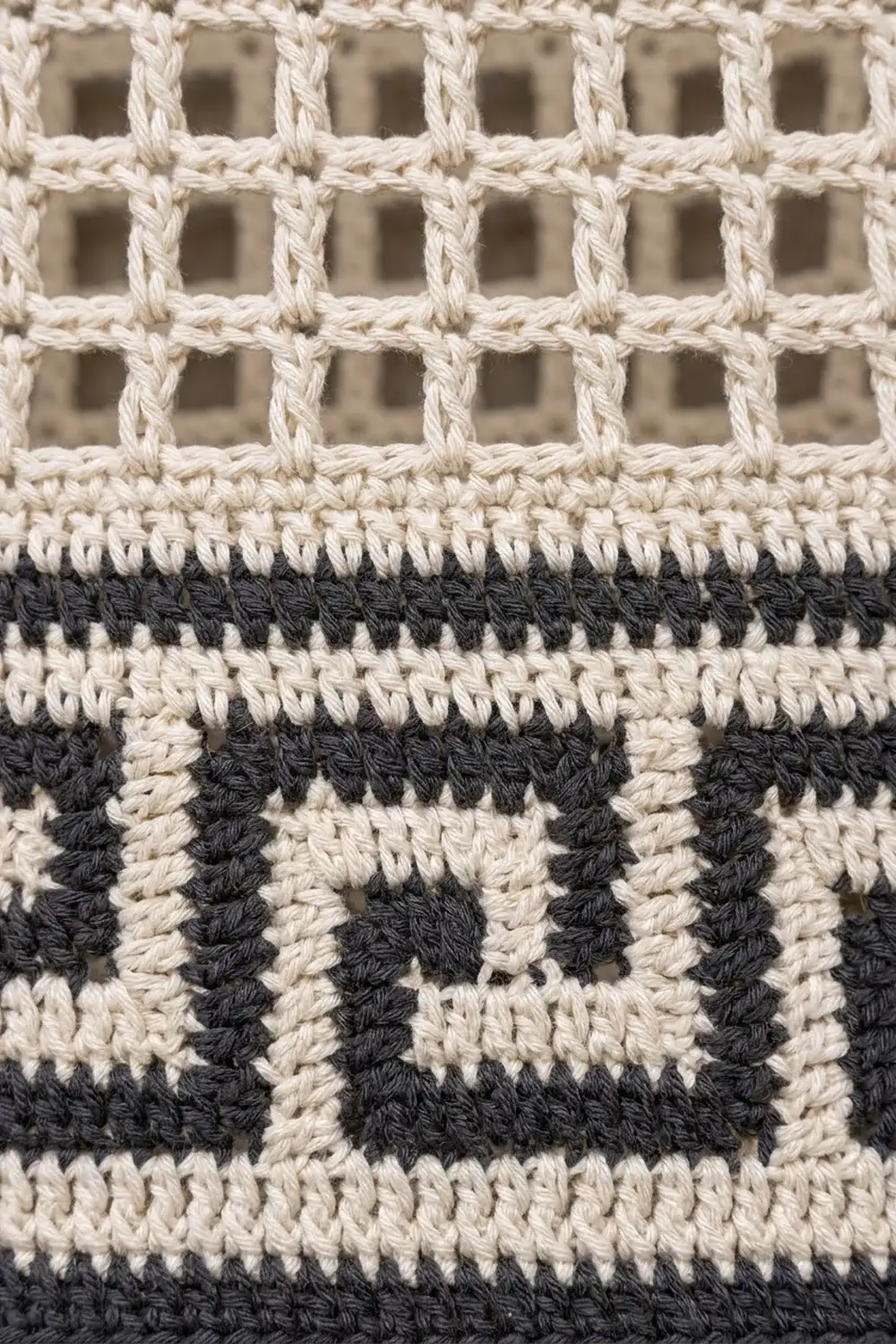
Greek Key Band
The band is 178 sts wide and 20 rows tall. Odd rows are RS rows and even rows are WS rows. The ch 1 at the start of each row does not count as a stitch.
Foundation (D): Ch 179.
Row 1 (RS, D): Sc in 2nd ch from hook and in each ch across, turn. (178 sc)
Row 2 (D): Ch 1, sc in each st across, changing to C on the last st, turn. (178 sc)
Rows 3–5 (C): Ch 1, sc in each st across, turn. (178 sc per row) Join D on the last st of Row 5 and begin carrying it.
Rows 6–13 (chart rows): Work tapestry sc following the chart rows below. Each chart row is a 9-st repeat, read from column 1 to column 9.
- RS rows (7, 9, 11, 13): 3 C, [9-st repeat] 19 times, 1 D, 3 C
- WS rows (6, 8, 10, 12): 3 C, 1 D, [9-st repeat read from column 9 back to column 1] 19 times, 3 C
That gives 3 + 171 + 1 + 3 = 178 sts in every row. The single D stitch after the last repeat adds a matching vertical bar to close the motif, so both ends of the band look the same.
Chart rows (columns 1–9):
- Row 6: 9 D
- Row 7: 1 D, 8 C
- Row 8: 1 D, 1 C, 6 D, 1 C
- Row 9: 1 D, 1 C, 1 D, 4 C, 1 D, 1 C
- Row 10: 1 D, 1 C, 1 D, 4 C, 1 D, 1 C
- Row 11: 1 D, 1 C, 4 D, 1 C, 1 D, 1 C
- Row 12: 1 D, 6 C, 1 D, 1 C
- Row 13: 8 D, 1 C
Row 6 is a solid D base line, broken only by the 3 C edge sts at each end. Column 1 rises from it as a vertical bar and Row 13 forms the top bar. Column 8 drops back down, and Rows 8 and 11 turn the line inward into a spiral. A 1-stitch column of C separates each repeat from the next.
Cut D at the end of Row 13, leaving a 6 in (15.2 cm) tail.
Rows 14–16 (C): Ch 1, sc across, turn. Join D on the last st of Row 16. (178 sc)
Rows 17–18 (D): Ch 1, sc across, turn. Change to C on the last st of Row 18. (178 sc) Cut D.
Rows 19–20 (C): Ch 1, sc across, turn. (178 sc)
Checkpoint: 47.5 in (120.7 cm) x 5 in (12.7 cm). Don’t continue until this matches.
Mesh Body
Work with C only.
Mesh Row 1 (RS): Ch 3 (counts as dc), *ch 2, sk 2 sts, dc in next st; rep from * across, turn. (59 squares: 60 dc + 118 ch = 178 sts)
Mesh Rows 2–95: Ch 3 (counts as dc), *ch 2, sk ch-2 sp, dc in next dc; rep from * across, working the last dc in the top of the turning ch, turn. (59 squares per row)
Each dc stacks directly over the dc below, so the columns stay vertical and the windows stay square. Place a marker every 10 rows to make counting easier.
Checkpoint: the mesh section is 76 in (193.0 cm) tall after Row 95.
Header
Header Row 1 (conversion row): Ch 1, sc in first dc, *2 sc in next ch-2 sp, sc in next dc; rep from * across, turn. (60 sc in dc + 118 sc in spaces = 178 sc)
Header Rows 2–6: Ch 1, sc in each st across, turn. (178 sc per row)
The header is 1.5 in (3.8 cm) deep. Total panel length: 5 + 76 + 1.5 = 82.5 in (209.6 cm). Fasten off.
Tabs
There are 8 tabs, each 10 sts wide, with 14 sts between tabs. That is 8 x 10 + 7 x 14 = 80 + 98 = 178 sts, so the first and last tabs sit flush with the edges of the panel.
Tab 1 uses header sts 1–10 and tab 2 uses sts 25–34. Each later tab starts 24 sts after the one before, so tab 8 uses sts 169–178. Place a marker in the first st of each tab before you begin.
Each tab: With RS facing, join C in the first marked st. Ch 1, sc in the same st and in the next 9 sts, turn. (10 sc) Work 27 more rows of 10 sc, for 28 rows total. Fasten off, leaving a 12 in (30.5 cm) tail.
Each tab is about 2.67 in (6.8 cm) wide and 7 in (17.8 cm) long, and the gaps between tabs are 3.73 in (9.5 cm). Fold each tab toward the WS so its last row overlaps the header by 1.5 in (3.8 cm). Whipstitch it across the header with the tail. The finished loop rises about 2.75 in (7.0 cm) above the header.
Border
The border is one row of C sc along each long side. The hem is already a finished D sc edge and the top carries the tabs, so neither needs edging.
Border gauge: 15 sc = 4 in (10.2 cm), the same as the band.
Right side edge: With RS facing, join C at the top corner of the header and work down the side:
- Header: 1 sc in each of the 6 row ends (6 sc)
- Mesh: 3 sc around each of the 95 dc row-end posts (285 sc)
- Band: 1 sc in each of the 20 row ends (20 sc)
Total: 6 + 285 + 20 = 311 sc. Fasten off.
Left side edge: Join at the bottom corner and work the same counts in reverse order: 20 + 285 + 6 = 311 sc. Fasten off.
Why the math works: Each mesh row is 0.8 in (2.0 cm) tall, and 3 sc at 15 sc per 4 in also measure 0.8 in. The edging therefore lies flat along the mesh without rippling or pulling in. The sc row ends are slightly shorter (4 rows per inch), so 1 sc per row end adds only about 1.6 sts too many across all 26 sc rows, and blocking evens this out. Each edge adds 0.25 in (0.6 cm), which brings the width from 47.5 in (120.7 cm) to 48 in (121.9 cm).
Final Blocking
- Weave in all ends inside sc stitches of the matching color. In the band, run tails along the carried strand.
- Soak the panel in cool water with a little wool wash or mild soap for 15 minutes.
- Press out the water gently and roll the panel in towels. Do not wring it.
- Lay the panel flat on the blocking surface, RS up.
- Pin the band first to 48 in (121.9 cm) wide and 5 in (12.7 cm) tall, keeping the Greek key lines straight.
- Work up the panel, pinning both sides to the same 48 in (121.9 cm) width and checking that the mesh columns are vertical.
- Pin the full length to 82.5 in (209.6 cm). Don’t stretch it longer, because cotton grows when hung.
- Let it dry completely, at least 24 hours, before unpinning.
Final Quality-Control Checklist
- The band has 178 sts in every row and 19 complete key repeats plus the closing bar
- No charcoal shows through the cream areas of the band
- All 95 mesh rows have 59 squares
- The header is 1.5 in (3.8 cm) deep with 178 sc
- There are 8 evenly spaced tabs, with the edge tabs flush with the sides
- Each side edge has 311 sc
- The panel blocks to 48 in (121.9 cm) x 82.5 in (209.6 cm)
- For a pair, both panels match in length within 0.5 in (1.3 cm)
Troubleshooting
Band is narrower than the mesh: The carried strand is too tight. Spread the stitches before each color change, or go up half a hook size for the band only.
Charcoal shows through the cream: Hold the carried strand slightly toward the back and pull each stitch snug around it.
Mesh squares look like tall rectangles: Your dc is too tall. Pull up a shorter first loop or hold the yarn more firmly.
Panel leans to one side: You probably lost or added a square. Count to confirm 59 squares and fix the row where the count changes.
Edging ripples: Use 3 sc per mesh row, not 4. If the edging pulls in instead, check your hook size.
Tabs twist: Fold each tab straight back before sewing, and whipstitch both corners.
Care
Hand wash in cool water and dry flat, reshaping to 48 in (121.9 cm) x 82.5 in (209.6 cm). Don’t hang the panel while it is wet, because the weight will stretch it.

Final Notes
Every measurement follows from the gauge. Gauge sets 15 sts per 4 in, so 178 sts give 47.5 in (120.7 cm). Each mesh square uses 3 of those sts, so 59 squares keep the same width. Twenty band rows give 5 in (12.7 cm) and 95 mesh rows give 76 in (193.0 cm). The header adds 1.5 in (3.8 cm), for a total of 82.5 in (209.6 cm). The 311-stitch side edging matches the mesh rows and finishes the panel at 48 in (121.9 cm) wide. Check each measurement as you go and your panel will hang straight and square.
Happy crocheting!