
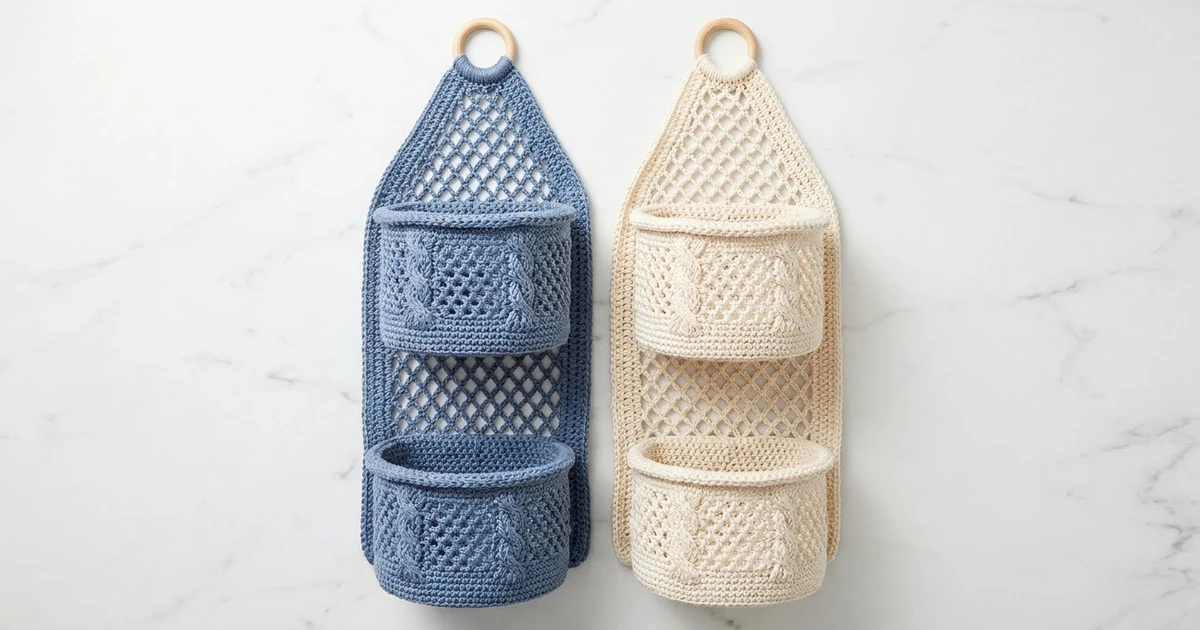
This hanging holder stores three standard toilet rolls in a neat vertical column. Each roll sits in its own round basket, and the three baskets are sewn to a diamond-net back panel that tapers to a strap wrapped around a wooden ring.
The sample is worked in one color, a soft denim blue. A cream version works just as well if you want a lighter bathroom look. Every basket wall has six rope cables of front-post stitches, separated by small panels of open diamond mesh, and a rolled single crochet rim. The back panel is an open net of chain loops with a firm two-row edging.
The pattern uses US crochet terms. Each basket is about 5.5 in (14.0 cm) across and 3.75 in (9.5 cm) tall. The bordered back panel is 7 in (17.8 cm) wide. From the bottom edge to the top of the ring, the holder measures about 19.25 in (48.9 cm).
You make it in four parts. First crochet three identical baskets from the base up, in joined rounds. Then work the net panel in rows from the bottom up, decreasing it to a point and finishing with a short strap. Sew the baskets to the panel, edge the panel, and fold the strap around the ring.
Finished Size and Construction
- Finished size: 7 in (17.8 cm) wide x about 19.25 in (48.9 cm) tall including the ring
- Skill level: Intermediate (front-post cables, net mesh, simple shaping)
- Terminology: US crochet terms
- Yarn weight: Aran / heavy worsted (#4) cotton or cotton blend
- Hook: 5.0 mm (H-8)
- Number of pieces: 4 crocheted pieces (3 baskets + 1 back panel), plus a wooden ring
- Layout: 1 column of 3 baskets, stacked vertically on the panel
- Basket size: 5.5 in (14.0 cm) diameter x 3.75 in (9.5 cm) tall
- Panel size before border: 6 in (15.2 cm) wide x 13.75 in (34.9 cm) body length, plus a 2 in (5.1 cm) taper
- Border depth: 0.5 in (1.3 cm), 2 rows
Materials
Choose a smooth, firm cotton or cotton blend. Cotton keeps the baskets upright and copes well with bathroom humidity. Avoid splitty yarn, because front-post cables show every split ply.
- Denim blue (Color A): 200 g, about 340 m (372 yd), based on 85 m per 50 g
- Optional cream colorway: same amount, in place of Color A
Tools
- 5.0 mm (H-8) crochet hook
- 1 wooden ring, 2 in (5.1 cm) diameter
- 4 stitch markers
- Tapestry needle
- Rustproof pins
- Scissors and tape measure
The yarn amount includes a margin of about 20%. The finished holder uses about 165 g.
Abbreviations (US Terms)
- ch – chain
- sl st – slip stitch
- sc – single crochet
- dc – double crochet
- tr – treble crochet
- inc – 2 sc in the same stitch
- BLO – back loop only
- FPdc – front post double crochet
- FPtr – front post treble crochet
- MR – magic ring
- sk – skip
- sp – space
- st(s) – stitch(es)
Special stitch – C4 (rope cable cross): Skip the next 2 front-post sts. FPtr around each of the next 2 front-post sts. Then, working in front of the 2 sts you just made, FPtr around each of the 2 skipped sts. This uses 4 sts and makes 4 sts.
Gauge and Checkpoints
Gauge: 14 sc and 16 rounds = 4 in (10.2 cm) in sc. In the net, 2 rows (one diamond) = 1 in (2.5 cm), so each net row measures 0.5 in (1.3 cm).
Make one basket first to test your gauge.
Checkpoints:
- Basket base, after Rnd 10: 5.25 in (13.3 cm) across, lying flat
- Finished basket wall: 3.75 in (9.5 cm) tall, outside diameter 5.5 in (14.0 cm)
- Panel, after Row 2: 6 in (15.2 cm) wide
- Panel, after Row 28: 13.75 in (34.9 cm) long
- Bordered panel: 7 in (17.8 cm) wide
A standard roll is 4.5 in (11.4 cm) across, so it should drop into the basket easily with a little room around it. If the base is too large, go down a hook size. If the roll will not fit, go up a hook size. Change hook size rather than the stitch counts, because the cable and mesh repeats depend on exactly 60 sts.
Baskets (Make 3)
Base
Join every round with a sl st to the first sc. Start each round with ch 1, which does not count as a stitch.
Rnd 1: 6 sc in MR. (6 sts)
Rnd 2: Inc in each st. (12 sts)
Rnd 3: [Sc 1, inc] 6 times. (18 sts)
Rnd 4: [Sc 2, inc] 6 times. (24 sts)
Rnd 5: [Sc 3, inc] 6 times. (30 sts)
Rnd 6: [Sc 4, inc] 6 times. (36 sts)
Rnd 7: [Sc 5, inc] 6 times. (42 sts)
Rnd 8: [Sc 6, inc] 6 times. (48 sts)
Rnd 9: [Sc 7, inc] 6 times. (54 sts)
Rnd 10: [Sc 8, inc] 6 times. (60 sts)
Checkpoint: the base is 5.25 in (13.3 cm) across and lies flat.
Wall
Rnd 11 (turning ridge): Ch 1, sc in BLO of each st. (60 sc)
The unused front loops of Rnd 10 form a ridge around the base, and the wall starts to rise.
Rnd 12: Ch 2 (does not count), dc in each st. Join to the first dc. (60 dc)
Rnds 13–17 have 6 repeats of 10 sts each: a cable of 4 front-post sts followed by a mesh panel. Start each round with ch 2 (ch 3 on cross rounds), which does not count. Join to the top of the first post st.
Rnd 13 (mesh set-up): *FPdc around each of next 4 dc, ch 2, sk 1, sc in next st, ch 4, sk 2, sc in next st, ch 2, sk 1; rep from * 5 more times. (24 FPdc; each mesh panel has ch-2, ch-4, ch-2 sps and 2 sc)
Check the math: each repeat uses 4 + 1 + 1 + 2 + 1 + 1 = 10 sts, and 6 repeats use all 60.
Rnd 14 (cross + offset): *C4, ch 4, sk ch-2 sp, sc in ch-4 sp, ch 4, sk ch-2 sp; rep from * 5 more times. (24 FPtr; each mesh panel has 2 ch-4 loops and 1 sc)
Rnd 15 (mesh): *FPdc around each of next 4 post sts, ch 2, sc in next ch-4 loop, ch 4, sc in next ch-4 loop, ch 2; rep from * 5 more times. (24 FPdc; each mesh panel has ch-2, ch-4, ch-2 sps and 2 sc)
Rnd 16 (cross + offset): Repeat Rnd 14. (24 FPtr; each mesh panel has 2 ch-4 loops and 1 sc)
On every offset round, the sc anchors in the center of the previous loop. That makes the loops close into diamonds, while the two crosses twist each cable into a rope.
Rnd 17 (conversion): *FPdc around each of next 4 post sts, 3 dc in each of next 2 ch-4 loops; rep from * 5 more times. (24 FPdc + 36 dc = 60 sts)
Each repeat has 4 post sts (1 per existing post) plus 6 dc worked into the loops, which brings the round back to 60 sts.
Rnds 18–19 (rim): Ch 1, sc in each st. (60 sc)
Fasten off, leaving a 24 in (61.0 cm) tail for sewing. Checkpoint: the basket is 3.75 in (9.5 cm) tall and 5.5 in (14.0 cm) across.
Back Panel (Make 1)
The panel is worked in rows from the bottom up.
Foundation: Ch 22.
Row 1: Sc in 2nd ch from hook and in each ch across. (21 sc)
Row 2: Ch 1, turn, sc in first st, [ch 5, sk 3, sc in next st] 5 times. (5 loops, 6 sc)
Check: 1 + (5 x 4) = 21 sts used.
Row 3: Ch 5 (counts as dc + ch 2), turn, sc in first ch-5 loop, [ch 5, sc in next loop] 4 times, ch 2, dc in last sc. (4 full loops + 2 half loops)
Row 4: Ch 1, turn, sc in first dc, [ch 5, sc in next ch-5 loop] 4 times, ch 5, sc in 3rd ch of turning ch. (5 loops)
Rows 5–28: Repeat Rows 3 and 4 alternately, ending with a Row 4 repeat. (Row 28 has 5 loops)
Checkpoint: 6 in (15.2 cm) wide and 13.75 in (34.9 cm) long. That is Row 1 at 0.25 in (0.6 cm) plus 27 net rows at 0.5 in (1.3 cm) each.
Taper
Each taper row starts at the center of the end loop, which removes one loop per row.
Row 29: Turn, sl st in each of first 3 ch of first loop, ch 1, sc in same loop, [ch 5, sc in next loop] 4 times. (4 loops)
Row 30: Turn, sl st in first 3 ch, ch 1, sc in same loop, [ch 5, sc in next loop] 3 times. (3 loops)
Row 31: As Row 30, working the bracketed repeat 2 times. (2 loops)
Row 32: As Row 30, working the bracketed repeat 1 time. (1 loop)
Strap
Row 33: Ch 1, turn, 5 sc in the ch-5 loop. (5 sc)
Rows 34–40: Ch 1, turn, sc in each st. (5 sc)
Fasten off and leave a 12 in (30.5 cm) tail. The taper and strap together add about 4 in (10.2 cm).
Make All Pieces
All four pieces use Color A (or all cream for the alternative colorway).
- Baskets: 3 pieces, about 40 g (68 m) each
- Back panel: 1 piece, about 45 g (77 m)
- Total: about 165 g (281 m), from the 200 g bought
Layout (front view):
      ( O )   ring
       |=|    strap
      /   \   taper, Rows 29-32
     | [B3] | Rows 21-28
     |      |
     | [B2] | Rows 12-19
     |      |
     | [B1] | Rows 3-10
     |______| Row 1 + border
Joining
Sew each basket to the center of the panel with whipstitch, using the basket’s long tail. Each basket is attached at two lines: the rim and the base ridge.
Placement (measured from the foundation edge):
- Basket 1: base ridge on Row 3, at 1.25 in (3.2 cm); rim on Row 10, at 4.75 in (12.1 cm)
- Basket 2: base ridge on Row 12, at 5.75 in (14.6 cm); rim on Row 19, at 9.25 in (23.5 cm)
- Basket 3: base ridge on Row 21, at 10.25 in (26.0 cm); rim on Row 28, at 13.75 in (34.9 cm)
Stitch-to-stitch logic: Pick the cable you want at the back. Mark that cable’s 4 sts plus the 3 sts on each side, for 10 rim sts. At 3.5 sts per in, those 10 sts span about 3 in (7.6 cm), so center them across the middle 3 in (7.6 cm) of the panel row. Make one whipstitch per rim st, catching a chain or anchor sc of the panel directly behind it. Repeat at the base, sewing the 10 matching front loops of Rnd 10 to the ridge row.
From base ridge to rim, the basket wall is 3.5 in (8.9 cm), which matches the 7 net rows between the two lines (7 x 0.5 in). That is why each basket sits flat against the panel without tilting.
Tension: Pull each stitch snug, but stop before the net puckers. Check that the panel still measures 6 in (15.2 cm) across at every rim row. The gaps between baskets should be 1 in (2.5 cm).
Border
The border goes around the panel only, starting and ending at the base of the strap. Do not turn between the two border rows.
Border gauge: 3.5 sc per in (2.5 cm) across the foundation edge. On the long sides and taper, work 2 sc per net row end, which is 4 sc per in. This slightly firmer edge keeps the stretchy row ends from flaring.
Border Row 1: Join yarn at the right base of the strap with RS facing. Work these sections in order:
- 8 sc down the right taper edge (2 per row end for Rows 32–29)
- 54 sc down the right long side (2 per row end for Rows 28–2)
- 3 sc in the first foundation ch (corner)
- sc in each of the next 19 foundation chs
- 3 sc in the last foundation ch (corner)
- 54 sc up the left long side
- 8 sc up the left taper edge
Total: (149 sc)
Check: 8 + 54 + 3 + 19 + 3 + 54 + 8 = 149. Along the bottom, the 19 sts plus one center corner st on each end make 21, which matches the 21 sts of Row 1, so the edge stays straight. On each long side, 27 rows x 2 = 54.
Border Row 2: Ch 1, do not turn, reverse sc in each st. (149 reverse sc)
Fasten off. The border adds 0.5 in (1.3 cm) on each side, so the panel becomes 6 + 0.5 + 0.5 = 7 in (17.8 cm) wide.
Ring: Fold the strap over the ring from front to back. Sew Row 40 to Row 33 on the back.
Final Blocking
- Wet the finished holder in cool water and squeeze it out gently. Do not wring.
- Lay it flat on a towel and roll it up to remove extra water.
- Pin the panel to 7 in (17.8 cm) wide, opening the net into even diamonds.
- Fill each basket with a roll wrapped in plastic so the walls dry round and upright.
- Shape the cables with your fingers so they stand straight up the walls.
- Let it dry completely, then remove the pins and hang it.
Final Quality-Control Checklist
- Each basket has 60 sts on the rim and 6 evenly spaced rope cables
- All three baskets are 3.75 in (9.5 cm) tall
- The panel is 7 in (17.8 cm) wide with the border
- The baskets are centered, level, and spaced 1 in (2.5 cm) apart
- Rims are sewn across 10 sts and do not sag forward
- The strap is sewn securely around the ring
- All ends are woven in at least 2 in (5.1 cm)
Troubleshooting
- Base cups or ruffles: Check that Rnd 10 has 60 sts. If the count is right, adjust your tension.
- Wall flares out: The dc rounds are too loose. Work Rnd 12 and Rnd 17 with a 4.5 mm (G-7) hook.
- Cables lean: Always cross toward the front, in the same direction on both cross rounds.
- Mesh loops look uneven: Count the chains in each loop and keep the anchors in the loop centers.
- Panel too narrow: The ch-5 loops are tight. Chain more loosely, or go up a hook size for the net only.
- Baskets droop: Add a few more whipstitches at the rim and pull them slightly tighter.
Care
Hand wash in cool water and lay flat to dry, reshaping the baskets around a roll. Keep the holder away from direct shower spray so it doesn’t stay damp.

Final Notes
Everything in this pattern builds on one gauge. A 60-st base 5.25 in (13.3 cm) across gives a 5.5 in (14.0 cm) basket with a 3.75 in (9.5 cm) wall. The 3.5 in (8.9 cm) between ridge and rim fits 7 net rows, so each basket sits flat on the panel. The 21-st panel is 6 in (15.2 cm) wide, and the border brings it to 7 in (17.8 cm). Taper, strap, and ring complete the 19.25 in (48.9 cm) hanger. Check each number as you reach it and the holder will hang straight and hold all three rolls.
Happy crocheting!