

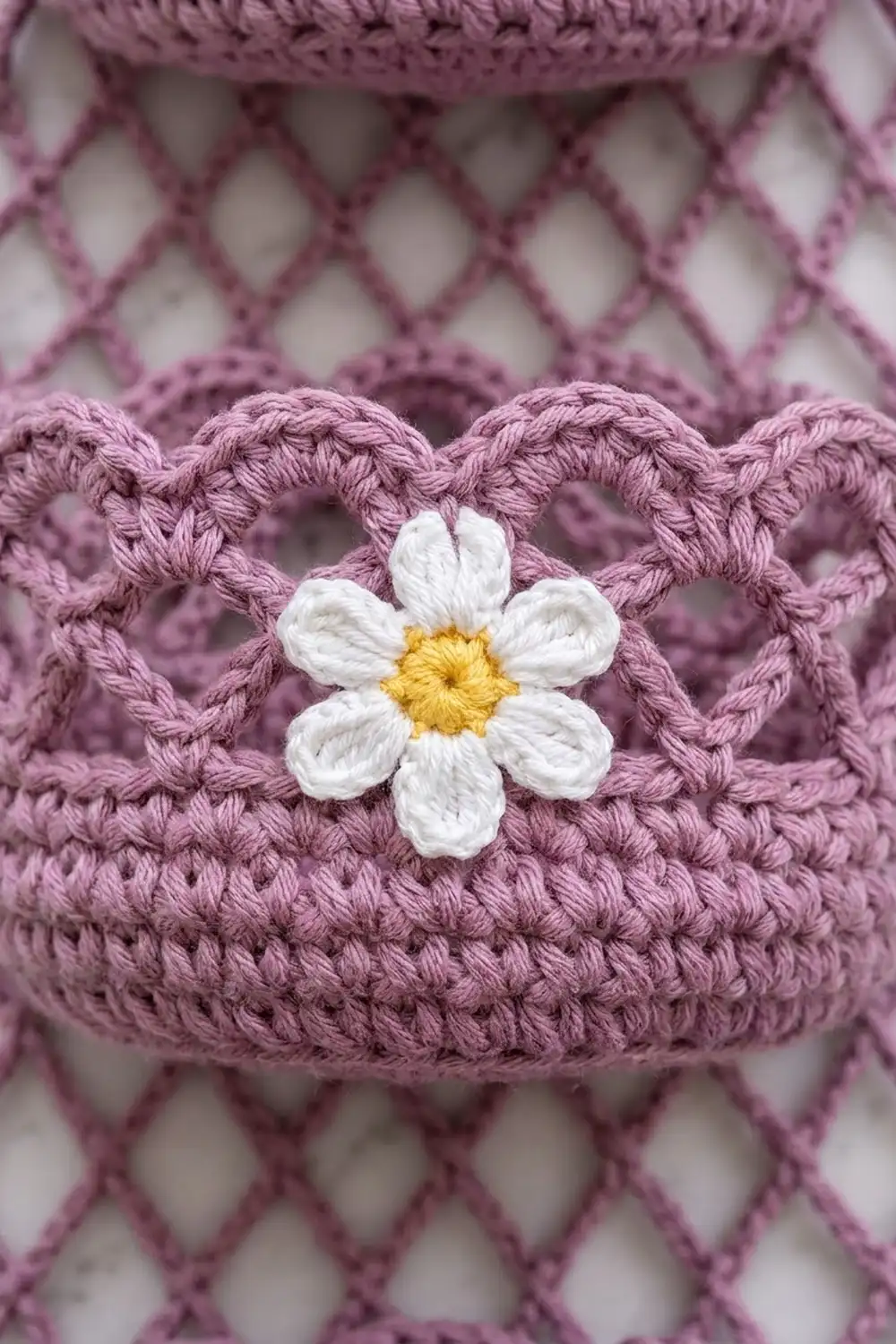
This hanging toilet paper holder keeps three spare rolls neatly stacked on the wall. Each roll sits in its own round lace basket with a scalloped rim, and a diamond mesh net wraps all three baskets and gathers up to a wooden ring.
The sample is worked in dusty mauve cotton. Each basket has a small daisy on the front with white petals and a yellow center. A soft butter-yellow version looks just as good, so pick whatever suits your bathroom.
The pattern uses US crochet terms. The finished holder is about 5 in (12.7 cm) wide across the baskets and about 21 in (53.3 cm) long including the ring. Each basket base is 4.75 in (12.1 cm) across, which fits a standard roll.
You will make three baskets in the round, starting with a flat base and working up the wall. Next comes the net, worked top-down from a solid neck into a cone and a straight mesh tube. After that you place the baskets inside the net and join them, work the scalloped rims, tack the scallops to the mesh, and attach the ring.
Finished Size and Construction
- Finished size: about 5 in (12.7 cm) wide x 21 in (53.3 cm) long including ring
- Skill level: Intermediate
- Terminology: US
- Yarn weight: Worsted (#4) cotton
- Hook: 4.5 mm (US 7)
- Number of pieces: 7 crocheted pieces (3 baskets, 1 net, 3 daisies) plus 1 wooden ring
- Layout: 1 column x 3 tiers, stacked vertically
- Piece size: basket base 4.75 in (12.1 cm) across; basket 3 in (7.6 cm) tall with rim
- Size before border: basket 2.25 in (5.7 cm) tall after Rnd 18
- Border depth: scalloped rim adds 0.75 in (1.9 cm)
Materials
Use a smooth, firm worsted-weight cotton. Cotton holds the baskets’ shape and doesn’t stretch much under the weight of the rolls. The amounts below assume roughly 85 m (93 yd) per 50 g.
- Mauve (main color): 130 g, about 220 m (241 yd)
- White (petals): 10 g, about 17 m (19 yd)
- Yellow (daisy centers): 5 g, about 9 m (10 yd)
All quantities include a margin of about 15% for swatching and joining.
Tools:
– 4.5 mm (US 7) crochet hook
– Wooden ring, 2.5 in (6.4 cm) outer diameter
– 10 locking stitch markers
– Tapestry needle
– Scissors
– Measuring tape
– Spray bottle and blocking pins
Abbreviations (US Terms)
- ch – chain
- sl st – slip stitch
- sc – single crochet
- dc – double crochet
- inc – 2 sc in the same stitch
- BLO / FLO – back loop only / front loop only
- MR – magic ring
- sp – space
- st(s) – stitch(es)
Special stitch – Petal: In the stated stitch, work (sl st, ch 3, 2 dc, ch 3, sl st).
Gauge and Checkpoints
Gauge: 16 sc x 18 rounds = 4 in (10.2 cm) in sc.
Mesh gauge: 4 rounds of ch-6 mesh = 3 in (7.6 cm) when lightly stretched. One ch-6 loop spans about 1.5 in (3.8 cm) across.
Make one complete basket before anything else and check it against these points:
- After Rnd 5: base measures 2.4 in (6.1 cm) across.
- After Rnd 10: base measures 4.75 in (12.1 cm) across.
- After Rnd 18: basket stands 2.25 in (5.7 cm) tall, and the rim circumference is 15 in (38.1 cm).
- After the rim: basket stands 3 in (7.6 cm) tall.
If the base is too big, go down 0.5 mm in hook size. If it is too small or curls into a bowl, go up 0.5 mm. Don’t change the number of increase rounds. Before you continue, drop a toilet roll into the basket to check that it sits flat with a little ease.
Basket (Make 3)
Work in joined rounds in mauve. Join each round with a sl st to the first st and start with ch 1, which does not count as a st.
Base
- Rnd 1: 6 sc in MR. (6)
- Rnd 2: inc in each st. (12)
- Rnd 3: sc 1, inc 6 times. (18)
- Rnd 4: sc 2, inc 6 times. (24)
- Rnd 5: sc 3, inc 6 times. (30)
- Rnd 6: sc 4, inc 6 times. (36)
- Rnd 7: sc 5, inc 6 times. (42)
- Rnd 8: sc 6, inc 6 times. (48)
- Rnd 9: sc 7, inc 6 times. (54)
- Rnd 10: sc 8, inc 6 times. (60)
Stagger the increases on Rnds 6–10 by starting each round with half the sc count before the first inc. This keeps the base round rather than hexagonal.
Wall
- Rnd 11: sc in BLO of each st. (60) The unused front loops make a base ridge of 60 FLO, which you will use later for joining.
- Rnds 12–15: sc in each st. (60)
Lattice band
- Rnd 16: sc in first st, ch 4, skip 3, sc in next st 14 times, ch 4, skip 3, join to first sc. (15 sc + 15 ch-4 loops)
- Rnd 17: sl st into the first ch-4 loop, ch 1, sc in same loop, ch 4, sc in next loop 14 times, ch 4, join. (15 sc + 15 ch-4 loops) Because each loop now sits over the sc below, the openwork forms diamonds.
- Rnd 18 (conversion round): sl st into the first loop, ch 1, 4 sc in each ch-4 loop around, join. (1 sc per chain: 15 loops x 4 ch = 60 sc, + 0 extra = 60)
Fasten off, leaving a 6 in (15.2 cm) tail. Do not work the rim yet. You will add it in the Border section after the baskets are inside the net.
Daisy (Make 3)
- Rnd 1 (yellow): 8 sc in MR, join. (8) Fasten off.
- Rnd 2 (white): Join in any sc. Work a Petal in each st around, then join. (8 petals)
Fasten off, leaving a 10 in (25.4 cm) tail. The daisy measures about 1.5 in (3.8 cm) across.
Sew one daisy to each basket, centered over Rnds 13–17. This is the front of the basket.
Net (Make 1)
Work in mauve in joined rounds.
Neck
- Rnd 1: 10 sc in MR, join. (10)
- Rnds 2–4: sc in each st. (10) The neck is about 1 in (2.5 cm) tall.
Cone
- Rnd 5 (conversion round): sc in first st, ch 4, sc in next st 9 times, ch 4, join. (10 sc, 1 per existing st, + 10 ch-4 loops added)
- Rnd 6: sl st into the first loop, ch 1, sc in same loop, ch 5, sc in next loop 9 times, ch 5, join. (10 sc + 10 ch-5 loops)
- Rnd 7: Work as Rnd 6, but with ch 6. (10 sc + 10 ch-6 loops)
The cone measures about 2 in (5.1 cm) tall.
Straight mesh
- Rnds 8–27: sl st into the first loop, ch 1, sc in same loop, ch 6, sc in next loop 9 times, ch 6, join. (10 sc + 10 ch-6 loops in each round)
After Rnd 27, the 20 straight rounds measure 15 in (38.1 cm), and the net measures 18 in (45.7 cm) from the top of the neck. Don’t fasten off. Place your hook on a marker and set the net aside. Rnd 28 is worked during joining.
Intersections: In every round, each of the 10 sc is an intersection where two mesh diagonals meet.
Make All Pieces
| Piece | Qty | Color |
|---|---|---|
| Basket | 3 | Mauve |
| Net | 1 | Mauve |
| Daisy center | 3 | Yellow |
| Daisy petals | 3 | White |
Layout grid (front view):
        [ wooden ring ]
        [ neck, Rnds 1–4 ]
        [ cone, Rnds 5–7 ]
        [ mesh, Rnds 8–9 ]
[ TOP basket    ] base on Rnd 14, tips on Rnd 10
        [ mesh gap ]
[ MIDDLE basket ] base on Rnd 21, tips on Rnd 17
        [ mesh gap ]
[ BOTTOM basket ] base on Rnd 28, tips on Rnd 24
The baskets are spaced 7 mesh rounds apart, which puts the base of each basket 5.25 in (13.3 cm) above the base of the one below. A 4 in (10.2 cm) tall roll fits with clearance beneath the next basket.
Joining
Mark the base ridges. On each basket, count the 60 FLO of the base ridge. Place a marker in FLO 1, 7, 13, 19, 25, 31, 37, 43, 49, and 55, so you have 10 markers, one every 6th loop. The math works because 60 ridge loops ÷ 10 net intersections = 6.
Insert the baskets. Feed the baskets in through the open bottom of the net with the daisies facing the same way. Insert the top basket first and push it up, then the middle basket, then the bottom basket.
Top basket: With a tapestry needle and mauve yarn, tack each marked FLO to one sc intersection of Rnd 14. That makes 10 tacks. Each tack is 2 small stitches through the ridge loop and the sc, pulled snug but not puckered.
Middle basket: Tack it the same way to the 10 intersections of Rnd 21.
Bottom basket, Rnd 28 (join round): Pick up the net’s live loop. Sl st into the first ch-6 loop, ch 1, then work sc in the loop, ch 3, sc through the next marked FLO of the bottom basket’s base ridge, ch 3 10 times, and join. (20 sc: 10 in net loops + 10 in ridge, + 20 ch-3 spaces) Fasten off.
Tension: Keep the tacks firm enough that the base doesn’t slide, but don’t cinch the mesh. The diamonds should stay open and even.
Size checkpoint: Hang the net from your finger. The base of each basket should sit 5.25 in (13.3 cm) above the base of the one below, and the distance from the neck to the bottom should still be about 18 in (45.7 cm).
Border: Scalloped Rim
Border gauge: One finished scallop spans 1.5 in (3.8 cm) around and stands 0.75 in (1.9 cm) tall.
Work the rim on each basket now that it is in the net. The rim edge is free and the mesh hangs loosely outside it, so you can reach in from above. Join mauve in any st of Rnd 18, directly above the daisy.
- Rnd 19: ch 1, sc in same st, ch 7, skip 5, sc in next st 9 times, ch 7, skip 5, join. (10 sc + 10 ch-7 arches)
- Rnd 20: work 9 sc in the next ch-7 arch, sl st in the next sc 10 times. (Per arch: 7 sc, 1 per chain, + 2 extra = 9 sc. Total: 90 sc + 10 sl st)
Fasten off.
Why the math works: Rnd 18 has 60 sts, and each arch uses 6 sts (1 sc + 5 skipped), so 60 ÷ 6 = 10 arches. That matches the 10 mesh intersections per round. The 2 extra sc per arch make each arch curve into a raised scallop without ruffling. Because the rim circumference is 15 in (38.1 cm) and the net’s 10 loops at 1.5 in (3.8 cm) each also total 15 in (38.1 cm), the scallops line up with the mesh without strain.
Tack the scallop tips. The 5th sc of each 9-sc arch is the tip. Tack each tip to one intersection: Rnd 10 for the top basket, Rnd 17 for the middle basket, and Rnd 24 for the bottom basket. That’s 10 tacks per basket. If a tip falls between two intersections, rotate the basket slightly before tacking.
Attach the ring. Join mauve to any st of net Rnd 1 and ch 8. Pass the chain through the wooden ring, then sl st to the opposite st of Rnd 1 (st 6). Work 14 sc around the ch-8 loop and the ring together, join, and fasten off. The tab adds about 0.5 in (1.3 cm).
Final Blocking
- Weave in all ends along solid sc rounds. Don’t weave them into the mesh chains.
- Mist the whole piece evenly with water until it is damp.
- Put a toilet roll in each basket to shape the walls and rims.
- Lay the holder flat with the daisies up. Pin the scallops so each arch is round and even.
- Pull the mesh gently lengthwise so the diamonds open evenly and each gap between tiers is the same.
- Check that the length from the neck to the bottom is 18 in (45.7 cm).
- Let it dry completely, then remove the rolls and pins.
Final Quality-Control Checklist
- Each base is 4.75 in (12.1 cm) across and lies flat.
- Each basket has 60 sts on Rnd 18 and 10 scallops on its rim.
- The lattice band shows 15 even diamonds.
- All three daisies are centered and face the same way.
- The net has 10 loops in every round from Rnd 7 down.
- The bases sit on Rnds 14, 21, and 28.
- The scallop tips sit on Rnds 10, 17, and 24.
- The finished length with the ring is about 21 in (53.3 cm).
- The ring tab is secure, and no ends show on the front.
Troubleshooting
- The base cups upward: You have too few stitches for your tension. Use a larger hook, or check that you worked 6 increases in every round.
- The base ruffles: Use a smaller hook, and recount each round.
- The lattice diamonds lean: On Rnd 17, make sure each sc goes into a loop and not into a chain stitch.
- The scallops flip outward: Work 8 sc per arch instead of 9, then recheck that you have 10 arches.
- The mesh is too short: Tight chains shorten each round. Loosen your chains or add a round between tiers. Add rounds in pairs so the stacking order stays the same.
- A basket tilts: One or more base tacks are missing or loose. Recount all 10.
- A roll won’t fit: Add one more increase round (66 sts). This changes the rim to 11 arches and needs 11 mesh loops, so plan it before you start the net.
Care
Hand wash in cool water and lay flat to dry, reshaping the baskets around rolls. Don’t tumble dry, because heat can shrink cotton unevenly.

Final Notes
Everything in this pattern follows from one measurement chain. A gauge of 16 sc per 4 in (10.2 cm) gives a 60-st base that is 4.75 in (12.1 cm) across. Those 60 sts give a 15 in (38.1 cm) rim, which divides into 10 scallops. The 10 scallops match the 10 mesh loops, and the 10 marked ridge loops match the 10 mesh intersections. With 7 mesh rounds between tiers, the baskets sit 5.25 in (13.3 cm) apart, and the finished holder is 21 in (53.3 cm) long. If your swatch and your first basket match, the rest of the holder will fit together without adjustment.
Happy crocheting!