

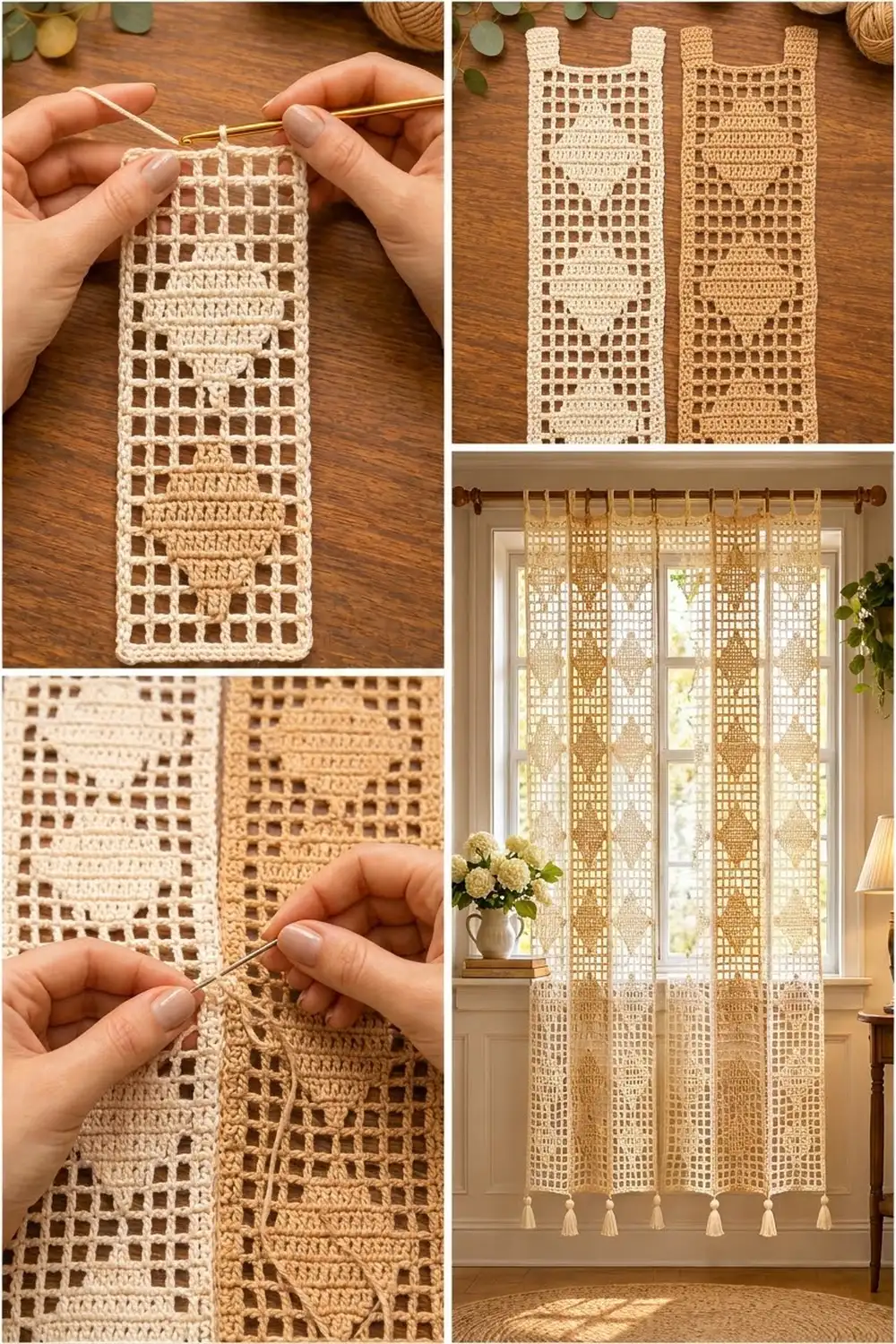
The Honey Lattice Curtain is a tall, airy filet curtain made from eight long strips in cream and warm tan. Each strip is an open grid of mesh squares, with solid diamonds stacked down its center. When light comes through the window, the diamonds look like soft lanterns against the lattice.
The style is relaxed boho farmhouse. The cream strips keep the curtain bright, and the tan strips add warmth and rhythm. Small tab loops at the top slide onto a wooden rod. A tassel at the bottom of each strip finishes the look.
The pattern uses US crochet terms. The finished curtain, including the border, measures 45.6 x 81.6 in (115.8 x 207.3 cm). The tabs add about 1.8 in (4.6 cm) above the top edge, and the tassels hang 4 in (10.2 cm) below it.
You work eight identical filet strips in rows, block them, and whipstitch them together. Then you add a two-round single crochet border, the tab loops, and the tassels.
Finished Size and Construction
- Finished size: 45.6 x 81.6 in (115.8 x 207.3 cm), not counting tabs and tassels
- Skill level: Intermediate
- Terminology: US
- Yarn weight: Worsted (#4) cotton or cotton blend
- Hook: 5.0 mm (H-8)
- Number of pieces: 8 strips (4 cream, 4 tan)
- Layout: 8 strips side by side, 1 strip deep, alternating colors
- Strip size: 5.6 x 80.8 in (14.2 x 205.2 cm), 7 blocks wide x 101 rows tall
- Size before border: 44.8 x 80.8 in (113.8 x 205.2 cm)
- Border depth: 0.4 in (1.0 cm) on each edge
Materials
Choose a smooth, mercerized or combed cotton in worsted weight. Cotton gives crisp mesh squares, holds its shape when blocked, and doesn’t fuzz in sunlight. Avoid splitty or very loosely plied yarn, because the open blocks show every stitch.
- Cream: 750 g (about 1,275 m) for 4 strips, the joining, the border, the tabs, and 4 tassels
- Tan: 600 g (about 1,020 m) for 4 strips and 4 tassels
Quantities assume about 170 m per 100 g and include a margin of roughly 10–15%.
Tools:
– 5.0 mm (H-8) crochet hook
– Tapestry needle
– Stitch markers
– Measuring tape
– A 4.5 in (11.4 cm) piece of cardboard for tassels
– Rustproof pins, a spray bottle, and blocking mats or a large towel-covered surface
Abbreviations (US Terms)
- ch: chain
- sl st: slip stitch
- sc: single crochet
- dc: double crochet
- sk: skip
- sp: space
- st(s): stitch(es)
- tch: turning chain
- RS / WS: right side / wrong side
Filet blocks:
– Open block (O): ch 2, sk the next 2 sts (or the ch-2 sp), dc in the next dc.
– Solid block (S) over an open block: 2 dc in the ch-2 sp, dc in the next dc.
– Solid block (S) over a solid block: dc in each of the next 3 dc.
– Edge stitch: ch 3 at the start of each row counts as the first dc. Work the last dc of each row into the 3rd ch of the tch.
Every row is 22 sts wide: 1 starting dc plus 3 sts per block x 7 blocks.
Gauge and Checkpoints
Gauge: 5 blocks x 5 rows = 4 x 4 in (10.2 x 10.2 cm) in filet mesh, after blocking. One block = 0.8 x 0.8 in (2.0 x 2.0 cm).
Swatch: Ch 18. Dc in 4th ch from hook and in each ch across (16 sts). Then work 5 rows of open blocks (5 O per row). Wet the swatch, pin it square, let it dry, and measure.
Test one complete strip before making all eight. Every later measurement depends on it.
Checkpoints:
– After Row 10: 5.6 x 8 in (14.2 x 20.3 cm)
– After the first diamond (Row 9): the diamond is 4 x 4 in (10.2 x 10.2 cm)
– Finished strip, blocked: 5.6 x 80.8 in (14.2 x 205.2 cm)
If your blocks are too big, go down one hook size (4.5 mm). If they’re too small, go up one size (5.5 mm). If your blocks are tall rectangles, shorten the dc by pulling the first loop up less. Width matters most, because it is multiplied by eight. A difference of 0.1 in (0.3 cm) per strip adds up to 0.8 in (2.0 cm) across the curtain.
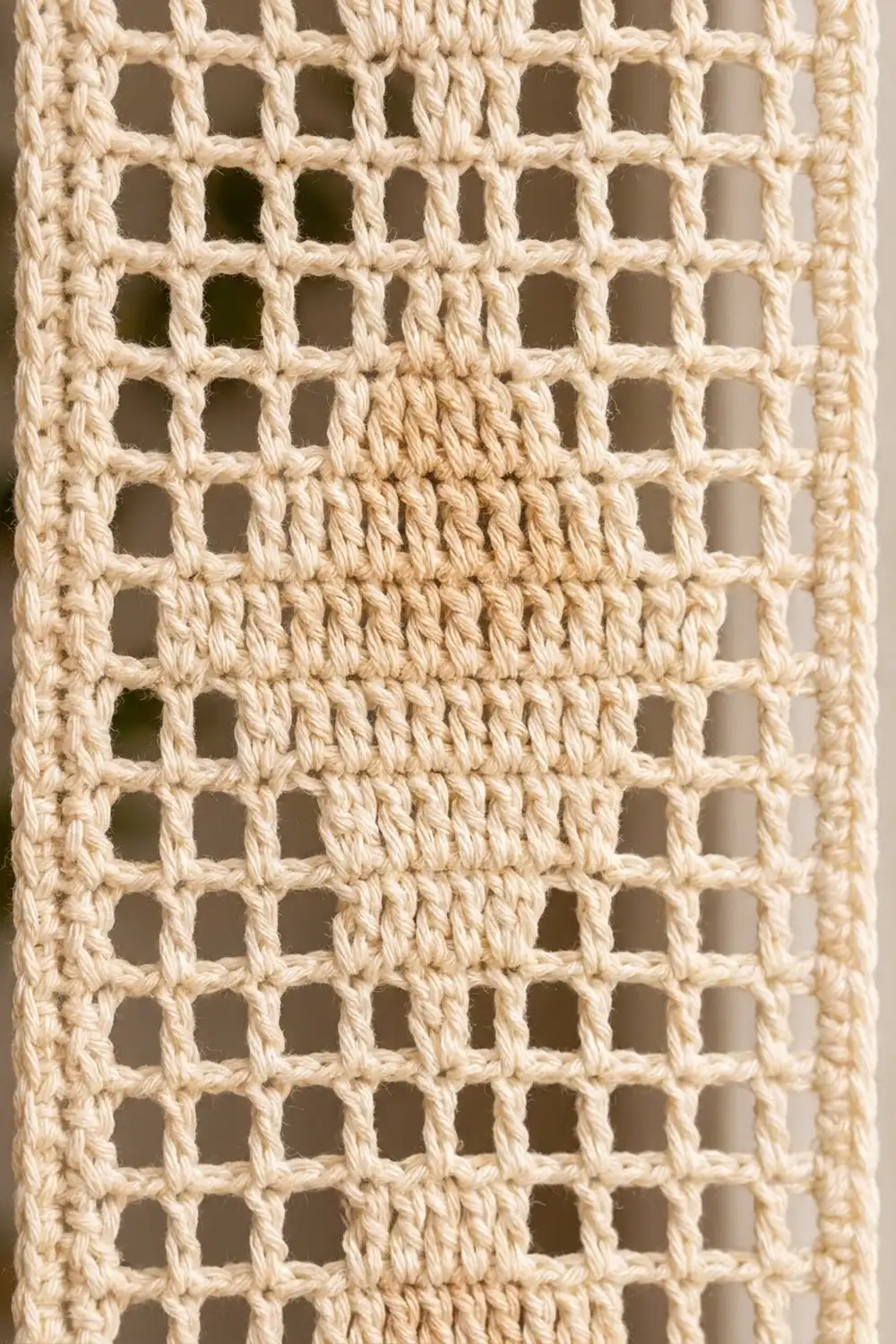
Strip Pattern (Make 8)
Each strip has 1 solid row, 3 mesh rows, twelve 8-row diamond repeats, and 1 solid row.
Foundation: Ch 24.
Row 1 (RS): Dc in 4th ch from hook (skipped ch count as first dc) and in each ch across. Turn. (22 dc: 7 S)
Row 2: Ch 3, ch 2, sk 2 dc, dc in next dc; repeat from * 6 more times, working the last dc in the top of the tch. Turn. (8 dc, 7 ch-2 sps: 7 O = 22 sts)
Rows 3–4: Ch 3, ch 2, sk ch-2 sp, dc in next dc; repeat from * 6 more times. Turn. (8 dc, 7 ch-2 sps)
Diamond Repeat (Rows A–H)
Block 4 is the center block. Read each row as a block sequence.
Row A: Ch 3, 3 O, 1 S, 3 O. Turn. (10 dc, 6 ch-2 sps = 22 sts)
Row B: Ch 3, 2 O, 3 S, 2 O. Turn. (14 dc, 4 ch-2 sps = 22 sts)
Row C: Ch 3, 1 O, 5 S, 1 O. Turn. (18 dc, 2 ch-2 sps = 22 sts)
Row D: Ch 3, 2 O, 3 S, 2 O. Turn. The outer two solid blocks of Row C become open (ch 2, sk 2 dc, dc in next dc). (14 dc, 4 ch-2 sps)
Row E: Ch 3, 3 O, 1 S, 3 O. Turn. (10 dc, 6 ch-2 sps)
Rows F–H: Ch 3, 7 O. Turn. (8 dc, 7 ch-2 sps each)
Work Rows A–H a total of 12 times. These are strip Rows 5–100. You now have 12 diamonds, each 4 x 4 in (10.2 x 10.2 cm), separated by 3 mesh rows, or 2.4 in (6.1 cm).
Row 101: Ch 3, 7 S (2 dc in each ch-2 sp, dc in next dc). (22 dc) Fasten off and weave in the ends.
The strip is symmetrical. Below the first diamond are 1 solid row and 3 mesh rows, and above the last diamond are 3 mesh rows and 1 solid row.
Strip count check: 1 + 3 + (8 x 12) + 1 = 101 rows. 101 rows x 0.8 in = 80.8 in (205.2 cm).
Make All Pieces
- Cream: 4 strips
- Tan: 4 strips
Spray-block each strip to 5.6 x 80.8 in (14.2 x 205.2 cm) before joining. Pin the long edges straight with a measuring tape alongside.
Layout (RS facing, Row 1 at the bottom):
| C | T | C | T | C | T | C | T |
C = cream, T = tan. All strips run in the same direction so the diamonds line up across the curtain.
Joining
Method: Whipstitch with cream yarn and a tapestry needle, RS facing up.
Stitch logic: Place two strips side by side with Row 1 at the bottom of both. Each row end is one dc post, either the tch or the last dc. Match row end to row end: Row 1 to Row 1, Row 50 to Row 50, Row 101 to Row 101. Work 2 whipstitches around each pair of row-end posts. That gives 202 whipstitches per seam. Place a marker every 10 rows on both strips so the seams can’t drift.
Tension: Pull each stitch just snug enough that the two edges meet flat. If the stitches are too tight, the seam puckers and the curtain narrows. If they’re too loose, a gap opens between the solid edges.
Make 7 seams in total. You don’t add any stitches to the strips themselves, so the bottom and top edges keep exactly 22 sts per strip.
Size checkpoint: The joined curtain measures 8 x 5.6 in = 44.8 in wide by 80.8 in tall (113.8 x 205.2 cm). Check that all 12 rows of diamonds line up across the curtain.
Border
Use cream throughout.
Border gauge: One sc round adds 0.2 in (0.5 cm) on each edge. Along the top and bottom, 22 sc per 5.6 in is about 3.9 sc per inch. Along the sides, 3 sc per row end over 0.8 in is about 3.75 sc per inch. Both edges are almost exactly 4 sc per inch, so the border lies flat without ruffling or cupping.
For this border, “per side” counts sc only. The ch-2 corner spaces are counted separately.
Round 1 (RS): Join with a sl st in the first st of Row 101 at the top right corner. Ch 1.
– Top edge: Sc in each st across all 8 strips. (8 x 22 = 176 sc)
– Corner: Ch 2.
– Left side: 3 sc around each row end. (101 x 3 = 303 sc)
– Corner: Ch 2.
– Bottom edge: Sc in each foundation ch across. (8 x 22 = 176 sc)
– Corner: Ch 2.
– Right side: 3 sc around each row end. (303 sc)
– Corner: Ch 2. Join with a sl st to the first sc.
Total: 176 + 303 + 176 + 303 = 958 sc and 4 ch-2 corner sps
Round 2: Ch 1. Sc in each sc around, and work (sc, ch 2, sc) in each corner sp. Join.
Per side: top 178, sides 305 each, bottom 178. Total: 966 sc and 4 ch-2 corner sps. Each side gains exactly 2 sc, 1 from each corner.
Why the math works: The top and bottom counts are 8 strips x 22 sts with nothing added at the seams, so every dc has exactly one sc above it. The side counts are 101 rows x 3 sc. The only increases are at the corners.
The bordered curtain measures 44.8 + 0.8 = 45.6 in by 80.8 + 0.8 = 81.6 in (115.8 x 207.3 cm).
Tab Loops (Make 16)
Each strip gets 2 tabs. On the top edge of Round 2, skip the corner sc. The next 176 sc sit directly above the strip stitches, 22 per strip. Work the tabs over strip sts 1–4 and 19–22 of each strip.
Row 1: With RS facing, join cream with a sl st in the first sc of the tab position. Ch 1, sc in the same st and in the next 3 sc. Turn. (4 sc)
Rows 2–18: Ch 1, sc in each sc. Turn. (4 sc)
The tab is 1 x 3.6 in (2.5 x 9.1 cm). Fold it to the WS and whipstitch the last row to the back of strip Row 101. The finished loop stands 1.8 in (4.6 cm) tall and fits rods up to about 1 in (2.5 cm) in diameter.
Tassels (Make 8)
Wrap the yarn 30 times around the 4.5 in (11.4 cm) card, using the same color as the strip. Tie the top with a 10 in (25.4 cm) strand, cut the bottom loops, and wrap the neck 0.5 in (1.3 cm) below the top. Trim to 4 in (10.2 cm).
Tie each tassel to the bottom border directly below the center of block 4 of its strip, which is between strip sts 11 and 12.
Final Blocking
- Lay large towels or mats on the floor. Work in sections if you need to.
- Lay the curtain RS up and smooth it to 45.6 x 81.6 in (115.8 x 207.3 cm).
- Pin the corners square, then pin the long edges every 4 in (10.2 cm).
- Run a measuring tape across the curtain at the top, middle, and bottom. All three widths must match.
- Spray until damp but not dripping.
- Nudge any crooked mesh squares square with your fingertips.
- Let it dry completely, then unpin.
- Comb the tassels straight and trim any uneven ends.
Final Quality-Control Checklist
- 8 strips in C-T-C-T-C-T-C-T order
- Each strip has 101 rows and 12 diamonds
- Every row is 22 sts, and the diamond rows use 10, 14, 18, 14, and 10 dc
- Diamonds line up horizontally across all seams
- Seams lie flat with 2 whipstitches per row end
- Border Round 2 has 178 / 305 / 178 / 305 sc
- 16 tabs, evenly spaced and the same height
- 8 tassels, each 4 in (10.2 cm), centered on its strip
- All ends woven in securely
Troubleshooting
Mesh squares slant to one side: You’re probably skipping the tch at the row ends or working into the wrong st. Check the 8 dc posts in every open row.
Diamond is off-center: Count blocks from the start of the row. In Row A, the solid block must be block 4.
Strip is shorter than the others: The row tension has drifted. Block it longer, or adjust the hook size for the next strip.
Border ruffles: You have too many sc on the sides. Use exactly 3 per row end.
Border cups: You have too few sc, or the stitches are too tight. Go up a hook size for the border only.
Tabs twist: Center the fold and stitch through both layers evenly.
Care
Hand wash or machine wash cold on a gentle cycle in a mesh bag, then lay flat to dry and re-block. Don’t hang the curtain while it’s wet, because the weight of the water will stretch it.
Final Notes
The measurement chain is simple. One block is 0.8 in (2.0 cm). Seven blocks make a 5.6 in (14.2 cm) strip, and 101 rows make it 80.8 in (205.2 cm) tall. Eight strips joined row to row measure 44.8 in (113.8 cm) wide. The border adds 0.4 in (1.0 cm) on every edge, for a final size of 45.6 x 81.6 in (115.8 x 207.3 cm). If your first strip matches its checkpoints, the whole curtain will too.
Happy crocheting!