

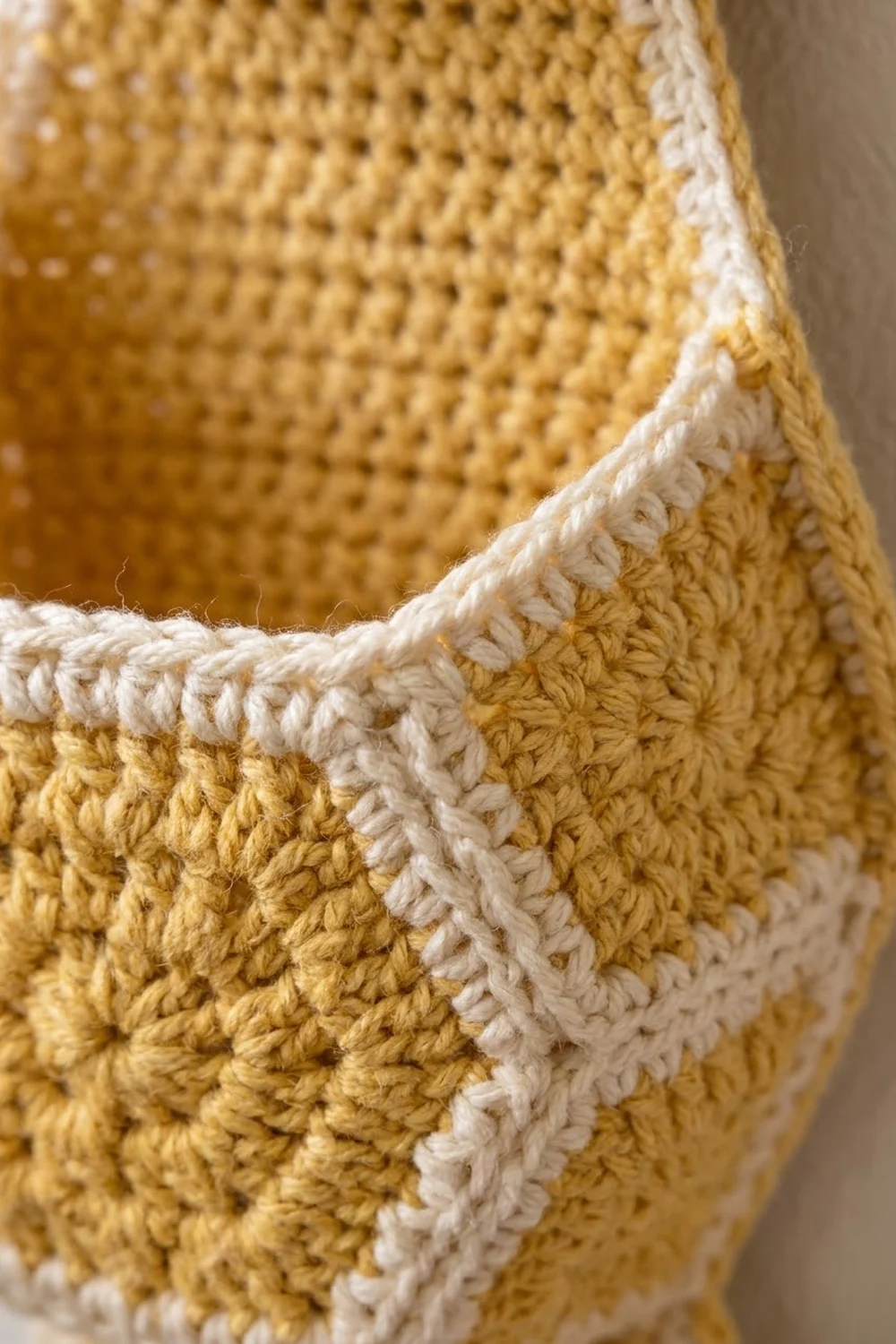
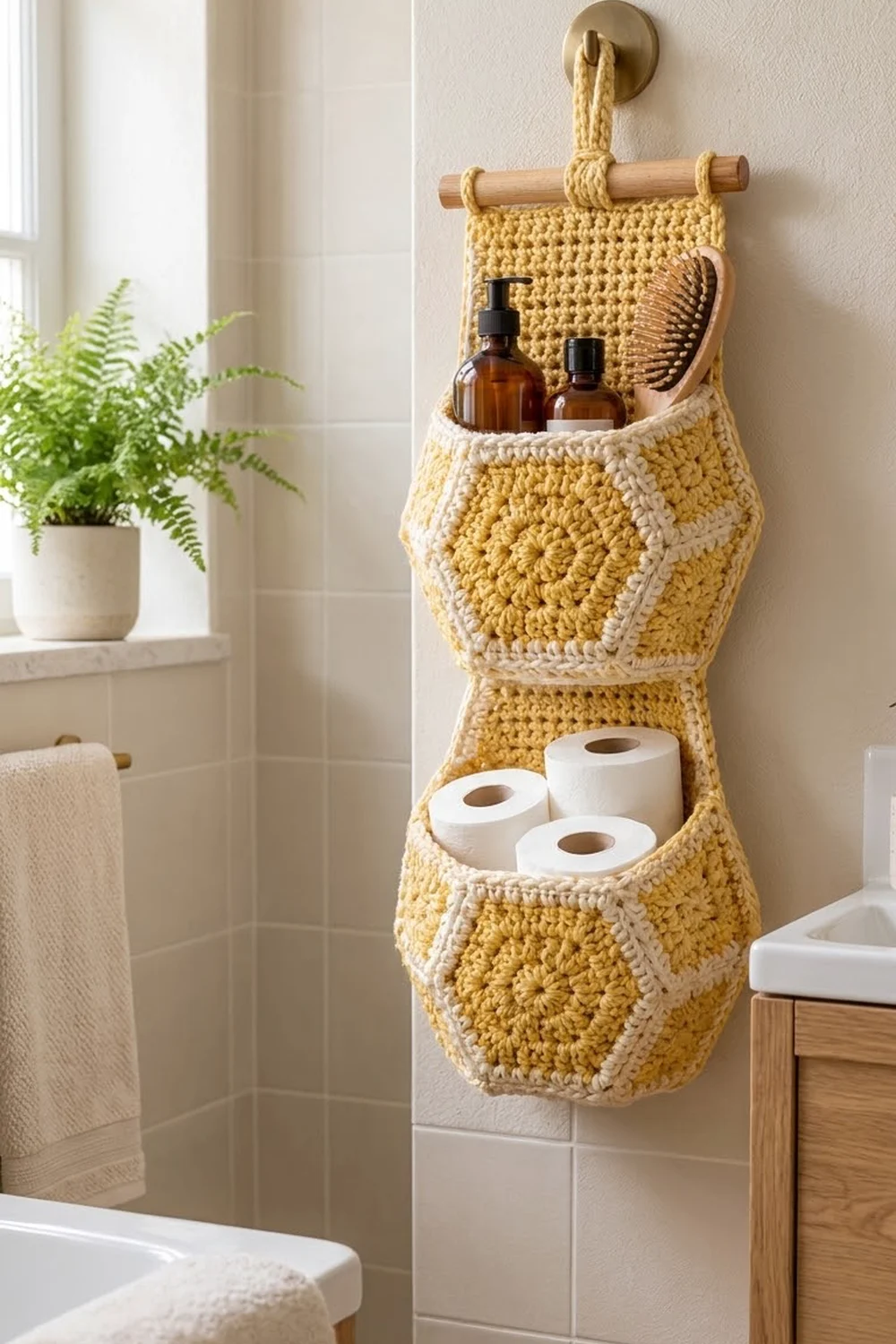
This hanging organizer pairs a long mustard backing panel with two deep pockets built from hexagon motifs. Each hexagon has a textured mustard double crochet center outlined in crisp cream single crochet, so the pockets look like faceted honeycomb bowls. A wooden dowel runs through a casing at the top, and a crocheted loop hangs it from a hook.
The palette is warm and calm. Mustard yellow is used for the panel, the hexagon centers, and the filler triangles. Cream is used for every outline, seam, and pocket rim. The pockets hold toilet paper rolls, bottles, and brushes.
This pattern uses US crochet terms. The finished organizer measures about 11″ wide x 21.875″ tall (27.9 cm x 55.6 cm), not counting the hanging loop. The backing panel is 8″ (20.3 cm) wide.
Construction is modular. You work one panel in rows, then 12 hexagons and 8 triangles. Each pocket is one base hexagon, five wall hexagons, and four triangles, all seamed stitch to stitch. A cream rim row finishes each opening, and then the pockets are whipstitched to the panel.
Finished Size and Construction
- Finished size: 11″ x 21.875″ (27.9 cm x 55.6 cm), plus a 4″ (10.2 cm) loop
- Skill level: Intermediate
- Terminology: US crochet terms
- Yarn weight: Bulky (#5)
- Hook: 6.0 mm (J-10)
- Number of pieces: 1 panel, 12 hexagons, 8 triangles, 1 strap
- Layout: 2 pockets stacked on 1 panel; each pocket = 1 base + 5 walls + 4 triangles
- Hexagon size: 3.5″ (8.9 cm) per side, 6″ (15.2 cm) flat to flat, 7″ (17.8 cm) point to point
- Triangle size: 3.5″ (8.9 cm) per side
- Panel size before border: 7.25″ x 22.5″ (18.4 cm x 57.2 cm)
- Border depth: 0.375″ (1.0 cm) panel edging and 0.375″ (1.0 cm) pocket rim
Materials
Choose a smooth bulky cotton or cotton blend with about 140 m per 100 g. Cotton holds the pocket shape and handles a damp bathroom better than soft acrylic.
- Mustard yellow: 300 g, about 420 m
- Cream: 100 g, about 140 m
These quantities include a margin of about 15-20% for gauge differences and seaming.
Tools:
- 6.0 mm (J-10) crochet hook
- Tapestry needle
- 8 locking stitch markers
- Wooden dowel, 10″ (25.4 cm) long and 0.5″ (1.3 cm) in diameter
- Measuring tape, rust-proof pins, blocking mat
- Scissors
Abbreviations (US Terms)
- ch – chain
- sl st – slip stitch
- sc – single crochet
- hdc – half double crochet
- dc – double crochet
- st(s) – stitch(es)
- sp – space
- RS / WS – right side / wrong side
Corner group: This is the set of stitches worked into one ch-2 corner space, as stated in each round: (dc, ch 2, dc), (2 hdc, ch 2, 2 hdc), or (sc, ch 2, sc). The stitches on either side of the ch-2 belong to the two sides that meet at that corner.
Gauge and Checkpoints
Make and measure one hexagon and one triangle before you start the other 18 motifs. Every seam depends on each motif edge holding exactly 10 sc and measuring 3.5″ (8.9 cm).
Panel gauge: 11 hdc and 8 rows = 4″ (10.2 cm).
Hexagon checkpoints (flat to flat):
- Round 1: 1.75″ (4.4 cm)
- Round 2: 3.0″ (7.6 cm)
- Round 3: 4.25″ (10.8 cm)
- Round 4: 5.5″ (14.0 cm)
- Round 5: 6.0″ (15.2 cm), with each side 3.5″ (8.9 cm)
Triangle checkpoints (one side):
- Round 1: 1.75″ (4.4 cm)
- Round 2: 2.75″ (7.0 cm)
- Round 3: 3.5″ (8.9 cm)
If the hexagon is too big, go down to a 5.5 mm hook. If it is too small, go up to a 6.5 mm hook. If it cups, your corners are tight, so loosen the ch-2. If it ruffles, your dc are too tall, so snug each loop to the hook. Hexagon and triangle edges must match, so use the same hook for both.
Hexagon (Make 12)
Use mustard for Rounds 1-4 and cream for Round 5. Work in the round with the RS facing, and do not turn.
Round 1 (mustard): Make a magic ring. Ch 3 (counts as dc here and throughout), dc in ring, ch 2, 2 dc in ring, ch 2; repeat from * 4 more times. Join with sl st to the top of the ch-3. (12 dc, 2 per side, 6 ch-2 corners)*
Round 2: Ch 3, dc in next dc, (dc, ch 2, dc) in corner sp, dc in next 2 dc, (dc, ch 2, dc) in corner sp; repeat from * 4 more times. Join. (24 dc, 4 per side)*
Round 3: Ch 3, dc in each dc to corner, (dc, ch 2, dc) in corner sp, dc in each dc to next corner, (dc, ch 2, dc) in corner sp; repeat from * 4 more times. Join. (36 dc, 6 per side)*
Round 4: Repeat Round 3. (48 dc, 8 per side) Fasten off mustard.
Round 5 (cream): Join cream in any corner sp. Ch 1, (sc, ch 2, sc) in same sp, sc in each of next 8 dc, (sc, ch 2, sc) in corner sp; repeat from * 4 more times, sc in each of last 8 dc. Join to first sc. (60 sc)*
Round 5 is a trim round: 48 sc worked 1 per existing dc + 12 sc added in the corners = 60 sc. Each side has 10 sc from corner to corner: 1 corner sc + 8 sc + 1 corner sc.
Fasten off. Leave a 24″ (61.0 cm) cream tail on 6 of the hexagons for seaming.
Triangle (Make 8)
The triangles fill the gaps between neighboring walls and tip the walls slightly outward into a bowl. Triangles need faster corner growth than hexagons, so Round 2 uses hdc with 2-stitch corners.
Round 1 (mustard): Make a magic ring. Ch 3, 3 dc in ring, ch 2, 4 dc in ring, ch 2; repeat from * once more. Join to the top of the ch-3. (12 dc, 4 per side, 3 ch-2 corners)*
Round 2: Ch 2 (does not count), hdc in each of next 4 dc, (2 hdc, ch 2, 2 hdc) in corner sp, hdc in each of next 4 dc, (2 hdc, ch 2, 2 hdc) in corner sp; repeat from * once more. Join to first hdc. (24 hdc, 8 per side)* Fasten off mustard.
Round 3 (cream): Join cream in any corner sp. Ch 1, (sc, ch 2, sc) in same sp, sc in each of next 8 hdc, (sc, ch 2, sc) in corner sp; repeat from * once more, sc in each of last 8 hdc. Join. (30 sc)*
Round 3 is a trim round: 24 sc worked 1 per existing hdc + 6 sc added in the corners = 30 sc. Each side has 10 sc from corner to corner, which matches a hexagon side exactly.
Backing Panel (Make 1)
Row 1 (mustard): Ch 22. Hdc in 3rd ch from hook and in each ch across. (20 hdc)
Rows 2-45: Ch 2 (does not count), turn, hdc in each st across. (20 hdc)
Do not fasten off. Checkpoint: 7.25″ x 22.5″ (18.4 cm x 57.2 cm).
Hanging Strap (Make 1)
With mustard, ch 5.
Row 1: Sc in 2nd ch from hook and in each ch across. (4 sc)
Rows 2-25: Ch 1, turn, sc in each st. (4 sc)
The strap measures about 1.5″ x 10″ (3.8 cm x 25.4 cm). Fasten off, leaving a long tail.
Make All Pieces
- Hexagons: 12 (2 bases + 10 walls)
- Triangles: 8 (4 per pocket)
- Panel: 1
- Strap: 1
Pocket layout, viewed from above with the panel at the top:
        ====== PANEL ======
   [Wall R-L]  [BASE]  [Wall R-R]
        [T]            [T]
   [Wall F-L] [Wall F] [Wall F-R]
            [T]    [T]
The back edge of the base touches the panel. Walls stand on the other 5 base edges, and one triangle sits between each pair of neighboring walls. Mark the 2 rear walls (R-L and R-R) with locking markers.
Joining
Sew every seam with cream. Use a whipstitch through the outer loops of the cream edge round, with the RS facing out.
Stitch logic: Every motif edge has 10 sc from corner to corner. Hold two edges together and match them 1 to 1: corner sc to corner sc, then the 8 side sc, then the far corner sc. Pass through the ch-2 corner spaces once at each end to close the point.
- Seam one wall hexagon to each of 5 base edges, leaving the back edge open. That is 5 x 10 = 50 sts.
- Set a triangle between each pair of neighboring walls. Starting at the shared base corner, seam one triangle edge to each wall’s lower slanted edge. That is 20 sts per triangle and 80 per pocket.
- Leave the third edge of each triangle free. It becomes part of the rim.
Keep tension even and moderate. Tight seams pucker the cream outline, and loose seams let the walls sag.
Checkpoint: Each assembled pocket should measure about 11″ (27.9 cm) across the opening, 7″ (17.8 cm) deep, and 5.75″ (14.6 cm) tall.
Border
There are two borders: a sc edging around the panel and a sc rim along each pocket opening.
Border gauge: 11 sc = 4″ (10.2 cm) along the top and bottom. Along the sides, work 4 sc per 3 hdc rows.
Panel Edging
Continue with mustard at the end of Row 45. Ch 1, do not turn.
Round 1: 3 sc in first st, sc in next 18 sts, 3 sc in last st. Work 60 sc evenly down the side (4 sc per 3 rows). Along the foundation, 3 sc in first ch, sc in next 18 ch, 3 sc in last ch. Work 60 sc up the other side. Join. (168 sc)
This is a trim round: 160 sc worked 1 per existing stitch or row group (20 + 20 + 60 + 60) + 8 sc added at the corners (2 extra in each 3-sc corner) = 168.
Per side, corner to corner and including both corner sc:
- Top: 22 sc
- Bottom: 22 sc
- Each long side: 64 sc (60 row-end sc + 2 outer corner-group sc + 2 corner sc)
- Check: 22 + 22 + 64 + 64 = 172, minus the 4 corners counted twice = 168.
Why the math works: At 11 sc per 4″, 20 sc covers 7.27″, which matches the 7.25″ (18.4 cm) panel. On the sides, 45 rows x 4/3 = 60 sc, a whole number. The edging adds 0.375″ (1.0 cm) all around, so the panel becomes 8″ x 23.25″ (20.3 cm x 59.1 cm).
Pocket Rim
Join cream at the top rear corner of one rear wall, where the pocket will meet the panel. Work one row along the opening only.
Rim row: Ch 1. Work 1 sc in each of the 8 non-corner sts on every free edge, and 1 sc through each corner or seam point between edges. (154 sc)
The opening has 17 free edges: 2 on each rear wall (top and front upper slant), 3 on each of the 3 front walls (top and both upper slants), and 1 on each of the 4 triangles. That gives 17 x 8 = 136 sts, plus 18 points (16 between edges + 2 ends), for 154 sc. Fasten off, leaving a 24″ (61.0 cm) tail.
Final Assembly
- Fold the top edging and Rows 44-45 to the WS. That fold is 1.375″ (3.5 cm). Whipstitch the edging to Row 43 to form the casing. The hanging length is now 21.875″ (55.6 cm).
- Fold the strap in half. Sew one end to the RS and one end to the WS at the top center of the casing, forming a 4″ (10.2 cm) loop.
- Center the lower pocket so its base back edge is 1″ (2.5 cm) above the bottom edge, and pin it. Pin the upper pocket’s base back edge 10″ (25.4 cm) above the bottom edge.
- Whipstitch each base back edge (10 sts) to the panel. Ease the 2 back edges of each rear wall against the panel and whipstitch them, 20 sts per rear wall.
- Slide in the dowel so 1″ (2.5 cm) extends past each side. Wrap each end 8 times with mustard and knot it.
Final Blocking
- Remove the dowel.
- Mist the panel and pockets with cool water until damp.
- Pin the panel flat to 8″ x 21.875″ (20.3 cm x 55.6 cm), RS up.
- Fill each pocket with a folded towel so the walls flare evenly.
- Shape the cream rims so the hexagon tops sit level.
- Let it dry fully, at least 24 hours, then put the dowel back in.
Final Quality-Control Checklist
- Every hexagon measures 6″ (15.2 cm) flat to flat and has 60 sc in Round 5.
- Every triangle has 30 sc and 3.5″ (8.9 cm) sides.
- No ch-2 corner holes are open at seam points.
- Each rim row has 154 sc.
- The panel edging has 168 sc and lies flat.
- The pocket bases sit 1″ (2.5 cm) and 10″ (25.4 cm) above the bottom edge.
- The strap is sewn through both casing layers.
- All tails are woven in at least 2″ (5.1 cm) and trimmed.
Troubleshooting
Hexagon cups: The corners are too tight. Loosen the ch-2 or go up a hook size.
Hexagon ruffles: The dc are too tall. Snug each loop or go down a hook size.
Triangle edge shorter than hexagon edge: Make the Round 2 hdc slightly taller, or work Round 3 with the next hook size up.
Walls lean inward: The seams are too tight. Re-seam the triangles with looser tension.
Pocket drags the panel: Add a second line of stitches 0.25″ (0.6 cm) above the base seam.
Long sides wave: There are too many sc. Recount to 60 row-end sc per side.
Care
Remove the dowel. Hand wash in cool water with mild soap, press out the water in a towel, and dry flat with the pockets filled.
Final Notes
The measurement chain is short. Each 3.5″ (8.9 cm) motif edge holds 10 sc, and matching those 1 to 1 builds two 11″ (27.9 cm) pockets. The 7.25″ x 22.5″ (18.4 cm x 57.2 cm) panel plus a 0.375″ (1.0 cm) edging becomes 8″ x 23.25″ (20.3 cm x 59.1 cm). The 1.375″ (3.5 cm) casing fold then gives a hanging length of 21.875″ (55.6 cm). If each link checks out, the organizer comes together cleanly.
Happy crocheting!