

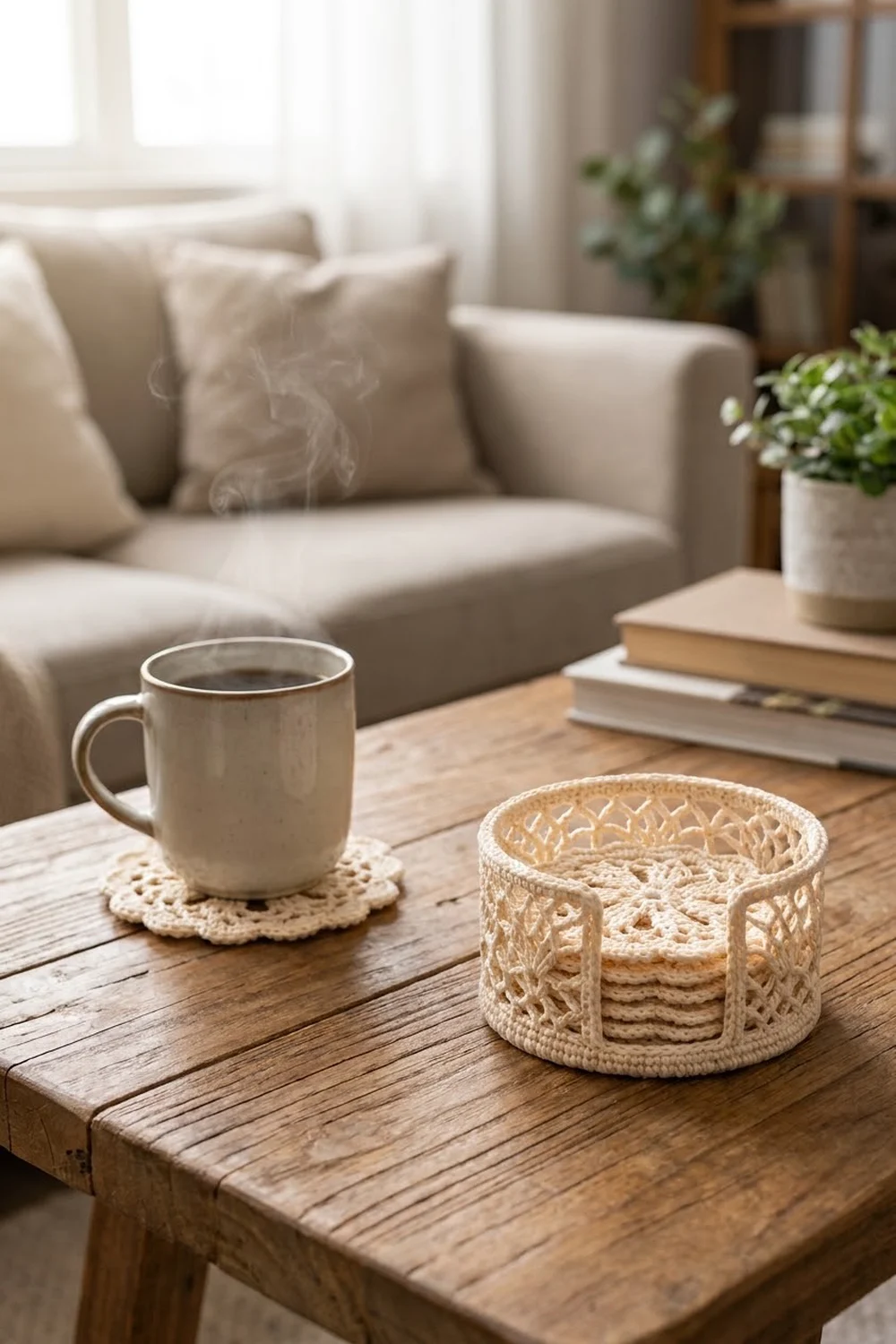
The Ivory Bloom set is six lacy flower coasters and a matching round holder with open lace walls. Each coaster has a small open ring at the center, eight long petals, a ring of chain-loop lace, and a soft scalloped edge. The holder has a solid round base and two curved lace panels. Two wide slots between the panels let the stacked coasters show from the front and back.
The whole set uses one color, a warm cream cotton. Keeping to one color shows off the stitch texture and suits a farmhouse, cottage, or holiday table. This pattern uses US crochet terms throughout.
Each finished coaster is 4.5 in (11.4 cm) across. The holder is 5.25 in (13.3 cm) across and 2 in (5.1 cm) tall.
To make the set, you work each coaster in joined rounds from a magic ring. For the holder, you work the base as a flat single crochet circle and turn it up with one back-loop round. Then you work two lace panels back and forth directly off that round, so there is nothing to sew. A two-round rim finishes the holder.
Finished Size and Construction
- Coaster size: 4.5 in (11.4 cm) diameter
- Holder size: 5.25 in (13.3 cm) diameter, 2 in (5.1 cm) tall
- Skill level: Intermediate
- Terminology: US terms
- Yarn weight: DK / light worsted (#3) cotton
- Hook: 3.5 mm (E-4)
- Number of pieces: 7 (6 coasters + 1 holder)
- Layout: Coasters stack loose inside the holder; nothing is joined
- Coaster size before border: 3.5 in (8.9 cm) after Round 6
- Coaster border depth: 0.5 in (1.3 cm) on every side (Rounds 7–8)
Materials
Yarn. Use a smooth, mercerized or combed cotton in DK weight, about 200 m per 100 g. Cotton handles warm mugs well and gives clear stitch definition. Avoid acrylic, because heat can make it go limp.
- Cream: 100 g, about 200 m (219 yd) in total
- Each coaster: about 8 g / 16 m
- Holder: about 28 g / 56 m
These quantities include a margin of about 25% for your gauge swatch and any ripping back.
Tools:
- 3.5 mm (E-4) crochet hook
- Tapestry needle
- 4 locking stitch markers
- Scissors
- Blocking mat and rustproof pins
- Spray bottle with water
- Ruler or tape measure
Abbreviations (US Terms)
- ch – chain
- sl st – slip stitch
- sc – single crochet
- dc – double crochet
- sp – space
- st(s) – stitch(es)
- BLO – back loop only
- RS / WS – right side / wrong side
- rev sc – reverse single crochet (crab stitch)
Special stitch – rev sc: Work single crochet from left to right (right to left if you crochet left-handed). Insert the hook into the next st to the right, yarn over, pull up a loop, yarn over, and pull through both loops. This makes the corded rim on the holder.
Note: The ch 3 at the start of a dc round or row counts as 1 dc.
Gauge and Checkpoints
Make one coaster before anything else. It is your gauge swatch.
- Coaster gauge: Round 1 (16 dc in a ring) = 1 in (2.5 cm) across.
- Holder gauge: 19 sc and 20 rounds = 4 in (10.2 cm) in a flat circle.
Coaster checkpoints (lightly pressed flat):
- After Round 1: 1 in (2.5 cm)
- After Round 4: 2.25 in (5.7 cm)
- After Round 6: 3.5 in (8.9 cm)
- After Round 8: 4.5 in (11.4 cm)
Holder checkpoints:
- After Round 6: 2.4 in (6.1 cm)
- After Round 13: 5.25 in (13.3 cm)
- After the panels: 1.75 in (4.4 cm) tall
- After the rim: 2 in (5.1 cm) tall
If your piece is too big: go down to a 3.25 mm hook.
If it is too small: go up to a 3.75 mm hook.
If a coaster cups (bowls upward), your chains are too tight, so relax your chain tension. If it ruffles, your chains are too loose. The holder base must be at least 0.75 in (1.9 cm) wider than your coasters so they drop in easily.
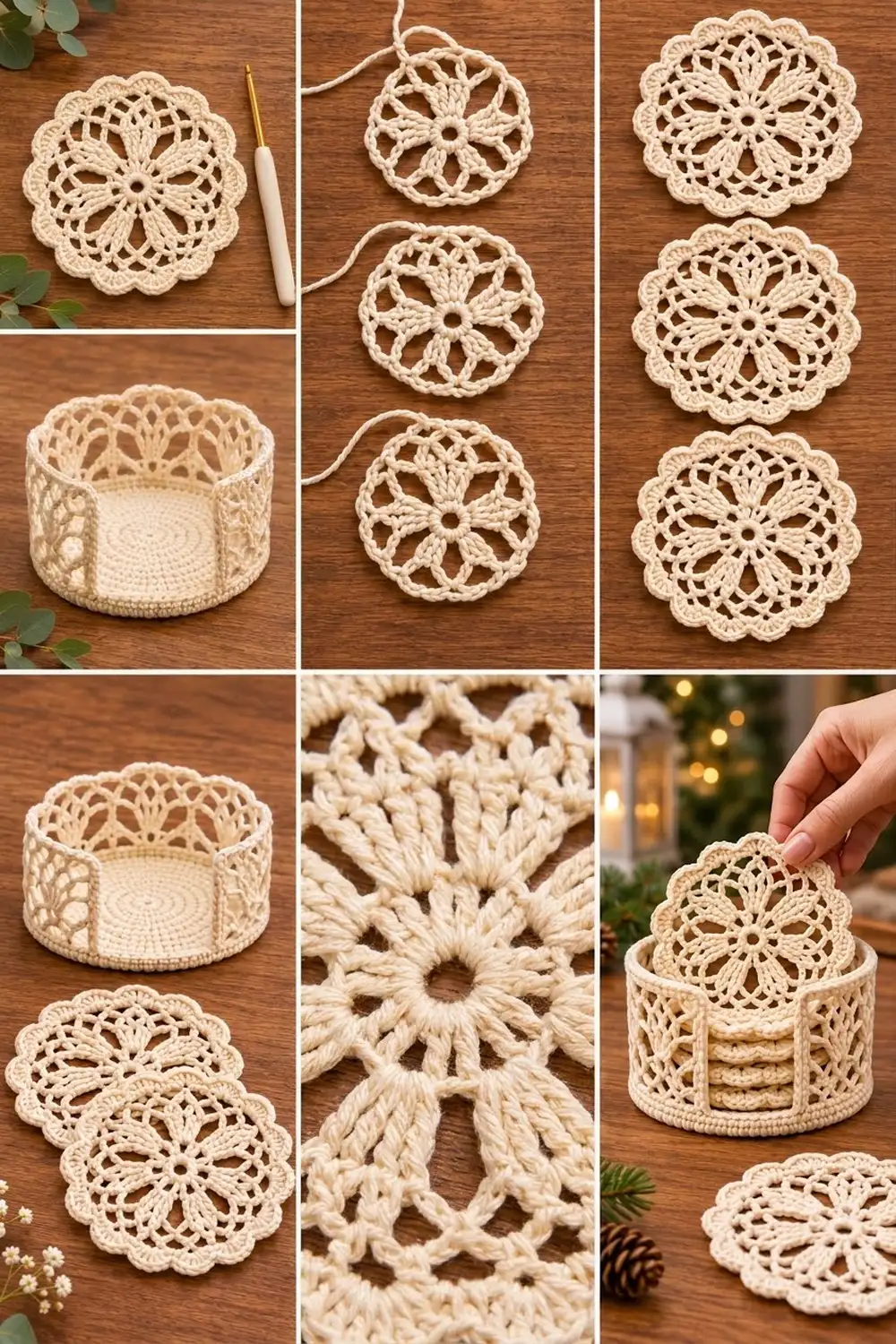
Coaster Pattern
Make a magic ring.
Round 1: Ch 3, work 15 dc in the ring, join with a sl st to the top of the beginning ch-3. Pull the ring closed, leaving a small open center. (16 dc)
Round 2: Ch 1, sc in the same st, ch 3, skip 1 st, sc in the next st, ch 3, skip 1 st; repeat from * 6 more times, join to the first sc. (8 sc, 8 ch-3 sps)*
Round 3 (petal base): Sl st into the first ch-3 sp. Ch 3, then work (dc, ch 2, 2 dc) in the same sp, ch 1. Work (2 dc, ch 2, 2 dc) in the next ch-3 sp, ch 1; repeat from * 6 more times, join. (32 dc in 8 shells, 8 ch-2 tips, 8 ch-1 sps)*
Round 4 (petal growth): Sl st in the next dc and into the ch-2 tip. Ch 3, then work (2 dc, ch 2, 3 dc) in the same sp, ch 3. Work (3 dc, ch 2, 3 dc) in the next ch-2 tip, ch 3; repeat from * 6 more times, join. (48 dc in 8 shells, 8 ch-2 tips, 8 ch-3 sps)*
Round 5 (petal points): Sl st in the next 2 dc and into the ch-2 tip. Ch 3, then work (dc, ch 3, 2 dc) in the same tip, ch 4, sc in the next ch-3 sp, ch 4. Work (2 dc, ch 3, 2 dc) in the next ch-2 tip, ch 4, sc in the next ch-3 sp, ch 4; repeat from * 6 more times, join. (32 dc, 8 sc, 8 ch-3 tips, 16 ch-4 sps)*
Each petal now narrows from 6 dc to 4 dc, which gives the long, tapered petal shape.
Round 6 (lace ring): Sl st in the next dc and into the ch-3 tip. Ch 1, sc in the same tip, ch 6, skip the ch-4 sp, sc in the next sc, ch 6, skip the ch-4 sp. Sc in the next ch-3 tip, ch 6, skip the ch-4 sp, sc in the next sc, ch 6, skip the ch-4 sp; repeat from * 6 more times, join to the first sc. (16 sc, 16 ch-6 loops)*
Checkpoint: The coaster should measure 3.5 in (8.9 cm) across. The border rounds come next.
Make All Pieces
All pieces are cream.
- Coasters: 6 (Rounds 1–8 each)
- Holder: 1 (base, two panels, rim)
Text layout of the set (side view of the stacked coasters in the holder):
  [panel A]  slot  [panel B]  slot
  |  coaster 6 (top)       |
  |  coaster 5             |
  |  coaster 4             |
  |  coaster 3             |
  |  coaster 2             |
  |  coaster 1             |
  [====== base, 78 sc ======]
Holder Pattern
Base
Make a magic ring.
Round 1: Ch 1, work 6 sc in the ring, join to the first sc. (6 sc)
Round 2: Ch 1, 2 sc in each st around, join. (12 sc)
Rounds 3–13: Ch 1, *sc in the next N sts, 2 sc in the next st; repeat from * 5 more times, join. N is 1 on Round 3 and goes up by 1 each round, so it reaches 11 on Round 13.
The total for each round is 6 times the round number:
| Round | 3 | 4 | 5 | 6 | 7 | 8 | 9 | 10 | 11 | 12 | 13 |
|---|---|---|---|---|---|---|---|---|---|---|---|
| Stitches | 18 | 24 | 30 | 36 | 42 | 48 | 54 | 60 | 66 | 72 | 78 |
To keep the circle round instead of hexagonal, stagger the increases. On even rounds, work half of the plain stitches before the first increase.
Round 14 (turning round): Ch 1, sc in BLO of each st around, join. (78 sc) The unused front loops form the raised ridge at the bottom edge. Fasten off.
Joining: Placing the Wall Panels
The holder has no separate pieces to sew. Instead, you “join” the walls by working each panel straight into Round 14, stitch for stitch.
Placement: Number the Round 14 stitches 1–78, starting at the join. Place a marker in stitches 1, 25, 40, and 64.
- Stitches 1–24: Panel A (24 sts)
- Stitches 25–39: front slot (15 sts)
- Stitches 40–63: Panel B (24 sts)
- Stitches 64–78: back slot (15 sts)
Check the math: 24 + 15 + 24 + 15 = 78. ✓
Panel (make 2). With the outside of the holder facing, join yarn in stitch 1 for Panel A or stitch 40 for Panel B.
Row 1 (RS, fans): Ch 3, dc in the next st. Skip 2 sts, 5 dc in the next st, skip 2 sts; repeat from * 3 more times. Dc in the last 2 panel sts, turn. (24 dc: 2 edge dc + 4 fans + 2 edge dc)*
Row 2 (WS, net): Ch 3, dc in the next dc, ch 2. Sc in the center (3rd) dc of the next fan, ch 5; repeat from * 2 more times. Sc in the center dc of the last fan, ch 2, dc in the last 2 dc, turn. (4 dc, 4 sc, 3 ch-5 loops, 2 ch-2 sps)*
Row 3 (RS, fans): Ch 3, dc in the next dc, ch 1, sc in the first sc. Work 6 dc in the next ch-5 loop, sc in the next sc; repeat from * 2 more times. Ch 1, dc in the last 2 dc, turn. (4 edge dc, 18 fan dc, 4 sc, 2 ch-1 sps)*
Row 4 (WS, top band): Ch 1, sc in the first 2 dc, sc in the ch-1 sp. Skip the next sc, sc in each of the next 6 dc; repeat from * 2 more times. Skip the last sc, sc in the ch-1 sp, sc in the last 2 dc. Fasten off. (2 + 1 + 18 + 1 + 2 = 24 sc)*
Tension: Work Row 1 a little loosely so the panel stands straight and does not pull the base inward.
Size checkpoint: Each panel measures 1.75 in (4.4 cm) tall, including Round 14. It spans about 5 in (12.7 cm) of the curve, and each slot is about 3.2 in (8.1 cm) wide.
Border
Coaster Border (Rounds 7–8)
Border gauge: 64 sc in Round 7 = 3.75 in (9.5 cm) across.
Round 7 (conversion round): Sl st into the first ch-6 loop. Ch 1, work 4 sc in each ch-6 loop around, join. (16 loops × 4 sc = 64 sc) This round turns the open loops into a solid band.
Round 8 (scallops): Ch 1, sc in the first st, skip 1, 5 dc in the next st, skip 1. Sc in the next st, skip 1, 5 dc in the next st, skip 1; repeat from * 14 more times. Join to the first sc and fasten off. (16 scallops: 16 sc + 80 dc)*
Why the math works:
- Each scallop uses exactly 4 stitches of Round 7 (sc, skip, shell, skip), and 64 ÷ 4 = 16 scallops with nothing left over.
- That gives 2 scallops per petal, so the edge stays lined up with the flower.
- Rounds 7–8 add 0.5 in (1.3 cm) all around: 3.5 in + 0.5 in + 0.5 in = 4.5 in (8.9 cm becomes 11.4 cm).
Holder Rim (2 rounds)
Rim gauge: 1 sc per sc stitch, 2 sc per dc row end, and 1 sc per sc row end.
Rim Round 1: With the outside facing, join yarn at the bottom right corner of Panel A (in Round 14). Work around the holder as follows, then join to the first sc.
- Up the side edge: 8 sc (1 in the Round 14 row end, 2 in each of Rows 1–3, 1 in Row 4)
- Along the top: 28 sc (24 sts, with 3 sc in each top corner stitch, which adds 4)
- Down the other side: 8 sc
- Across the slot: 15 sc, 1 in each of the 15 free Round 14 slot stitches
- Repeat the same counts for Panel B and the second slot.
Per panel: 8 + 28 + 8 = 44 sc.
Total: 44 + 15 + 44 + 15 = 118 sc.
Rim Round 2: Ch 1, rev sc in each st around, join. (118 rev sc) Fasten off.
Why the math works:
- The corner increases only count once, inside the 28 top stitches. The side edges do not include any corner stitches.
- Each slot uses the same 15 stitches you left free in Round 14, so the rim lies flat without gathering.
Final Blocking
- Weave in all ends along solid stitches. Avoid weaving through chain loops.
- Soak the coasters in cool water for 10 minutes, then gently squeeze out the water. Do not wring.
- Pin each coaster to a 4.5 in (11.4 cm) circle. Put one pin at the tip of every petal and one at the center of every scallop.
- Open each ch-6 loop of Round 6 evenly with your fingers.
- For the holder, spray it until damp. Stuff it firmly with a 5 in (12.7 cm) jar or a rolled towel.
- Pin the panel top corners straight up so the slot edges stand vertical.
- Let everything dry completely, which takes about 24 hours.
Final Quality-Control Checklist
- [ ] Every coaster has 8 petals and 16 scallops.
- [ ] Every coaster measures 4.5 in (11.4 cm) across, within 0.1 in (0.3 cm) of each other.
- [ ] The coaster centers are small open rings and are not puckered.
- [ ] The holder base measures 5.25 in (13.3 cm) and lies flat.
- [ ] Each panel has 24 stitches across Row 4, and each slot has 15 stitches.
- [ ] The rim has 118 stitches, and all 4 top corners are square.
- [ ] Six coasters drop in and lift out easily.
- [ ] All ends are secured and invisible.
Troubleshooting
Coaster cups upward: Your chains are too tight. Loosen your ch-6 loops in Round 6, or re-work that round using a 3.75 mm hook for the chains.
Coaster ruffles: Your chains are too loose. Work the Round 6 loops as ch 5, and keep 4 sc per loop in Round 7.
Petals lean or twist: You may have started a shell in the wrong space. Check that every shell in Rounds 3–5 sits in the space or tip directly above the previous shell.
Scallop count is off: Round 7 must have exactly 64 sc. Count it before you start Round 8.
Base looks hexagonal: Stagger the increases as described, then steam-block the base over a flat surface.
Panels flop outward: Re-work the panels with a 3.25 mm hook, and keep the rim stitches firm.
Coasters fit too tightly: Add one more increase round (84 sc) before the turning round. Then divide the stitches as 24 + 18 + 24 + 18.
Care
Hand wash in cool water with mild soap, press out the water gently, and lay flat to dry. Reshape the scallops and panel corners while the pieces are damp.
Final Notes
Everything here builds on one measurement chain:
- Coaster: 1 in (2.5 cm) after Round 1, 3.5 in (8.9 cm) after Round 6, and 4.5 in (11.4 cm) after the border.
- Holder: 78 stitches at 5.25 in (13.3 cm), split 24 + 15 + 24 + 15, with 118 stitches in the rim, for a finished height of 2 in (5.1 cm).
If your first coaster matches its checkpoints, every other piece will match too. Happy crocheting!