
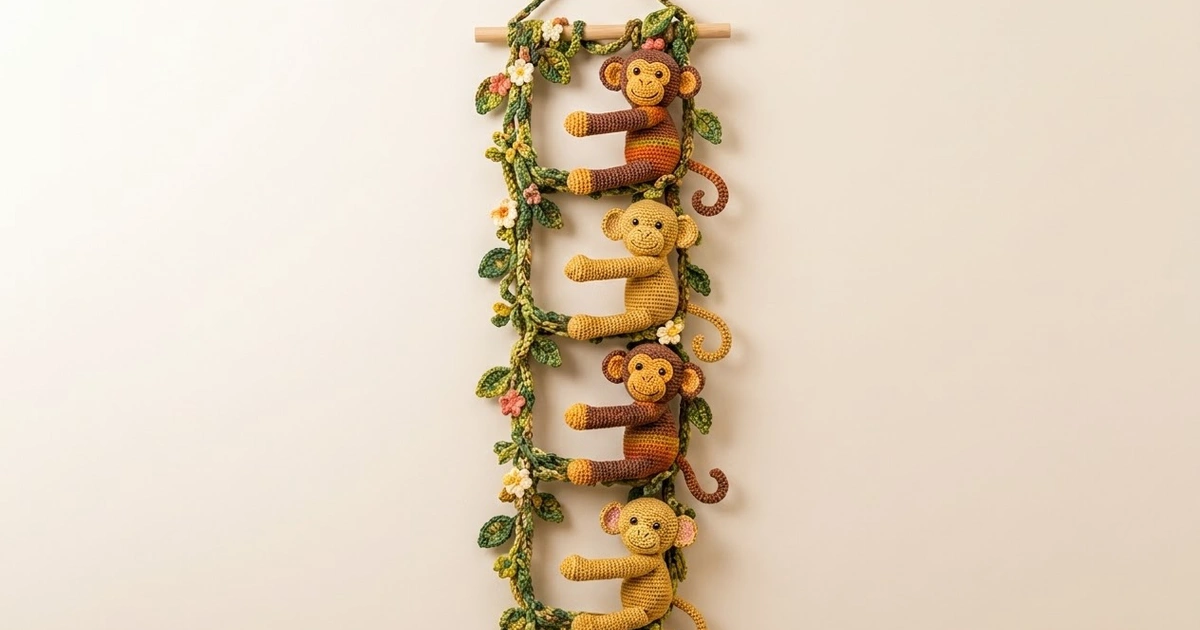
This hanging toilet paper holder turns a plain bathroom wall into a little jungle. Four amigurumi monkeys sit on the rungs of a leafy vine ladder. Each one hugs a spare roll with long, bendable arms and legs, and their curled tails hang below.
The monkeys are chocolate brown, rust, mustard and honey gold, and the vines are moss, forest and olive green. Small flowers in cream, soft pink and orange add some brightness. Brown and golden monkeys alternate down the ladder, two of each.
The pattern uses US crochet terms. The finished ladder is 8 in (20.3 cm) wide and 28 in (71.1 cm) long below a 12 in (30.5 cm) dowel. Each monkey sits about 6 in (15.2 cm) tall.
Construction is simple and modular. Crochet the monkey parts in spiral rounds. Work the ladder rails and rungs as flat two-row strips with two strands held together. Then sew everything together, add a slip stitch vine edge, and spread leaves and flowers along the frame.
Finished Size and Construction
- Finished size: 8 in × 28 in (20.3 × 71.1 cm) hanging frame, plus dowel and hanger
- Skill level: Intermediate
- Terminology: US
- Yarn weight: Worsted (#4)
- Hooks: 3.5 mm (E-4) for monkeys, leaves and flowers; 5.5 mm (I-9) for the frame
- Number of pieces: 4 monkeys (11 parts each), 2 rails, 4 rungs, 1 hanger, 32 leaves, 12 flowers
- Layout: 1 column of 4 bays, one monkey per bay
- Piece size: each bay 6 in (15.2 cm) tall × 7 in (17.8 cm) wide inside the rails
- Size before border: 8 in × 28 in (20.3 × 71.1 cm)
- Border depth: one slip stitch row, adds no measurable width
Materials
Use a smooth worsted acrylic or cotton blend for the monkeys so the stitches stay tight and the stuffing doesn’t show through. For the vines, a slightly heathered or variegated green gives the rope texture seen on the frame. Amounts assume about 170 m per 100 g.
- A – Chocolate Brown: 90 g / 153 m
- B – Rust Orange: 20 g / 34 m
- C – Mustard Gold: 30 g / 51 m
- D – Honey Gold: 110 g / 187 m
- E – Pale Wheat: 10 g / 17 m
- F – Soft Pink: 10 g / 17 m
- G – Cream: 10 g / 17 m
- H – Variegated Moss Green: 30 g / 51 m
- I – Forest Green: 30 g / 51 m
- J – Olive Green: 10 g / 17 m
All quantities include a margin of roughly 15–20% for gauge differences, sewing tails and color changes.
Tools and notions:
– 3.5 mm (E-4) and 5.5 mm (I-9) hooks
– 8 black safety eyes, 9 mm
– 120 g polyester fiberfill
– 20 chenille stems, 12 in (30.5 cm) each
– Wooden dowel, 12 in (30.5 cm) long, 1/2 in (1.3 cm) diameter
– Stitch markers, tapestry needle, scissors, pins
Abbreviations (US Terms)
- ch – chain
- sl st – slip stitch
- sc – single crochet
- hdc – half double crochet
- dc – double crochet
- inc – 2 sc in the same stitch
- dec – single crochet 2 together (invisible decrease recommended)
- MR – magic ring
- st(s) – stitch(es)
- Rnd – round
Special stitch – Petal: (sl st, ch 2, 2 dc, ch 2, sl st) all in the same stitch.
Gauge and Checkpoints
Make one complete brown monkey before anything else. It tests your tension, your yarn amounts and your stuffing style.
- Monkey gauge: 5 sc and 5 rounds = 1 in (2.5 cm) with 3.5 mm hook.
- Frame gauge: 4 sc and 4 rows = 1 in (2.5 cm) with 5.5 mm hook and H + I held together.
Checkpoints:
– Head after Rnd 7, laid flat: 2.7 in (6.9 cm) across.
– Body after Rnd 5, laid flat: 1.9 in (4.8 cm) across.
– Finished arm: 6 in (15.2 cm). Finished leg: 5 in (12.7 cm). Tail: 7 in (17.8 cm).
– Frame swatch of 16 sc × 4 rows: 4 in × 1 in (10.2 × 2.5 cm).
If your pieces are too big, go down 0.5 mm. If they are too small, go up 0.5 mm. For the frame, length matters most: each rail must measure 30 in (76.2 cm) so the bays stay 6 in (15.2 cm) tall.
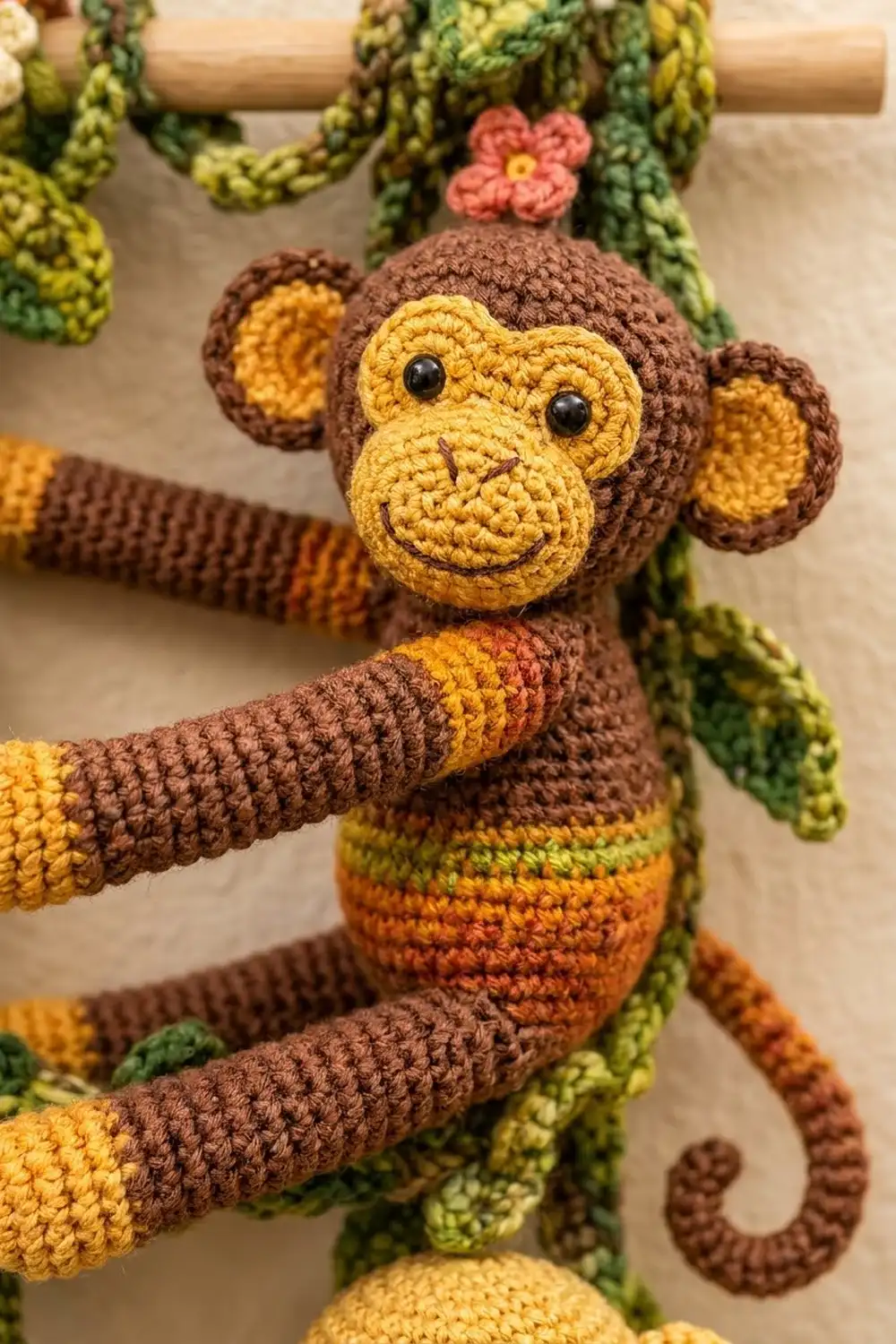
Monkey Pattern
Work in continuous spiral rounds unless told otherwise. Mark the first stitch of each round. Colors are listed as brown monkey / golden monkey.
Head (A / D)
- Rnd 1: 6 sc in MR. (6)
- Rnd 2: inc in each st. (12)
- Rnd 3: (sc, inc) × 6. (18)
- Rnd 4: (2 sc, inc) × 6. (24)
- Rnd 5: (3 sc, inc) × 6. (30)
- Rnd 6: (4 sc, inc) × 6. (36)
- Rnd 7: (5 sc, inc) × 6. (42)
- Rnds 8–14: sc in each st. (42)
- Rnd 15: (5 sc, dec) × 6. (36)
- Rnd 16: (4 sc, dec) × 6. (30)
Sew on the face patch and insert the eyes now (see Monkey Assembly), then stuff firmly.
- Rnd 17: (3 sc, dec) × 6. (24)
- Rnd 18: (2 sc, dec) × 6. (18)
- Rnd 19: (sc, dec) × 6. (12)
- Rnd 20: dec × 6. (6)
Finish stuffing, fasten off and close.
Face Patch (C / E), Worked Flat in Joined Rounds
- Rnd 1: ch 9. Sc in 2nd ch from hook, sc in next 6, 3 sc in last ch; working along the other side, sc in next 6, 2 sc in same ch as first sc. (18)
- Rnd 2: inc, sc in next 6, inc in each of next 3, sc in next 6, inc in each of next 2. Sl st to join. (24)
Fasten off with a long tail. The patch measures about 2 in × 1.2 in (5.1 × 3.0 cm).
Muzzle (C / E)
- Rnd 1: ch 7. Sc in 2nd ch from hook, sc in next 4, 3 sc in last ch; along the other side, sc in next 4, 2 sc in same ch as first sc. (14)
- Rnd 2: inc, sc in next 4, inc in each of next 3, sc in next 4, inc in each of next 2. (20)
- Rnd 3: sc in each st. (20)
Fasten off with a long tail. The muzzle measures about 1.8 in × 1 in (4.6 × 2.5 cm).
Ears (Make 2)
- Rnd 1: with C / F, 6 sc in MR. (6)
- Rnd 2: inc in each st. (12)
- Rnd 3: change to A / D, (sc, inc) × 6. Sl st to join. (18)
Fasten off with a long tail. Each ear is 1.1 in (2.8 cm) across.
Body (Worked from the Base Up)
Brown monkey stripes: Rnds 1–6 B, Rnds 7–8 C, Rnds 9–10 B, Rnds 11–19 A. Golden monkey: all D.
- Rnds 1–5: work as Head Rnds 1–5. (30)
- Rnds 6–15: sc in each st. (30)
- Rnd 16: (3 sc, dec) × 6. (24)
- Rnd 17: sc in each st. (24)
- Rnd 18: (2 sc, dec) × 6. (18)
- Rnd 19: sc in each st. (18)
Stuff firmly. Leave the top open and leave a long tail.
Arms (Make 2)
Brown monkey: Rnds 1–7 C, Rnds 8–30 A. Golden monkey: all D.
- Rnd 1: 6 sc in MR. (6)
- Rnd 2: inc in each st. (12)
- Rnd 3: (sc, inc) × 6. (18)
- Rnds 4–6: sc in each st. (18)
- Rnd 7: (sc, dec) × 6. (12)
- Rnds 8–30: sc in each st. (12)
Stuff the hand firmly. Fold a chenille stem in half, push it down to the hand, and stuff the arm lightly around it. Leave the end open.
Legs (Make 2)
Work as for the Arms, but stop after Rnd 25 (Rnds 8–25 in A / D). Insert a folded chenille stem and stuff lightly.
Tail
With A / D, work 6 sc in MR (6). Rnds 2–35: sc in each st (6). Insert a folded chenille stem with no stuffing, and curl the last 2 in (5.1 cm) into a spiral.
Frame Pattern
Use the 5.5 mm hook with H and I held together.
Rails (Make 2)
- Foundation: ch 121.
- Row 1: sc in 2nd ch from hook and in each ch across. (120)
- Row 2: ch 1, turn, sc in each st. (120)
Fasten off. Each rail measures 30 in × 1/2 in (76.2 × 1.3 cm). Number the stitches 1–120 from the top.
Rungs (Make 4)
- Foundation: ch 29.
- Row 1: sc in 2nd ch from hook and in each ch across. (28)
- Row 2: ch 1, turn, sc in each st. (28)
Each rung measures 7 in (17.8 cm).
Hanger
Ch 60, about 15 in (38.1 cm) long. Fasten off, leaving 6 in (15.2 cm) tails at both ends.
Leaves (Make 32: 12 in H, 10 in I, 10 in J)
Use the 3.5 mm hook and a single strand.
Ch 8. Sl st in 2nd ch from hook, sc in next, hdc in next, dc in next 2, hdc in next, sc in last ch (7 sts). Ch 2 for the tip. Working along the other side of the chain: sc, hdc, dc, dc, hdc, sc, sl st (7 sts). Total: 14 sts plus the ch-2 tip. Fasten off with a tail. Each leaf is 1.5 in × 0.75 in (3.8 × 1.9 cm).
Flowers (Make 12: 4 Each in G, F and B)
- Rnd 1: with C, 5 sc in MR, sl st to join. Fasten off. (5)
- Rnd 2: join petal color, Petal in each st around. (5 petals)
Each flower is 1.25 in (3.2 cm) across.
Make All Pieces
- Brown monkeys (2): head, body, 2 arms, 2 legs and tail in A, with the body striped in B and C. Face patch, muzzle and inner ears in C.
- Golden monkeys (2): all main parts in D. Face patch and muzzle in E; inner ears in F.
- Frame: 2 rails, 4 rungs and 1 hanger in H + I.
- Trims: 32 leaves and 12 flowers.
Layout (top to bottom):
[ Dowel + hanger ]
| Bay 1: Brown monkey   |
|======= Rung 1 ========|
| Bay 2: Golden monkey  |
|======= Rung 2 ========|
| Bay 3: Brown monkey   |
|======= Rung 3 ========|
| Bay 4: Golden monkey  |
|======= Rung 4 ========|
  vine tails   vine tails
Joining
Monkey Assembly
- Pin the face patch over Rnds 8–13 of the head, centered on the front. Whipstitch around its edge.
- Insert the safety eyes through the patch and head between Rnds 10 and 11, 7 sts apart. Secure the backs, then finish the head.
- Sew the muzzle over Rnds 12–16, overlapping the lower edge of the patch. Stuff it lightly before closing. With A, embroider two nostril stitches and a wide smile.
- Sew the ears to the sides of the head at Rnds 8–12, cupped forward.
- Sew the body’s 18-st opening to the underside of the head around Rnds 17–18, one body stitch to one head stitch.
- Flatten each arm opening to 6 sts per layer and sew it across the side of the body at Rnds 15–16. Sew the legs the same way at the front of Rnds 5–6.
- Sew the tail to the back at Rnd 4.
Frame Assembly
Stitch map for each rail:
– Sleeve: sts 1–8
– Bay 1: sts 9–32
– Rung 1: sts 33–34
– Bay 2: sts 35–58
– Rung 2: sts 59–60
– Bay 3: sts 61–84
– Rung 3: sts 85–86
– Bay 4: sts 87–110
– Rung 4: sts 111–112
– Vine tail: sts 113–120
- Lay the rails parallel, 7 in (17.8 cm) apart.
- Whipstitch each rung end to the inner edge of both rails. The 2 row-ends of the rung match the 2 rail stitches listed above, one to one.
- Fold sts 1–8 of each rail over the dowel to the back and sew st 1 to the back of st 9.
- Tie the hanger ends around the dowel just outside the sleeves.
Keep the whipstitches snug but not tight, because pulled seams make the rungs dip. Checkpoint: the frame now measures 8 in × 28 in (20.3 × 71.1 cm) below the dowel.
Seating the Monkeys
Sew each monkey’s base across rung sts 19–26. Tack its back to the right rail 4–11 sts above its rung: rail sts 22–29, 48–55, 74–81 and 100–107. Rung sts 1–18 stay open for the roll. At 4 sts per inch, 18 sts = 4.5 in (11.4 cm), the width of a standard roll.
Border: Vine Edge, Leaves and Flowers
Border gauge: 4 sl st = 1 in (2.5 cm), H + I held together, 5.5 mm hook.
Vine Edge Row: work along the outer long edge of each rail (the edge with no rungs). Sl st in each st from st 1 to st 120.
– Left rail: 120 sl st
– Right rail: 120 sl st
– Inner edges and rungs: 0
Leaves: sew 12 leaves along the outer edge of each rail at sts 12, 21, 30, 39, 48, 57, 66, 75, 84, 93, 102 and 111 (24 leaves). Alternate the colors and angle the tips outward. Sew 2 leaves to each rung at rung sts 4 and 15 (8 leaves).
Flowers: sew 5 flowers to each rail at sts 16, 40, 64, 88 and 112 (10 flowers), plus 1 on the front of each sleeve (2 flowers).
Why the math works:
– A slip stitch row worked 1 per stitch adds no length, so each rail stays 120 sts = 30 in (76.2 cm).
– The sleeve uses 8 sts (2 in, 5.1 cm), leaving 112 sts = 28 in (71.1 cm) hanging.
– Four bays of 24 sts plus four rungs of 2 sts = 104 sts = 26 in (66.0 cm). The 8-st vine tail adds 2 in (5.1 cm): 104 + 8 = 112.
– Across, 28 rung sts = 7 in (17.8 cm), plus two 1/2 in (1.3 cm) rails = 8 in (20.3 cm).
– Leaves every 9 sts and flowers every 24 sts repeat evenly within that map.
Final Blocking
- Pin each leaf and flower flat on a blocking mat. Mist them and let them dry fully.
- Lay the assembled frame face down, smooth the rails straight and pin at each rung.
- Hover steam over the rails only (never press acrylic). Let them cool before unpinning.
- Do not steam the monkeys. Reshape them by hand and bend the wired limbs into position.
- Twist the vine tails gently and curl the monkey tails.
Final Quality-Control Checklist
- Each rail measures 30 in (76.2 cm) before folding.
- All rungs are level and 6.5 in (16.5 cm) apart, measured top edge to top edge.
- The safety eyes are locked and no chenille stem ends poke through.
- Every monkey is sewn at both the base and the back.
- Leaves and flowers are knotted securely on the back.
- A roll slides in and out without stretching the arm seams.
Troubleshooting
- Rails stretch when hung: your frame stitches are loose. Remake them with a 5 mm hook or tighter tension.
- Monkeys tip forward: tack the back higher on the rail and add stuffing to the base.
- Stuffing shows through: go down a hook size for the monkey pieces.
- Rungs sag in the middle: weave a chenille stem through the rung stitches to stiffen it.
- Arms won’t hold the roll: bend the stem tighter and tuck the hand slightly behind the roll.
Care
Spot clean only, with a damp cloth and mild soap. The chenille stems and dowel make machine washing unsuitable. This is a décor piece, not a toy, so keep it away from small children.

Final Notes
Everything rests on one measurement chain. A gauge of 5 sc per inch makes monkeys 6 in (15.2 cm) tall, and 4 sc per inch makes 120-stitch rails 30 in (76.2 cm) long. Eight stitches wrap the dowel. Four 26-stitch bay-and-rung units make 26 in (66.0 cm), and an 8-stitch vine tail finishes the 28 in (71.1 cm) drop. Check those numbers at each stage and the holder will hang straight.
Happy crocheting!