

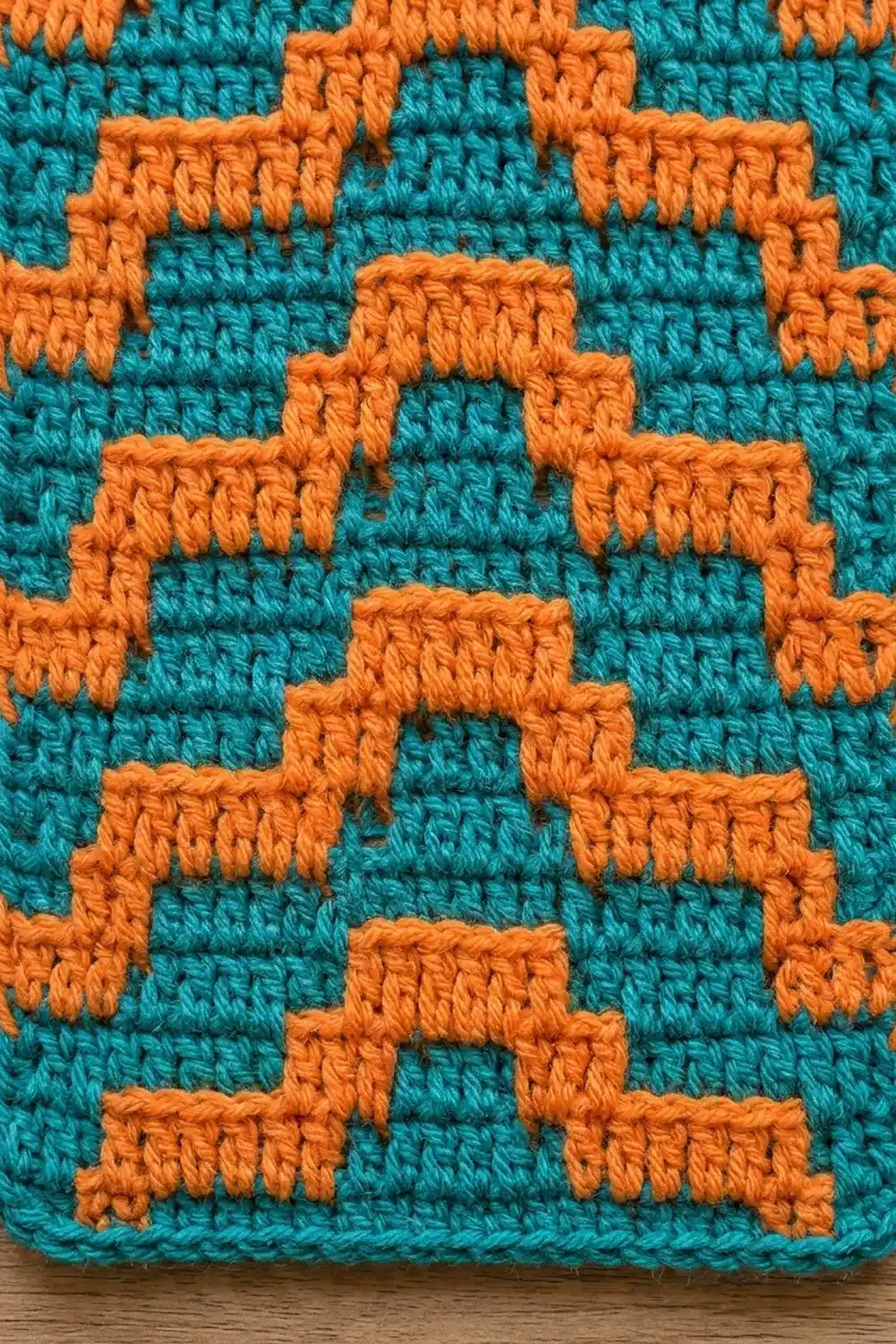
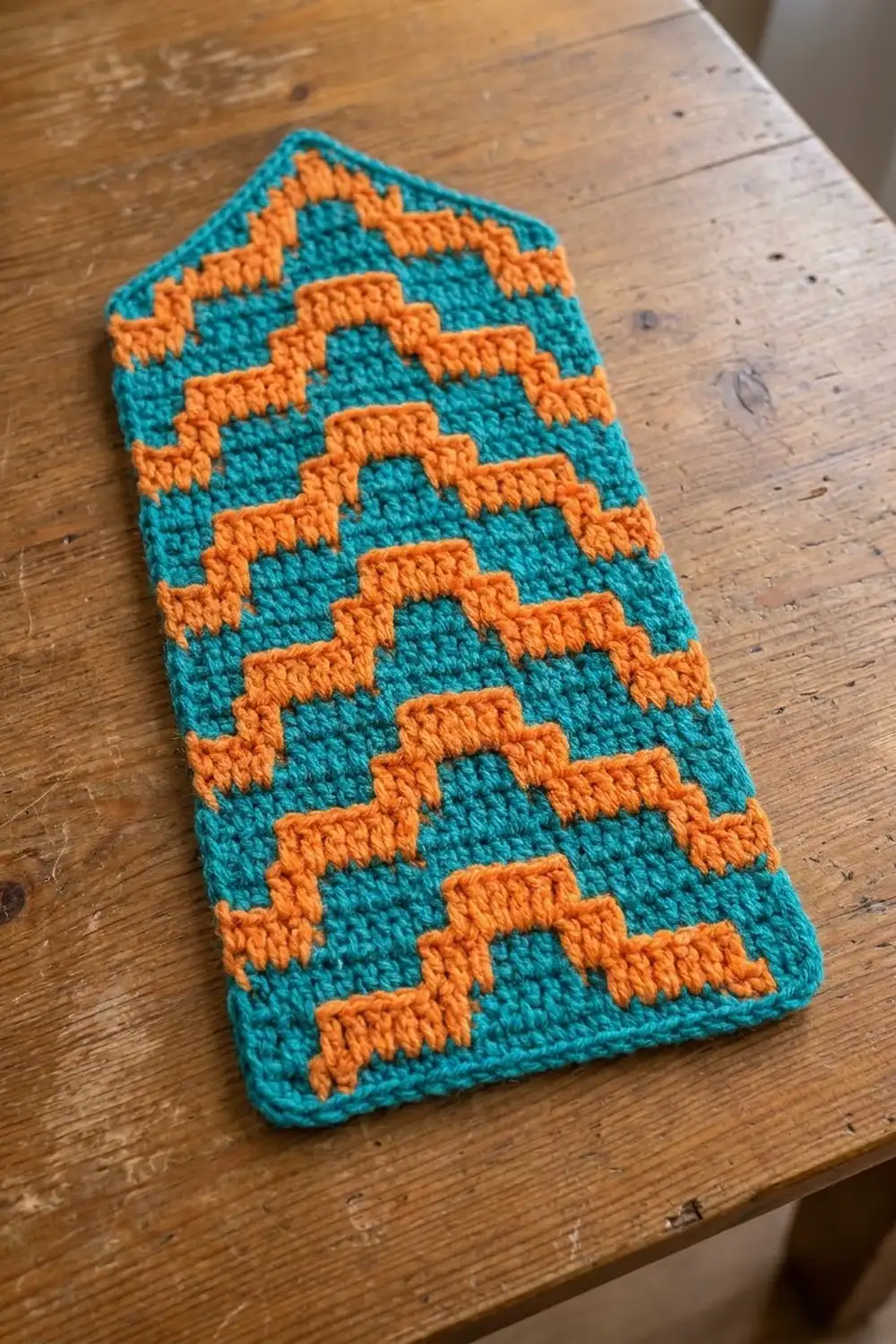
The Lagoon Steps Pennant is a single flat panel with a pointed top, worked in teal and bright orange tapestry crochet. Stepped orange chevrons climb the panel. Each one is built from square blocks that rise toward the center, so the lines look like little staircases rather than smooth zigzags.
The colors are simple: a deep teal background and a warm tangerine orange for the chevrons, finished with a one-round teal edge. The look is bold and graphic, a little retro. It works as a wall pennant, a door hanging or a decorative mat.
This pattern uses US crochet terms throughout. The finished panel measures 6.75 in (17.1 cm) wide and 14.5 in (36.8 cm) tall from the bottom edge to the tip of the point.
You work the body in rows of single crochet from the bottom up, carrying the unused color inside the stitches. Then you shape the point with decreases while one last chevron follows the slope. A single round of teal single crochet finishes all the edges.
Finished Size and Construction
- Finished size: 6.75 in x 14.5 in (17.1 cm x 36.8 cm)
- Skill level: Intermediate (tapestry color changes, simple decreases)
- Terminology: US crochet terms
- Yarn weight: Worsted (#4)
- Hook: 4.5 mm (US 7)
- Number of pieces: 1 single panel; no joining
- Layout: Rectangular body topped with a triangular point, chevrons stacked vertically
- Piece size before border: 6.25 in x 14 in (15.9 cm x 35.6 cm)
- Body (rectangle) height: about 11.3 in (28.7 cm)
- Point height: about 2.7 in (6.9 cm)
- Border depth: 0.25 in (0.6 cm) on every edge
Materials
Yarn advice: Choose a smooth worsted-weight cotton or cotton blend for crisp, clear color blocks. Acrylic works too, but fuzzy yarns blur the steps. Pick two colors with strong contrast so the steps show clearly from across the room.
- Color A, Teal (background and border): 60 g, about 120 m (131 yd)
- Color B, Orange (chevrons): 35 g, about 70 m (77 yd)
Tools:
- 4.5 mm (US 7) crochet hook
- Tapestry needle
- Scissors
- 2 locking stitch markers
- Measuring tape
- Blocking mat and rust-proof pins
- Spray bottle
These quantities include a margin of about 20% to cover your gauge swatch and the carried strand, which uses more yarn than plain single crochet.
Abbreviations (US Terms)
- ch – chain
- sc – single crochet
- sc2tog – single crochet 2 together (1 stitch decreased)
- sc3tog – single crochet 3 together (2 stitches decreased)
- st(s) – stitch(es)
- rnd – round
- A – Color A (teal)
- B – Color B (orange)
- T / O – in color counts, T = teal stitches, O = orange stitches
Special technique – tapestry color change: Work the last stitch before a color change until 2 loops remain on the hook. Drop the old color, yarn over with the new color, and pull through both loops. Lay the unused color along the tops of the stitches in the row below, and work every stitch over it so it stays hidden inside. Keep both colors carried for the whole panel, even on all-teal rows, so the fabric stays the same thickness throughout.
Turning chain: Ch 1 at the start of each row. It does not count as a stitch.
Gauge and Checkpoints
Gauge: 16 sc and 18 rows = 4 in (10.2 cm) in tapestry sc with both colors carried.
Make a swatch before you start. Chain 21, work 20 sc per row for 18 rows while carrying a second strand, and measure the center. Tapestry crochet is denser than plain sc, so always swatch with the carried strand.
Checkpoints:
- After Row 3 (base): 6.25 in (15.9 cm) wide and about 0.7 in (1.8 cm) tall.
- After the first chevron (Row 15): about 3.3 in (8.4 cm) tall.
- After Row 51 (body complete): about 11.3 in (28.7 cm) tall, still 6.25 in (15.9 cm) wide.
- After the point (Row 63): 14 in (35.6 cm) tall at the tip.
If your panel is too big: go down 0.5 mm in hook size. If it is too small: go up 0.5 mm. Always fix size with the hook, never with the stitch count. The chevron chart depends on exactly 25 stitches.
Body
The body is 25 stitches wide. The chevron chart is mirrored around the center stitch (st 13), so every row reads the same from either direction. You never need to track right side or wrong side for the colors.
The stitches are split into blocks. Counting from either edge, block 1 = sts 1–3, block 2 = sts 4–6, block 3 = sts 7–9, and the center block = sts 10–16 (7 sts). Each orange block is 3 rows tall and starts 2 rows above the block beside it. This 1-row overlap joins the steps into one continuous staircase.
Foundation: With A, ch 26, leaving a long tail. Lay B along the chain to carry it from Row 1.
Row 1 (A): Sc in 2nd ch from hook and in each ch across, working over B. Turn. (25 sts)
Rows 2–3 (A): Ch 1, sc in each st across. Turn. (25 sts)
Place a marker at each end of Row 3 for the base checkpoint.
Chevron Repeat (12 rows)
For each row, ch 1, then sc in each st across, changing colors as listed. Turn at the end of every row. Every row has 25 sts.
- Repeat Row 1: 3 O, 19 T, 3 O. (25 sts)
- Repeat Row 2: 3 O, 19 T, 3 O. (25 sts)
- Repeat Row 3: 6 O, 13 T, 6 O. (25 sts)
- Repeat Row 4: 3 T, 3 O, 13 T, 3 O, 3 T. (25 sts)
- Repeat Row 5: 3 T, 6 O, 7 T, 6 O, 3 T. (25 sts)
- Repeat Row 6: 6 T, 3 O, 7 T, 3 O, 6 T. (25 sts)
- Repeat Row 7: 6 T, 13 O, 6 T. (25 sts)
- Repeat Row 8: 9 T, 7 O, 9 T. (25 sts)
- Repeat Row 9: 9 T, 7 O, 9 T. (25 sts)
- Repeat Rows 10–12: 25 T. (25 sts)
How the chart builds the staircase:
- Block 1 is orange on Repeat Rows 1–3.
- Block 2 is orange on Rows 3–5.
- Block 3 is orange on Rows 5–7.
- The center block is orange on Rows 7–9.
Each step sits 2 rows higher than the one before it, so the chevron rises to a stepped point. Rows 10–12 are teal spacers between chevrons.
Work the 12-row repeat 4 times in total. Panel Rows 4–51 hold the four body chevrons. (Row 51 = 25 sts.)
Checkpoint: The body is now 51 rows, about 11.3 in (28.7 cm) tall and 6.25 in (15.9 cm) wide. All four chevrons should point straight up and be centered.
Point
Shape the point by decreasing 1 st at each end of every row. Work each sc2tog (or sc3tog) in the color of the group it opens or closes. It counts as 1 st of that group. Each row uses up its own stitch total plus 2 stitches from the row below.
- Row 52: Ch 1, sc2tog, sc to last 2 sts, sc2tog, all in T. (23 sts)
- Row 53: Ch 1, 3 O (first st is sc2tog), 15 T, 3 O (last st is sc2tog). (21 sts)
- Row 54: Ch 1, 6 O (first st is sc2tog), 7 T, 6 O (last st is sc2tog). (19 sts)
- Row 55: Ch 1, 3 T (first st is sc2tog), 3 O, 5 T, 3 O, 3 T (last st is sc2tog). (17 sts)
- Row 56: Ch 1, 3 T (first st is sc2tog), 9 O, 3 T (last st is sc2tog). (15 sts)
- Row 57: Ch 1, 3 T (first st is sc2tog), 7 O, 3 T (last st is sc2tog). (13 sts)
- Row 58: Ch 1, 2 T (first st is sc2tog), 7 O, 2 T (last st is sc2tog). (11 sts)
Cut B after Row 58, leaving a 6 in (15.2 cm) tail to weave in. Continue in A only.
- Row 59: Ch 1, sc2tog, 7 sc, sc2tog. (9 sts)
- Row 60: Ch 1, sc2tog, 5 sc, sc2tog. (7 sts)
- Row 61: Ch 1, sc2tog, 3 sc, sc2tog. (5 sts)
- Row 62: Ch 1, sc2tog, 1 sc, sc2tog. (3 sts)
- Row 63: Ch 1, sc3tog. (1 st)
Do not fasten off. The orange in Rows 53–58 forms a final, smaller stepped chevron that follows the slope of the point.
Checkpoint: The point measures about 2.7 in (6.9 cm) from Row 51 to the tip. The whole panel is now 6.25 in x 14 in (15.9 cm x 35.6 cm).
Border
Border gauge: The border uses the same gauge of 16 sc = 4 in (10.2 cm). Row ends run 18 rows = 4 in (10.2 cm), so the straight sides get fewer sc than rows. The sloped edges get more.
Rnd 1 (A): Continue from the tip st and work around the whole panel with the right side facing.
- Tip: 3 sc in the final st of Row 63. (3 sts)
- Right slope (row ends of Rows 63–52, 12 row ends): *Sc in each of next 2 row ends, 2 sc in next row end; rep from * 4 times. (16 sts)
- Right side (Rows 51–1, 51 row ends): *Sc in each of next 7 row ends, skip next row end; rep from * 6 times (42 sts over 48 row ends), then sc in each of last 3 row ends. (45 sts)
- Bottom (25 foundation chains): 3 sc in first ch (corner), sc in each of next 23 ch, 3 sc in last ch (corner). (29 sts, including both 3-sc corner groups)
- Left side (Rows 1–51, 51 row ends): Sc in each of first 3 row ends, then *skip next row end, sc in each of next 7 row ends; rep from * 6 times. (45 sts)
- Left slope (Rows 52–63, 12 row ends): *2 sc in next row end, sc in each of next 2 row ends; rep from * 4 times. (16 sts)
Join with a sl st to the first sc of the tip group. Fasten off.
Total for Rnd 1: 3 + 16 + 45 + 29 + 45 + 16 = 154 sts.
Why the math works:
- Straight sides: 45 sc at 4 sts per in = 11.25 in (28.6 cm). That is within a few millimeters of the 11.3 in (28.7 cm) body, so the edges lie flat.
- Bottom: The 25 stitches keep a 1-to-1 count, and the two 3-sc corner groups turn each corner neatly.
- Slopes: Each edge runs 3 in (7.6 cm) across and 2.7 in (6.9 cm) up, a diagonal of about 4 in (10.2 cm). That length needs 16 sc, not 12, so the 4 increases keep the point from pulling.
- Tip: The 3-sc group keeps the point sharp.
The border adds 0.25 in (0.6 cm) on every edge, bringing the panel to 6.75 in x 14.5 in (17.1 cm x 36.8 cm).
Final Blocking
- Weave in all tails through stitches of the same color, working over the carried strand where you can.
- Lay the panel right side up on a blocking mat.
- Pin the two bottom corners 6.75 in (17.1 cm) apart.
- Pin the two shoulders, where the straight sides meet the slopes, 11.6 in (29.5 cm) above the bottom edge and 6.75 in (17.1 cm) apart.
- Pin the tip 14.5 in (36.8 cm) above the center of the bottom edge.
- Add pins every 1 in (2.5 cm) along each edge, keeping the edges straight.
- Mist evenly with water until damp, not soaked. For acrylic, steam lightly from above without touching the yarn.
- Pat the chevron blocks square with your fingertips.
- Leave it to dry completely, at least 12 hours, before unpinning.
Final Quality-Control Checklist
- Panel measures 6.75 in x 14.5 in (17.1 cm x 36.8 cm).
- Each body row has exactly 25 sts.
- There are four full chevrons in the body, plus one smaller chevron in the point.
- Every chevron is centered, with matching 3-st steps on both sides.
- No orange shows through teal areas, and no teal shows through orange.
- The point is symmetrical, with a sharp tip.
- The border lies flat with no ruffles or puckers and has 154 sts in total.
- All tails are woven in securely.
Troubleshooting
The carried color peeks through. Keep the carried strand snug along the stitch tops and tug it gently every few stitches. Teal carried behind orange shows the most, so watch your tension in orange areas.
The panel leans to one side. Tapestry sc often slants. Work through both loops and yarn over the same way every time. Blocking will correct a mild lean.
The chevron looks off center. Count each color group and check that the row totals 25. One miscounted block at an edge shifts the whole staircase.
The point is lopsided. Make sure you decrease at both ends of every point row and that each row total matches the listed count.
The border ruffles. Skip one more row end on each side.
The border pulls. Add one more sc on each side.
The edges curl. Block firmly and check your gauge. Very tight tension makes sc fabric curl.
Care
Hand wash in cool water with mild soap, press out the water in a towel, and dry flat, reshaping to size. Do not tumble dry, because heat can shrink cotton and distort the blocks.
Final Notes
Here is the full measurement chain:
- 25 sts at 16 sts per 4 in (10.2 cm) give 6.25 in (15.9 cm) of width.
- 51 body rows at 18 rows per 4 in (10.2 cm) give about 11.3 in (28.7 cm).
- The 12-row point adds about 2.7 in (6.9 cm), for 14 in (35.6 cm) before the border.
- One round of 154 sc adds 0.25 in (0.6 cm) on every edge, for a finished size of 6.75 in x 14.5 in (17.1 cm x 36.8 cm).
Check your gauge, count each color group, and the steps will line up. Happy crocheting!