

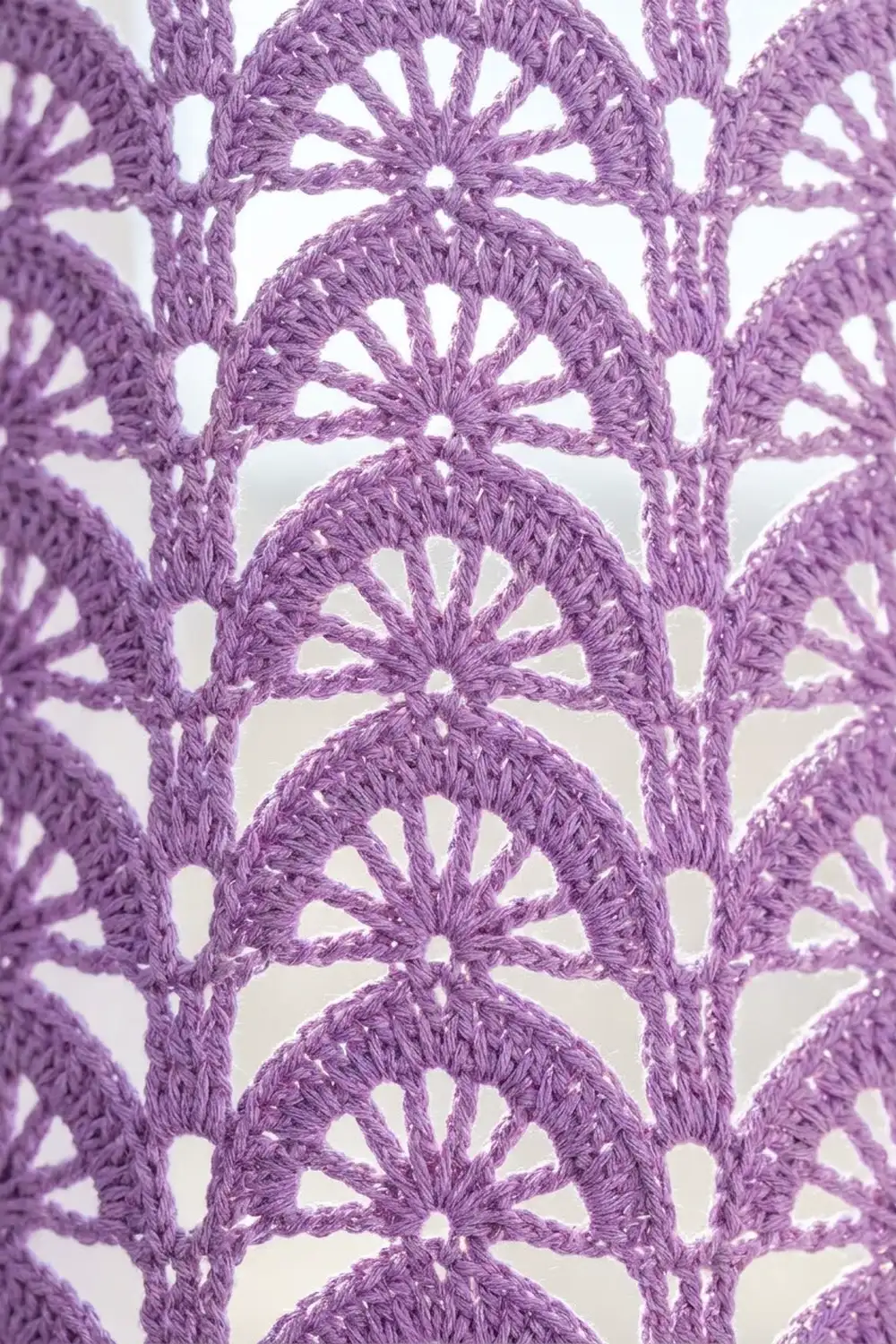
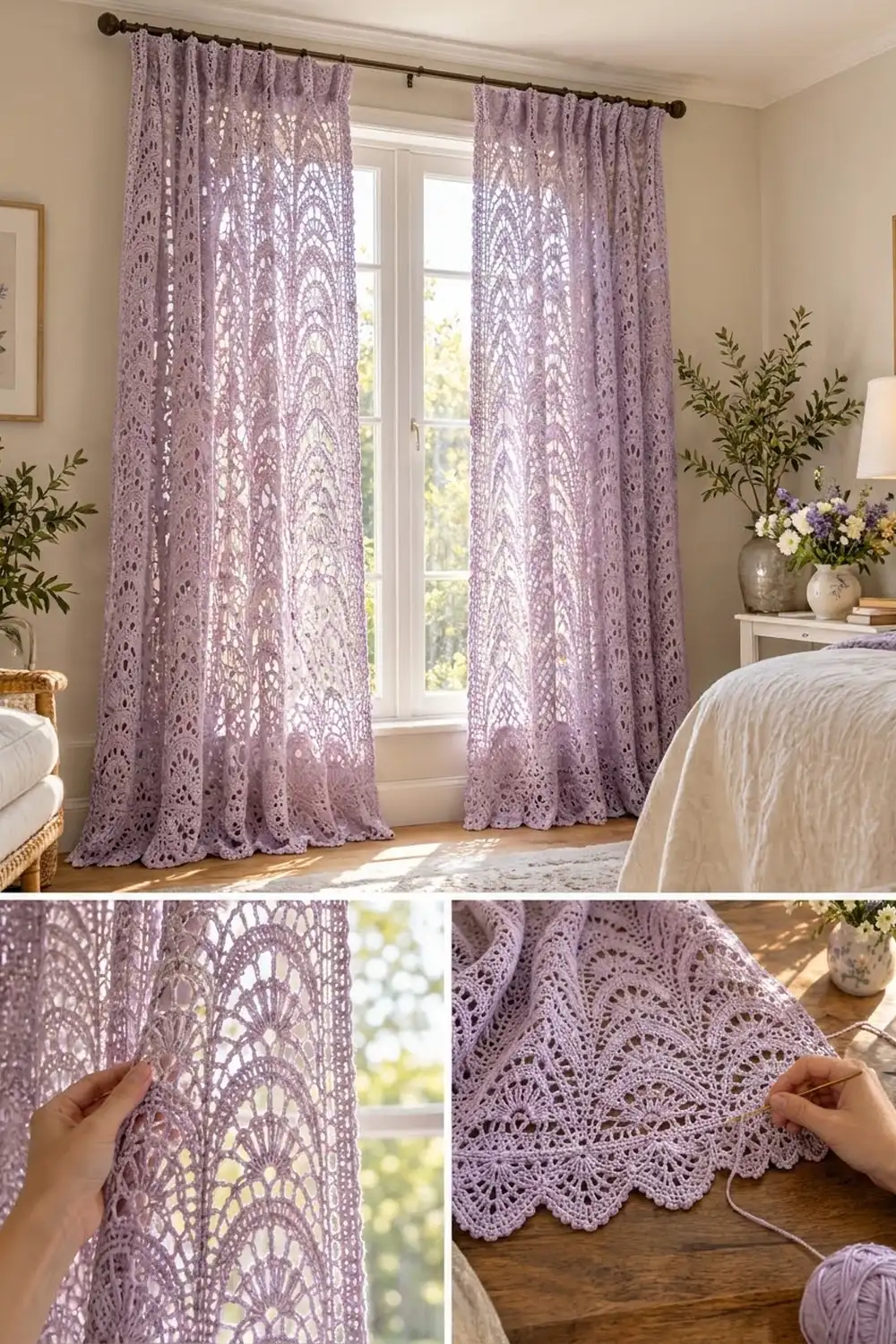
The Lavender Arches curtain panel is a tall, airy lace curtain built from columns of domed fans. Each fan opens from a small hub into six spokes and is capped by a solid arch. The next fan grows from the top of that arch, so every column becomes a stack of nested domes. Thin ribs separate the columns, and deep picot scallops finish the hem.
The sample uses a single soft lavender cotton. Light passes through the open spokes and casts the arch pattern into the room. The style is romantic and cottage-like, but the construction is orderly and easy to memorize.
The pattern uses US crochet terms. One finished panel measures 41 in (104.1 cm) wide by 84 in (213.4 cm) long, including the rod pocket. The photo shows a matching pair, so you’ll make two identical panels.
Each panel is worked flat in rows from the hem up: a foundation row, a 4-row arch repeat worked 32 times, and a plain header that folds into a rod pocket. A 3-row border runs down one side, across the hem in scallops, and up the other side.
Finished Size and Construction
- Finished size (one panel): 41 in (104.1 cm) wide x 84 in (213.4 cm) long
- Skill level: Intermediate
- Terminology: US crochet terms
- Yarn weight: Sport (#2 fine) mercerized cotton
- Hook: 3.5 mm (E-4)
- Number of pieces: 2 identical panels. Each is one continuous piece, and the panels are not joined.
- Layout: 10 arch columns across and 32 arch repeats up each panel
- Piece size: 40 in (101.6 cm) wide x 82.5 in (209.6 cm) long with the header folded, before the border
- Size before border: 40 in (101.6 cm) x 84.5 in (214.6 cm) with the header still flat
- Border depth: 0.5 in (1.3 cm) on the sides and 1.5 in (3.8 cm) at the hem
Materials
Yarn: Choose a smooth, mercerized sport-weight cotton. It shows the spokes clearly and sags less than acrylic at this length. Light colors show the lace best.
- Lavender: 1,250 g / 3,875 m (4,238 yd) per panel. That’s about 25 balls of 50 g / 155 m (170 yd).
- Pair of panels: 2,500 g / 7,750 m (8,476 yd), about 50 balls
These quantities include a margin of about 10% for the swatch and tension differences. Buy every ball from one dye lot so the panels match.
Tools:
- 3.5 mm (E-4) crochet hook
- Tapestry needle
- Locking stitch markers (at least 11)
- Tape measure
- Rust-proof pins plus blocking mats, or blocking wires
- Spray bottle
- Curtain rod up to 1.125 in (2.9 cm) in diameter
Abbreviations (US Terms)
- ch – chain
- sl st – slip stitch
- sc – single crochet
- hdc – half double crochet
- dc – double crochet
- tr – treble crochet
- sp(s) – space(s)
- st(s) – stitch(es)
- RS / WS – right side / wrong side
- rep – repeat
Special stitches
- Fan: (dc, [ch 1, dc] 5 times) all in the same st. This makes 6 dc and 5 ch-1 sps, 11 sts in total.
- Picot: ch 3, then sl st in the top of the sc just made.
Gauge and Checkpoints
Gauge (blocked):
- One 16-st arch repeat is 4 in (10.2 cm) wide.
- One 4-row arch repeat is 2.5 in (6.4 cm) tall.
- One dc row is 0.5 in (1.3 cm) tall.
- Border: 4 sc = 1 in (2.5 cm).
Make a test swatch first. Ch 35 and work the Foundation Row (33 dc). Work Rows 1–4 twice. Wet-block the swatch and let it dry. It should measure 8 in (20.3 cm) wide by 5.5 in (14.0 cm) tall.
- Swatch too big: change to a 3.25 mm (D-3) hook.
- Swatch too small: change to a 3.75 mm (F-5) hook.
Small errors grow quickly on a curtain. If each repeat is 0.25 in (0.6 cm) too wide, the whole panel will be 2.5 in (6.4 cm) too wide.
Checkpoints (measure flat, lightly eased to the blocked shape):
- After the Foundation Row: 40 in (101.6 cm) wide and 0.5 in (1.3 cm) tall
- After 4 arch repeats (16 rows): 10.5 in (26.7 cm) long
- After 16 arch repeats: 40.5 in (102.9 cm) long
- After 32 arch repeats: 80.5 in (204.5 cm) long
- After the header: 84.5 in (214.6 cm) long
Panel Pattern
The stitch count is a multiple of 16 + 1. Each 16-st repeat has 1 column st and 15 arch sts.
Foundation
Foundation Row (RS): Ch 163. Dc in the 4th ch from the hook (the skipped ch count as 1 dc), then dc in each ch across. Turn. (161 sts)
Place a marker in the first st and in every 16th st after it. These 11 sts are the column sts. The 9th st of each repeat is the center st.
Arch Repeat (Rows 1–4)
Row 1 (RS, Fan Row): Ch 3 (counts as dc and as the first column st). Ch 2, skip 7 sts, Fan in the next st, ch 2, skip 7 sts, dc in the next st (column); rep from * across. Work the last dc into the top of the turning ch. Turn. (161 sts: 1 + 10 repeats x 16 [2 ch + 11 Fan + 2 ch + 1 dc])*
The Fan sits on the center st and spreads over the skipped sts. This spread creates the dome shape.
Row 2 (WS, Spoke Row): Ch 3 (counts as dc). Ch 2, dc in the first Fan dc, [ch 2, dc in the next Fan dc] 5 times, ch 2, dc in the next column dc; rep from * across. Turn. (211 sts: 1 + 10 x 21)*
Each repeat now has 7 dc and 7 ch-2 sps: 1 side sp, 5 inner sps, and 1 side sp. Don’t work into the ch-2 sps of Row 1. The new chains pass over them.
Row 3 (RS, Arch Row): Ch 1 (does not count as a st). Sc in the first dc. Skip the side ch-2 sp, 3 hdc in the next ch-2 sp, 3 dc in the next ch-2 sp, (dc, tr, dc) in the next ch-2 sp, 3 dc in the next ch-2 sp, 3 hdc in the next ch-2 sp, skip the side ch-2 sp, sc in the next column dc; rep from * across. Turn. (161 sts: 1 + 10 x 16 [15 arch sts + 1 sc])*
The stitches rise to a tr at the center and drop to an sc at each column, which forms the solid domed outline. The skipped side sps leave the open windows beside each dome.
Row 4 (WS, Leveling Row): Ch 4 (counts as tr). Tr in the next 2 sts, dc in the next 3 sts, hdc in the next 2 sts, sc in the next st (the center tr), hdc in the next 2 sts, dc in the next 3 sts, tr in the next 2 sts, tr in the next sc (column); rep from * across. Turn. (161 sts: 1 + 10 x 16)*
Tall sts fill the low ends of each arch and short sts sit over the peak, so the top edge comes out level. The next Fan goes into the center sc, so each dome rises from the one below it.
Work Rows 1–4 a total of 32 times, ending with Row 4. That makes 128 pattern rows. Check for 161 sts after every Row 4. The panel should now measure 80.5 in (204.5 cm) from the foundation edge.
Header and Rod Pocket
Header Rows 1–8: Ch 3 (counts as dc), dc in each st across, turn. (161 sts in each row)
The header adds 4 in (10.2 cm) of solid fabric. Fasten off. Don’t fold the header yet, because the border runs along its side edges. The unfolded panel measures 40 in (101.6 cm) x 84.5 in (214.6 cm).
Make Both Panels
Make 2 panels exactly as written, using 1,250 g of lavender for each. The arch pattern is symmetrical, so you don’t need to mirror the second panel.
Layout at the window, seen from inside the room:
| Panel 1 |      window      | Panel 2 |
| 10 cols |                  | 10 cols |
| 32 high |                  | 32 high |
The panels hang separately on the rod, so there is no joining step. Block them at the same time so they come out the same length.
Border
Border gauge: 4 sc = 1 in (2.5 cm). Each side edge is 84.5 in (214.6 cm) long, and 84.5 x 4 = 338 sc. The hem has 1 sc per foundation ch: 161 sts over 40 in (101.6 cm), or about 4 per inch.
Side edge placement (per side):
- Foundation Row end: 2 sc
- Each 4-row arch repeat: 10 sc (2 in each dc row end, 2 in the sc row end, and 4 in the tr row end)
- Each header row end: 2 sc
Each side gets 2 + (32 x 10) + (8 x 2) = 338 sc.
Border Row 1 (RS): With the RS facing, join the yarn at the top right corner of Header Row 8.
- Work 338 sc down the right side.
- Work 3 sc in the first foundation ch (corner).
- Sc in each of the next 159 foundation chs.
- Work 3 sc in the last foundation ch (corner).
- Work 338 sc up the left side. Fasten off.
(841 sts: 338 + 3 + 159 + 3 + 338)
Border Row 2 (RS, Scallop Row): Join at the same corner with the RS facing.
- Sc in each of the 338 side sc.
- Sc in the first corner sc, then 3 sc in the center corner sc.
- Hem: sc in the third corner sc, *skip 3 sts, 9 dc in the next st, skip 3 sts, sc in the next st; rep from * 20 times. The last sc lands in the first sc of the next corner.
- Work 3 sc in the center corner sc, then sc in the last corner sc.
- Sc in each of the 338 sc up the left side. Fasten off.
Counts:
- Sides: 338 each (1 per st).
- Corners: 4 each (2 sts worked 1 per st + 2 extra).
- Hem: works over 161 sts (1 + 20 x 8) and makes 20 scallops, giving 21 sc + 180 dc = 201 sts.
- Total: 338 + 4 + 201 + 4 + 338 = 885 sts.
Border Row 3 (RS, Picot Row): Join at the same corner with the RS facing.
- Sc in each of the 338 side sc.
- Corner: sc in the next 2 sts, 3 sc in the center corner st, sc in the next st.
- Hem: sc in the first sc, *sc in the next 4 dc, sc in the next dc and work a Picot, sc in the next 4 dc, sc in the next sc; rep from * 20 times.
- Work the second corner in reverse: sc in the next st, 3 sc in the center st, sc in the next 2 sts.
- Sc in each of the 338 sc up the left side. Fasten off.
Counts:
- Sides: 338 each.
- Corners: 6 each (4 sts worked 1 per st + 2 extra).
- Hem: 201 sc (1 per st) + 20 Picots.
- Total: 338 + 6 + 201 + 6 + 338 = 889 sc + 20 Picots.
Why the math works: At 4 sc per inch, the border matches the length of each side edge, so the sides don’t ruffle or pull in. The 161 hem sts are a multiple of 8 + 1, which gives exactly 20 scallops, 2 under each arch column. The three side rows add 0.5 in (1.3 cm) to each side, so the width is 40 + 0.5 + 0.5 = 41 in (104.1 cm).
Rod pocket: Fold Header Rows 5–8 to the WS. Whipstitch the top of Header Row 8 to the base of Header Row 1, st by st across all 161 sts. This makes a 2 in (5.1 cm) pocket and a 2 in (5.1 cm) visible header. Leave the ends of the pocket open.
Finished length: 0.5 + 80 + 2 = 82.5 in (209.6 cm), plus the 1.5 in (3.8 cm) hem border, gives 84 in (213.4 cm).
Final Blocking
- Weave in ends along the column sts or inside the solid arch rows.
- Soak the panel in cool water with a little wool wash for 15 minutes. Press out the water without wringing.
- Roll the panel in towels to remove extra moisture.
- Lay it flat on blocking mats. If you’re short on space, block one half, let it dry, then block the other half.
- Pin the side edges straight to 41 in (104.1 cm) wide. Blocking wires make this easier.
- Pin each scallop tip so the points along the hem are even.
- Shape each arch into a round dome and open the spokes with your fingers.
- Check that the length is 84 in (213.4 cm), then let the panel dry completely.
- Block the second panel to the same measurements.
Final Quality-Control Checklist
- Every Row 4 has 161 sts.
- Every Fan sits on a center sc, and each column of domes runs straight.
- Each panel has 10 columns across and 32 arch repeats up.
- Each hem has 20 scallops and 20 picots.
- The side edges are straight, with no waves or puckers.
- Each panel measures 41 in (104.1 cm) x 84 in (213.4 cm).
- The two panels match in length to within 0.5 in (1.3 cm).
- The rod slides easily through the pocket.
Troubleshooting
- Fans drift off center: Recount the 7 skipped sts from the nearest column marker.
- Domes look flat: Make sure the center group has a real tr, and keep your hdc loose.
- Panel gets narrower: Your Row 4 tr sts are too tight. Pull up each loop fully.
- Side edges ruffle: There are too many border sc. Work 10 per arch repeat.
- Hem flips up: Go up one hook size for Border Row 2 only.
- Panel stretches when hung: Cotton drops a little over time. Re-block the panel and hang it only when it’s fully dry.
Care
Hand wash in cool water, or machine wash on a gentle cycle inside a large mesh bag. Lay flat to dry, reshaping the panel to 41 in (104.1 cm) x 84 in (213.4 cm).
Final Notes
Every measurement starts from the 4 in (10.2 cm) arch repeat:
- 10 repeats give 40 in (101.6 cm) across.
- 32 repeats at 2.5 in (6.4 cm) give 80 in (203.2 cm) of lace.
- The foundation row and the 2 in (5.1 cm) visible header bring the panel to 82.5 in (209.6 cm).
- The border finishes it at 41 in (104.1 cm) x 84 in (213.4 cm).
Check your swatch and count 161 sts after every Row 4, and your two panels will match.
Happy crocheting!