

This curtain panel is a field of cream calla lilies set into open lace. Each lily has a cupped cream spathe with a raised, corded rim, a ribbed lavender spadix, and a slender lavender stem that runs down into the lily below. Light passes through the mesh, so the flowers stand out clearly against a window.
The palette uses two colors. Warm cream is for the mesh, the lily cups, and the border, and soft lavender is for the spadices, stems, and tendrils. The look is romantic and a little vintage, but the construction is simple and modular.
This pattern uses US crochet terms. One finished panel measures 32 x 83 in (81.3 x 210.8 cm) after blocking. That fits a standard 84 in (213.4 cm) curtain drop when hung from clip rings.
The panel is made of 45 identical blocks. Each block is a cream filet mesh rectangle with one calla lily appliqué and a lavender stem sewn on top. The blocks are joined 5 across and 9 down, and a three-round picot border finishes the panel.
Finished Size and Construction
- Finished size: 32 x 83 in (81.3 x 210.8 cm)
- Skill level: Intermediate
- Terminology: US crochet terms
- Yarn weight: Sport (2, fine) mercerized cotton
- Hook: 3.0 mm
- Number of pieces: 45 blocks; each has 1 mesh base, 1 spathe, 1 spadix, 1 stem, 2 tendrils
- Layout: 5 blocks wide x 9 blocks tall
- Block size: 6 x 9 in (15.2 x 22.9 cm) after edging
- Size before border: 30 x 81 in (76.2 x 205.7 cm)
- Border depth: 1 in (2.5 cm) on every side
Materials
Use a smooth mercerized cotton. It shows stitches crisply, holds the cup shape, and resists sagging as the panel hangs. Avoid fuzzy or stretchy blends, which grow over time.
Yarn (about 150 m per 50 g ball):
- Cream: 600 g / 1,800 m (12 balls)
- Lavender: 100 g / 300 m (2 balls)
These amounts include about a 10% margin for your test block and for differences in tension. Buy each color from a single dye lot.
Tools: 3.0 mm hook, blunt tapestry needle, 4 stitch markers, scissors, measuring tape, blocking mats, rustproof pins, spray bottle, and clip rings (optional).
Abbreviations (US Terms)
- ch – chain
- sl st – slip stitch
- sc – single crochet
- dc – double crochet
- rev sc – reverse single crochet (crab stitch)
- sp – space
- sk – skip
- st(s) – stitch(es)
- BLO – back loop only
- RS – right side
Special stitches:
- Crossed dc pair: Sk next st, dc in next st, then dc in the skipped st, working in front of the dc just made. Covers 2 sts.
- Picot: Ch 3, sl st in 3rd ch from hook.
- Back-bump cord: Chain as stated, then sl st in the back bump of the 2nd ch from hook and of each ch across.
Gauge and Checkpoints
Mesh gauge: 8 squares and 8 rows = 4 in (10.2 cm). One square is 0.5 in (1.3 cm) wide and one row is 0.5 in (1.3 cm) tall.
Edge gauge: 6 sc = 1 in (2.5 cm).
Make one complete block first, with its edging, and measure it before you continue.
Checkpoints:
- After mesh Row 17: 5.5 x 8.5 in (14.0 x 21.6 cm)
- After the edging: 6 x 9 in (15.2 x 22.9 cm)
- Spathe with rim: about 3 in tall x 3.25 in wide (7.6 x 8.3 cm)
- Spadix: about 1.5 in (3.8 cm) long
If the block is too big, go down 0.25 mm in hook size. If it is too small, go up 0.25 mm. An error of 0.25 in (0.6 cm) per block adds up to 2.25 in (5.7 cm) over 9 blocks.
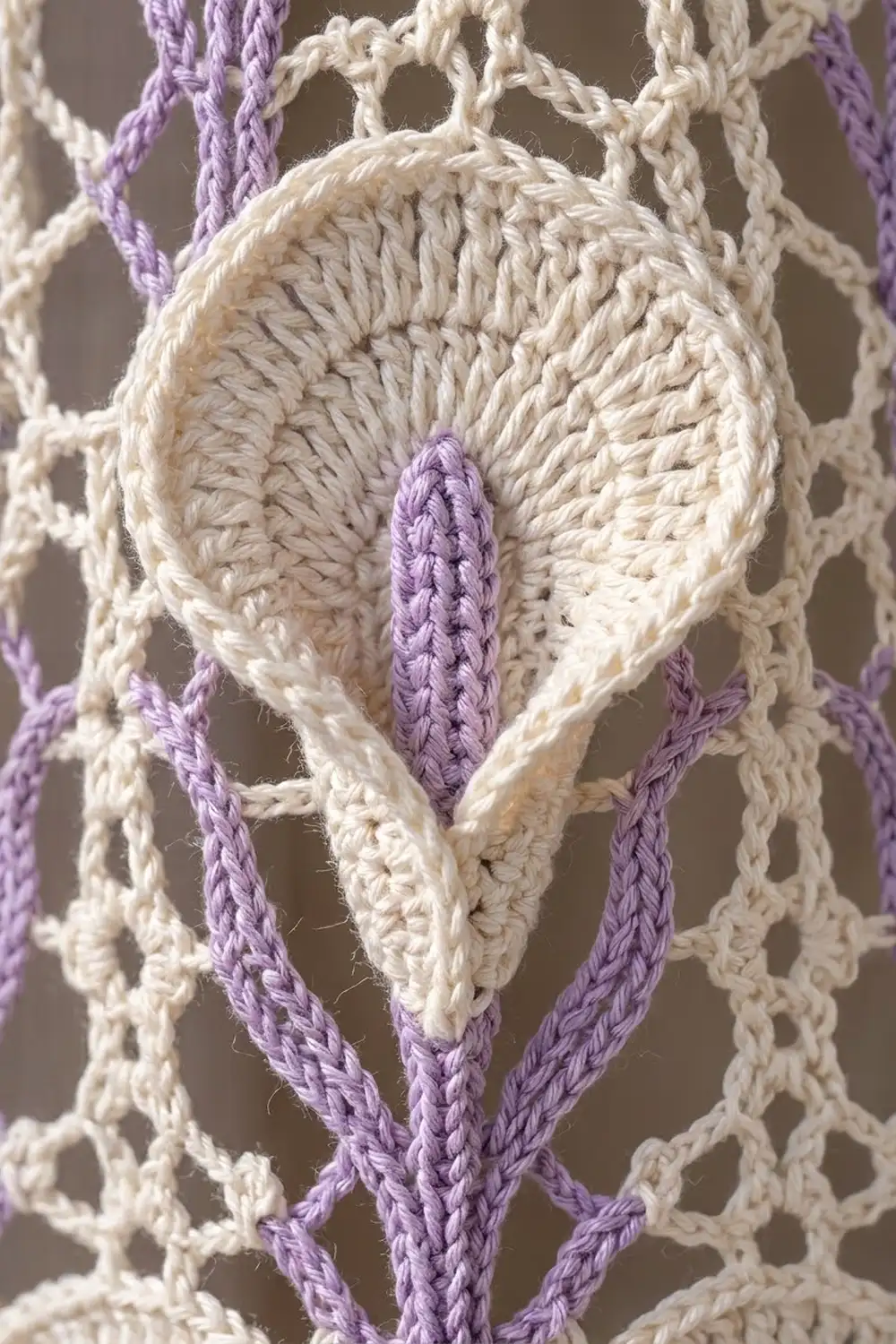
Mesh Block (Make 45, Cream)
Foundation: Ch 38.
Row 1 (RS): Dc in 8th ch from hook (skipped chs count as dc + ch 2), ch 2, sk 2 ch, dc in next ch; repeat from * across. Turn. (12 dc including turning ch; 11 squares)*
Row 2: Ch 5 (counts as dc + ch 2), dc in next dc, ch 2, dc in next dc; repeat from * across, working the last dc in the 3rd ch of the turning ch. Turn. (11 squares)*
Rows 3–17: Repeat Row 2. Do not fasten off. (11 squares per row)
Edging Round: Ch 1. Do not turn.
- Top: 3 sc in the last dc (corner), 2 sc in next ch-2 sp, sc in next dc 10 times, 2 sc in last ch-2 sp, 3 sc in the turning-ch corner. (32 sc between corner groups)
- Side: 2 sc around the end post of Row 17, then 3 sc around each of the other 16 row-end posts. (50 sc)
- Bottom: 3 sc in the corner ch, then 2 sc in each ch-2 sp and 1 sc in the ch at the base of each of the 10 interior dc, then 3 sc in the last corner ch. (32 sc)
- Second side: As first side. (50 sc)
Sl st to first sc. Fasten off, leaving a 12 in (30.5 cm) tail.
Counts: The center sc of each 3-sc group is the corner st. Counting from corner st to corner st inclusive, the top and bottom each have 1 + 1 + 32 + 1 + 1 = 36 sts, and each side has 1 + 1 + 50 + 1 + 1 = 54 sts. The round total is 12 corner-group sts + 64 + 100 = 176 sts. At 6 sc per inch, that gives 6 x 9 in (15.2 x 22.9 cm).
Spathe (Make 45, Cream)
Work the spathe from the bottom point upward as a fan.
Foundation: Ch 4.
Row 1: 4 dc in 4th ch from hook (skipped chs count as dc). Turn. (5 dc)
Row 2: Ch 3 (counts as dc throughout), dc in first st, 2 dc in each st across. Turn. (10 dc)
Row 3: Ch 3, dc in first st, dc in next st, 2 dc in next st, dc in next st; repeat from * across. Turn. (15 dc)*
Row 4: Ch 3, dc in next 3 sts, 2 dc in next st, dc in next 4 sts, 2 dc in next st twice. Turn. (18 dc)
Row 5: Ch 3, dc in each st across. Do not turn. (18 dc)
Round 6: Ch 1, 3 sc in first st, sc in next 16 sts, 3 sc in last st (22 sc). Work 2 sc around each of the 5 row-end posts down the side (10 sc), 3 sc in the foundation ch at the tip (3 sc), and 2 sc around each of the 5 row-end posts up the other side (10 sc). Sl st to first sc. (45 sc)
Round 7 (rim): Ch 1, rev sc in each sc around. Sl st to join. (45 sts) Fasten off, leaving a 12 in (30.5 cm) tail.
Shape the cup: With the point at the bottom, fold the lower left edge over the lower right edge so they overlap for 1 in (2.5 cm) above the tip. Tack with 3–4 small stitches. The top opens into a rounded cup and the bottom wraps into a cone.
Spadix (Make 45, Lavender)
Round 1: Ch 9. Sc in 2nd ch from hook and in the next 6 chs, then 3 sc in the last ch. Working along the underside of the chain, sc in the next 6 chs, then 2 sc in the first ch. Sl st to first sc. (18 sc)
Round 2: Sl st in BLO of each st around. (18 sl sts) Fasten off with a long tail. The BLO slip stitches create the ribbed texture.
Stem and Tendrils (Lavender)
Stem (make 45): Ch 29 and work a back-bump cord. (28 sl sts) It should be about 5 in (12.7 cm) long.
Tendril (make 90): Ch 13 and work a back-bump cord. (12 sl sts) It should be about 2.25 in (5.7 cm) long.
Assemble Each Block
- Lay the mesh RS up with Row 17 at the top.
- Center the spathe with its rim 1 in (2.5 cm) below the top edge. The tip should sit about 4 in (10.2 cm) down.
- Sew the spadix inside the cup, with its base tucked into the cone.
- Sew the spathe’s tip and lower edges to the mesh. Leave the upper rim free so the cup stands up off the lace.
- Tuck the stem under the tip and sew it straight down the center to the bottom edging.
- Sew a tendril on each side of the stem, starting 2 in (5.1 cm) above the bottom edge and angling up and out.
Make All Pieces
- Cream: 45 mesh blocks, 45 spathes
- Lavender: 45 spadices, 45 stems, 90 tendrils
Layout (L = assembled block, lily at top):
Row 1:  L  L  L  L  L
Row 2:  L  L  L  L  L
Row 3:  L  L  L  L  L
Row 4:  L  L  L  L  L
Row 5:  L  L  L  L  L
Row 6:  L  L  L  L  L
Row 7:  L  L  L  L  L
Row 8:  L  L  L  L  L
Row 9:  L  L  L  L  L
Each stem reaches its block’s bottom edge, so the stems run into the lilies below and form continuous columns.
Joining
Join with a flat slip stitch seam in cream. Place two blocks RS up, edge to edge. Insert the hook through the back loop of one stitch on each block and sl st.
Work stitch to stitch, from corner st to corner st, without skipping or doubling any stitch. First, join the blocks into 9 strips of 5; each side seam joins 54 sts to 54 sts. Then join the strips top to bottom; each long seam joins 5 x 36 = 180 sts to 180 sts.
Keep your tension relaxed, because a tight seam puckers the lace and shortens the panel. If the seams feel firm, go up one hook size for joining only.
Checkpoint: 30 x 81 in (76.2 x 205.7 cm).
Border
Border gauge: 6 sts = 1 in (2.5 cm). Three rounds add 1 in (2.5 cm) of depth.
Starting counts: Top and bottom: 5 blocks x 36 sts = 180 sts. Each long side: 9 blocks x 54 sts = 486 sts. These counts include the panel corner sts. Nothing is added at the seams, because both blocks’ corner sts are already counted.
Round 1: Join cream. Ch 1, sc in each st around, working 3 sc in each panel corner st. Sl st to join.
Top and bottom: 1 + 1 + 178 + 1 + 1 = 182 sts. Sides: 1 + 1 + 484 + 1 + 1 = 488 sts. Total: 1,328 sts worked 1 per st + 8 corner extras = 1,336 sts.
Round 2: Sl st to the corner st. Ch 3 (counts as dc), then (dc, ch 2, 2 dc) in the same st. Work crossed dc pairs across all the sts between corners, and (2 dc, ch 2, 2 dc) in each corner st. Sl st to join.
Top and bottom: 180 sts = 90 pairs. Sides: 486 sts = 243 pairs. Counting the corner dc and leaving out the ch-2 sps: 184 dc on the top and bottom and 490 dc on each side, 1,348 dc total.
Round 3: Ch 1. Work (sc, ch 3, sc) in each corner sp. Along the sides, sc in next st, picot, sc in next st across. Sl st to join and fasten off.
Top and bottom: 184 / 2 = 92 picots. Sides: 490 / 2 = 245 picots.
Why the math works: Round 1 adds stitches only at the corners. The 2-st repeats in Rounds 2 and 3 fit exactly into 180, 486, 184, and 490 because all four numbers are even. No side ends with a leftover stitch, so the border lies flat.
Checkpoint: 32 x 83 in (81.3 x 210.8 cm).
Final Blocking
- Weave the ends into the cords and the spathe rims.
- Soak the panel in cool water for 15 minutes.
- Roll it in towels to remove water. Do not wring.
- Lay it flat RS up and pin the corners to 32 x 83 in (81.3 x 210.8 cm).
- Pin every 2 in (5.1 cm) along the edges, with a pin in each bottom picot.
- Check that the blocks measure 6 x 9 in (15.2 x 22.9 cm) and the seams are straight.
- Shape each cup and fill it with a little plastic wrap. Let everything dry completely.
Final Quality-Control Checklist
- 45 blocks, each 176 sts around (36 / 54 per side)
- Each spathe has 45 rim sts and a tacked cone
- Spadices centered, stems straight, all lilies pointing up
- Seams flat; panel 30 x 81 in (76.2 x 205.7 cm) before the border
- Border: 182 / 488, then 90 / 243 pairs, then 92 / 245 picots
- Final size: 32 x 83 in (81.3 x 210.8 cm)
Troubleshooting
Mesh squares come out tall and narrow: Pull up shorter dc loops, or chain more loosely.
The spathe ruffles: Recount Row 4 (18 sts), or use a hook 0.25 mm smaller for the spathe.
The spathe won’t cup: Increase the overlap to 1.25 in (3.2 cm).
The stem twists: Steam it and pin it straight before sewing.
The border ripples: Recount Round 1. Extra stitches usually creep in at the seams.
The panel stretches when hung: Re-block it, then let it hang for a few days before setting the rings.
Care
Hand wash in cool water with mild detergent and dry flat. Reshape the lily cups while they are damp.
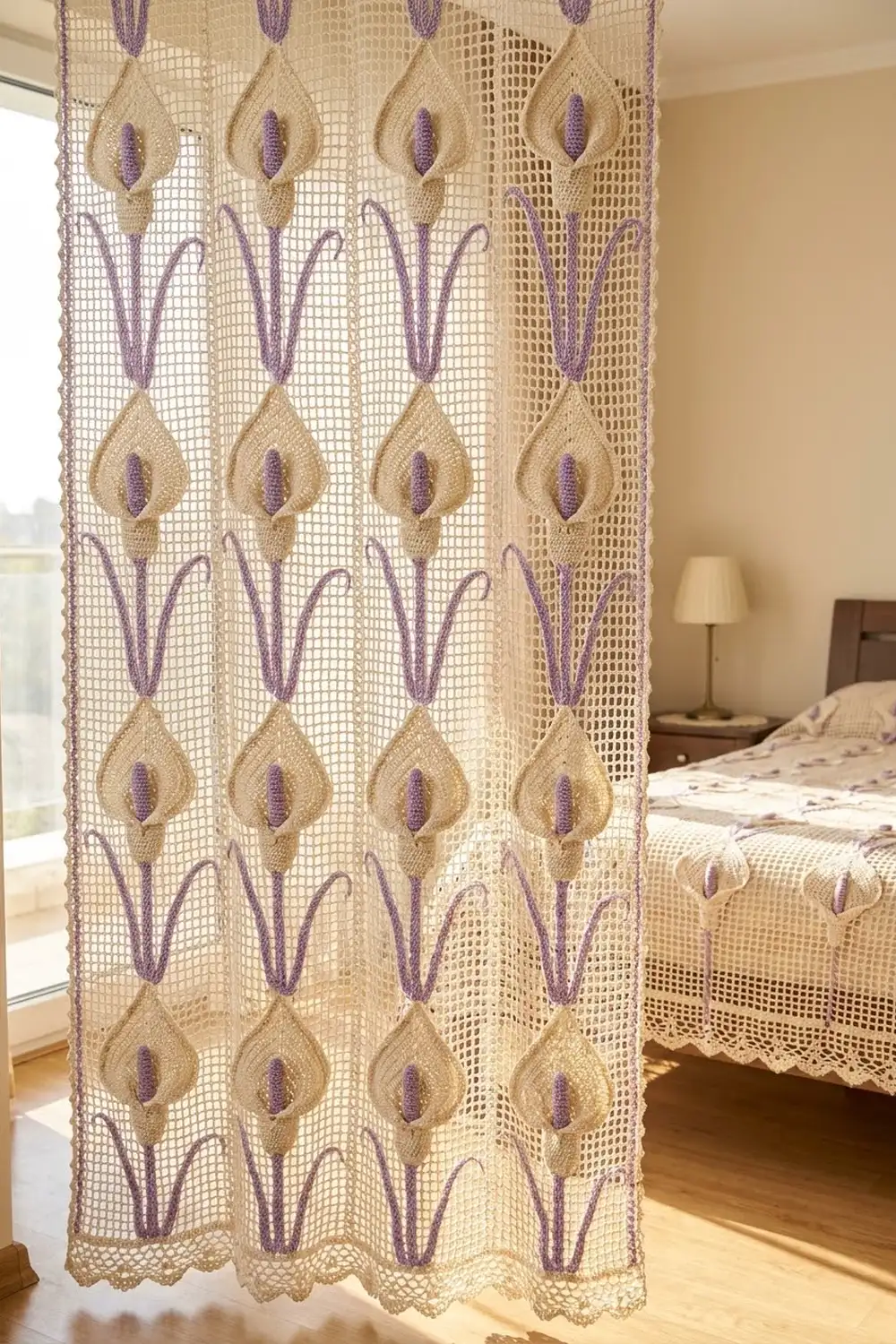
Final Notes
The sizes all build on each other. At a gauge of 8 squares and 8 rows = 4 in (10.2 cm), the mesh comes out at 5.5 x 8.5 in (14.0 x 21.6 cm). The edging brings each block to 36 x 54 sts, or 6 x 9 in (15.2 x 22.9 cm). Joining 5 x 9 blocks gives 30 x 81 in (76.2 x 205.7 cm), and the 1 in (2.5 cm) border makes the finished panel 32 x 83 in (81.3 x 210.8 cm).
Get the first block right and the rest of the panel will follow.
Happy crocheting!