

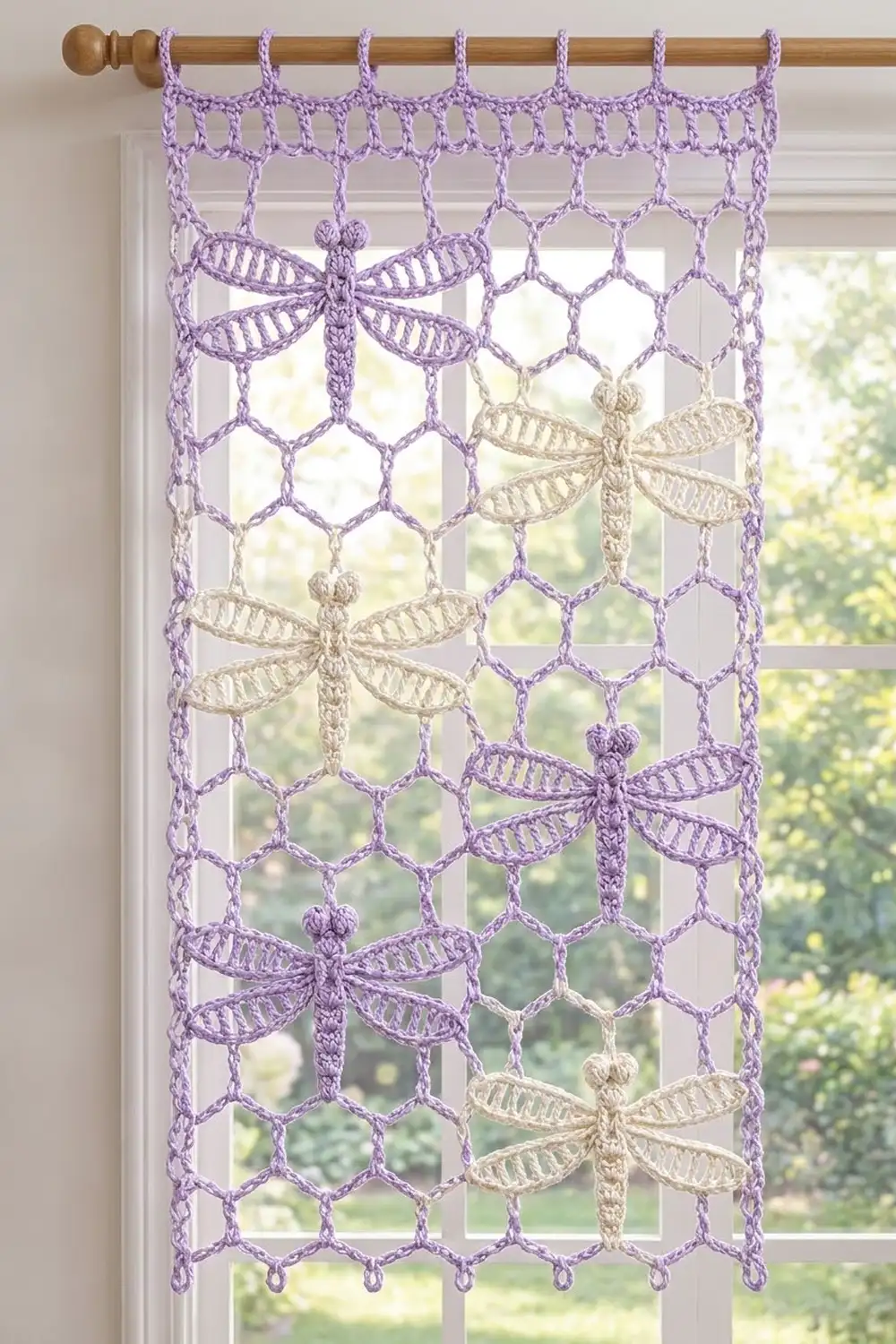
This airy panel is a lavender honeycomb net with six dragonflies sewn on in two staggered columns. Three are lavender and three are cream. A band of filet squares crosses the top, and small chain rings hang from the bottom edge.
The style is light and botanical. Each dragonfly has two bobble eyes, a solid single crochet body, and four oval wings with treble “ladder” rungs that echo the open net behind them.
The pattern uses US crochet terms. The finished panel measures 12¾ in x 22¼ in (32.4 cm x 56.5 cm), including the border.
You work the mesh flat from the top down: a 3-row band, then rows of chain loops joined by short chain links. Next you make the dragonflies, assemble them, and sew them on. A one-row single crochet border finishes the sides and top.
Finished Size and Construction
- Finished size: 12¾ in x 22¼ in (32.4 cm x 56.5 cm)
- Skill level: Intermediate
- Terminology: US
- Yarn weight: DK (#3) mercerized cotton
- Hook: 4.0 mm (US G-6)
- Number of pieces: 1 mesh panel plus 6 sewn-on dragonfly appliqués (each is 1 body and 4 wings)
- Layout: 2 staggered columns of 3 dragonflies
- Piece size: each loop repeat is 2 in (5.1 cm) wide, and each net row is 1¼ in (3.2 cm) deep
- Size before border: 12¼ in x 22 in (31.1 cm x 55.9 cm)
- Border depth: ¼ in (0.6 cm) on the sides and top
Materials
Use a smooth mercerized DK cotton. It keeps the chain loops crisp and cord-like, and it blocks flat. These amounts assume about 115 m per 50 g.
- Lavender: 60 g (about 138 m) for the mesh, the border, and 3 dragonflies
- Cream: 25 g (about 58 m) for 3 dragonflies
Quantities include a comfortable margin for swatching and tension differences. Each dragonfly uses about 11 m.
Tools:
– 4.0 mm (US G-6) hook
– Tapestry needle
– 4 stitch markers
– Rustproof pins and a blocking mat
– Spray bottle
– Tape measure
– Optional: a thin dowel or café rod for hanging
Abbreviations (US Terms)
- ch: chain
- sl st: slip stitch
- sc: single crochet
- dc: double crochet
- tr: treble crochet (yarn over twice)
- dtr: double treble crochet (yarn over 3 times)
- sp: space
- st(s): stitch(es)
- rep: repeat
Special stitches:
– Link: (sc, ch 3, sc) in the same ch. This makes the short hanging bar between the openings.
– Ring link: (sc, ch 5, sc) in the same ch. Use it on the last row only.
– Bobble: Work [yarn over, insert hook in st, pull up a loop, yarn over, draw through 2 loops] 4 times in the same st. Then yarn over and draw through all 5 loops.
Gauge and Checkpoints
Stitch gauge: 16 dc and 8 rows = 4 in (10.2 cm).
Net gauge (blocked): One loop repeat (8 base sts) is 2 in (5.1 cm) wide, and one net row is 1¼ in (3.2 cm) deep.
Test one piece first.
1. Ch 19 and work Rows 1–3. You should have 17 sts measuring 4¼ in (10.8 cm) wide.
2. Work Rows 4–6 across 2 loop repeats, changing the repeat counts to fit, then pin the swatch out gently. Two net rows should measure 2½ in (6.4 cm) deep.
3. Make one upper wing. It should be 3 in (7.6 cm) long.
Checkpoints:
– After Row 3: 12¼ in (31.1 cm) wide and 1½ in (3.8 cm) deep
– After Row 6: 4 in (10.2 cm) deep, lightly stretched
– After Row 12: 11½ in (29.2 cm) deep
– After Row 20: 21½ in (54.6 cm) to the edge posts, or 22 in (55.9 cm) including the rings
Too big? Go down to a 3.75 mm hook. Too small? Go up to a 4.5 mm hook. If only the net rows come out short, loosen your chains instead of adding stitches.

Pattern: Mesh Panel
Use lavender throughout.
Top Band
Foundation: Ch 51.
Row 1: Dc in 4th ch from hook (the skipped chs count as a dc) and in each ch across. Turn. (49 sts)
Row 2 (filet row): Ch 4 (counts as dc + ch 1), skip next st, dc in next st. Ch 1, skip next st, dc in next st; rep from * across. Turn. (25 dc, 24 ch-1 sps)*
Row 3: Ch 3 (counts as dc). Dc in each ch-1 sp and each dc across, with the last dc in the 3rd ch of the turning ch. Turn. (49 sts)
The squares in Row 2 form the open top band. You can weave a rod through them to hang the panel.
Honeycomb Net
Row 4: Ch 1, sc in first st. Ch 9, skip next 7 sts, sc in next st; rep from * 5 more times. Turn. (7 sc, 6 ch-9 loops; 1 + 6 x 8 = 49 sts used)*
Row 5: Ch 9 (counts as dtr + ch 4). Work a link in the 5th (center) ch of the first loop. Ch 9, link in center ch of next loop; rep from * 4 more times. Ch 4, dtr in last st. Turn. (2 edge dtr, 2 ch-4 half loops, 6 links, 5 ch-9 loops)*
Row 6: Ch 5 (counts as dtr). Ch 9, link in center ch of next full ch-9 loop; rep from * 4 more times. Ch 9, dtr in 5th ch of turning ch-9. Turn. (2 edge dtr, 6 ch-9 loops, 5 links)*
Each row’s links sit in the centers of the loops below, and each link’s ch-3 hangs free. After blocking, the loops open into elongated hexagons with a short chain bar at the top and bottom points. The edge dtr posts keep the sides as long as the middle.
Rows 7–19: Rep Rows 5–6 six more times, then work Row 5 once more. On repeats of Row 5, the final dtr goes into the top of the turning ch-5.
Row 20 (ring row): Work as Row 6, but replace each link with a ring link. (2 edge dtr, 6 ch-9 loops, 5 ring links)
Fasten off. Rows 5–20 add 16 net rows of 1¼ in (3.2 cm) each, so the net measures 20 in (50.8 cm) deep.
Pattern: Dragonfly Appliqués
Make 3 dragonflies in lavender and 3 in cream.
Upper Wing (make 2 per dragonfly)
Foundation: Ch 14.
Row 1: Tr in 6th ch from hook (the skipped chs count as tr + ch 1). Ch 1, skip next ch, tr in next ch; rep from * 3 more times. Do not turn. (6 tr posts, 5 ch-1 sps)*
Rnd 2 (edging): Ch 1. Working across the tops of Row 1, sc in first tr, then sc in next ch-1 sp, sc in next tr; rep from * 4 more times (11 sc). Work 4 sc evenly down the end post. Work 11 sc across the foundation chain, then 4 sc up the turning-chain post. Join with a sl st. (30 sc)*
Rnd 3 (cord outline): Sl st loosely in each sc around. (30 sl st) Fasten off, leaving a 10 in (25.4 cm) tail.
The wing is an oval 3 in (7.6 cm) long and 1 in (2.5 cm) wide, with 5 ladder spaces.
Lower Wing (make 2 per dragonfly)
Foundation: Ch 12.
Row 1: Tr in 6th ch from hook. Ch 1, skip next ch, tr in next ch; rep from * 2 more times. (5 tr posts, 4 ch-1 sps)*
Rnd 2: Edge the wing the same way: 9 sc across the top, 4 sc down the end post, 9 sc across the foundation, 4 sc up the turning post. Join. (26 sc)
Rnd 3: Sl st in each sc around. (26 sl st) Fasten off, leaving a long tail. The wing measures 2½ in (6.4 cm) x 1 in (2.5 cm).
Body
Foundation: Ch 16.
Rnd 1: Sc in 2nd ch from hook and in next 13 ch, then 3 sc in last ch. Working along the opposite side of the foundation, sc in next 13 ch, then 2 sc in last ch. Join. (14 + 3 + 13 + 2 = 32 sc)
Head: Ch 1. In the first of the 3 end sc, work (bobble, ch 1, sl st in same st). Sl st in the center end sc. In the third end sc, work (bobble, ch 1, sl st in same st). Fasten off. (2 eyes)
The body is 3¾ in (9.5 cm) long and ½ in (1.3 cm) wide.
Assemble Each Dragonfly
- Mark the wing junction 1 in (2.5 cm) below the eyes.
- Tuck the inner end of each upper wing ¼ in (0.6 cm) under the body at the junction, angled slightly upward. Sew from the back.
- Sew the lower wings directly below the upper wings, angled slightly downward.
- Check: the wingspan should be ½ + 2 x (3 − ¼) = 6 in (15.2 cm), and the total length about 4¼ in (10.8 cm).
Attach the Dragonflies
Lay the panel flat at 12¼ in x 22 in (31.1 cm x 55.9 cm) before adding the border. The left column centers 3½ in (8.9 cm) from the left edge, and the right column centers 3½ in (8.9 cm) from the right edge. Place each wing junction at these distances from the top edge:
- Lavender, left: 3½ in (8.9 cm)
- Cream, right: 6½ in (16.5 cm)
- Cream, left: 9½ in (24.1 cm)
- Lavender, right: 12½ in (31.8 cm)
- Lavender, left: 15½ in (39.4 cm)
- Cream, right: 18½ in (47.0 cm)
Pin each dragonfly in place. With matching yarn, whipstitch through each wing’s cord outline and along both edges of the body. Take a stitch about every ½ in (1.3 cm), catching the mesh strands underneath. Where a wing crosses an opening, let it float on top.
Border
Border gauge: Along the net, work 4 sc per 1¼ in (3.2 cm) row end, which is 3.2 sc per in. Along the band and across the top, work 4 sc per in.
With the right side facing, join lavender at the Row 20 edge dtr on the left side.
Left side: Work 4 sc around each edge dtr post from Row 20 up to Row 5 (16 x 4 = 64 sc). Skip the Row 4 sc. Work 2 sc in each of the 3 band row ends (6 sc). (70 sc)
Corner: Ch 2.
Top: Sc in the base of each Row 1 st. (49 sc)
Corner: Ch 2.
Right side: Work 2 sc in each band row end, then 4 sc around each edge dtr post down to Row 20. (70 sc)
Fasten off. (70 + 49 + 70 = 189 sc, plus 2 ch-2 corners)
Why the math works:
– Each 1¼ in (3.2 cm) net row end takes 4 sc without ruffling.
– Each ½ in (1.3 cm) band row takes 2 sc.
– Across the top, 49 sc in 49 sts keeps the 12¼ in (31.1 cm) width.
– The ch-2 corners sit outside the side counts, so no stitch is counted twice.
– The bottom stays unbordered so the rings hang free.
The border adds ¼ in (0.6 cm) at each side and at the top, for a final size of 12¾ in x 22¼ in (32.4 cm x 56.5 cm).
Final Blocking
- Lay the panel face down on a blocking mat.
- Pin the top corners 12¾ in (32.4 cm) apart, keeping the top straight.
- Pin down both sides to 22¼ in (56.5 cm), with one pin at each edge dtr.
- Pull each bottom ring down gently and pin it.
- Ease each loop into a hexagon, keeping the chain bars vertical.
- Mist thoroughly and pat the dragonflies smooth.
- Leave everything pinned until fully dry.
Final Quality-Control Checklist
- Rows 1 and 3 have 49 sts, and Row 2 has 24 ch-1 sps.
- Row 5-type rows have 6 links, and Row 6-type rows have 5 links.
- There are 5 rings along the bottom.
- The dragonflies alternate sides in this order: lavender, cream, cream, lavender, lavender, cream.
- Each dragonfly measures 6 in (15.2 cm) across the wings.
- The border has 70 sc on each side and 49 sc across the top.
- All tails are woven in behind the bodies.
- The blocked size is 12¾ in x 22¼ in (32.4 cm x 56.5 cm).
Troubleshooting
- Sides pull in: The edge dtr posts are too short. Work them more loosely.
- Openings look like diamonds: Block more firmly downward, and check that every link has its full ch-3.
- Wings cup: Loosen the Rnd 3 sl sts, or work them with a hook one size larger.
- Body twists: Steam it flat before sewing it on.
- Border ruffles: Work 3 sc per net row end instead of 4, the same on both sides.
Care
Hand wash in cool water with a mild detergent. Roll the panel in a towel to remove water, then pin it back to its blocked size to dry.
Final Notes
The measurements build on each other:
– 16 dc = 4 in (10.2 cm), so the 49-st band is 12¼ in (31.1 cm) wide.
– The band (1½ in / 3.8 cm) plus sixteen 1¼ in (3.2 cm) net rows gives 21½ in (54.6 cm).
– The rings bring the length to 22 in (55.9 cm).
– The ¼ in (0.6 cm) border brings the finished panel to 12¾ in x 22¼ in (32.4 cm x 56.5 cm).
Check each stage against these numbers and every dragonfly will land where it should.
Happy crocheting!