
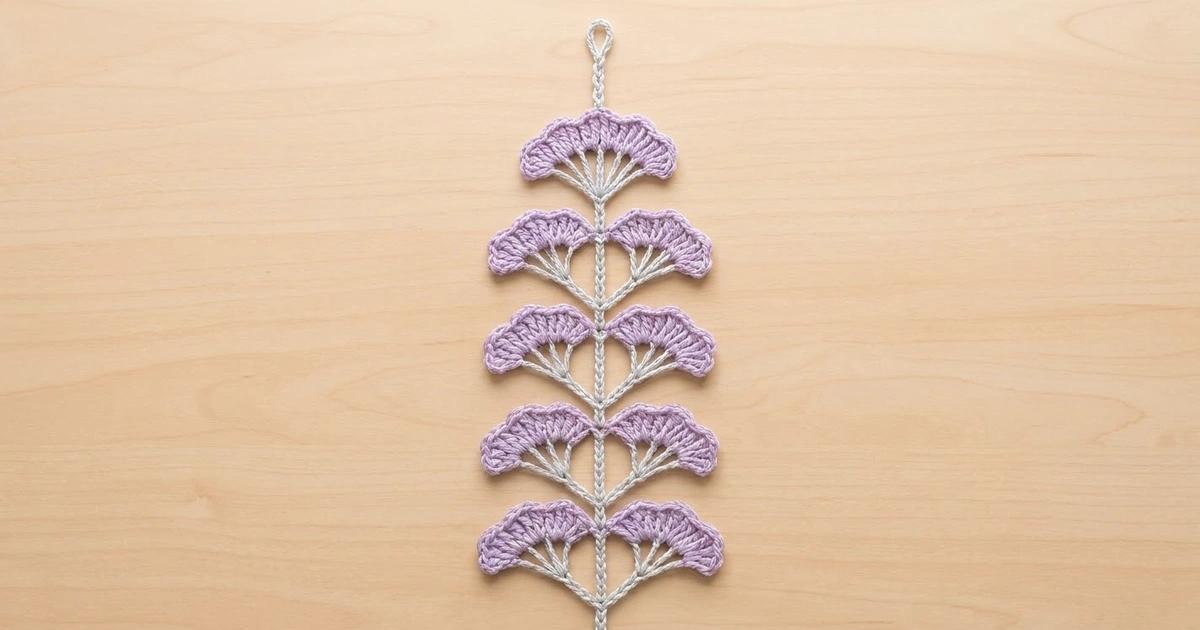
This hanging strand looks like a sprig of tiny ginkgo leaves. A light gray chain stem runs down the middle. A single fan sits at the top, and five pairs of fans branch out below it. Each fan has slim gray spokes that open out from one point, and a lavender band with a scalloped edge runs across the spoke tips.
The palette is two soft colors: light silver-gray for the stem and spokes, and pale lavender for the fan bands. The look is airy and botanical, and it suits doorways, windows, shelf edges, or a wall hook.
The pattern uses US crochet terms. One finished strand measures 14.5 in (36.8 cm) long, including the hanging loop, and 7 in (17.8 cm) across at its widest pair of fans.
The construction is simple. First you crochet the whole gray framework in one pass from the top down: the hanging loop, the stem, and every spoke as a slip-stitch cord. Then you pin the framework flat and work each lavender fan straight onto the spoke tips in two rows. You never sew anything. An optional section explains how to make the eight-strand curtain.
Finished Size and Construction
- Finished size (one strand): 14.5 in (36.8 cm) long × 7 in (17.8 cm) wide
- Skill level: Easy-intermediate
- Terminology: US crochet terms
- Yarn weight: Sport-weight (#2) cotton
- Hook: 3.0 mm (US C/2 or D/3)
- Number of pieces: 1 continuous strand (11 fans total)
- Layout: 1 top fan + 5 pairs of side fans along one stem
- Top fan size: 4.5 in (11.4 cm) wide × 2.25 in (5.7 cm) tall
- Side fan size: 3 in (7.6 cm) wide × 2 in (5.1 cm) tall
- Fan size before scalloped edge: top fan 3.75 in (9.5 cm) wide; side fan 2.25 in (5.7 cm) wide
- Scalloped edge depth: about 0.375 in (1.0 cm)
Materials
Pick a smooth, tightly plied mercerized or combed cotton. Cotton gives crisp spokes, and the fans stay flat once blocked. Acrylic is fine too, but the fans may curl more. The quantities below assume sport cotton at about 3 m per gram.
For one strand:
- Color A, light gray (stem and spokes): 8 g, 24 m
- Color B, lavender (fan bands): 10 g, 30 m
For the optional eight-strand curtain (13 pairs per strand):
- Color A, light gray: 128 g, 384 m (16 g, 48 m per strand)
- Color B, lavender: 160 g, 480 m (20 g, 60 m per strand)
All quantities include a margin of about 20 percent for swatching and tails.
Tools:
- 3.0 mm crochet hook
- Tapestry needle
- Scissors
- Rustproof pins and a foam blocking board
- Ruler or tape measure
- Spray bottle
- Locking stitch markers
Abbreviations (US Terms)
- ch – chain
- sl st – slip stitch
- sc – single crochet
- dc – double crochet
- sk – skip
- sp – space
- st(s) – stitch(es)
Special stitches
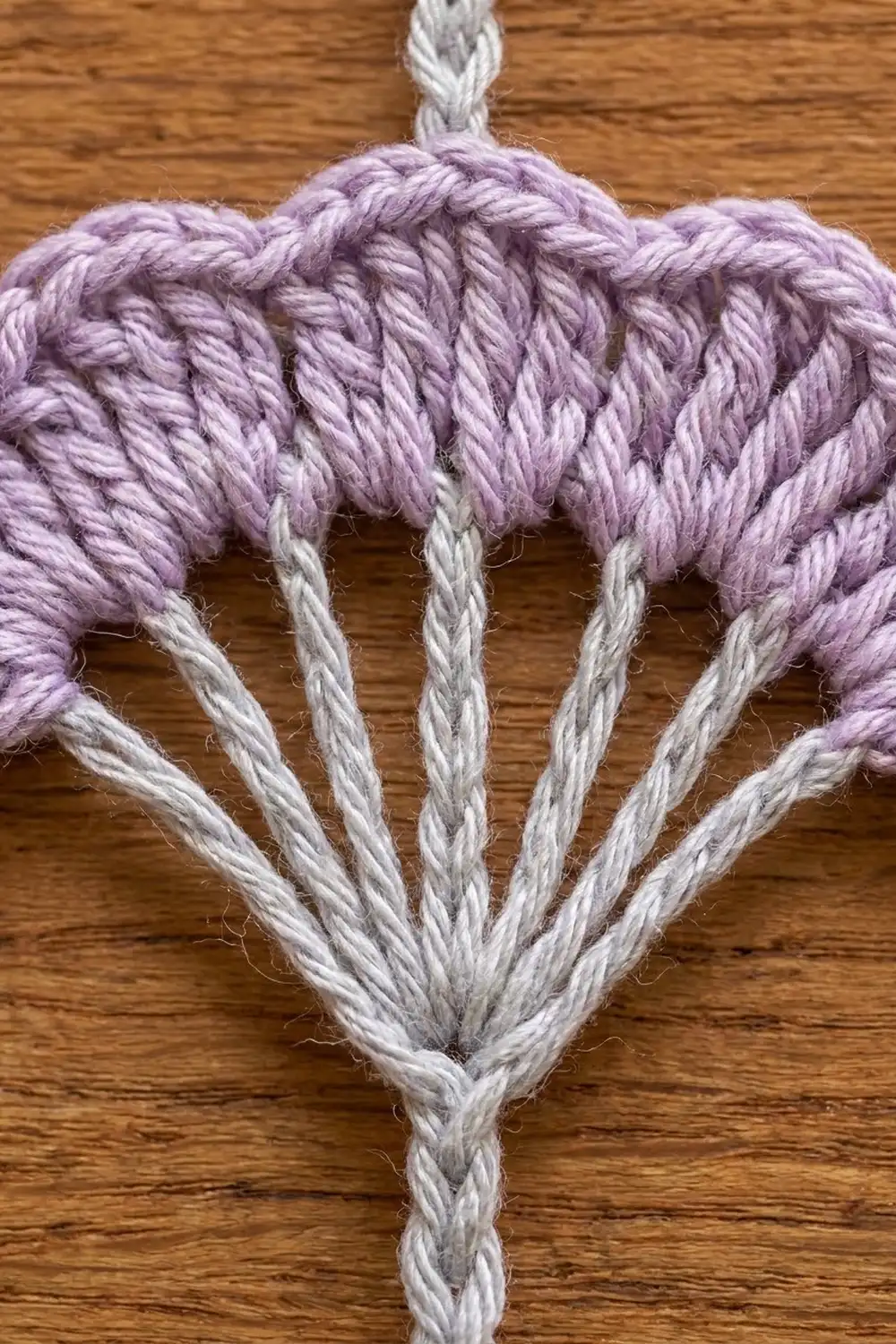
- Spoke: Ch the stated number, sl st in 2nd ch from hook and in each ch back to the anchor, then sl st in the anchor. The unworked ch at the end is the tip. The slip stitches twist the chain into a firm cord.
- Shell: 5 dc in the same sp.
Gauge and Checkpoints
Gauge matters for the strand’s length and the fans’ shape, so make one test piece first. Work a hanging loop, an 18-ch upper stem, and the six top spokes, then add the lavender top fan. If that one fan matches the checkpoints, the rest of the strand will match too.
- Chain gauge: 12 ch = 2 in (5.1 cm), measured relaxed.
- Top spoke: 1.5 in (3.8 cm) from node to tip.
- Side spoke: 1.25 in (3.2 cm) from branch end to tip.
- Top fan after Row 1: 3.75 in (9.5 cm) wide.
- Top fan after Row 2: 4.5 in (11.4 cm) wide, 2.25 in (5.7 cm) tall from the node.
- Side fan after Row 2: 3 in (7.6 cm) wide, 2 in (5.1 cm) tall.
- One pair: 7 in (17.8 cm) from outer edge to outer edge.
If your fan is too big, go down to a 2.75 mm hook. If it is too small or cups, go up to a 3.25 mm hook. If the spokes are right but the lavender band ruffles, change hooks for Color B only.
Part 1: Gray Framework
Work with Color A from the top down. You make the nodes, branches, and spokes as you go, and the working loop always ends back on the stem.
Hanging loop: Ch 12, sl st in first ch to form a ring. This loop hangs about 1 in (2.5 cm) long.
Upper stem: Ch 18. The last ch made is the top node. Place a marker in the 10th ch counted up from the node, not counting the node itself. This is the 8th ch after the loop, and it will be the center tip of the top fan.
Top fan spokes: [Ch 10, sl st in 2nd ch from hook and in each of next 8 ch, sl st in top node] 6 times. (6 spokes, each with 9 sl st and 1 tip ch.) Spokes 1–3 will sit to the left of the stem and spokes 4–6 to the right. The upper stem itself is the center spoke.
Stem segment: Ch 12. The last ch is the pair node.
Left branch: Ch 4. You are now at the branch end.
- [Ch 8, sl st in 2nd ch from hook and in each of next 6 ch, sl st in branch end] 5 times. (5 spokes, each with 7 sl st and 1 tip ch.)
- Sl st in each of next 3 branch ch, sl st in pair node.
Right branch: Work the same as the left branch, ending with a sl st in the pair node.
Pairs 2–5: [Ch 12, then work the left and right branches] 4 times.
Tail: Ch 3, fasten off, and weave in.
Gray stitch check: The stem has 93 ch in total: 12 in the loop, 18 in the upper stem, 5 × 12 in the segments, and 3 in the tail. There are 56 spokes: 6 top spokes and 50 side spokes (10 fans × 5).
Checkpoint: Lay the framework flat. From the top of the loop to the tail end, it should measure 14.5 in (36.8 cm).
Part 2: Pin the Framework
Pin the stem straight down the center of the blocking board. Fan the top spokes upward like an open hand, three on each side, with the stem as the center line. For each side fan, angle the branch up and out at about 45 degrees. Then spread its five spokes evenly over a half circle that opens upward and outward. Put one pin through each tip. The lavender rows go on much more evenly with the tips fixed in place.
Part 3: Top Fan (Color B)
Work into each tip ch, inserting the hook under both loops. Work into the marked stem ch at the center.
Row 1: Join Color B with a sl st in the tip of spoke 1 (outer left). Ch 3 (counts as dc), then 2 dc in the same tip. Work [ch 1, 3 dc in next tip] 6 times, going left to right through spokes 2 and 3, the marked stem ch, and spokes 4, 5, and 6. Turn.
Count: 21 dc in 7 groups + 6 ch-1 sps = 27 sts.
Checkpoint: The band measures 3.75 in (9.5 cm) across and lies flat over the spokes.
Do not fasten off. Go straight on to Row 2 in the Scalloped Edge section below.
Part 4: Side Fans (Color B)
Work each of the 10 side fans the same way. Start at the tip of the spoke nearest the stem and work outward.
Row 1: Join Color B with a sl st in the first tip. Ch 3 (counts as dc), then 2 dc in the same tip. Work [ch 1, 3 dc in next tip] 4 times. Turn.
Count: 15 dc in 5 groups + 4 ch-1 sps = 19 sts.
Checkpoint: The band measures 2.25 in (5.7 cm) across.
Go on to Row 2 below.
Scalloped Edge (Border)
The scalloped edge acts as each fan’s border. It is a trim row: each shell sits over one ch-1 sp, and each sc anchors on the center dc of a group.
Border gauge: One shell plus its sc is about 0.75 in (1.9 cm) wide along the outer edge and rises about 0.375 in (1.0 cm).
Top fan, Row 2: Ch 1. Sc in first 2 dc, sk next dc. Then work [shell in next ch-1 sp, sk next dc, sc in next dc, sk next dc] 5 times. Shell in last ch-1 sp, sk next dc, sc in last 2 dc. Fasten off.
Count: 39 sts = 9 sc (1 per used dc) + 30 dc (6 shells × 5), making 6 scallops.
Side fan, Row 2: Ch 1. Sc in first 2 dc, sk next dc. Then work [shell in next ch-1 sp, sk next dc, sc in next dc, sk next dc] 3 times. Shell in last ch-1 sp, sk next dc, sc in last 2 dc. Fasten off.
Count: 27 sts = 7 sc (1 per used dc) + 20 dc (4 shells × 5), making 4 scallops.
Why the math works: A fan with t tips has t dc groups and t − 1 ch-1 sps. Row 2 places one shell per sp, so the top fan has 6 scallops and each side fan has 4. Every middle group gives up its two outer dc and keeps its center dc as an anchor. The two end groups each keep 2 dc, so the scallop line finishes neatly at both ends. The outer arc of the fan is longer than the inner arc. Row 2 therefore needs more stitches than Row 1: 39 against 27 on the top fan, and 27 against 19 on a side fan. That growth lets the edge spread out flat instead of cupping. At 0.75 in (1.9 cm) per shell, 6 shells give 4.5 in (11.4 cm) and 4 shells give 3 in (7.6 cm).
Checkpoint: The top fan is 4.5 in (11.4 cm) wide and each side fan is 3 in (7.6 cm) wide. Each pair spans 7 in (17.8 cm).
Make All Pieces (Optional Curtain)
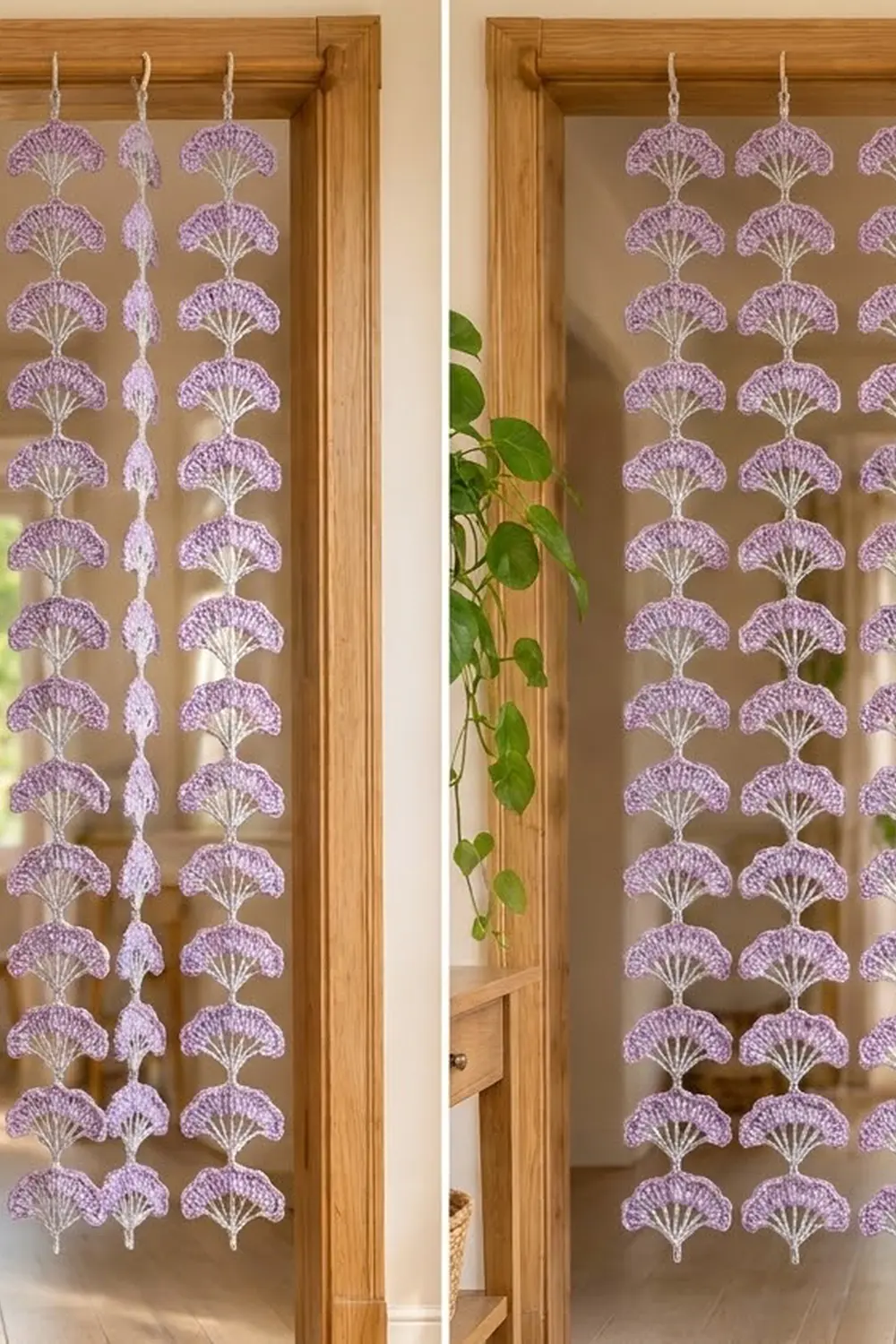
The last photo shows a curtain of separate strands. To make it, crochet 8 strands. Work 13 pairs instead of 5 in each strand: after the first pair, work [ch 12, then the left and right branches] 12 times.
- Each curtain strand: 1 top fan + 26 side fans = 27 fans
- Total fans: 216 (8 top fans + 208 side fans)
- Per strand: 16 g, 48 m of Color A and 20 g, 60 m of Color B
- Strand length: 4.5 in + 13 × 2 in = 30.5 in (77.5 cm)
Each extra pair adds 2 in (5.1 cm) of length. The other 4.5 in (11.4 cm) is made up of the loop, the upper stem, and the tail.
Layout grid (front view, strands numbered left to right):
Rod:  [1]  [2]  [3]  [4]  [5]  [6]  [7]  [8]
      7 in (17.8 cm) between strand centers
Each: top fan, then 13 pairs down the stem
Hanging the Strands (Joining)
The strands are not joined to one another. Each one hangs on its own from its 12-ch loop. Slide the loops onto a tension rod or curtain rod, or hang each one from a small curtain ring or S-hook.
Spacing logic: Each pair is 7 in (17.8 cm) wide. Spacing the strands 7 in (17.8 cm) apart center to center lets the outer fan tips just meet without overlapping. Eight strands cover 8 × 7 in = 56 in (142.2 cm).
Tension advice: Before you hang them, lay all eight strands side by side and compare their lengths. Chains worked at different sittings can drift. Make any fixes before blocking.
Size checkpoint: Every strand should be within 0.25 in (0.6 cm) of the target 30.5 in (77.5 cm).
Final Blocking
- Weave in all tails along the gray spokes or through the back of the lavender dc.
- Pin the strand flat as in Part 2: stem straight, spokes evenly spread.
- Pin every scallop point, shaping each fan into a smooth half circle.
- Spray until damp but not dripping.
- Check the measurements while it is wet: 4.5 in (11.4 cm) for the top fan, 3 in (7.6 cm) for each side fan, and 7 in (17.8 cm) per pair.
- Let it dry completely, at least 12 hours.
- Unpin and hang. Cotton keeps its shape well once dry.
Final Quality-Control Checklist
- Loop is closed and sits at the very top of the stem
- Stem counts 93 ch (or 189 ch for a 13-pair strand)
- Top fan: 6 spokes + stem center, 39 sts in Row 2, 6 scallops
- Each side fan: 5 spokes, 27 sts in Row 2, 4 scallops
- All tips caught in Row 1, with no loose spokes behind the band
- Pairs mirror each other across the stem
- Strand measures 14.5 in (36.8 cm) × 7 in (17.8 cm)
- All tails woven in and trimmed
Troubleshooting
Spokes are wavy or kinked. The slip stitches are too tight. Loosen them or use a hook one size larger for the spokes only.
Fan cups upward. Row 2 is too tight. Go up one hook size for Color B.
Fan ruffles. Your dc are too loose. Go down one hook size for Color B.
Stem is too long. Your chains are loose. Use a smaller hook for the stem only.
A spoke tip slipped out of Row 1. Pull out the stitches back to that group and rework the 3 dc under both loops of the tip ch.
Pairs are lopsided. Make sure both branches have exactly 4 ch, with 3 sl st worked back to the node.
Care
Hand wash in cool water with mild soap, press out the water in a towel, and dry flat and pinned. Re-block lightly if the fans lose their shape after washing.
Final Notes
The measurement chain is short. With 12 ch = 2 in (5.1 cm), the top spokes come out at 1.5 in (3.8 cm) and the side spokes at 1.25 in (3.2 cm). The top fan grows from 3.75 in (9.5 cm) to 4.5 in (11.4 cm) with its scalloped edge, and each side fan grows from 2.25 in (5.7 cm) to 3 in (7.6 cm). Two side fans and their branches make a 7 in (17.8 cm) pair. Five pairs at 2 in (5.1 cm) each, plus 4.5 in (11.4 cm) of loop, upper stem, and tail, give a strand 14.5 in (36.8 cm) long. Check each link as you go and the whole strand will hang true.
Happy crocheting!