

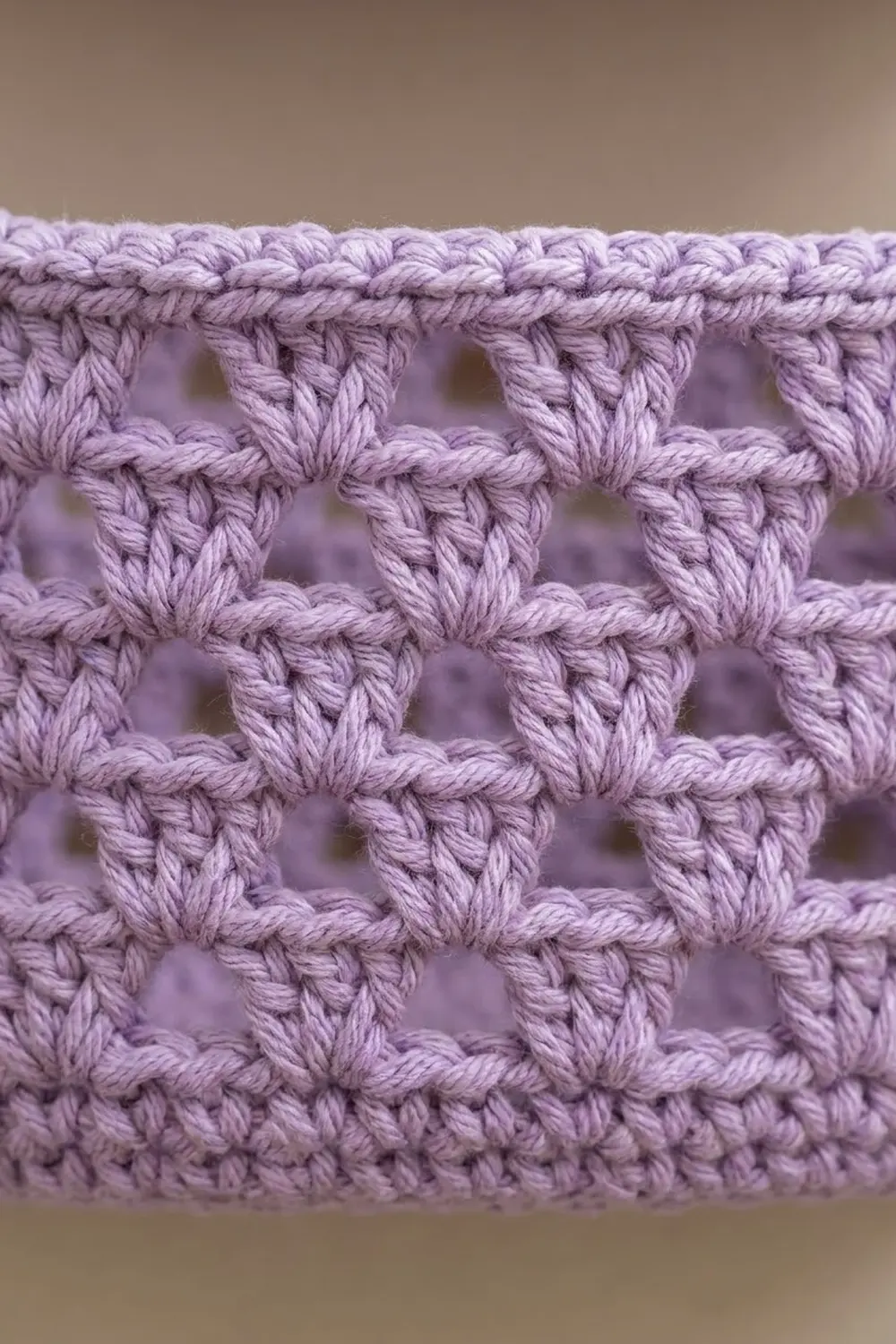
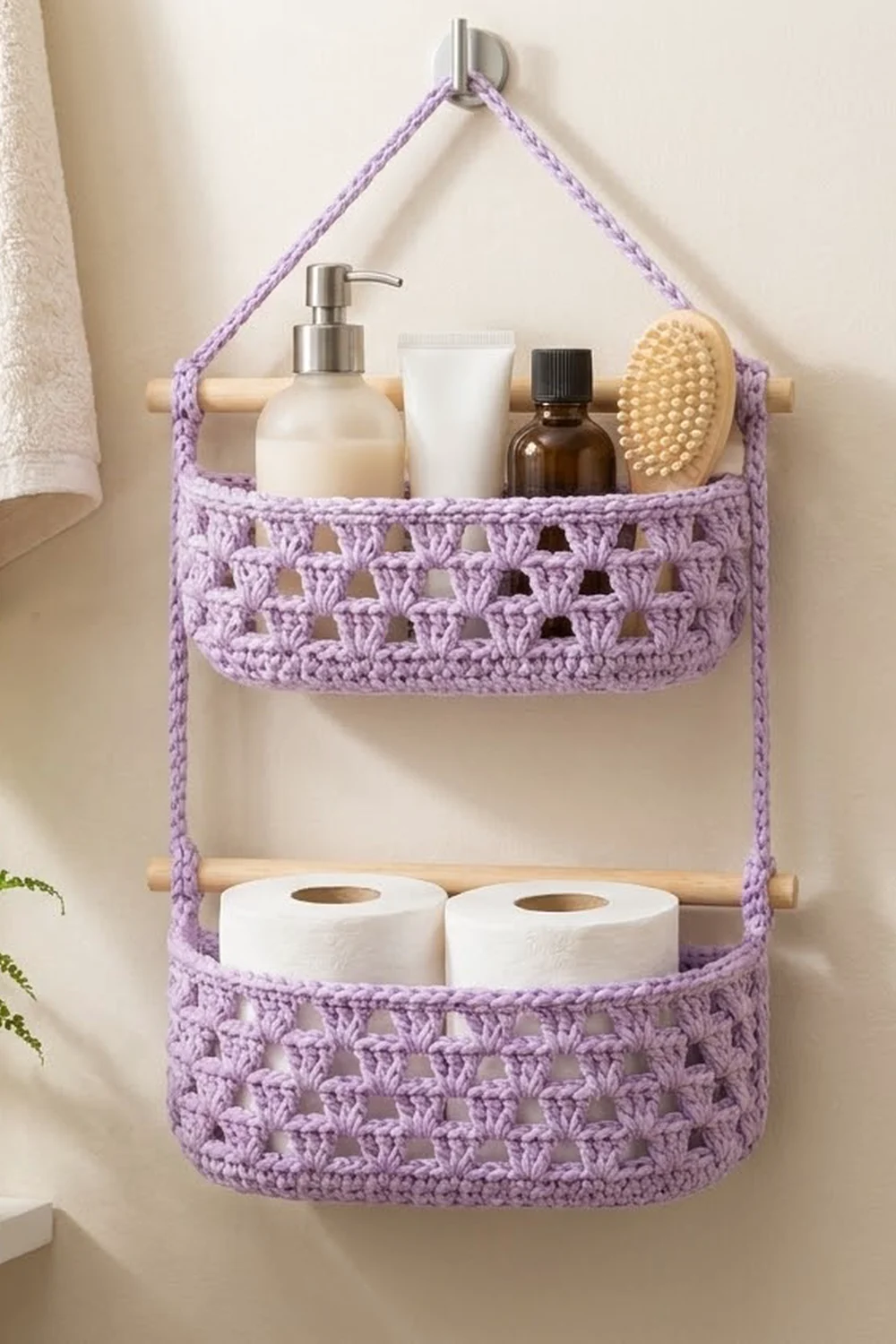
This hanging organizer gives you two open baskets that take up no shelf space. A small top basket holds pumps, tubes and brushes, and a larger bottom basket fits two standard toilet rolls side by side. Each basket has a solid oval base, a short solid band, and a lattice of offset shells that shows off what’s inside.
The sample uses one soft lavender worsted-weight cotton. Two light wooden dowels keep each basket mouth open and spread the hanging cords evenly. The look is clean and calm and suits a bathroom or nursery.
This pattern uses US crochet terms. The finished organizer hangs about 21 in (53.3 cm) tall and 12.5 in (31.8 cm) wide at the bottom dowel. The large basket measures 11.5 × 4.5 in (29.2 × 11.4 cm) at the base and stands 4.1 in (10.4 cm) tall. The small basket measures 9 × 3.5 in (22.9 × 8.9 cm) and stands 3.1 in (7.9 cm) tall.
To make it, you crochet two oval baskets in joined rounds, starting with the base and working up the walls without turning. Next, you make two slip-stitch cords. Finally, you sew the cords around the dowels and down the basket ends, then join their tops with a hanging loop.
Finished Size and Construction
- Finished size: about 21 in (53.3 cm) tall × 12.5 in (31.8 cm) wide
- Skill level: Intermediate
- Terminology: US
- Yarn weight: #4 worsted, cotton
- Hook: 5.0 mm (H-8)
- Number of pieces: 4 crocheted pieces (2 baskets, 2 cords) + 2 dowels
- Layout: small basket stacked above large basket, both hanging on the same pair of cords
- Piece sizes: large basket 11.5 × 4.5 × 4.1 in (29.2 × 11.4 × 10.4 cm); small basket 9 × 3.5 × 3.1 in (22.9 × 8.9 × 7.9 cm)
- Height before rim: large 3.4 in (8.6 cm); small 2.4 in (6.1 cm)
- Rim depth: 0.7 in (1.8 cm), 3 rounds
Materials
Yarn: Use a smooth, firm worsted cotton or cotton blend. Cotton holds the basket shape and handles bathroom humidity well. Avoid fuzzy acrylic, because it hides the lattice and lets the walls sag.
- Lavender: 250 g / about 425 m (465 yd)
- Large basket: about 130 g
- Small basket: about 85 g
- Cords and hanging loop: about 10 g
These quantities include a safety margin of roughly 10%.
Tools:
– 5.0 mm (H-8) crochet hook
– 2 wooden dowels, 1/2 in (1.3 cm) in diameter: one 10 in (25.4 cm) long, one 12.5 in (31.8 cm) long
– 6 removable stitch markers
– Tapestry needle
– Scissors and a measuring tape
– Fine sandpaper for the dowel ends
Abbreviations (US Terms)
- ch – chain
- sl st – slip stitch
- sc – single crochet
- dc – double crochet
- BLO – back loop only
- rev sc – reverse single crochet (crab stitch)
- inc – 2 sc in the same stitch
- st(s) – stitch(es)
- sp – space
- rnd(s) – round(s)
- rep – repeat
Shell: 3 dc worked into the same stitch or space.
Rev sc: Work sc from left to right (right to left if you crochet left-handed). Insert the hook into the next stitch to the right, yarn over, pull up a loop, yarn over and pull through both loops.
Gauge and Checkpoints
Base gauge: 16 sc × 18 rnds = 4 in (10.2 cm).
Lattice gauge: 1 repeat (shell + ch-2) = 1 in (2.5 cm) wide; 4 shell rnds = 2 in (5.1 cm) tall.
Make the small basket first. It is your gauge test.
Checkpoints:
– Small basket after Rnd 1: about 6 in (15.2 cm) long
– Small base after Rnd 8: 9 × 3.5 in (22.9 × 8.9 cm)
– Small basket before the rim: 2.4 in (6.1 cm) tall
– Large basket after Rnd 1: about 7.5 in (19.1 cm) long
– Large base after Rnd 10: 11.5 × 4.5 in (29.2 × 11.4 cm)
– Large basket before the rim: 3.4 in (8.6 cm) tall
If your base comes out more than 0.25 in (0.6 cm) too big, go down one hook size. If it is too small, go up one hook size. If the base curls up like a bowl, your tension is too tight on the ends. If it ripples, your tension is too loose. In either case, change hooks rather than changing the stitch counts.
Large Basket
Base
Ch 31.
Rnd 1: Sc in 2nd ch from hook, sc in next 28 ch, 3 sc in last ch. Working along the opposite side of the foundation chain, sc in next 28 ch, then 2 sc in the last ch (the same ch that holds the first sc). Join with sl st to the first sc, then sl st in the next sc to move the start of the round onto the straight side. (62 sts: 28 per side + 3 per end)
Rnd 2: Ch 1, sc in the same st and in the next 27 sts, 2 sc in each of next 3 sts, sc in next 28 sts, 2 sc in each of next 3 sts. The last of these 3 sts is the first sc of Rnd 1, which holds the joining sl st. Join with sl st to the first sc. (68 sts: 28 per side + 6 per end)
Rnd 3: Ch 1, sc in first 28 sts, [sc in next st, inc] 3 times, sc in next 28 sts, [sc in next st, inc] 3 times, join. (74 sts: 28 per side + 9 per end)
Rnds 4–10: Ch 1, sc in first 28 sts, [sc in next X sts, inc] 3 times, sc in next 28 sts, [sc in next X sts, inc] 3 times, join. In each round, X is the round number minus 2: X = 2 in Rnd 4 and X = 8 in Rnd 10.
Stitch count at the end of each round:
– Rnd 4: 80
– Rnd 5: 86
– Rnd 6: 92
– Rnd 7: 98
– Rnd 8: 104
– Rnd 9: 110
– Rnd 10: 116 (28 per side + 30 per end)
Checkpoint: the base measures 11.5 × 4.5 in (29.2 × 11.4 cm).
Walls
Rnd 11: Ch 1, sc BLO in each st around, join. (116) This round makes the folded edge between base and wall.
Rnd 12: Ch 1, sc in each st around, join. (116)
Rnd 13 (first shell rnd): Ch 3 (counts as dc), 2 dc in the same st, ch 2, skip next 3 sts, shell in next st, ch 2, skip next 3 sts; rep from * 27 more times. Join with sl st to the top of the ch-3. (29 shells, 29 ch-2 sps)*
Rnds 14–18: Sl st in next 2 dc and into the ch-2 sp. Ch 3, 2 dc in the same sp, ch 2, shell in next ch-2 sp, ch 2; rep from * 27 more times, join. (29 shells, 29 ch-2 sps per rnd)*
Each new shell sits between two shells of the round below, and each ch-2 crosses over the center of a shell below. This offset creates the V-and-triangle lattice. Checkpoint: the basket is 3.4 in (8.6 cm) tall.
Continue with the rim (see Rim/Border).
Small Basket
Base
Ch 25.
Rnd 1: Sc in 2nd ch from hook, sc in next 22 ch, 3 sc in last ch. Working along the opposite side, sc in next 22 ch, then 2 sc in the last ch. Join to the first sc, then sl st in the next sc. (50 sts: 22 per side + 3 per end)
Rnd 2: Ch 1, sc in the same st and in the next 21 sts, 2 sc in each of next 3 sts, sc in next 22 sts, 2 sc in each of next 3 sts, join. (56)
Rnds 3–8: Ch 1, sc in first 22 sts, [sc in next X sts, inc] 3 times, sc in next 22 sts, [sc in next X sts, inc] 3 times, join. X is the round number minus 2.
Stitch count at the end of each round:
– Rnd 3: 62
– Rnd 4: 68
– Rnd 5: 74
– Rnd 6: 80
– Rnd 7: 86
– Rnd 8: 92 (22 per side + 24 per end)
Checkpoint: the base measures 9 × 3.5 in (22.9 × 8.9 cm).
Walls
Rnd 9: Ch 1, sc BLO in each st around, join. (92)
Rnd 10: Ch 1, sc in each st around, join. (92)
Rnd 11: Work as large basket Rnd 13, repeating from * 22 more times. (23 shells, 23 ch-2 sps)
Rnds 12–14: Work as large basket Rnds 14–18, repeating from * 22 more times. (23 shells per rnd)
Checkpoint: the basket is 2.4 in (6.1 cm) tall. Continue with the rim.
Cords (Make 2)
Cord gauge: 18 sl sts = 4 in (10.2 cm).
Ch 109. Sl st in the back bump of the 2nd ch from hook and in each ch across. (108 sts) Fasten off and leave a 24 in (61.0 cm) tail for sewing. Each cord measures 24 in (61.0 cm).
Count from the starting end and place markers at these points:
– After st 40: end of the apex leg, about 8.9 in (22.6 cm)
– After st 49: end of the top dowel loop
– After st 63: end of the section sewn to the top basket
– After st 76: end of the free span
– After st 85: end of the bottom dowel loop
– After st 103: end of the section sewn to the large basket. Sts 104–108 tuck under the base.
Check: 40 + 9 + 14 + 13 + 9 + 18 + 5 = 108.
Make All Pieces
All pieces are Lavender:
– 1 large basket: about 130 g
– 1 small basket: about 85 g
– 2 cords: about 5 g each
Layout:
            ( hanging loop )
              /          \
      ==== 10 in dowel ====
      [  small basket 9 in  ]
        |                |
   ===== 12.5 in dowel =====
   [  large basket 11.5 in  ]
Joining
Method: whipstitch with the cord tails, one stitch per cord stitch.
- Dowel loops. Fold cord sts 41–49 into a loop and sew st 49 to st 40 to make a closed sleeve. Do the same with sts 77–85, sewing st 85 to st 76. Each loop is 2 in (5.1 cm) around, which fits snugly over a 1/2 in (1.3 cm) dowel.
- Top basket. Place cord sts 50–63 along the center of one curved end of the small basket. The bottom of the loop sits at the rim and st 63 reaches the base fold. That is 14 cord sts over 3.1 in (7.9 cm) of wall. Take one whipstitch per cord stitch through the matching wall stitch. Repeat with the second cord on the opposite end.
- Bottom basket. Sew cord sts 86–103 down each curved end of the large basket. That is 18 sts over 4.1 in (10.4 cm). Fold sts 104–108 under the base and sew them flat.
- Free span. Sts 64–76 hang free between the baskets, about 2.9 in (7.4 cm). Each one angles outward about 1.25 in (3.2 cm), because the large basket is longer than the small one.
- Hanging loop. Hold the tops of both cords together and join the yarn through both. Ch 12, sl st into the same place, then work 18 sc into the loop and fasten off.
- Dowels. Sand the ends and slide each dowel through its pair of loops. About 0.5 in (1.3 cm) should stick out past each cord.
Tension: Pull each whipstitch just enough to close the gap. If you pull too hard, the basket end will pucker.
Size checkpoint: Hang the organizer and check that both dowels are level. Each apex leg should be 8.9 in (22.6 cm) long, and the whole organizer should hang about 21 in (53.3 cm) tall.
Rim/Border
Rim gauge: 4 sc = 1 in (2.5 cm); 3 rnds = 0.7 in (1.8 cm).
Large Basket
Rnd 19 (conversion rnd): Ch 1. Work 1 sc in each dc (the ch-3 counts as a dc) and 1 sc in each ch-2 sp. Join. (87 sc in dc + 29 sc in spaces = 116)
Rnd 20: Ch 1, sc in each st around, join. (116)
Rnd 21: Ch 1, rev sc in each st around, join and fasten off. (116)
Count per section on each rim round: 28 along the front, 30 around one end, 28 along the back, 30 around the other end.
Small Basket
Rnd 15 (conversion rnd): Ch 1, sc in each dc, 1 sc in each ch-2 sp, join. (69 + 23 = 92)
Rnd 16: Ch 1, sc in each st around, join. (92)
Rnd 17: Ch 1, rev sc in each st around, join and fasten off. (92)
Count per section: 22 along each side, 24 around each end.
Why the math works: Each lattice repeat sits on 4 base stitches. The conversion round gives each repeat 4 stitches back: 3 dc plus 1 space. So the rim count matches the base exactly (29 × 4 = 116 and 23 × 4 = 92). The rim has the same circumference as the base, so it stays straight without flaring or pulling in.
Final Blocking
- Mist each basket with water until it is damp but not soaked.
- Stuff the basket firmly with folded towels or a box cut to size.
- Shape the ends into smooth curves and keep the walls straight up.
- Pat the lattice so every opening is even.
- Let the baskets dry completely, which takes 24 hours.
- Lay the cords flat and straighten them while they are damp.
- Reassemble the organizer once everything is dry.
Final Quality-Control Checklist
- Base counts are 116 (large) and 92 (small)
- Both baskets have 29 or 23 shells on every lattice round
- Rim counts match the base counts
- The BLO fold is crisp all the way around
- The dowel loops are snug and sewn securely
- Both cords are sewn to the center of each basket end
- The dowels hang level
- All ends are woven in at least 2 in (5.1 cm)
Troubleshooting
- Base cups upward: Loosen your tension on the end increases, or go up a hook size.
- Wall leans outward: Tighten your ch-2s or make them ch 1 instead.
- Shell count is off: Count the skipped stitches in the first shell round; there should be 3 skipped each time.
- Basket tilts: Check that both cords are sewn at the same height on each end.
- Rim ruffles: Work only 1 sc into each ch-2 sp.
- Dowel slips out: Resew the loop 1 cord stitch smaller.
Care
Remove the dowels and hand wash the crochet pieces in cool water. Lay them flat to dry, then reshape the baskets over a towel.
Final Notes
Every measurement depends on the one before it. If your gauge of 16 sc = 4 in (10.2 cm) is correct, the bases will measure 11.5 in (29.2 cm) and 9 in (22.9 cm). Correct bases give you the 116- and 92-stitch rounds, which divide evenly into 29 and 23 shell repeats. The conversion round brings back the same counts, so the rims stay straight. Finally, the cords’ 108 stitches line up exactly with the dowel loops and the wall heights. Check each stage before moving on, and the organizer will hang straight and level.
Happy crocheting!