

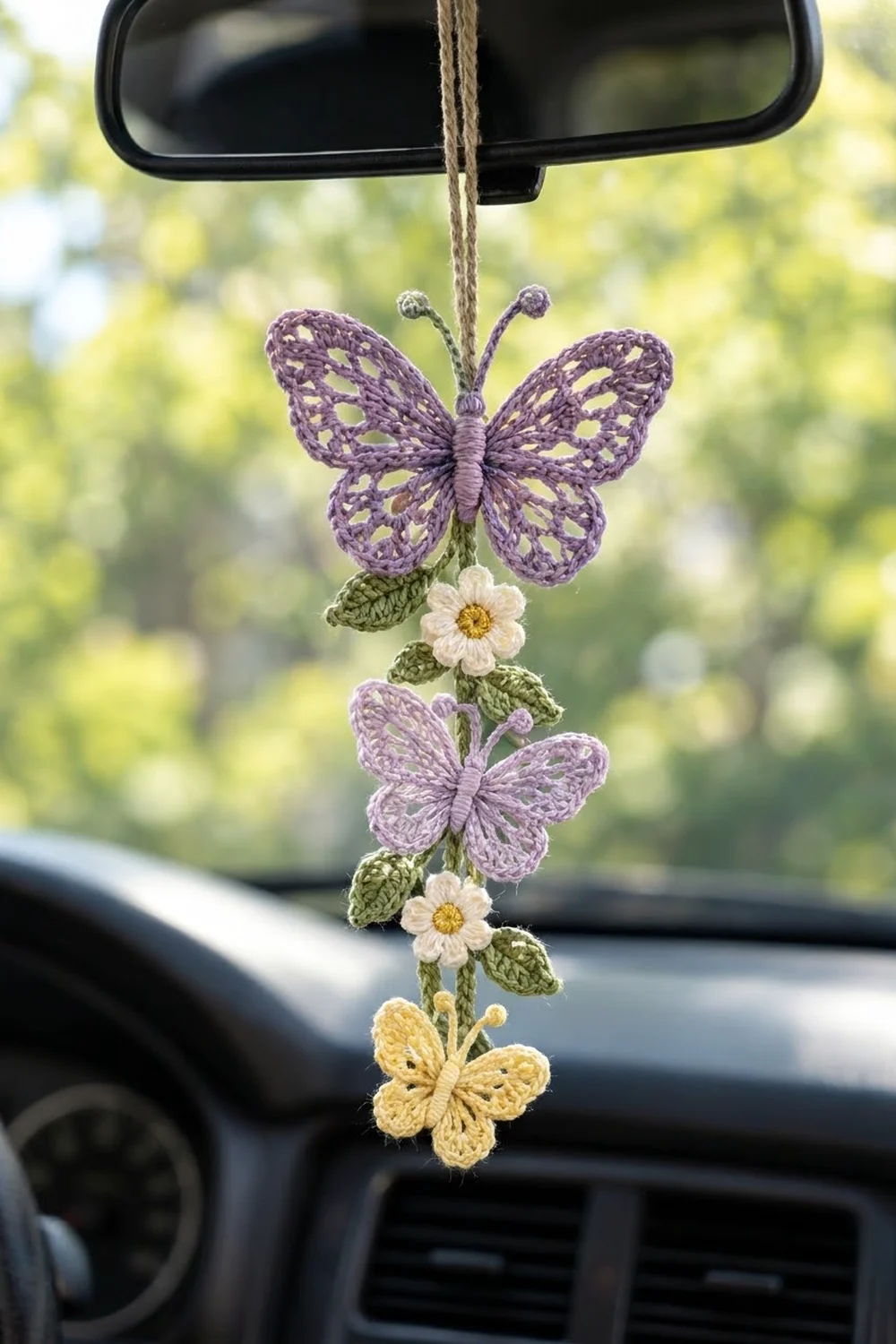
This hanging charm brings a little spring meadow into your car. Three lacy butterflies, two daisies, and a scatter of leaves run down a slim green vine. The whole thing hangs from the rearview mirror on a twisted cotton cord.
The colors get deeper from bottom to top: a pale-yellow butterfly at the bottom, a light-lilac one in the middle, and a deep-lavender butterfly at the top. White daisies with golden centers and sage-green leaves sit between them. The style is soft and cottagecore, and the lace wings catch the light through the windshield.
The pattern uses US crochet terms. The finished charm is about 10 in (25.4 cm) long and 3.5 in (8.9 cm) wide at the top butterfly. The hanging loop adds a 5 in (12.7 cm) drop, so the overall length is about 15 in (38.1 cm).
Each butterfly is worked in the round from a center ring, with four chain loops that become the wing lobes. A rolled body and antennae are sewn on top. The daisies and leaves are tiny motifs. You make a slip-stitch vine, sew everything onto it in order, and add a twisted cord at the top.
Finished Size and Construction
- Finished size: about 10 in (25.4 cm) long x 3.5 in (8.9 cm) wide; 15 in (38.1 cm) including the hanging loop
- Skill level: Intermediate
- Terminology: US crochet terms
- Yarn weight: Sport-weight (2, fine) cotton
- Hooks: 3.0 mm and 2.25 mm (US B/1)
- Number of pieces: 15 components: 3 butterflies (each with its own body), 2 daisies, 8 leaves, 1 vine, 1 hanging cord
- Layout: one vertical column: large butterfly, leaf-daisy cluster, medium butterfly, leaf-daisy cluster, small butterfly
- Piece sizes: large butterfly 3.5 x 2.5 in (8.9 x 6.4 cm); medium 2.75 x 2 in (7.0 x 5.1 cm); small 2.25 x 1.75 in (5.7 x 4.4 cm); daisy 1.25 in (3.2 cm); leaf 1 x 0.5 in (2.5 x 1.3 cm); vine 9 in (22.9 cm)
- Large butterfly before edging: 3.25 in (8.3 cm) wide
- Edging depth: about 0.125 in (0.3 cm)
Materials
Use a smooth mercerized cotton in sport weight. Cotton holds the lace shape, stands up to sun and heat in a car, and blocks crisply. Avoid fuzzy or stretchy yarns, because the open wings will lose their definition.
- Deep lavender: 8 g / 24 m (large butterfly)
- Light lilac: 6 g / 18 m (medium butterfly)
- Pale yellow: 4 g / 12 m (small butterfly)
- White: 3 g / 9 m (daisy petals)
- Golden yellow: 1 g / 3 m (daisy centers)
- Sage green: 8 g / 24 m (leaves and vine)
- Natural/ecru: 3 g / 9 m (hanging cord)
These amounts include about 25% extra for swatching and sewing tails.
Tools: 3.0 mm hook, 2.25 mm hook, tapestry needle, scissors, 4 stitch markers, blocking mat, rust-proof pins, spray bottle, optional fabric stiffener.
Abbreviations (US Terms)
- ch – chain
- sl st – slip stitch
- sc – single crochet
- hdc – half double crochet
- dc – double crochet
- tr – treble crochet
- BLO – back loop only
- sp(s) – space(s)
- st(s) – stitch(es)
- rep – repeat
- MR – magic ring
Special stitch – bobble: (Yarn over, insert hook in st, yarn over and pull up a loop, yarn over and pull through 2 loops) 3 times in the same st, then yarn over and pull through all 4 loops on the hook.
Gauge and Checkpoints
Gauge: 6 sc and 6 rows = 1 in (2.5 cm) with the 3.0 mm hook. Vine: 5 sl sts = 1 in (2.5 cm).
Gauge isn’t critical for a charm, but it decides how well the pieces fit along the vine. Make the large butterfly first and measure it at each stage:
- After Rnd 3: 2.5 in (6.4 cm) wide
- After Rnd 4: 3.25 in (8.3 cm) wide
- After Rnd 5: 3.5 in (8.9 cm) wide, 2.5 in (6.4 cm) tall
If it is more than 0.25 in (0.6 cm) too big, go down one hook size. If it is too small, go up one size. Use the same hook for the medium butterfly, daisies, leaves, and vine.
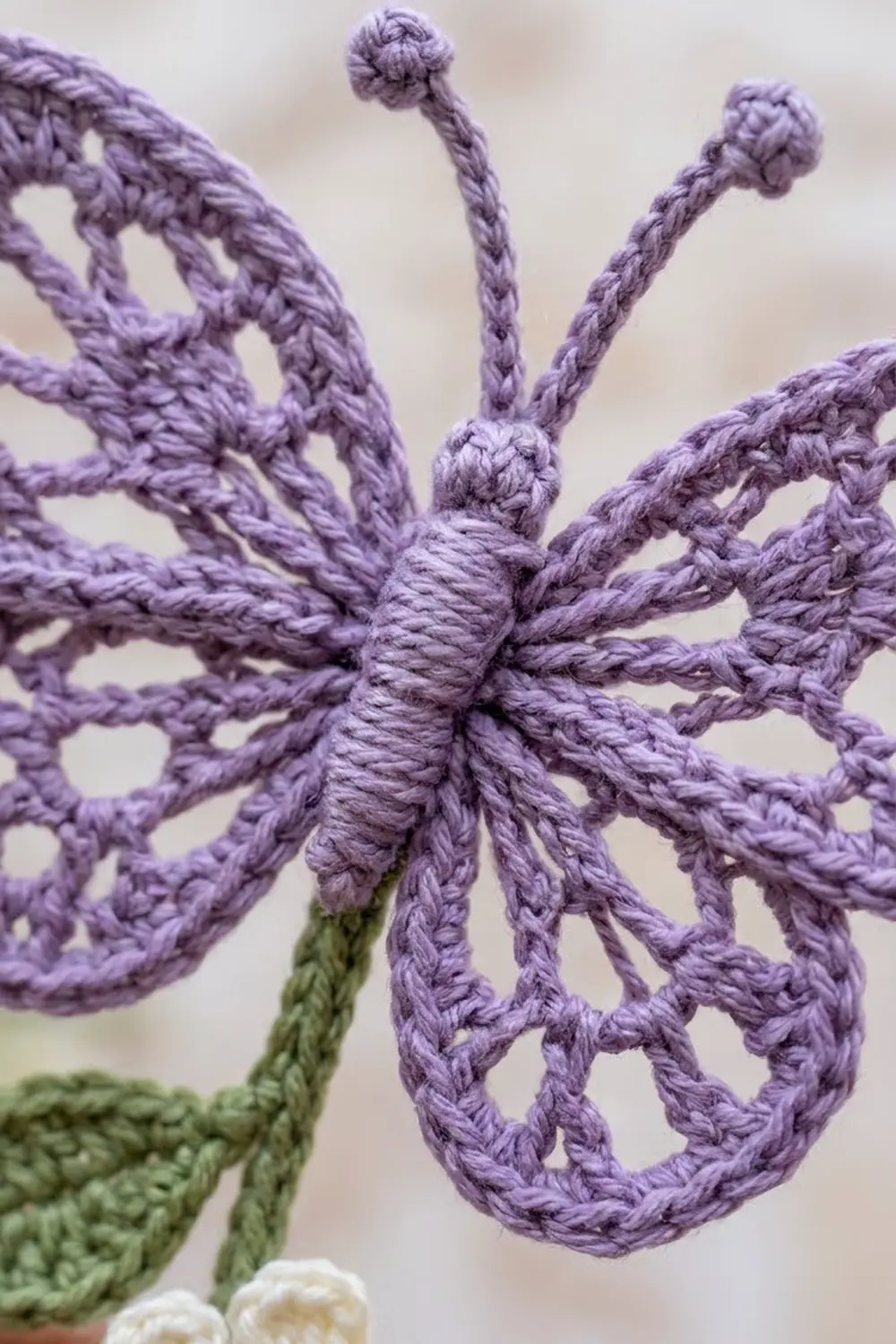
Large Butterfly
Use deep lavender and the 3.0 mm hook.
Rnd 1: MR, ch 1, 8 sc in ring, sl st to first sc. Pull the ring closed. (8 sc)
Rnd 2 (wing frames): Ch 1, sc in same st (st A), ch 12, sk 1 st, sc in next st (st B), ch 9, sk 1 st, sc in next st (st C), ch 9, sk 1 st, sc in next st (st D), ch 12, sk last st, sl st to first sc. (4 sc, two ch-12 loops, two ch-9 loops)
St A is the top center (head) and st C is the bottom center (tail). The ch-12 loops become the upper wings and the ch-9 loops become the lower wings.
Rnd 3 (wing fans): Ch 1. Work an upper fan in the first ch-12 loop, sl st in st B. Work a lower fan in the next ch-9 loop, sl st in st C. Work a lower fan in the next ch-9 loop, sl st in st D. Work an upper fan in the last ch-12 loop, sl st in st A.
- Upper fan: (sc, hdc, 3 dc, [ch 2, tr] 4 times, ch 2, 3 dc, hdc, sc). (14 sts, 5 ch-2 sps)
- Lower fan: (sc, hdc, 2 dc, [ch 2, dc] 3 times, ch 2, 2 dc, hdc, sc). (11 sts, 4 ch-2 sps)
Round total: 50 sts and 18 ch-2 sps, plus 4 sl sts between lobes. The tall stitches and chain spaces form the radiating openwork.
Rnd 4 (lace loops): Ch 1. Work each lobe as below, then sl st in the sl st between lobes. Join with a sl st to the first sl st.
- Upper lobe: Sc in first 5 sts, (ch 4, sc in next ch-2 sp, ch 4, sc in next tr) 4 times, ch 4, sc in last ch-2 sp, ch 4, sc in last 5 sts. (19 sc, 10 ch-4 loops)
- Lower lobe: Sc in first 4 sts, (ch 4, sc in next ch-2 sp, ch 4, sc in next dc) 3 times, ch 4, sc in last ch-2 sp, ch 4, sc in last 4 sts. (15 sc, 8 ch-4 loops)
Round total: 68 sc and 36 ch-4 loops. Checkpoint: 3.25 in (8.3 cm) wide.
Rnd 5: Work the Wing Edging (see Border). Fasten off.
Medium and Small Butterflies
Medium: Use light lilac and the 3.0 mm hook. Work Rnds 1–3 exactly as for the large butterfly, then work Edging B (see Border). Checkpoint: 2.75 x 2 in (7.0 x 5.1 cm).
Small: Use pale yellow and the 2.25 mm hook. Work it exactly like the medium butterfly. The smaller hook brings it down to 2.25 x 1.75 in (5.7 x 4.4 cm).
Butterfly Bodies and Antennae
Large body: With deep lavender and the 3.0 mm hook, ch 10.
- Row 1: Sc in 2nd ch from hook and in each ch across, turn. (9 sc)
- Rows 2–3: Ch 1, sc BLO in each st, turn. (9 sc)
Fasten off, leaving a 12 in (30.5 cm) tail. Roll the strip lengthwise into a tube with the ridges on the outside, and whipstitch the edge closed. Wrap the tail tightly around the tube 3 times, evenly spaced, to make segments. The body is 1.5 in (3.8 cm) long.
Antennae (make 2): Join deep lavender at the top end of the body. Ch 8, bobble in 4th ch from hook, sl st in next 4 ch. Fasten off. Work the second antenna in the next st along the top.
Medium and small bodies: Ch 8 and work as above, with 7 sc per row. For each antenna: ch 6, bobble in 4th ch from hook, sl st in next 2 ch. Use the 3.0 mm hook for the medium body and the 2.25 mm hook for the small one.
Sew each body down the center of its butterfly from st A to st C, covering the ring.
Daisies (Make 2)
Use golden yellow and the 3.0 mm hook.
Rnd 1: MR, ch 1, 8 sc in ring, sl st to first sc. Fasten off. (8 sc)
Rnd 2: Join white in any sc. *(Ch 2, 3 dc, ch 2, sl st) in the same sc, sl st in next sc; rep from * 7 more times. The last sl st lands in the joining st. (8 petals)
Fasten off. Each daisy measures 1.25 in (3.2 cm). Push the center forward from the back so it sits above the petals.
Leaves (Make 8)
With sage green and the 3.0 mm hook, ch 8.
Rnd 1: Sc in 2nd ch from hook, hdc in next ch, dc in next 3 ch, hdc in next ch, (sc, ch 2, sc) in last ch for the tip. Working along the other side of the foundation chain: hdc in next ch, dc in next 3 ch, hdc in next ch, sc in last ch. Sl st to first sc. (14 sts, 1 ch-2 tip)
Fasten off, leaving a 6 in (15.2 cm) tail for sewing. Each leaf is 1 x 0.5 in (2.5 x 1.3 cm).
Vine and Hanging Cord
Vine: With sage green and the 3.0 mm hook, ch 46. Sl st in 2nd ch from hook and in each ch across. (45 sl sts)
Checkpoint: 9 in (22.9 cm). Place stitch markers in sts 1, 12, 24, and 36.
Hanging cord: Cut 2 strands of natural cotton, each 40 in (101.6 cm) long. Hold them together, knot both ends, and twist until the strands kink. Fold the cord in half and let it twist back on itself, then knot the open end. The finished cord is about 12 in (30.5 cm). Fold it in half to form a loop.
Make All Pieces
| Piece | Color | Quantity |
|---|---|---|
| Large butterfly + body | Deep lavender | 1 |
| Medium butterfly + body | Light lilac | 1 |
| Small butterfly + body | Pale yellow | 1 |
| Daisy | Golden yellow + white | 2 |
| Leaf | Sage green | 8 |
| Vine | Sage green | 1 |
| Hanging cord | Natural | 1 |
Layout grid (vine stitch numbers, top to bottom):
[ hanging cord loop ]
sts 1-8    : LARGE BUTTERFLY (body over vine)
sts 12-14  : leaf  |  leaf
sts 16-18  :    DAISY
sts 20-22  : leaf  |  leaf
sts 24-30  : MEDIUM BUTTERFLY
sts 32-34  : leaf  |  leaf
sts 36-38  :    DAISY
sts 40-42  : leaf  |  leaf
sts 43-45  : SMALL BUTTERFLY (top of body)
Joining
Method: Whipstitch each piece onto the front of the vine using that piece’s own tail. Go through the back loops of the piece and all the way through the vine.
Stitch-to-stitch logic:
- Large butterfly: Sew the body over vine sts 1–8, with one sewing stitch in each vine st. Then tack st B and st D (the wing sides) to the vine edge so the wings can’t flip.
- Leaf pairs: Sew the first sc of one leaf to each side of the vine across the 3 listed sts. Angle the tips outward and slightly down.
- Daisies: Sew the back of each center to the vine across 3 sts.
- Medium butterfly: Sew the body over sts 24–30, one sewing stitch per vine st.
- Small butterfly: Sew the top of the body over sts 43–45. The rest of the butterfly hangs below the end of the vine.
Tension: Pull each stitch snug but not tight. If the vine puckers, loosen up. Using one sewing stitch per vine st keeps the vine at 9 in (22.9 cm).
Cord: Sew both knotted ends of the cord to the back of the large butterfly, along the top 1 in (2.5 cm) of the vine. This leaves a 5 in (12.7 cm) loop above the charm.
Size checkpoint: Lay the charm flat. It should measure 10 in (25.4 cm), give or take 0.25 in (0.6 cm), from the top of the large butterfly to the bottom of the small one.
Border
On this charm, the border is the outline round on each butterfly’s wings. It turns the lace into a firm, neat edge.
Border gauge: about 7 sc per 1 in (2.5 cm) along the curved wing edge.
Wing Edging (large butterfly, Rnd 5): Ch 1. Work each lobe as below, then sl st in the sl st between lobes. Join with a sl st to the first sl st.
- Upper lobe: Sc in first 5 sc, *4 sc in next ch-4 loop, sc in next sc; rep from * 8 more times, 4 sc in last ch-4 loop, sc in last 5 sc. Count: 5 + (10 x 4) + 9 + 5 = 59 sc.
- Lower lobe: Sc in first 4 sc, *4 sc in next ch-4 loop, sc in next sc; rep from * 6 more times, 4 sc in last ch-4 loop, sc in last 4 sc. Count: 4 + (8 x 4) + 7 + 4 = 47 sc.
Round total: (2 x 59) + (2 x 47) = 212 sc. That is 68 sc worked one into each existing sc, plus 144 sc added in the 36 loops.
Why the math works: Each ch-4 loop gets 4 sc, one per chain. The stitches match the loop’s length, so the edge lies flat without ruffling or cupping.
Edging B (medium and small butterflies): Ch 1. On each lobe, sc in each st and 2 sc in each ch-2 sp, then sl st in the sl st between lobes.
- Upper lobe: 14 + (5 x 2) = 24 sc
- Lower lobe: 11 + (4 x 2) = 19 sc
Round total: (2 x 24) + (2 x 19) = 86 sc. That is 50 sc worked one into each existing st, plus 36 sc added in the 18 ch-2 sps. The sc sit on top of the spaces, so the gaps between the tall stitches stay open below the outline.
Final Blocking
- Weave in any remaining ends on the back.
- Spray the charm until it is damp but not dripping.
- Lay it face up on the blocking mat.
- Pin each wing lobe outward. On the large butterfly, put one pin in the center of every ch-4 loop.
- Use a fingertip to open the lace spaces evenly.
- Pin each leaf tip and daisy petal.
- Check the length: 10 in (25.4 cm).
- For stiffer wings, brush a thin coat of stiffener on the wings only.
- Let it dry completely, about 12 hours, before you unpin it.
Final Quality-Control Checklist
- Large butterfly edging: 212 sc, 3.5 in (8.9 cm) wide
- Medium and small butterfly edgings: 86 sc each
- Every lobe outline lies flat
- All 6 antennae have round bobble tips
- Each daisy has 8 petals and a raised center
- 8 leaves with sharp tips
- Vine has 45 sl sts and lies straight
- No sewing stitches show on the front
- Hanging loop is secure and drops 5 in (12.7 cm)
Troubleshooting
Wings ruffle: Your ch-4 loops are too short for 4 sc. Chain more loosely, or work 3 sc in each loop.
Wings cup: Your chains are too loose. Go down a hook size for Rnd 4.
Lace spaces close up: Block more firmly and pin each space open.
Vine stretches: Slip stitch more tightly, or use a smaller hook for the vine only.
Charm twists while hanging: Tack the wing sides (st B and st D) to the vine on all three butterflies.
Care
Hand wash in cool water with mild soap, press the water out in a towel, and reshape the charm flat to dry. Don’t put it in the dryer, because heat can damage the lace and the stiffener.
Final Notes
The whole charm comes down to a chain of measurements. The large butterfly grows from 2.5 in (6.4 cm) after Rnd 3 to 3.25 in (8.3 cm) after Rnd 4, and reaches 3.5 in (8.9 cm) after the edging. The medium butterfly finishes at 2.75 in (7.0 cm), and the small one at 2.25 in (5.7 cm) on the smaller hook. Everything sits on a 9 in (22.9 cm) vine, which gives a 10 in (25.4 cm) charm with a 5 in (12.7 cm) loop.
Check your counts at each edging round and the pieces will fit together neatly.
Happy crocheting!