

This curtain has lavender and cream dragonflies resting on sage green vines. Twelve leafy strands hang from a lattice header, and loop tabs at the top slide straight onto a wooden rod. Light comes through the open wings, the vines and the gaps between strands, so the curtain decorates a window without blocking it.
The colors are soft and natural. Sage green is used for the header, vines and leaves. Lavender and cream alternate on the dragonflies in a staggered checkerboard, so no two neighbors match. Each wing has a solid center, a ring of open windows and a firm single crochet rim, which gives a delicate lace look made with simple stitches.
The pattern uses US crochet terms. The finished curtain is 36.2 in (91.9 cm) wide and 60 in (152.4 cm) long from the top of the tabs to the vine tips.
Construction is modular. You crochet 48 dragonflies and assemble them first. Next, you make the header band and lattice. You then chain the 12 vines straight down from the lattice and add the leaves on the return pass. Finally, you sew the dragonflies onto the vines and add the rod tabs as a top border.
Finished Size and Construction
- Finished size: 36.2 in (91.9 cm) wide × 60 in (152.4 cm) long
- Skill level: Intermediate
- Terminology: US crochet terms
- Yarn weight: DK (#3, light) cotton
- Hook: 3.5 mm (E-4)
- Number of pieces: 48 dragonflies (24 lavender, 24 cream), 1 header, 12 vine strands worked from the header
- Layout: 12 strands, 3 in (7.6 cm) apart; dragonflies on 8 staggered levels
- Dragonfly size: 6 in (15.2 cm) wingspan × 4.5 in (11.4 cm) body length
- Size before border: header band plus lattice is 2.4 in (6.1 cm) deep; strands are 56 in (142.2 cm) long
- Border depth: tabs add 1.6 in (4.1 cm) above the band
Materials
Use a smooth mercerized or combed cotton DK. Cotton holds the wing windows crisply and does not stretch much when hung. The amounts below assume balls of about 50 g / 115 m (126 yd).
- Lavender: 250 g / 575 m (629 yd)
- Cream: 250 g / 575 m (629 yd)
- Sage green: 200 g / 460 m (503 yd)
All quantities include a margin of about 20% for swatching and sewing tails.
Tools:
– 3.5 mm (E-4) hook
– Tapestry needle
– Stitch markers
– Rustproof pins and a blocking board
– Measuring tape
– Spray bottle or steam iron
– A rod up to 1.25 in (3.2 cm) in diameter
Abbreviations (US Terms)
- ch: chain
- sl st: slip stitch
- sc: single crochet
- hdc: half double crochet
- dc: double crochet
- sk: skip
- sp: space
- st(s): stitch(es)
- RS: right side
- beg: beginning
- rep: repeat
Bobble: [Yarn over, insert hook in the stitch, yarn over and pull up a loop, yarn over and draw through 2 loops] 4 times in the same stitch. That leaves 5 loops on the hook; yarn over and draw through all 5.
Big bobble: Work the same as a bobble, but repeat the bracket 5 times, leaving 6 loops to draw through.
Leaf: Ch 6. Working back along the chain, sc in the 2nd ch from the hook, then hdc in the next ch, dc in the next ch, hdc in the next ch and sc in the last ch. Sl st into the same vine ch where the leaf started. Each leaf is 5 sts and about 1 in (2.5 cm) long.
Gauge and Checkpoints
Header gauge: 20 sc × 22 rows = 4 in (10.2 cm).
Vine gauge: 25 ch, slip-stitched back along the back bumps, measures 5 in (12.7 cm). That is 5 ch per 1 in (2.5 cm).
Make one upper wing before you start anything else. It is the quickest gauge test for the motifs.
Checkpoints:
– After Rnd 1, the upper wing measures 3 in (7.6 cm) long.
– The finished upper wing measures 3.25 × 1.75 in (8.3 × 4.4 cm).
– The finished lower wing measures 2.75 × 1.5 in (7.0 × 3.8 cm).
– The body measures 4.5 in (11.4 cm) from the tail to the antenna tips.
– Header Row 1 measures 36.2 in (91.9 cm).
– After the lattice, the header measures 2.4 in (6.1 cm) deep.
If your pieces are too big, go down 0.25 mm. If they are too small, go up 0.25 mm. Vine length matters most. If 25 ch measures more than 5 in (12.7 cm), your strands will come out longer than 56 in (142.2 cm), so check the vine gauge before you chain all 12 strands.
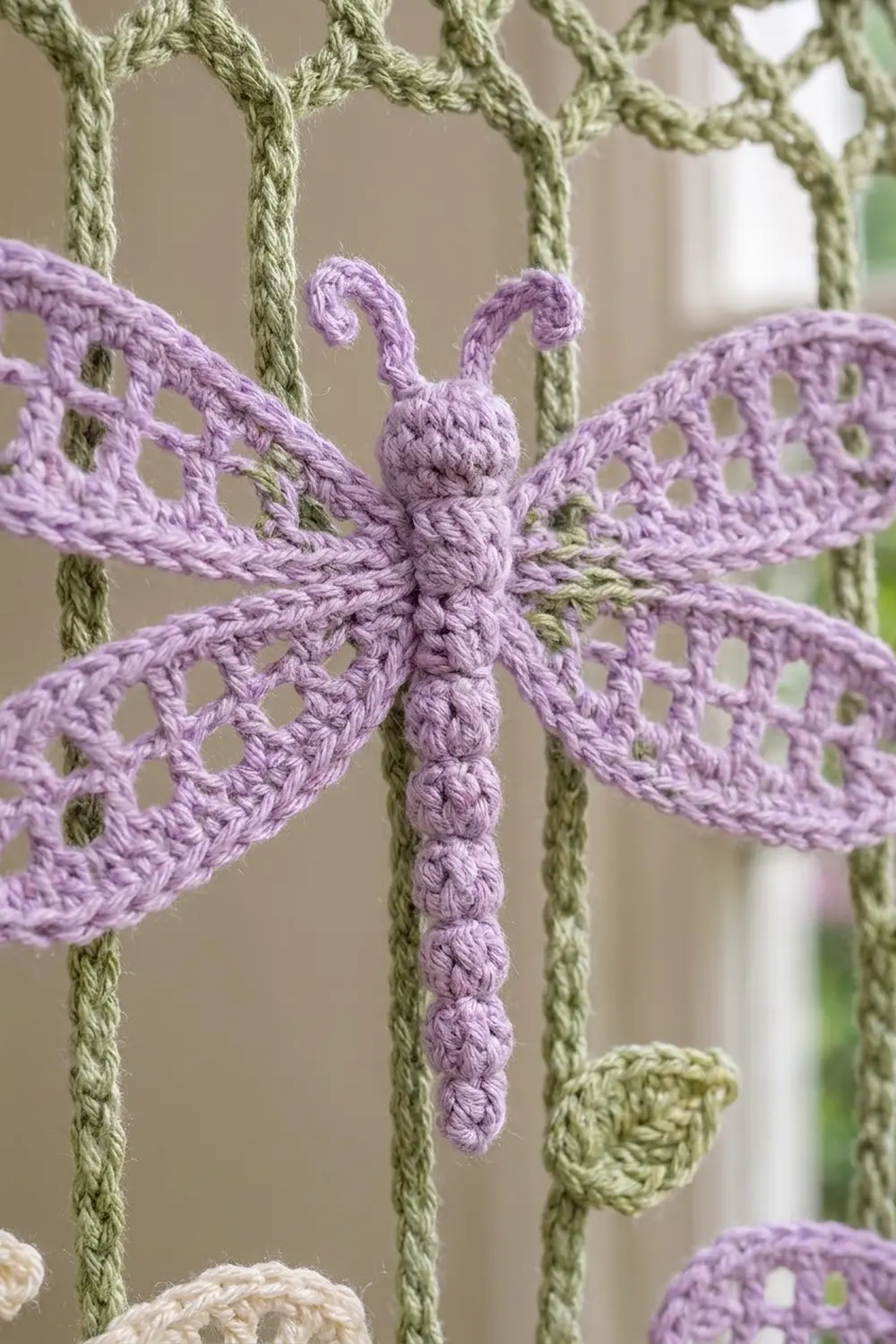
Part A: Dragonfly
Upper Wing (make 2 per dragonfly)
Ch 15.
Rnd 1: Sc in the 2nd ch from the hook and in the next 12 ch. Work 3 sc in the last ch. Working along the opposite side of the foundation, sc in the next 12 ch, then work 2 sc in the same ch as the first sc. Sl st to the first sc. (30 sc: 12 on each side and 3 at each tip)
This round forms the solid center spine.
Rnd 2 (windows):
1. Ch 4 (counts as dc and ch 1).
2. Sk the next sc. [Dc in the next sc, ch 1, sk the next sc] 5 times.
3. Dc in the next sc, ch 1.
4. Tip: [Dc in the next sc, ch 1] 3 times.
5. Sk the next sc. [Dc in the next sc, ch 1, sk the next sc] 5 times.
6. Dc in the next sc, ch 1.
7. Tip: [Dc in the next sc, ch 1] 2 times.
8. Sl st to the 3rd ch of the beg ch-4.
(18 dc and 18 ch-1 sps)
Each ch-1 space between dc is an open window. The extra dc at the tips let the oval lie flat.
Rnd 3 (rim): Ch 1. Sc in the same st as the join. Sc in the next ch-1 sp, sc in the next dc, rep around. At each tip, work 2 sc in each of the 2 ch-1 sps between the 3 tip dc. Sl st to the first sc. Fasten off and leave a 10 in (25.4 cm) tail.
(36 sts worked one per stitch or space + 4 extra = 40 sc)
Lower Wing (make 2 per dragonfly)
Ch 13.
Rnd 1: Sc in the 2nd ch from the hook and in the next 10 ch. Work 3 sc in the last ch. Working along the opposite side, sc in the next 10 ch, then work 2 sc in the same ch as the first sc. Sl st to the first sc. (26 sc: 10 on each side and 3 at each tip)
Rnd 2: Work as for the upper wing, but repeat each skip bracket 4 times instead of 5. (16 dc and 16 ch-1 sps)
Rnd 3: Work as for the upper wing. (32 sts worked one per stitch or space + 4 extra = 36 sc) Fasten off and leave a tail.
Body (make 1 per dragonfly)
Ch 19.
Row 1:
1. Sl st in the 2nd ch from the hook (tail tip).
2. Bobble in the next ch, sl st in the next ch, 7 times. These are the 7 abdomen beads.
3. Big bobble in the next ch (thorax), then sl st in the next ch.
4. Bobble in the last ch (head).
(18 ch used: 9 bobbles and 9 sl sts)
Antennae: Ch 7, work 3 sc in the 2nd ch from the hook to make the curl, then sl st in the next 5 ch and sl st in the top of the head. Rep once more for the second antenna. Fasten off.
The bobbles pop toward the back of the work. Use that side as the RS.
Assemble the Dragonfly
- Lay the body RS up.
- Tuck one tip of each upper wing 0.25 in (0.6 cm) under the thorax, angled slightly upward.
- Tuck the lower wings just below them, angled slightly downward and partly under the upper wings.
- Sew the wing tips to the back of the thorax and the first abdomen bead with the wing tails.
Checkpoint: the wingspan is 6 in (15.2 cm).
Part B: Header
Use sage green.
Ch 182.
Row 1: Sc in the 2nd ch from the hook and in each ch across. (181 sc)
Rows 2–6: Ch 1 and turn, sc in each st across. (181 sc)
The band now measures 1.1 in (2.8 cm) deep.
Row 7 (lattice 1): Ch 1 and turn. Sc in the first st, ch 5, sk 4, sc in the next st 36 times. (37 sc and 36 ch-5 sps; 1 + 36 × 5 = 181 sts used)
Row 8 (lattice 2): Ch 1 and turn. Sc in the first ch-5 sp, ch 5, sc in the next ch-5 sp 35 times. (36 sc points and 35 ch-5 sps)
Do not fasten off.
The lattice is 1.3 in (3.3 cm) deep, which brings the header to 2.4 in (6.1 cm). Number the Row 8 sc points 1–36 from right to left. Place a marker in points 2, 5, 8, 11, 14, 17, 20, 23, 26, 29, 32 and 35.
Part C: Vine Strands
Work one strand from each marked point.
Strand:
1. Join green with a sl st in the marked sc. Ch 281.
2. Sl st in the 2nd ch from the hook (the bottom tip), then work a leaf.
3. Sl st in the back bump of each of the next 20 ch, then work a leaf, 13 times.
4. Sl st in the last 19 ch, then sl st in the starting sc. Fasten off.
(280 vine sl sts: 1 + 13 × 20 + 19 = 280; 14 leaves per strand)
Before each leaf, turn the strand a half-twist so the leaves alternate left and right. The leaves sit 4 in (10.2 cm) apart, and the top 3.8 in (9.7 cm) of the vine has no leaves.
Checkpoint: each strand hangs 56 in (142.2 cm). Strands are 3 in (7.6 cm) apart, which is three 1 in (2.5 cm) lattice arches. The first and last strands sit 1.5 in (3.8 cm) in from the header edges.
Make All Pieces
- Lavender: 24 dragonflies
- Cream: 24 dragonflies
- Green: 1 header and 12 strands
Placement levels are measured down from the lattice point to the center of the thorax:
- Levels 1–8: 5, 11, 17, 23, 29, 35, 41 and 47 in
- Levels 1–8 in cm: 12.7, 27.9, 43.2, 58.4, 73.7, 88.9, 104.1 and 119.4 cm
Odd-numbered strands (S1, S3 and so on) carry the odd levels. Even-numbered strands carry the even levels.
Level     S1 S2 S3 S4 S5 S6 S7 S8 S9 S10 S11 S12
1         L  .  C  .  L  .  C  .  L  .   C   .
2         .  C  .  L  .  C  .  L  .  C   .   L
3         C  .  L  .  C  .  L  .  C  .   L   .
4         .  L  .  C  .  L  .  C  .  L   .   C
5         L  .  C  .  L  .  C  .  L  .   C   .
6         .  C  .  L  .  C  .  L  .  C   .   L
7         C  .  L  .  C  .  L  .  C  .   L   .
8         .  L  .  C  .  L  .  C  .  L   .   C
Each level has 3 lavender (L) and 3 cream (C) dragonflies: 8 levels × 6 = 48.
Joining
Sew each dragonfly to its vine by hand, using a tail in the dragonfly’s own color.
- Center the body over the vine, with the head toward the header.
- Stitch-to-stitch logic: The thorax big bobble covers about 3 vine sl sts. Whipstitch the back of the bobble to those 3 sl sts, going through both loops of the vine each time.
- Tack the tail-tip sl st of the body to one vine sl st 3.5 in (8.9 cm) below.
- Leave the wings and the rest of the abdomen free so they float.
Tension advice: Sew firmly but do not pull. If the vine bunches under a dragonfly, the strand will hang short and twisted. After each dragonfly, hold the strand up and let it drop straight.
Size checkpoint: With the curtain laid flat, dragonflies on the same level are 6 in (15.2 cm) apart center to center. Their wingtips may just touch, and neighboring levels sit 6 in (15.2 cm) apart vertically. The lowest dragonfly ends about 6.5 in (16.5 cm) above the vine tips.
Border: Rod Tabs
Border gauge: the same as the header, 5 sc per 1 in (2.5 cm).
Border Row 1: With the RS facing, join green in the first free loop of the foundation chain along the top edge. Ch 1, then sc in each loop across. (181 sc)
Border Row 2: Ch 1 and turn. Make a tab in the next sc, then sc in the next 14 sc, 12 times. Make a tab in the last sc. To make a tab, work (sc, ch 22, sl st in the same sc).
(13 tabs + 12 × 14 sc = 181 sts)
Border Row 3: Ch 1 and turn. Work 28 sc into the tab loop, then sl st in the next 14 sc, 12 times. Work 28 sc into the last tab loop. Fasten off.
(13 tabs × 28 sc = 364 sc, plus 168 sl sts)
Why the math works: 181 = 1 + 12 × 15. That places a tab at both corners and every 3 in (7.6 cm) between them, directly in line with the strand spacing. A 22-ch loop is 4.4 in (11.2 cm) around and still slides over a rod 1.25 in (3.2 cm) thick. The 28 sc packed into each loop stiffen the tab so it holds its shape.
Final Blocking
- Wet block the dragonflies: soak them, press out the water in a towel and pin each one flat. Open every wing window with a pin, and shape the wing tips into points.
- Let them dry completely, which takes about 24 hours.
- Hang the curtain on its rod before you steam the strands.
- Steam each vine from 1 in (2.5 cm) away. Never touch the iron to the yarn.
- Clip a light weight, such as a clothespin, to each vine tip while it cools.
- Pin the header band flat on a board and steam it so the lattice arches open evenly.
- Measure the width, 36.2 in (91.9 cm), and the drop, 60 in (152.4 cm).
Final Quality-Control Checklist
- 48 dragonflies: 24 lavender and 24 cream, following the grid
- Every wing has 18 or 16 open windows, depending on wing size
- Every rim is smooth, with pointed tips
- 12 strands, 14 leaves each, alternating sides
- All strands are within 0.5 in (1.3 cm) of 56 in (142.2 cm)
- 13 tabs, evenly spaced
- All ends are woven in through the solid stitches, not the windows
Troubleshooting
- Wings cup: Rnd 3 is too tight. Go up a hook size for the rim only.
- Wings ruffle: You have extra dc at the tips. Recount Rnd 2 against the stated totals.
- Strands curl or spiral: Your sl sts are too tight. Work them into the back bumps with a looser wrist, then steam with a weight attached.
- Strands are uneven: Count the chains in groups of 20 with markers.
- The header leans: Your Row 7 count is off. Check that you have 36 arches.
- Tabs won’t fit the rod: Lengthen the tab chain by 4 ch, then add 4 sc to Row 3 for each tab.
- Dragonflies flip over: Add a second tack at the head.
Care
Hand wash in cool water, roll in a towel and dry the curtain flat or hanging with light weights on the vines. Do not tumble dry; it tangles the strands.
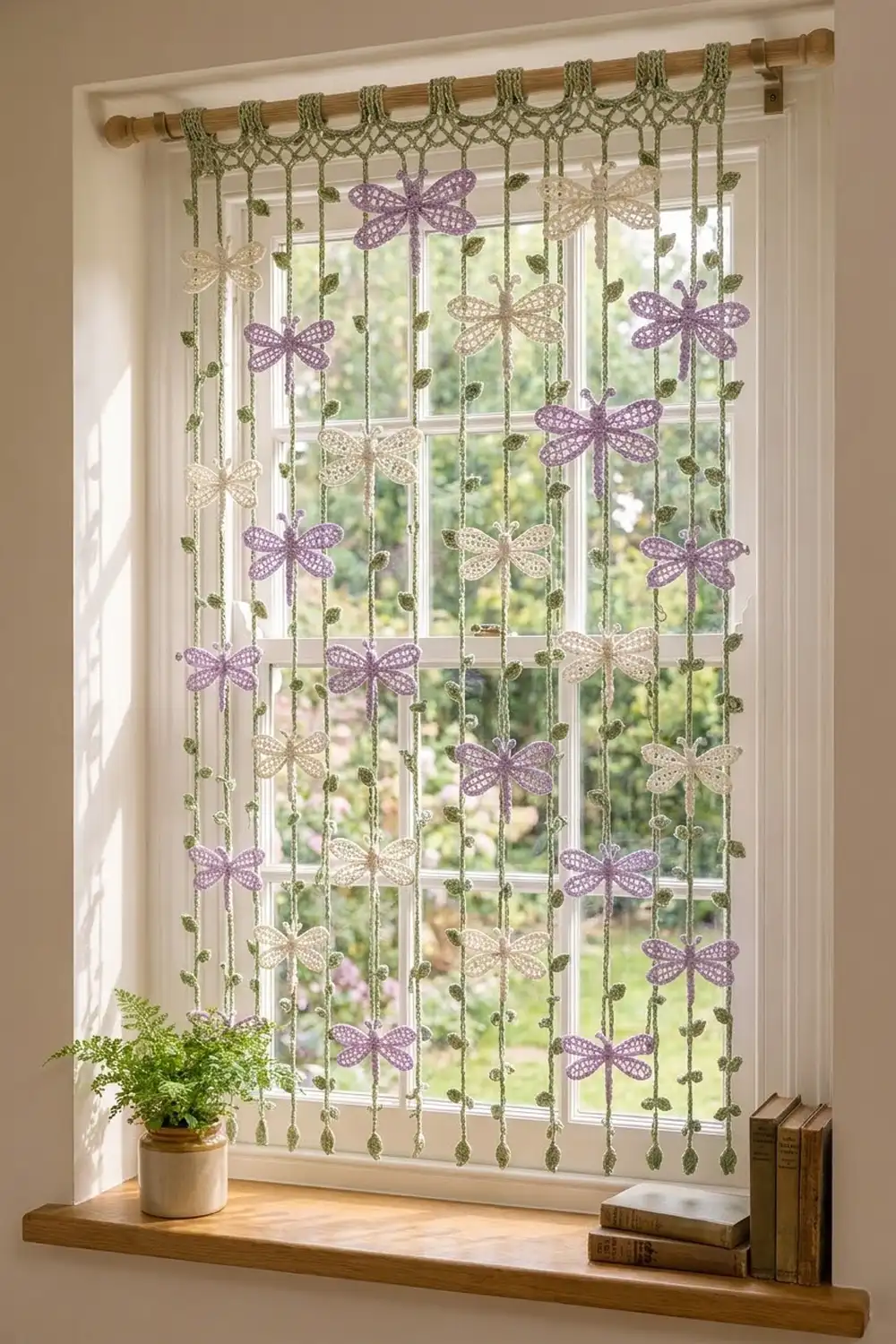
Final Notes
Here is the full measurement chain from start to finish:
– Ch 15 gives a 30-sc wing core, 18 windows and a 40-sc rim, for a 3.25 in (8.3 cm) upper wing.
– Four wings and a 9-bead body make a 6 in (15.2 cm) dragonfly.
– 181 header sts give 36 arches and 12 strand points spaced 3 in (7.6 cm) apart.
– 280 vine sts give 56 in (142.2 cm) strands with 14 leaves each.
– 13 tabs complete a curtain 36.2 × 60 in (91.9 × 152.4 cm).
Check each stage as you go, and the curtain will fit together when you assemble it.
Happy crocheting!