

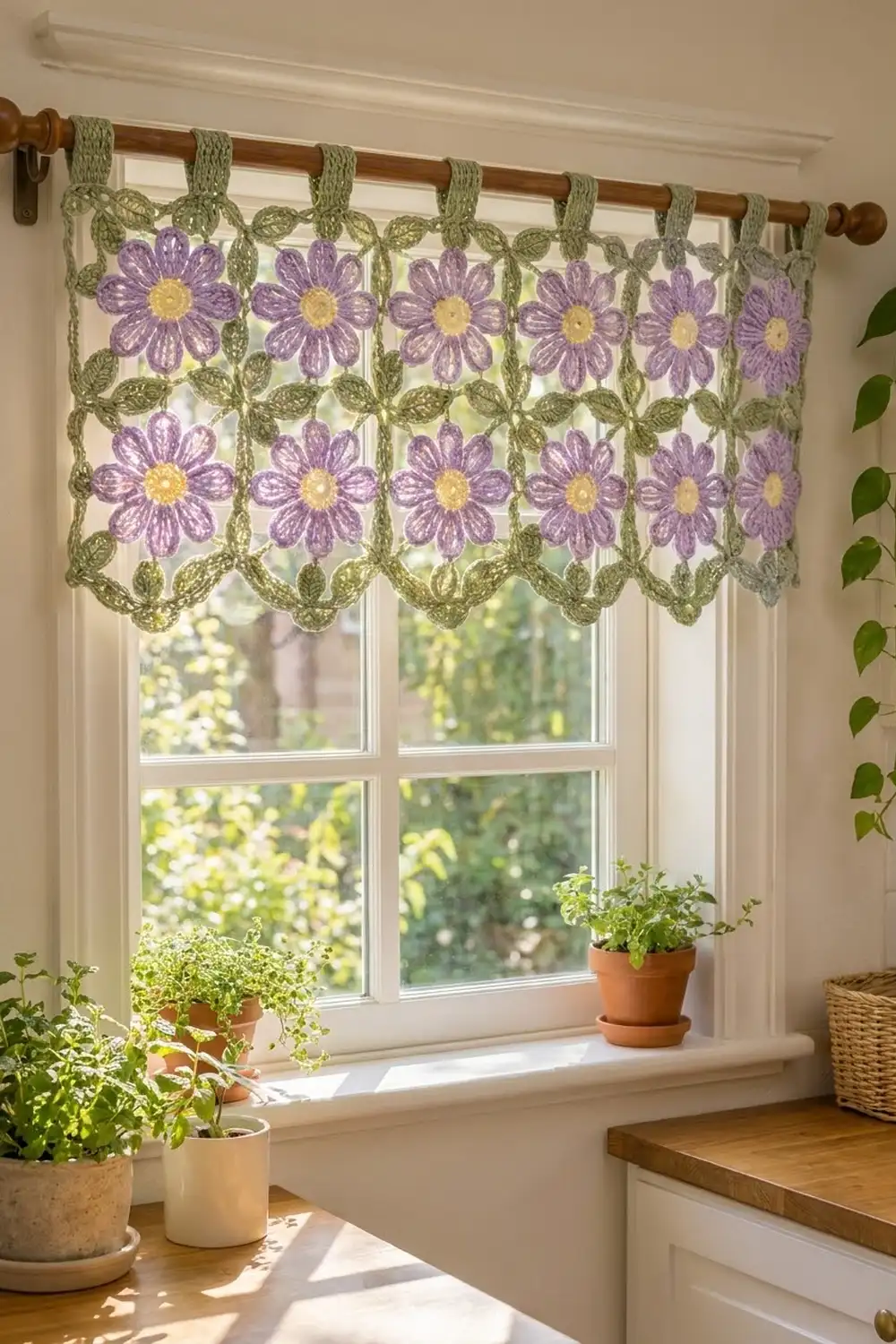
The Lavender Meadow Window Valance is a short café-style curtain made of fourteen square flower motifs. Each square holds a twelve-petal lavender flower with a soft yellow center, set in a sage-green frame with a small leaf in each corner. Green tab loops along the top slide onto a curtain rod, and the bottom edge forms pointed scallops with a leaf at every point.
The palette is three colors: lavender, butter yellow, and sage green. The open frame lets light through and the flowers stand out clearly, so the look is cottage-style and gentle without being fussy.
This pattern uses US crochet terms. The finished valance measures about 44.5 in (113.0 cm) wide and 14 in (35.6 cm) tall at the scallop points. The tabs add about 1.5 in (3.8 cm) above the rod line, and the leaves at the bottom points hang about 1.25 in (3.2 cm) lower.
Construction is simple. You make 14 identical motifs, working each one in the round from the center out, and join them flat in 2 rows of 7. Then you work a two-round border with a scalloped bottom edge and finish with eight tabs.
Finished Size and Construction
- Finished size: about 44.5 in (113.0 cm) wide x 14 in (35.6 cm) tall at the scallop points, plus tabs and leaf drops
- Skill level: Intermediate
- Terminology: US crochet terms
- Yarn weight: Worsted (#4) cotton or cotton blend
- Hook: 4.5 mm (US 7)
- Number of pieces: 14 square motifs, plus 8 tabs worked directly onto the border
- Layout: 7 motifs across x 2 motifs down
- Motif size: 6.25 in (15.9 cm) square, 29 stitches per side
- Size before border: 43.75 in x 12.5 in (111.1 cm x 31.8 cm)
- Border depth: about 0.4 in (1.0 cm) on the top and sides; up to about 0.8 in (2.0 cm) at the bottom scallop points, plus leaves
Materials
Use a smooth mercerized or matte cotton in worsted weight. Cotton holds the petal shapes and blocks crisply, and it does not stretch much when hung. A yarn of about 85 m per 50 g (93 yd per 50 g) is a good match.
- Yellow (A): 35 g, about 60 m (66 yd)
- Lavender (B): 130 g, about 220 m (241 yd)
- Sage green (C): 240 g, about 410 m (448 yd)
These quantities include a margin of roughly 15 percent for gauge swatches and tails.
Tools:
- 4.5 mm (US 7) crochet hook
- Tapestry needle
- Stitch markers
- Scissors
- Measuring tape
- Blocking mats and rustproof pins
- Spray bottle
- Curtain rod up to 1 in (2.5 cm) in diameter
Abbreviations (US Terms)
- ch – chain
- sl st – slip stitch
- sc – single crochet
- hdc – half double crochet
- dc – double crochet
- tr – treble crochet
- sk – skip
- sp – space
- st(s) – stitch(es)
- RS / WS – right side / wrong side
Leaf (special stitch): Ch 8. Working back along the chain, sl st in 2nd ch from hook (this is the leaf tip), sc in next ch, hdc in next ch, dc in next 2 ch, hdc in next ch, sc in last ch. This uses all 7 remaining chains, and you end back at the base of the leaf.
Corner Leaf (Round 5 only): Work the same as the Leaf, but start with ch 9 and add a sl st in the last ch, for 8 stitches along the chain. It is slightly longer so it can reach the corner of the square.
Gauge and Checkpoints
Gauge: 18 sc and 20 rows = 4 in (10.2 cm) in sc with the 4.5 mm hook.
Make one full motif and block it before you start the rest. A 1/8 in (0.3 cm) error on one motif adds up to almost 1 in (2.5 cm) across seven motifs.
Checkpoints for one motif:
- After Round 2: the yellow center is about 1.25 in (3.2 cm) across
- After Round 4: the flower is about 4.25 in (10.8 cm) across, from petal tip to petal tip
- After Round 7: the square is 6.25 in (15.9 cm) per side, measured from corner to corner along one edge
If your motif is too big, go down a hook size, to 4.0 mm. If it is too small, go up to 5.0 mm. Petals that cup while the frame lies flat mean your Round 4 tension is tight; relax only that round. If the frame ruffles, the chains in Round 6 are too loose, so pull them a little snugger.
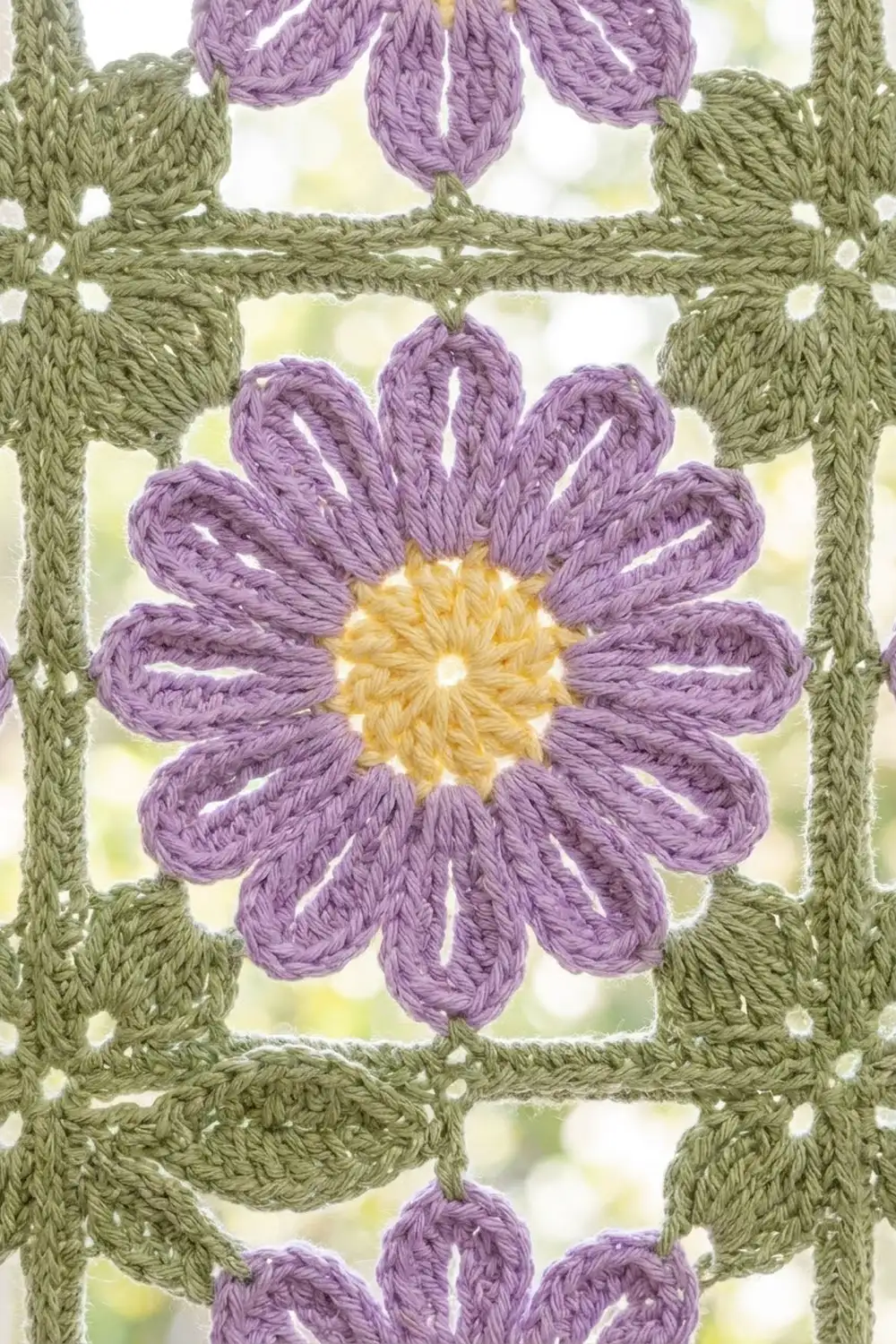
Motif (Make 14)
Round 1 (Color A)
Make a magic ring. Ch 1, then work 12 sc into the ring. Pull the ring closed and sl st to the first sc. (12 sc)
Round 2 (Color A)
Ch 1, 2 sc in each st around, sl st to the first sc. (24 sc) Fasten off.
Round 3 (Color B)
Join B with a sl st in any st. Ch 6, sk 1 st, sl st in next st; repeat from * around, working the last sl st into the joining sl st. (12 ch-6 loops)*
Round 4 (Color B, petals)
Sl st into the first ch-6 loop. In each loop around, work (sc, hdc, 3 dc, ch 2, 3 dc, hdc, sc), then sl st into the sl st between loops. Sl st to the first sc and fasten off. (12 petals; 120 sts plus 12 ch-2 tips)
The ch-6 loop leaves a slender opening down the middle of each petal, so the petals look outlined and airy, as in the photo.
Round 5 (Color C, frame and corner leaves)
Name the petal tips as you go: each side of the square uses tips A, B, Corner in that order.
Join C with a sc in the ch-2 tip of any petal (tip A).
*Ch 6, sc in next tip (B), ch 7, sc in next tip (Corner), work a Corner Leaf, sc in the same Corner tip, ch 7, sc in next tip (A); repeat from * 3 more times. On the last repeat, replace the final sc with a sl st to the first sc. Fasten off.
Count: 16 sc (2 on each corner tip and 1 on each other tip), 4 leaves, and 12 chain spaces (ch-6, ch-7, and ch-7 on each side).
The leaves point diagonally outward toward the corners of the future square.
Round 6 (Color C, squaring)
Join C with a sc in the skipped chain at the very tip of any leaf. Ch 3, sc in the same tip. This is the first corner.
*Ch 5, sc in next ch-7 sp, ch 5, sc in next ch-6 sp, ch 5, sc in next ch-7 sp, ch 5, (sc, ch 3, sc) in tip of next leaf; repeat from * around. On the last repeat, omit the final corner and sl st to the first sc.
Count: 20 sc (8 flanking the corners and 12 along the sides), 16 ch-5 sps, and 4 ch-3 corner sps.
Round 7 (Color C, solid frame)
Sl st into the first ch-3 corner sp, ch 1.
3 sc in corner ch-3 sp, sc in next sc, [5 sc in next ch-5 sp, sc in next sc] 3 times, 5 sc in next ch-5 sp, sc in next sc; repeat from * 3 more times. Sl st to the first sc and fasten off. (112 sc)*
Count per side: 29 sts, which includes the center sc of each 3-sc corner group at both ends. Four sides x 29 = 116, minus 4 shared corners = 112. ✓
Weave in all ends and block the motif to a 6.25 in (15.9 cm) square. Then make 13 more.
Make All Pieces
Each motif uses all three colors. For 14 motifs:
- Color A: 14 centers (Rounds 1–2)
- Color B: 14 flowers (Rounds 3–4)
- Color C: 14 frames (Rounds 5–7)
Layout (7 across x 2 down):
[M1] [M2] [M3] [M4] [M5] [M6] [M7]   <- top row (tabs above)
[M8] [M9] [M10][M11][M12][M13][M14]  <- bottom row (scallops below)
Block all motifs to the same size before joining. This matters more than any other step.
Joining
Method: Flat slip-stitch join with Color C, working through the back loops only.
Place two motifs RS up, side by side. Match their corner sts, the centers of the 3-sc corner groups. Work 1 sl st through the back loop of a st on each motif, pairing them one to one, from corner st to corner st. That is 29 sl sts per seam.
- Join M1 to M2, then M2 to M3, and so on, to make the top strip of 7. Repeat for the bottom strip.
- Join the two strips along their long edge with one continuous seam: 7 x 29 = 203 sl sts.
- At each four-way corner, work the vertical seams across the long seam, sl st into each other’s joining sts, so no hole forms.
Tension: Keep the sl sts as loose as your sc. A tight seam pulls the panel in. Check that it stretches as far as the motif’s own edge.
Size checkpoint: The joined panel is 43.75 in x 12.5 in (111.1 cm x 31.8 cm). The seams add nothing to the width, because the edges butt together.
Border
Border gauge: The same as the motifs, 18 sc = 4 in (10.2 cm), with each sc round about 0.2 in (0.5 cm) deep.
Starting counts (outer edge of the joined panel):
- Top and bottom: 7 motifs x 29 sts = 203 sts each
- Left and right: 2 motifs x 29 sts = 58 sts each
- Total existing outer sts: 203 + 203 + 58 + 58 − 4 shared corners = 518
At each seam, the two adjacent motif corner sts are both counted inside the 29s, so no extra stitches are added there.
Border Round 1 (Color C)
Join C in any st. Sc in each st around, and work 3 sc in each of the 4 outer corner sts. Sl st to the first sc.
Count: 518 (1 per existing st) + 8 (2 extra at each corner) = 526 sc
- Top and bottom: 203 + 2 = 205 each, including both corner centers
- Sides: 58 + 2 = 60 each
Check: 205 + 205 + 60 + 60 − 4 = 526. ✓
Border Round 2 (Color C, scalloped bottom)
On the bottom edge, the 205 sts are made up of a corner center at each end with 203 sts between them. That is 7 groups of 29, one group under each bottom motif.
Starting at the top-right corner, work across the top and down the left side: sc in each st, with 3 sc in each top corner center.
At the bottom-left corner center: (sc, Leaf, sc).
Across the bottom, for each 29-st group: tr in next 4 sts, dc in next 4, hdc in next 3, sc in next 7, hdc in next 3, dc in next 4, tr in next 4. (4 + 4 + 3 + 7 + 3 + 4 + 4 = 29.) After each of the first 6 groups, work a Leaf, so a leaf sits at each seam point.
At the bottom-right corner center: (sc, Leaf, sc). Then sc up the right side and sl st to the first sc.
The tall stitches at each seam push the edge down into a point, and the sc in the middle of each group rises into an arch. This gives the pointed scallops.
Count: 526 (1 per existing st) + 6 (2 extra at each top corner, 1 extra at each bottom corner) = 532 sts, plus 8 leaves.
- Top: 207, including corner centers
- Each side: 62
- Bottom: 203 scallop sts plus 2 sc in each corner, with 8 leaves (2 corners + 6 seams)
Tabs (Make 8, worked onto the top edge)
The top edge has 207 sts: a corner center, 1 sc, 203 sts aligned with the motifs, 1 sc, and a corner center.
Place markers for eight 6-st tabs:
- First 6 sts of group 1
- Last 6 sts of group 7
- 6 sts centered on each of the 6 seams (3 sts on each side)
Row 1: With RS facing, join C with a sc in the first marked st, then sc in the next 5. (6 sc)
Rows 2–15: Ch 1, turn, sc in each st. (6 sc)
Fasten off, leaving a 12 in (30.5 cm) tail. Fold the tab to the WS and whipstitch the last row to the back of Border Round 1. Each tab is 3 in (7.6 cm) long before folding and forms a loop about 1.5 in (3.8 cm) high, sized for a rod up to 1 in (2.5 cm) across.
Final Blocking
- Weave in all remaining ends along the green frame lines, where they hide best.
- Pin the valance RS up to 44.5 in x 14 in (113.0 cm x 35.6 cm), measured at the scallop points.
- Pin each motif corner along a straight grid line. Check that every seam is vertical or horizontal.
- Pin the 12 petals of each flower out evenly, and open the slit in each petal.
- Pin each leaf flat and pointed, both the corner leaves and the leaves at the scallop points.
- Mist thoroughly until damp. Let it dry completely, at least 24 hours.
- Unpin, then steam the tabs lightly so they hold their fold.
Final Quality-Control Checklist
- 14 motifs, each 6.25 in (15.9 cm) square with 29 sts per side
- Every flower has 12 petals and a yellow center
- Every motif has 4 corner leaves pointing toward the corners
- Seams have 29 sl sts each, and the long seam has 203
- Border Round 1 has 526 sc and Border Round 2 has 532 sts
- 8 bottom leaves and 7 even scallops
- 8 tabs, evenly spaced and the same length
- Final size about 44.5 in x 14 in (113.0 cm x 35.6 cm)
Troubleshooting
Petals curl forward. Round 4 is tight. Remake that round with a looser hand, or block it harder.
The frame ripples. The Round 6 chains are too long for your tension. Try ch 4 in place of ch 5, and keep 5 sc per space in Round 7.
The frame pulls the flower out of shape. The Round 6 chains are too short. Loosen your chain stitches.
The motif is the wrong size. Change hook size and remake the test motif before you continue.
The valance narrows at the seams. The slip-stitch join is tight. Redo it with a larger hook.
Scallops are uneven. Recount the 29 sts in each bottom group. Mark the seams before you start Border Round 2.
Tabs lean. Recount so each tab is centered on its seam, with 3 sts on each side.
Care
Hand wash in cool water with a mild soap and press out the water in a towel. Dry flat and re-pin the scallops if needed.
Final Notes
The whole valance depends on one measurement chain. The test motif must reach 6.25 in (15.9 cm) with 29 sts per side. Seven motifs across give 43.75 in (111.1 cm) with 203 border sts, and two motifs down give 12.5 in (31.8 cm) with 58 sts.
Border Round 1 makes 526 sts and Border Round 2 makes 532 sts, which brings the panel to about 44.5 in x 14 in (113.0 cm x 35.6 cm). If each checkpoint matches, the scallops, leaves, and tabs will line up with the seams.
Happy crocheting!