

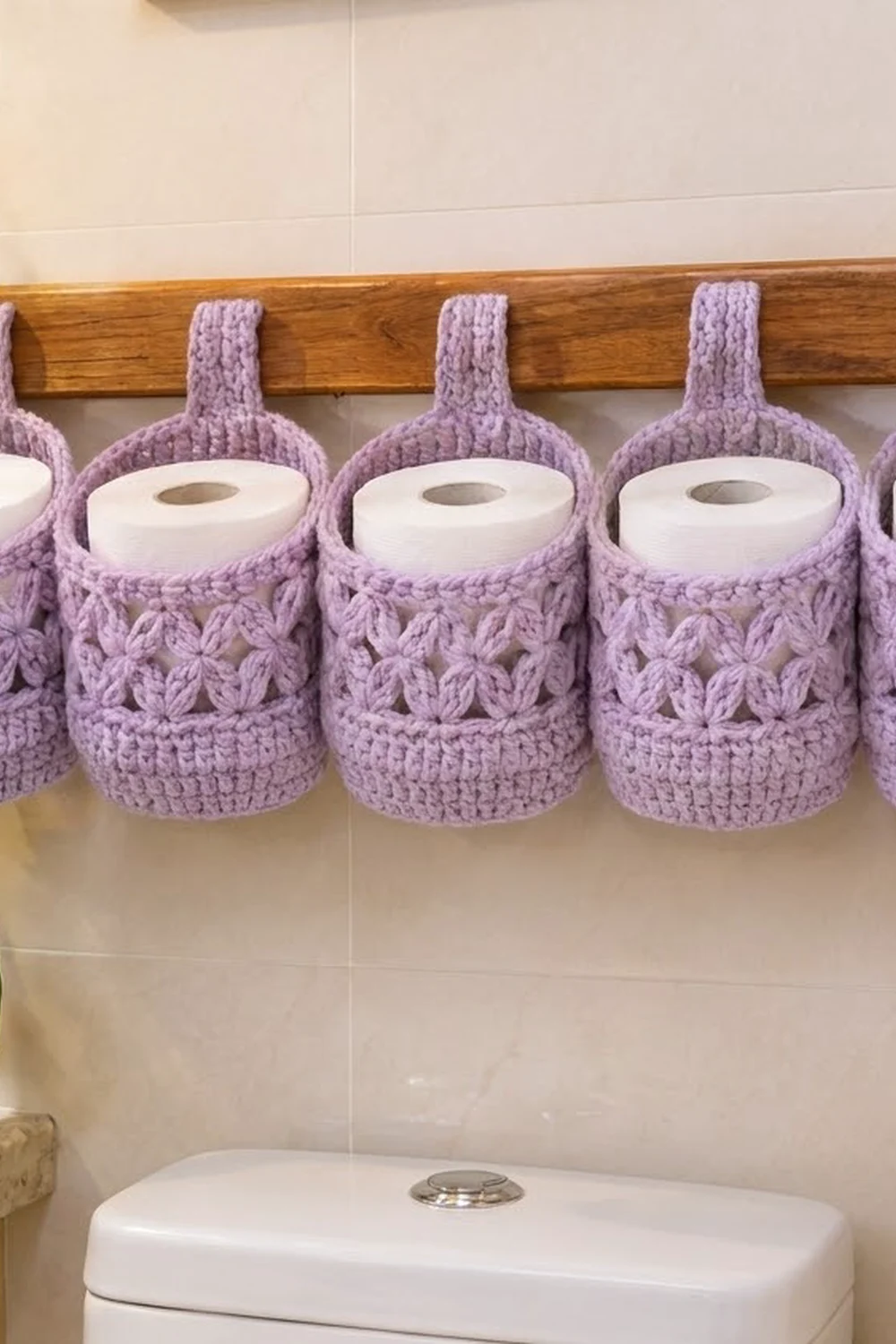
This hanging basket is a small, sturdy cylinder that holds one standard toilet paper roll. It has a solid single crochet base, a band of open star clusters around the middle, and a smooth rim with a crocheted strap for hanging. Make five and hang them side by side on a wooden rail for a soft, practical storage row on a bathroom wall.
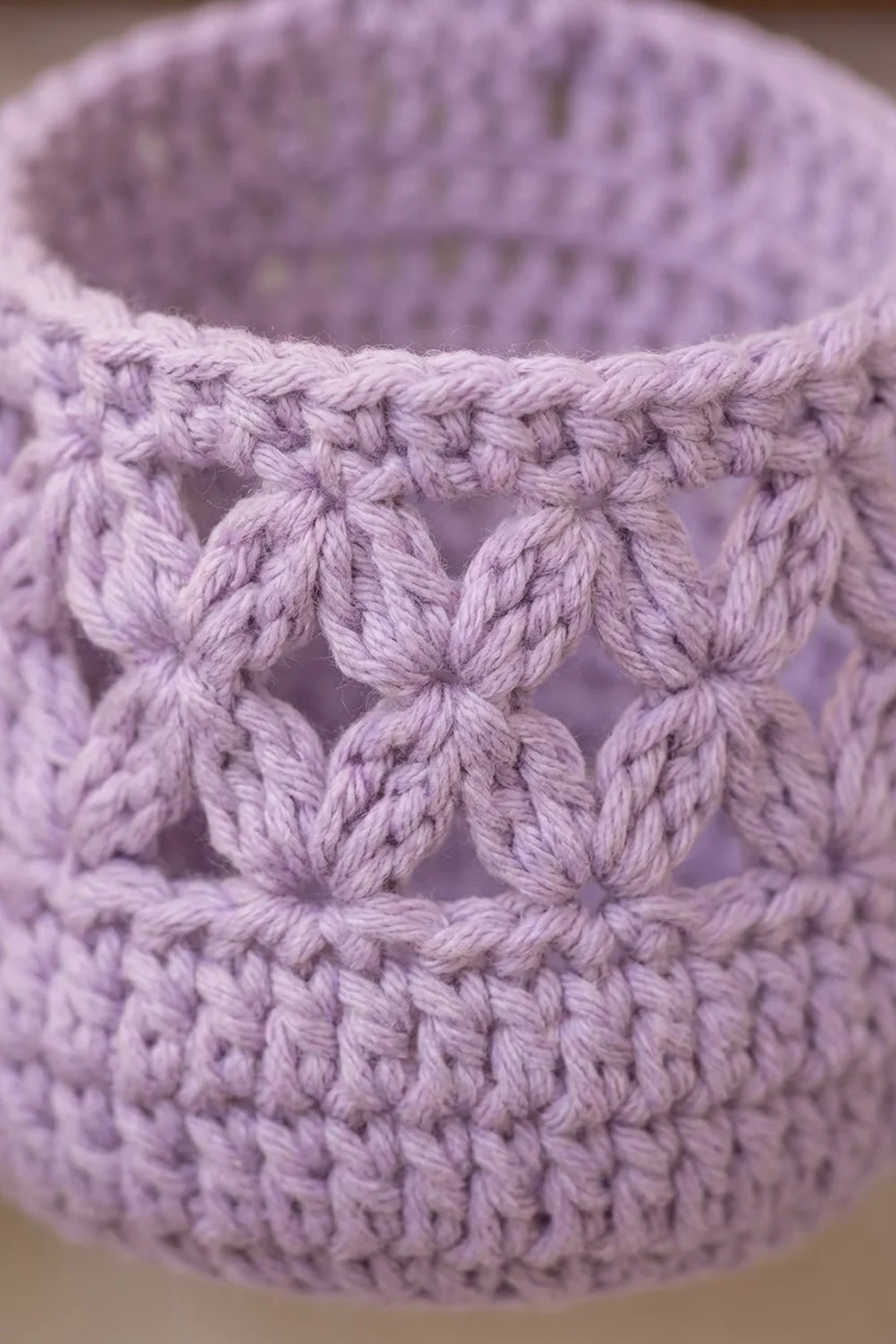
The sample uses one soft lavender cotton. A single color keeps the look clean and lets the stitch texture stand out: a smooth lower band, then two rows of raised stars with small diamond openings between them, then a smooth upper band.
The pattern uses US crochet terms. Each finished basket measures 5.5 in (14.0 cm) across and 4.25 in (10.8 cm) tall. Its hanging loop rises about 3.25 in (8.3 cm) above the rim.
The construction is simple. You work the flat base in joined rounds, turn the corner with a back-loop round, and work the walls straight up. Then you crochet the strap in rows from the rim. A slip stitch border neatens the rim and both strap edges, and you fold the strap end over and sew it to the inside back wall.
Finished Size and Construction
- Finished size (one basket): 5.5 in (14.0 cm) diameter x 4.25 in (10.8 cm) tall
- Height including loop: about 7.5 in (19.1 cm)
- Skill level: Easy to intermediate
- Terminology: US crochet terms
- Yarn weight: Worsted weight (#4) cotton
- Hook: 5.0 mm (H-8)
- Number of pieces: 5 separate baskets, not joined to each other
- Layout: 5 baskets in one row, each hanging from its own loop on a wooden rail
- Piece size: 5.5 in (14.0 cm) x 4.25 in (10.8 cm)
- Size before border: 5.5 in (14.0 cm) x 4.25 in (10.8 cm)
- Border depth: about 0.125 in (0.3 cm). The slip stitch border makes the edge firmer but doesn’t add height.
Materials
Choose a smooth worsted weight cotton or cotton blend. Cotton holds the cylinder shape well, shows the star clusters clearly, and handles bathroom humidity better than soft acrylic.
- Lavender: 300 g, about 510 m (558 yd), for all 5 baskets
- Per basket: about 55 g, about 94 m (103 yd)
These quantities include a margin of about 10 percent to allow for gauge differences and swatching.
Tools:
- 5.0 mm (H-8) crochet hook
- Stitch markers (at least 2)
- Tapestry needle
- Scissors
- Measuring tape
- Wooden rail or bar, about 30 in (76.2 cm) long, with mounting screws
- One toilet paper roll for fit testing
Abbreviations (US Terms)
- ch: chain
- sl st: slip stitch
- sc: single crochet
- dc: double crochet
- BLO: back loop only
- st(s): stitch(es)
- sp: space
- rep: repeat
Special stitch: dc5tog (5-double-crochet cluster). [Yarn over, insert hook in next st, yarn over and pull up a loop, yarn over and draw through 2 loops] 5 times, working across 5 sts. You now have 6 loops on the hook. Yarn over and draw through all 6 loops. This cluster forms the lower, inverted half of each star.
Gauge and Checkpoints
Gauge: 14 sc and 16 rounds = 4 in (10.2 cm) in sc.
Make one basket before starting the other four. A whole basket is small, so it makes the best gauge swatch.
Checkpoints:
- After Round 5 (30 sts), the base measures about 2.75 in (7.0 cm) across.
- After Round 10 (60 sts), the base measures 5.5 in (14.0 cm) across and lies flat.
- After Round 15, the wall measures 1.25 in (3.2 cm) from the base edge.
- After Round 19, the wall measures 3.5 in (8.9 cm) from the base edge.
- After Round 22, the wall measures 4.25 in (10.8 cm).
If the base is too big, switch to a 4.5 mm hook. If it’s too small, switch to a 5.5 mm hook. If the base ruffles, you have too many stitches for your tension. If it cups before Round 10, your tension is too firm. Fix the base before going on, because the 60-stitch round sets the size of everything above it.
Pattern: Basket (Make 5)
Join every round with a sl st to the first st. The ch 1 at the start of a round does not count as a stitch. Keep the joins stacked in a line; this line is the side seam.
Base
Round 1: Make a magic ring, ch 1, 6 sc in ring, join. (6 sts)
Round 2: Ch 1, 2 sc in each st around, join. (12 sts)
Round 3: Ch 1, *sc in next st, 2 sc in next st; rep from * around, join. (18 sts)
Round 4: Ch 1, *sc in next 2 sts, 2 sc in next st; rep from * around, join. (24 sts)
Round 5: Ch 1, *sc in next 3 sts, 2 sc in next st; rep from * around, join. (30 sts)
Round 6: Ch 1, *sc in next 4 sts, 2 sc in next st; rep from * around, join. (36 sts)
Round 7: Ch 1, *sc in next 5 sts, 2 sc in next st; rep from * around, join. (42 sts)
Round 8: Ch 1, *sc in next 6 sts, 2 sc in next st; rep from * around, join. (48 sts)
Round 9: Ch 1, *sc in next 7 sts, 2 sc in next st; rep from * around, join. (54 sts)
Round 10: Ch 1, *sc in next 8 sts, 2 sc in next st; rep from * around, join. (60 sts)
Checkpoint: the base measures 5.5 in (14.0 cm) across.
Lower Wall
Round 11: Ch 1, sc in BLO of each st around, join. (60 sts) The unused front loops make a neat ridge where the base turns up into the wall.
Rounds 12–15: Ch 1, sc in each st around, join. (60 sts)
Checkpoint: the solid lower band measures 1.25 in (3.2 cm) tall.
Star Lattice Band
The star band repeats over 6 sts, 10 times around the 60 sts.
Round 16 (cluster round): Ch 1, sc in first st, *ch 2, dc5tog over next 5 sts, ch 2, sc in next st; rep from * 8 more times, ch 2, dc5tog over last 5 sts, ch 2, join to first sc. (10 sc, 10 clusters, 20 ch-2 sps)
Round 17 (shell round): Ch 1, sc in first sc, *skip ch-2 sp, 5 dc in top of next cluster, skip ch-2 sp, sc in next sc; rep from * 8 more times, skip ch-2 sp, 5 dc in top of last cluster, skip ch-2 sp, join to first sc. (10 sc + 50 dc = 60 sts)
Each 5-dc shell sits directly on top of a cluster, so each cluster and shell together form one star. The skipped ch-2 sps leave small diamond openings between neighboring stars.
Round 18 (cluster round): Ch 1, sc in first sc, *ch 2, dc5tog over the 5 dc of next shell, ch 2, sc in next sc; rep from * 8 more times, ch 2, dc5tog over the 5 dc of last shell, ch 2, join. (10 sc, 10 clusters, 20 ch-2 sps)
Round 19 (shell round): Work as for Round 17. (60 sts)
The second row of stars sits directly above the first, so the stars line up in vertical columns.
Checkpoint: the wall measures 3.5 in (8.9 cm) from the base edge, and the lattice band alone measures 2.25 in (5.7 cm).
Upper Wall
Round 20 (conversion round): Ch 1, sc in each dc and each sc around, join. (50 sc worked in the dc + 10 sc worked in the sc + 0 extra = 60 sts)
Rounds 21–22: Ch 1, sc in each st around, join. (60 sts)
Checkpoint: the wall is 4.25 in (10.8 cm) tall and about 17 in (43.2 cm) around. Fasten off and weave in the end.
Hanging Strap
Lay the basket flat with the seam at one side. Starting from the first st of Round 22, count around and place markers in sts 29 and 33. These 5 sts sit opposite the seam and form the base of the strap.
Row 1: Join yarn in st 29, ch 1, sc in sts 29–33, turn. (5 sts)
Rows 2–32: Ch 1, sc in each st across, turn. (5 sts)
Strap length: 32 rows at 16 rows per 4 in = 8 in (20.3 cm). Strap width: 5 sts at 14 sts per 4 in = about 1.4 in (3.6 cm). Fasten off.
Make All Pieces
Make 5 identical baskets in lavender. Each uses about 55 g, so the five use 275 g before the margin.
Layout on the rail (one row, seen from the front):
[ rail ===================================== ]
  [B1]    [B2]    [B3]    [B4]    [B5]
All five baskets are the same, so any basket can go in any position. Turn the seams toward the wall.
Joining: Strap Attachment and Hanging
The baskets are not joined to each other. Each one hangs from its own loop, so the only joining is sewing each strap to its own basket.
Method: After working the border (below), fold the strap end toward the inside of the basket so that its last row sits 1.5 in (3.8 cm) below the rim on the inside back wall. Whipstitch the 5 sts of Row 32 to the 5 sts of Round 17 directly below the strap base, working stitch to stitch and catching one strand per stitch. Then sew 2 row ends on each side of the strap to the wall to keep it steady.
Why the loop height works: 8 in (20.3 cm) of strap minus the 1.5 in (3.8 cm) tucked inside leaves 6.5 in (16.5 cm). Half of that goes up and half comes back down, so the loop stands about 3.25 in (8.3 cm) above the rim.
Tension advice: Sew firmly, but don’t pull the wall inward. Seen from above, the rim should stay round.
Size checkpoint: Slide the loop onto the rail. The rail should pass through easily, and the rim should hang level.
Spacing on the rail: Space the basket centers 5.75 in (14.6 cm) apart, which leaves a 0.25 in (0.6 cm) gap between baskets. Five baskets span 4 x 5.75 in + 5.5 in = 28.5 in (72.4 cm). On a 30 in (76.2 cm) rail, that leaves 0.75 in (1.9 cm) at each end.
Border
Border gauge: one sl st in each sc along the rim, and one sl st in each row end along the strap edges.
Border Round: Join yarn with a sl st in st 34 of Round 22, the first rim st after the strap.
- Rim: Loosely sl st in sts 35–60 and then in sts 1–28. Counting the joining st, that makes 55 sts. (60 rim sts – 5 under the strap = 55)
- Strap edge 1: Sl st in each row end going up the strap. (32 sts)
- Strap top: Sl st in each st of Row 32. (5 sts)
- Strap edge 2: Sl st in each row end coming down the strap. (32 sts)
- Join with a sl st to the first sl st. (55 + 32 + 5 + 32 = 124 sts in total)
Why the math works: The rim has 60 sts, and the strap base covers 5 of them, so the rim border needs exactly 55. Each strap edge has 32 rows, with one sc row end per row, so working one sl st per row keeps the edges flat. The strap top matches its own 5 sts. No stitches are added or skipped, so the rim stays 17 in (43.2 cm) around and the strap stays 1.4 in (3.6 cm) wide.
Fasten off. Then fold and sew the strap as described in the Joining section.
Final Blocking
- Weave in all ends on the inside of the basket.
- Mist the basket lightly with water until it is damp but not soaked.
- Put a toilet roll or a jar 5.5 in (14.0 cm) across inside to shape the cylinder.
- Pat the star clusters so each shell sits centered over its cluster.
- Flatten the strap between your palms and straighten its edges.
- Let it dry completely, standing upright, for 12–24 hours.
- Take out the form and measure. The basket should be 5.5 in (14.0 cm) across and 4.25 in (10.8 cm) tall.
Final Quality-Control Checklist
- The base lies flat and measures 5.5 in (14.0 cm).
- The BLO ridge shows all the way around the base corner.
- Each star round has 10 complete stars, lined up in columns.
- Every solid round has 60 sts.
- The wall is 4.25 in (10.8 cm) tall all the way around.
- The strap is 5 sts wide and centered opposite the seam.
- The border has 124 sl sts in total, and the rim does not pucker.
- The loop rises about 3.25 in (8.3 cm) above the rim.
- All five baskets match within 0.25 in (0.6 cm).
- A toilet roll slides in and out easily.
Troubleshooting
The base ruffles: You have too many stitches for your tension. Go down a hook size or redo the base.
The base cups: Your tension is too tight. Go up a hook size.
The stars lean to one side: A shell may be in the wrong place. Check that each shell is worked into the top of a cluster.
The count is off after Round 17: Count the shells (10) and the sc (10). The usual cause is a missing sc between two shells.
The rim puckers: The sl st border is too tight. Redo it more loosely, or use a hook one size larger.
The basket tilts forward: The strap is sewn too low or off-center. Sew it again so it sits exactly opposite the seam.
The baskets are different heights: Recount the rounds. One extra sc round adds 0.25 in (0.6 cm).
Care
Hand wash in cool water with mild soap, then lay flat to dry, reshaping the basket over a roll or jar. Don’t hang the baskets while they are wet, or the straps may stretch.
Final Notes
Here’s how the measurements connect. A gauge of 14 sc and 16 rounds per 4 in (10.2 cm) gives a 60-stitch base 5.5 in (14.0 cm) across. Those 60 sts carry straight up the wall and through the star band, which is 10 repeats of 6 sts. The wall finishes at 4.25 in (10.8 cm), and the 5-stitch strap is 8 in (20.3 cm) long before folding. The 124-stitch border finishes the edges without changing the size. Five matching baskets, spaced 5.75 in (14.6 cm) apart, fill a 30 in (76.2 cm) rail.
Happy crocheting!