

The Lavender Weave Hanging Wall Organizer is a soft, sturdy storage panel for your craft corner. A flat back panel holds one deep basketweave pocket across the bottom and two smaller basketweave pockets above it. A scalloped shell border frames the panel, and a crocheted strap at the top hangs it from a hook or peg.
The sample is worked in one color, lavender purple. The pockets have a woven, checkerboard texture, the back panel is plain single crochet, and the shell edging softens the outline. A sage green version looks just as good, so you can make a matching pair.
This pattern uses US crochet terms. Without the strap, the finished organizer measures 10.5 in (26.7 cm) wide by 13.5 in (34.3 cm) tall. The strap loop peaks about 4.75 in (12.1 cm) above the panel’s top edge.
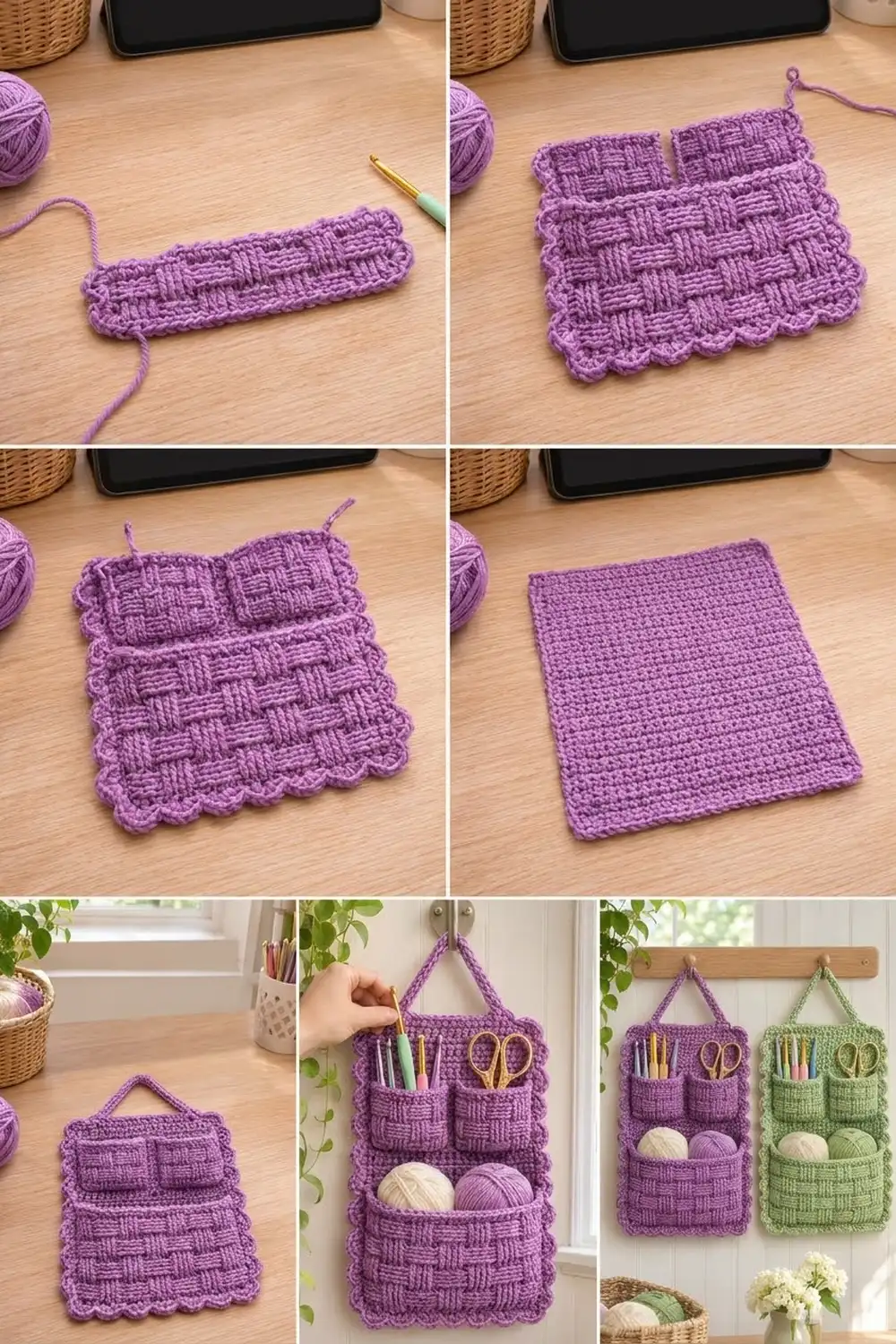
You crochet five flat pieces: a back panel, a large pocket, two small pockets and a strap. You then sew the pockets on with a little ease so they bulge forward, work the shell border around the panel, sew the strap to the back, and block.
Finished Size and Construction
- Finished size: 10.5 in x 13.5 in (26.7 cm x 34.3 cm), strap not included
- Skill level: Intermediate (post stitches, simple seaming)
- Terminology: US
- Yarn weight: Worsted (#4)
- Hook: 5.0 mm (H-8)
- Number of pieces: 5 (1 back panel, 1 large pocket, 2 small pockets, 1 strap)
- Layout: the large pocket runs across the bottom, the two small pockets sit side by side above it, and the strap is at the top
- Back panel: 9 in x 12 in (22.9 cm x 30.5 cm)
- Large pocket: 9.5 in x 6 in (24.1 cm x 15.2 cm)
- Small pockets: 4.5 in x 4 in (11.4 cm x 10.2 cm) each
- Strap: 15 in x 1 in (38.1 cm x 2.5 cm)
- Size before border: 9 in x 12 in (22.9 cm x 30.5 cm)
- Border depth: 0.75 in (1.9 cm) on every side
Materials
Choose a smooth worsted weight cotton or cotton blend. Cotton holds its shape when the pockets are loaded with hooks and yarn, and it shows the basketweave texture clearly. Acrylic also works, but it stretches more over time.
- Lavender purple (main color): about 260 g, about 470 m (514 yd)
- Optional alternate colorway: sage green, same amount
Tools:
- 5.0 mm (H-8) crochet hook
- 4.5 mm (7) hook (optional), for the back panel if your single crochet is loose
- Tapestry needle
- 10 locking stitch markers
- Rust-proof pins
- Measuring tape and scissors
- Blocking mat and spray bottle
The yarn quantities include about a 15% margin for your swatch and for seaming.
Abbreviations (US Terms)
- ch = chain
- sl st = slip stitch
- sc = single crochet
- hdc = half double crochet
- dc = double crochet
- FPdc = front post double crochet
- BPdc = back post double crochet
- sk = skip
- st(s) = stitch(es)
- sp = space
- RS / WS = right side / wrong side
- rep = repeat
Shell: 5 dc in the same stitch.
Corner shell: 7 dc in the same corner ch-2 space.
Gauge and Checkpoints
- Single crochet (back panel): 16 sts and 18 rows = 4 in (10.2 cm)
- Basketweave (pockets): 16 sts and 8 rows = 4 in (10.2 cm)
Make one small pocket first. It’s quick and it uses the basketweave gauge, so it works as your swatch. After Row 1 it should be 4.5 in (11.4 cm) wide, and after Row 7 it should be 3.5 in (8.9 cm) tall.
Checkpoints:
- Back panel after Row 1: 9 in (22.9 cm) wide
- Back panel after Row 18: 4 in (10.2 cm) tall
- Back panel after Row 54: 12 in (30.5 cm) tall
- Large pocket after Row 1: 9.5 in (24.1 cm) wide
- Large pocket after Row 11: 5.5 in (14.0 cm) tall
If a piece comes out too big, go down half a hook size. If it’s too small, go up half a hook size. Post stitches pull the fabric in, so you may need a slightly larger hook for the pockets than for the panel. Matching the gauge for each fabric matters more than using one hook throughout.
Back Panel
The back panel is worked in rows of plain sc.
Foundation: Ch 37.
Row 1 (RS): Sc in 2nd ch from hook and in each ch across, turn. (36 sc)
Rows 2–54: Ch 1 (does not count as a st), sc in each st across, turn. (36 sc)
Check: 36 sts ÷ 4 sts per inch = 9 in (22.9 cm). 54 rows ÷ 4.5 rows per inch = 12 in (30.5 cm).
Fasten off and weave in the ends. Mark the RS with a stitch marker.
Large Pocket
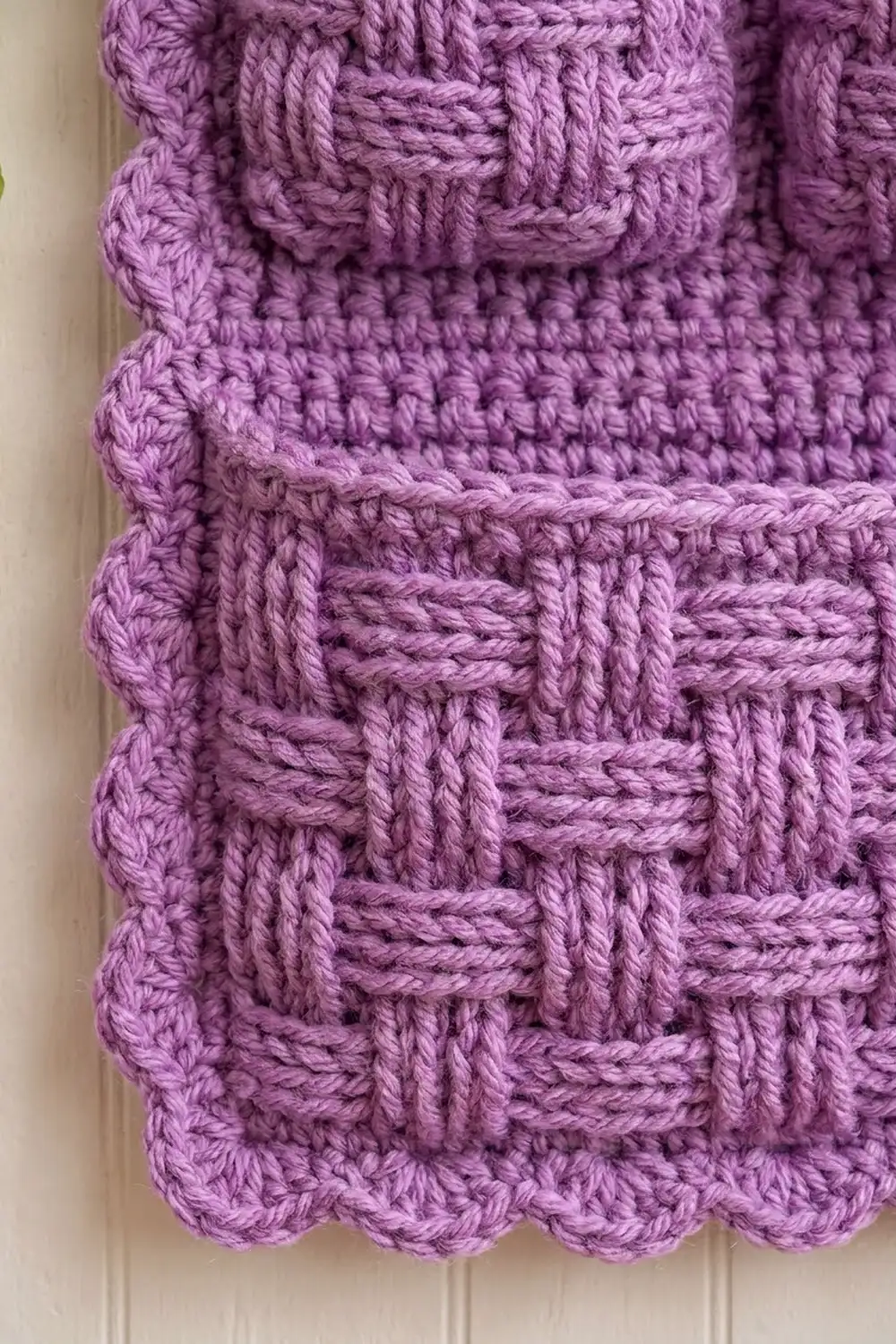
Each basketweave block is 4 sts wide and 2 rows tall. An hdc edge stitch at each end keeps the sides straight for seaming.
Foundation: Ch 40.
Row 1 (WS): Dc in 4th ch from hook and in each ch across, turn. (38 sts; the skipped ch-3 counts as the first dc)
Row 2 (RS): Ch 2 (does not count), hdc in first st, *FPdc in next 4 sts, BPdc in next 4 sts; rep from * 3 more times, FPdc in next 4 sts, hdc in top of turning ch, turn. (38 sts: 1 hdc + 36 post sts + 1 hdc)
Row 3 (WS): Ch 2, hdc in first st, *BPdc in next 4 sts, FPdc in next 4 sts; rep from * 3 more times, BPdc in next 4 sts, hdc in last st, turn. (38 sts)
Rows 2–3 make the first band. Seen from the RS, it has 5 raised blocks and 4 recessed blocks.
Row 4 (RS): Ch 2, hdc in first st, *BPdc in next 4 sts, FPdc in next 4 sts; rep from * 3 more times, BPdc in next 4 sts, hdc in last st, turn. (38 sts)
Row 5 (WS): Ch 2, hdc in first st, *FPdc in next 4 sts, BPdc in next 4 sts; rep from * 3 more times, FPdc in next 4 sts, hdc in last st, turn. (38 sts)
Rows 4–5 swap the blocks, which creates the checkerboard.
Rows 6–9: Rep Rows 2–5. (38 sts per row)
Rows 10–11: Rep Rows 2–3. (38 sts per row)
You now have 5 bands of blocks, and the pocket should be 5.5 in (14.0 cm) tall.
Rows 12–13 (top rim): Ch 1, sc in each st across, turn. (38 sc)
Fasten off, leaving a 30 in (76.2 cm) tail for sewing. The pocket measures about 9.5 in x 6 in (24.1 cm x 15.2 cm).
Small Pockets (Make 2)
Foundation: Ch 20.
Row 1 (WS): Dc in 4th ch from hook and in each ch across, turn. (18 sts)
Row 2 (RS): Ch 2, hdc in first st, *FPdc in next 4 sts, BPdc in next 4 sts; rep from * once more, hdc in last st, turn. (18 sts: 1 hdc + 16 post sts + 1 hdc)
Row 3 (WS): Ch 2, hdc in first st, *BPdc in next 4 sts, FPdc in next 4 sts; rep from * once more, hdc in last st, turn. (18 sts)
Row 4 (RS): Work as Row 3. (18 sts)
Row 5 (WS): Work as Row 2. (18 sts)
Rows 6–7: Rep Rows 2–3. (18 sts per row)
You now have 3 bands of blocks, and the pocket is 3.5 in (8.9 cm) tall.
Rows 8–9 (top rim): Ch 1, sc in each st across, turn. (18 sc)
Fasten off, leaving a 24 in (61.0 cm) tail. Each small pocket measures 4.5 in x 4 in (11.4 cm x 10.2 cm).
Strap
Foundation: Ch 61.
Row 1: Sc in 2nd ch from hook and in each ch across, turn. (60 sc)
Rows 2–4: Ch 1, sc in each st across, turn. (60 sc)
Fasten off, leaving a 12 in (30.5 cm) tail at each end. The strap is 15 in (38.1 cm) long and about 1 in (2.5 cm) wide.
Make All Pieces
All five pieces are lavender purple:
- 1 back panel (36 sts x 54 rows)
- 1 large pocket (38 sts x 13 rows)
- 2 small pockets (18 sts x 9 rows each)
- 1 strap (60 sts x 4 rows)
Layout on the RS of the panel:
+--------------------------------------+
|        plain sc, 1.5 in (3.8 cm)     |
| [small pocket]  gap  [small pocket]  |
|   sts 2-17    18-19    sts 20-35     |
|        gap, 0.5 in (1.3 cm)          |
| [          large pocket            ] |
|              sts 2-35                |
+--------------------------------------+
   strap ends sewn on the WS, top edge
Joining
Sew the pockets on before you work the border, so the panel’s edge stitches stay free for border Round 1. Whipstitch with the long tails, and keep every seam 1 st, or 0.25 in (0.6 cm), inside the panel’s side edges.
Large pocket: With the panel RS facing, pin the pocket’s foundation edge along Row 2 over panel sts 2–35. That’s 34 panel sts, or 8.5 in (21.6 cm), for 38 pocket sts. Sew 1 pocket st to each panel st, except at 4 evenly spaced points, about every 8–9 sts, where you sew 2 pocket sts into 1 panel st. Check: 30 + (4 x 2) = 38. The 1 in (2.5 cm) of ease lets the pocket bulge forward. Sew each side straight up the st 2 and st 35 columns for 6 in (15.2 cm), ending around Row 28.
Small pockets: Pin the bottom edges 0.5 in (1.3 cm) above the large pocket, around Row 30. Place one pocket over panel sts 2–17 and the other over sts 20–35, leaving sts 18–19 as the center gap. Each pocket’s 18 sts go onto 16 panel sts, so double up twice per pocket. Check: 1 + 16 + 2 + 16 + 1 = 36 panel sts. Sew the sides straight up for 4 in (10.2 cm), ending around Row 48.
Tension: Make each whipstitch snug but not tight, and loosen any seam that puckers. The panel should still measure 9 in (22.9 cm) wide across the seams.
Border
The border goes around the back panel only. It uses the panel’s gauge: 4 sc per inch along every edge.
Round 1 (RS): Join yarn in the first st of Row 54. Ch 1, sc in each st across the top (36 sc), ch 2. Working down the side in row ends, sc 48 times evenly, skipping every 9th row end (48 sc), ch 2. Sc in each free loop of the foundation ch (36 sc), ch 2. Work 48 sc evenly up the other side (48 sc), ch 2. Join with a sl st to the first sc. (168 sc and 4 ch-2 corner sps)
The corners are ch-2 spaces, not stitches, so they aren’t part of any side count. The top and bottom have 36 sts each, and each side has 48 sts.
Round 2 (shells): Ch 1. [Sc in next st, sk 1, shell in next st, sk 1] 9 times across the top, making the first sc in the same st as the join. Corner shell in the ch-2 sp. [Sc in next st, sk 1, shell in next st, sk 1] 12 times down the side. Corner shell. Rep the bracketed sequence 9 times across the bottom. Corner shell. Rep it 12 times up the last side. Corner shell in the last ch-2 sp. Join with a sl st to the first sc and fasten off.
Count: 42 repeats x 6 sts = 252, plus 4 corner shells x 7 dc = 28, for 280 sts.
Why the math works: Each repeat uses exactly 4 sts. The 36-st top and bottom take 9 repeats each, and the 48-st sides take 12 each, so every side ends with a skipped st just before its corner shell. The side count comes from gauge: 12 in x 4 sts = 48. Cutting the 54 row ends down to 48 sts keeps the edges flat.
The border adds 0.75 in (1.9 cm) per side: 9 + 1.5 = 10.5 in (26.7 cm) wide, and 12 + 1.5 = 13.5 in (34.3 cm) tall.
Attach the strap: On the WS, lay each strap end 1 in (2.5 cm) in from the panel’s side edge, over sts 5–8 and sts 29–32, overlapping the panel by 1 in (2.5 cm). Sew around all four sides of each end, going through the panel only. Check that the strap isn’t twisted.
Final Blocking
- Weave in all the ends along the seams or on the WS.
- Lay the organizer RS up on the blocking mat.
- Pin it to 10.5 in x 13.5 in (26.7 cm x 34.3 cm) with square corners.
- Pin out each scallop, especially at the corners.
- Stuff the pockets lightly with plastic bags so they keep their curve.
- Spray until the piece is damp but not soaked.
- Let it dry completely, at least 24 hours.
- Unpin and hang it by the strap.
Final Quality-Control Checklist
- The organizer measures 10.5 in x 13.5 in (26.7 cm x 34.3 cm)
- The large pocket shows 9 blocks across and 5 bands tall
- The small pockets are level, with a 0.5 in (1.3 cm) gap between them
- 1.5 in (3.8 cm) of plain panel shows above the small pockets
- The border has 9 scallops on the top and bottom, 12 on each side, and 4 corner shells
- The strap is untwisted and securely sewn on the WS
- No yarn ends show on the RS
Troubleshooting
Blocks look blurry: You’ve probably mixed up FP and BP on a WS row. On WS rows, work BP over the blocks that are raised on the RS.
Pocket is narrower than 9.5 in (24.1 cm): Post stitches pull in. Go up half a hook size for the pockets.
Border ruffles: The sides have too many sc. Recount Round 1 to 48 sts per side.
Border pulls in: Your stitches are too tight. Use a larger hook for the border.
Organizer hangs crooked: Re-measure both strap ends at 1 in (2.5 cm) from the side edges.
Pocket sags: Add a row of backstitch along the pocket’s bottom seam.
Care
Hand wash in cool water, roll the piece in a towel, and dry it flat. Reshape the pockets while they’re still damp.
Final Notes
The measurements build on each other. At a gauge of 16 sc to 4 in (10.2 cm), the 36-st panel is 9 in (22.9 cm) wide, and 54 rows make it 12 in (30.5 cm) tall. The pockets are sewn on with ease so they bulge without pulling the panel. Round 1 sets 36 and 48 sts per side, and both counts divide evenly into 4-st shell repeats. The 0.75 in (1.9 cm) border brings the organizer to 10.5 in x 13.5 in (26.7 cm x 34.3 cm).
Happy crocheting!