
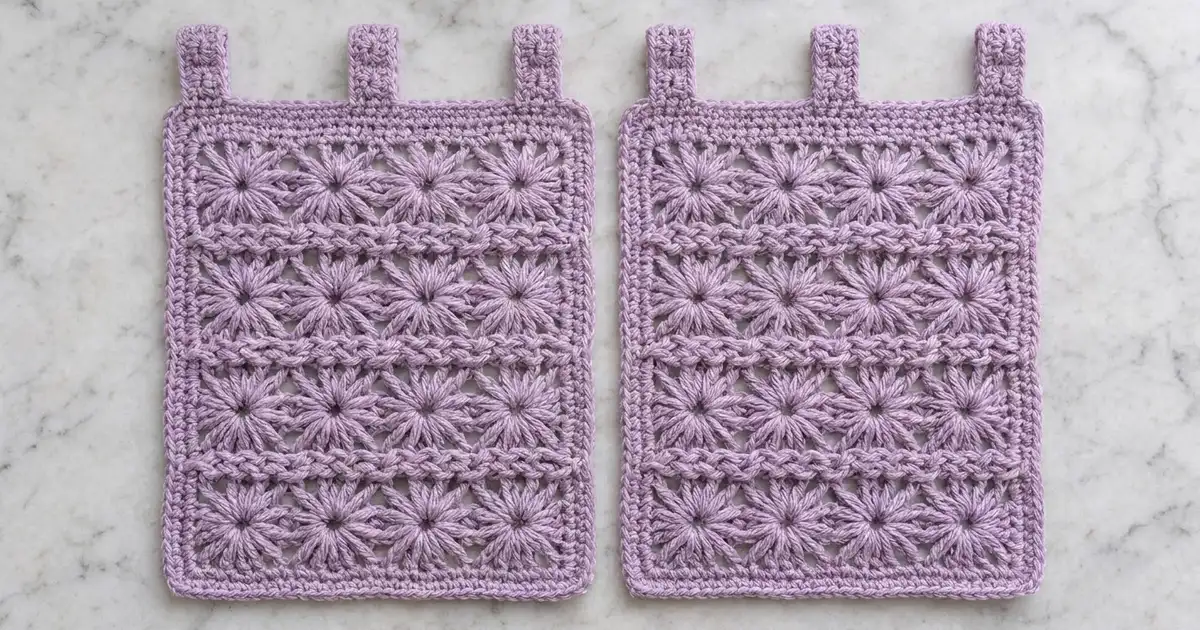
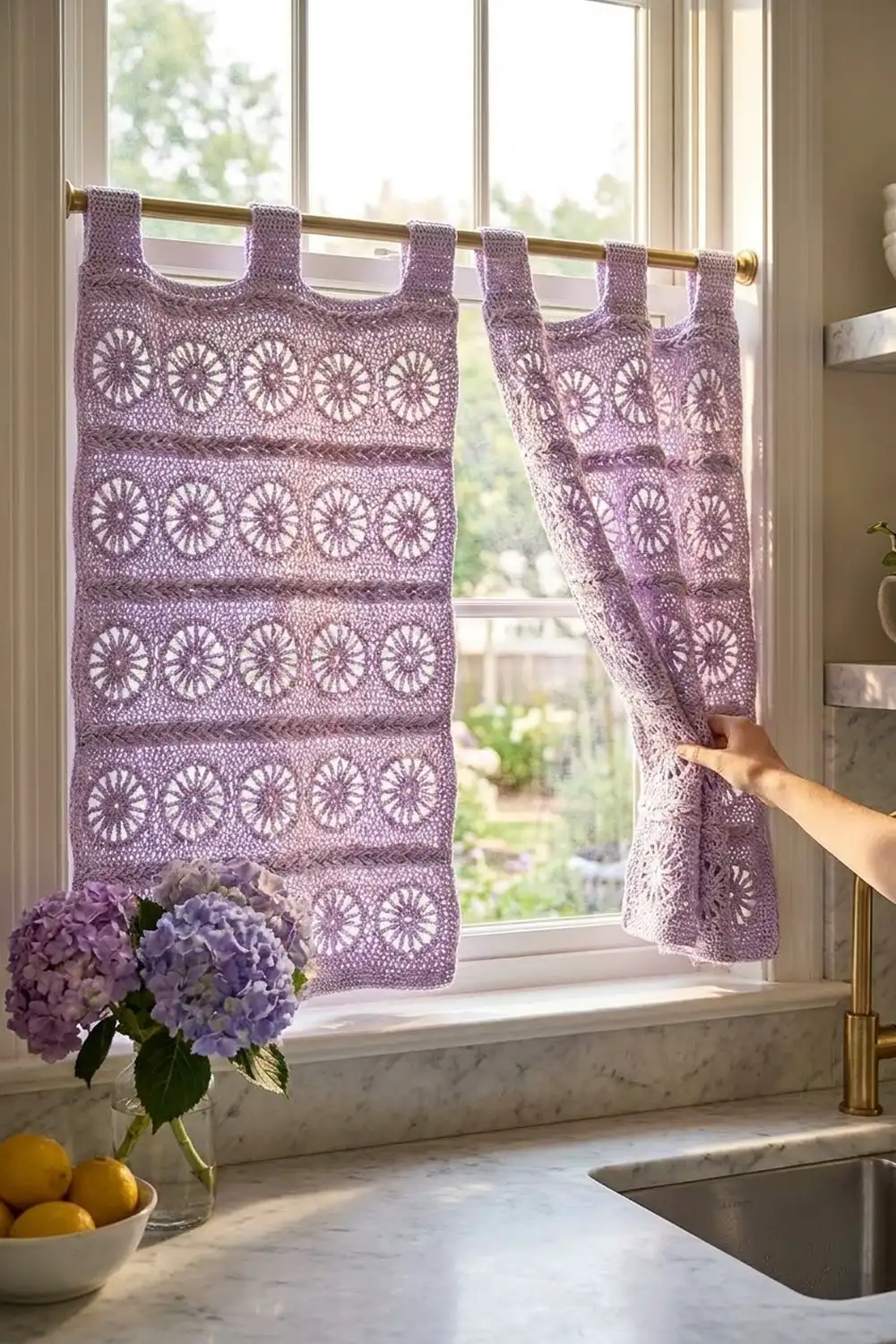
These tab-top café curtains are made of rows of round, spoked wheels. Each wheel has a small open eye in the center, and a crisp ridge band runs between the rows of wheels. The fabric looks light and textured, but it still has enough body to hang straight in a kitchen window.
The set is two identical panels in one soft lavender. A single color lets the wheel texture stand out. It also goes well with white trim, brass rods, and fresh flowers on the sill. This pattern uses US crochet terms throughout.
Each finished panel measures 15.25 in (38.7 cm) wide and 22.25 in (56.5 cm) tall. The tabs add 2 in (5.1 cm), so the total hanging length is 24.25 in (61.6 cm).
You work each panel flat in rows from the bottom up. One wheel band is a 4-row repeat:
- a 7-treble cluster for the lower spokes
- a 7-treble fan worked into the cluster’s eye for the upper spokes
- a leveling row
- a back-loop ridge row
Two border rounds square up the edges, and then you work three tabs straight off the top.
Finished Size and Construction
- Finished panel size: 15.25 in x 22.25 in (38.7 cm x 56.5 cm), plus 2 in (5.1 cm) tabs
- Skill level: Intermediate
- Terminology: US
- Yarn weight: Worsted (#4) cotton or cotton blend
- Hook: 5.0 mm (H-8)
- Number of pieces: 2 separate panels, each worked in one piece including its tabs
- Layout: The panels hang side by side on a rod and are not joined
- Panel body before border: 14.25 in x 21.25 in (36.2 cm x 54.0 cm)
- Border depth: 0.5 in (1.3 cm), made of 2 rounds at 0.25 in (0.6 cm) each
Materials
Yarn: Use a smooth worsted cotton or cotton blend. Cotton shows the wheel spokes clearly, handles kitchen humidity, and washes well. Avoid fuzzy or loosely plied yarns. They blur the eyes and can split while you work the clusters.
- Lavender: about 450 g / 765 m (837 yd) in total, roughly 185 g per panel
These amounts include a margin of about 20%. Buy all your yarn from one dye lot, because both panels hang next to each other in full light.
Tools:
- 5.0 mm (H-8) crochet hook
- Tapestry needle
- Stitch markers (4 or more)
- Measuring tape
- Blocking mats and rust-proof pins
- Spray bottle
- Café curtain rod, up to 1 in (2.5 cm) in diameter
Abbreviations (US Terms)
- ch – chain
- sl st – slip stitch
- sc – single crochet
- tr – treble crochet
- BLO – back loop only
- st(s) – stitch(es)
- sp – space
- RS / WS – right side / wrong side
- tr7tog – treble 7 together:
- Yarn over twice, insert hook in next st, pull up a loop, [yarn over, pull through 2 loops] twice.
- Repeat from * 6 more times. You now have 8 loops on the hook.
- Yarn over and pull through all 8 loops.
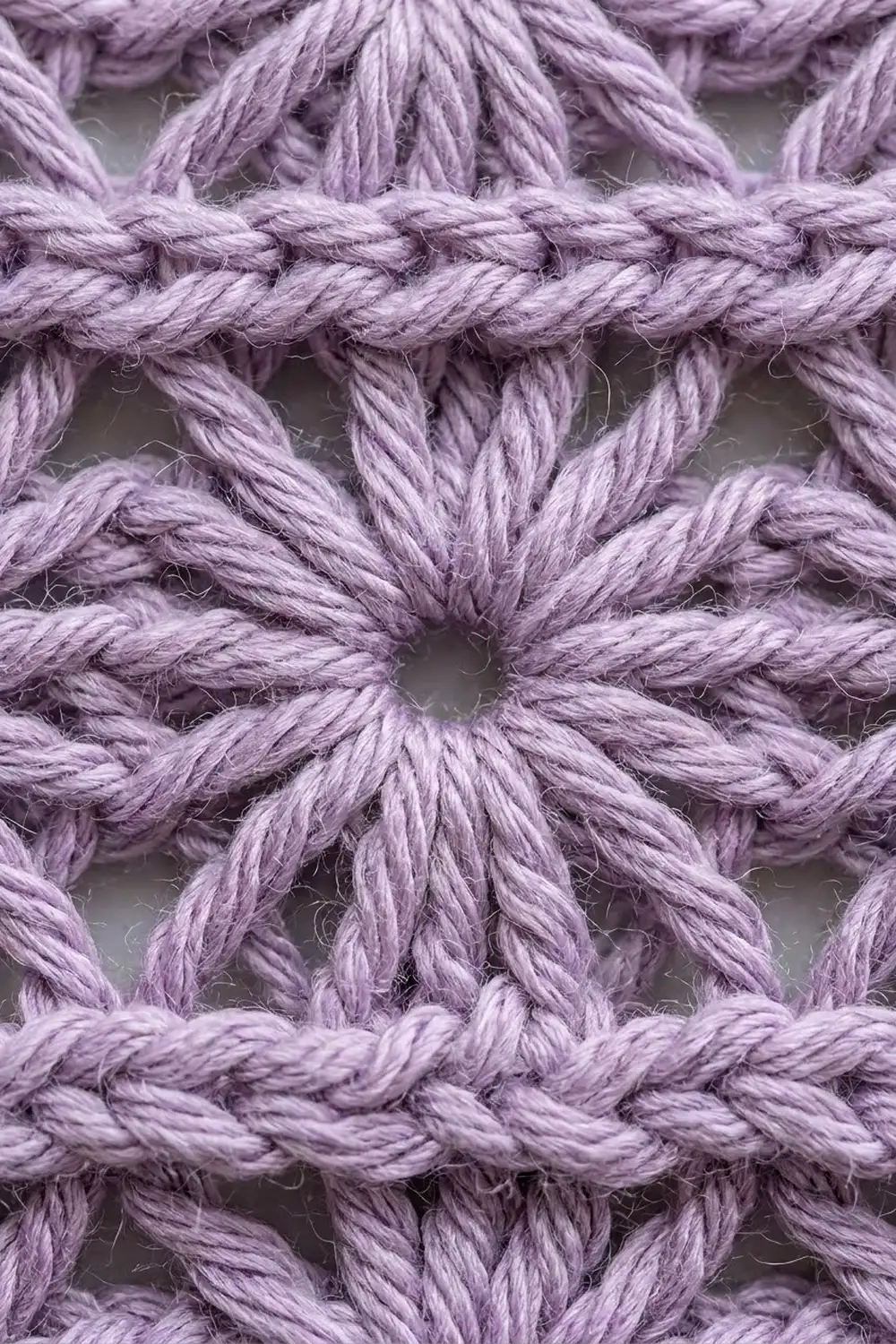
Special stitch – Wheel Cluster (WC): Work tr7tog over the next 7 sts, then ch 1 firmly to close the cluster. This closing ch-1 is the eye, the center hole of the wheel.
Gauge and Checkpoints
Pattern gauge: 8 sts (one wheel repeat) = 2 in (5.1 cm) wide. One full wheel band (Rows 2–5) = 1.5 in (3.8 cm) tall.
Border gauge: 4 sc = 1 in (2.5 cm).
Test swatch first: Ch 26. Work Row 1 (25 sc), then work Rows 2–5 three times. The swatch should be 3 wheels across and measure 6.25 in (15.9 cm) wide x 4.75 in (12.1 cm) tall. Block it before you measure.
Panel checkpoints (body only, before the border):
- After Row 1: 14.25 in (36.2 cm) wide
- After 4 bands: 6.25 in (15.9 cm) tall
- After 7 bands: 10.75 in (27.3 cm) tall
- After 10 bands: 15.25 in (38.7 cm) tall
- After 14 bands: 21.25 in (54.0 cm) tall
If your swatch is too big, go down 0.5 mm. If it’s too small, go up 0.5 mm. If the width is right but the bands are too tall, pull the first loop of each treble down snugly. Don’t change the stitch counts, because the border and tab math depends on them.
Panel Pattern (Make 2)
Foundation: Ch 58.
Row 1 (RS): Sc in 2nd ch from hook and in each ch across. Turn. (57 sc)
Row 2 (WS, lower spokes): Ch 4 (counts as tr here and throughout). Skip the first st. WC over the next 7 sts, ch 1, tr in the next st; repeat from * 6 more times. Turn. (7 WC, 7 eyes, 7 ch-1 sps, 8 tr including the turning ch)
The 7 legs of each cluster lean in toward the eye and form the lower half of the wheel. The tr between clusters stands as a straight post.
Row 3 (RS, upper spokes): Ch 1, sc in the first tr. Skip the ch-1 sp, work 7 tr in the next eye, skip the cluster top, sc in the next tr; repeat from * 6 more times. Work the last sc in the 4th ch of the turning ch. Turn. (7 fans of 7 tr + 8 sc = 57 sts)
Each fan opens upward from the same eye as the cluster below it. Together they make a full round wheel with 14 spokes.
Row 4 (WS, leveling row): Ch 4. Skip the first sc. Sc in each of the next 7 tr, tr in the next sc; repeat from * 6 more times. Turn. (7 x 7 sc + 8 tr including the turning ch = 57 sts)
The trebles fill the low dips between the fans, so the top edge comes out flat.
Row 5 (RS, ridge row): Ch 1. Sc BLO in each st across, working the last sc in the 4th ch of the turning ch. Turn. (57 sc)
The unworked front loops sit on the RS as a raised chain ridge. This is the braided band that runs between the rows of wheels.
Rows 6–57: Repeat Rows 2–5 thirteen more times, for 14 wheel bands in total. Row 57 is a ridge row. (57 sc) Fasten off.
Body check: The body should measure 14.25 in x 21.25 in (36.2 cm x 54.0 cm). It has 57 rows and 98 wheels (7 across x 14 tall).
Make Both Panels
Make 2 identical panels. Each one uses about 185 g of Lavender, including the border and tabs. Count rows the same way on both panels so the wheel bands line up when they hang side by side.
Layout on the rod, seen from the RS:
[tab]   [tab]   [tab]     [tab]   [tab]   [tab]
+-----------------+       +-----------------+
|                 |       |                 |
|     PANEL A     |       |     PANEL B     |
|  7 x 14 wheels  |       |  7 x 14 wheels  |
|                 |       |                 |
+-----------------+       +-----------------+
The panels are not joined. Each one slides along the rod on its own, so you can draw them apart or tie one back.
Border
Border gauge: 4 sc = 1 in (2.5 cm). Each border round adds 0.25 in (0.6 cm) to every side.
Side edge rule: In each wheel band, work these sc into the row ends:
- Row 2: 2 sc
- Row 3: 1 sc
- Row 4: 2 sc
- Row 5: 1 sc
That works out to 2 sc in each treble row end and 1 sc in each sc row end. Each 1.5 in band gets 6 sc, which matches the gauge of 4 sc per inch. Skip the ends of Row 1 and Row 57, because the corner stitches cover them.
Round 1 (RS): With RS facing, join yarn in the first st of Row 57.
- Top: 3 sc in the first st, sc in each of the next 55 sts, 3 sc in the last st.
- First side: 83 sc down the side. That’s 5 in the top band (Row 57 is skipped) plus 6 in each of the other 13 bands.
- Bottom: Working into the foundation ch, 3 sc in the first ch, sc in each of the next 55 ch, 3 sc in the last ch.
- Second side: 83 sc up the side.
- Sl st to the first sc. (288 sc)
Counting from corner center to corner center, with both corners included, the top and bottom have 59 sts each and the sides have 87 sts each. Check: 2 x 59 + 2 x 87 − 4 shared corners = 288.
Round 2: Ch 1. Sc in each st around, working 3 sc in each corner center st. Sl st to the first sc. Fasten off. (296 sc: 61 sts on the top and bottom, 89 sts on each side)
Why the math works:
- Width: The body is 57 sts across, which is 14.25 in (36.2 cm) at 4 sts per inch. Each round adds one stitch at each end of a side, so the width goes from 57 to 59 to 61 sts. That gives 61 ÷ 4 = 15.25 in (38.7 cm).
- Height: The sides have 85 sc of row ends, which is 21.25 in (54.0 cm). The two rounds take the side count to 87 and then 89 sts. That gives 89 ÷ 4 = 22.25 in (56.5 cm).
Tabs (3 per panel)
Number the 61 top-edge sts of Round 2, starting at the right corner center (st 1) and ending at the left corner center (st 61). Place the tabs on these sts:
- sts 1–5
- sts 29–33, centered on st 31
- sts 57–61
This leaves two even gaps of 23 sts each.
Each tab: With RS facing, join yarn in the first st of the tab position.
- Row 1: Ch 1, sc in the same st and in each of the next 4 sts. Turn. (5 sc)
- Rows 2–16: Ch 1, sc in each st across. Turn. (5 sc)
The finished strip is 1.25 in (3.2 cm) wide x 4 in (10.2 cm) long. Fasten off, leaving a 10 in (25.4 cm) tail. Fold the tab to the WS and whipstitch the last row to Round 1 of the border, directly behind the base of the tab. This makes a 2 in (5.1 cm) loop.
Final Blocking
- Weave in all ends along the ridge rows or inside the border. Never weave them through the eyes.
- Lay the panel RS up on the blocking mats.
- Pin the four corners to 15.25 in x 22.25 in (38.7 cm x 56.5 cm).
- Pin along each edge every 2 in (5.1 cm), keeping the ridge bands straight and level.
- Open each eye into a round hole using a pin or the tip of your hook.
- Mist the panel until it is damp but not dripping.
- Let it dry completely, then unpin it.
- Block the second panel to the same pin positions so the pair matches.
Final Quality-Control Checklist
- [ ] Each panel is 7 wheels across and 14 bands tall
- [ ] Every row has 57 sts (Row 2: 7 WC, 7 eyes, 7 ch-1 sps, 8 tr)
- [ ] Every eye is open and centered between its cluster and fan
- [ ] All 14 ridge bands are on the RS
- [ ] Border Round 2 has 296 sc (61 on the top and bottom, 89 on each side)
- [ ] The panel measures 15.25 in x 22.25 in (38.7 cm x 56.5 cm)
- [ ] There are 3 tabs per panel, each 5 sts wide and folded into a 2 in (5.1 cm) loop
- [ ] Both panels are the same length to within 0.25 in (0.6 cm)
Troubleshooting
The wheels look lopsided. Work all 7 fan trebles into the eye, not into the ch-1 sp next to it.
The eye has closed up. Keep the closing ch-1 of each WC firm but not tight. Open the eye again during blocking.
The ridge band is on the back. Row 5 must be a RS row. Recount your rows.
The sides wave or pull in. Recount the border sides against the edge rule: 6 sc per band, and 83 sc per side in Round 1.
One panel is longer than the other. Your tension has drifted. Block both panels to the same measurements, and check your gauge every 4 bands on future pairs.
A tab is twisted. Unpick the whipstitching, fold the tab straight, and sew it again.
Care
Hand wash, or machine wash on a gentle cool cycle in a mesh bag. Lay flat to dry, and re-pin to the blocked size if needed.
Final Notes
Every measurement in this pattern comes from your gauge:
- 8 sts make one wheel 2 in (5.1 cm) wide.
- 7 wheels plus 1 st make the 57-st body, 14.25 in (36.2 cm) wide.
- 14 bands of 1.5 in (3.8 cm), plus Row 1, give 21.25 in (54.0 cm) of height.
- Two border rounds bring the panel to 61 x 89 sts, or 15.25 in x 22.25 in (38.7 cm x 56.5 cm).
- The 2 in (5.1 cm) tabs complete the 24.25 in (61.6 cm) drop.
Check your gauge early and count every row, and both panels will come out the same size.
Happy crocheting!