

This holiday door curtain is made of six long, narrow strips. Each strip is a cream filet mesh decorated with chocolate-brown leaping reindeer and cranberry-red snowflakes, and has a crisp brown edging. The strips hang side by side from a rod, so you can walk between them. Brush one aside and it falls back into line.
The look is classic Nordic-cabin Christmas: warm brown, soft cream and deep berry red, set out in tidy pixel-style motifs. Each cell of the mesh works like one pixel of a picture.
This pattern uses US crochet terms. Each finished strip measures 6.8 in wide x 72.8 in long (17.3 cm x 184.9 cm), not counting the hanging loops.
Construction is simple and repetitive. You crochet a plain cream mesh strip, fill in the motif cells with brown and red cross-stitches, add a two-round brown border, and finish with two chain loops at the top. Make six strips and hang them. They are never joined to each other.
Finished Size and Construction
- Finished strip size: 6.8 in x 72.8 in (17.3 cm x 184.9 cm)
- Skill level: Easy-intermediate (filet mesh plus simple cross-stitch)
- Terminology: US crochet terms
- Yarn weight: DK (light worsted, #3)
- Hook: 4.0 mm (US G-6)
- Number of pieces: 6 separate strips
- Layout: 6 strips side by side on a rod, not joined
- Mesh size per strip (before border): 15 cells wide x 180 rows tall = 6 in x 72 in (15.2 cm x 182.9 cm)
- Border depth: 0.4 in (1.0 cm) per edge, for 2 rounds of single crochet
- Hanging loops: 2 per strip, each made on a 4 in (10.2 cm) chain
- Total width on the rod: 6 x 6.8 in = 40.8 in (103.6 cm)
Materials
Yarn: Choose a smooth DK cotton or cotton blend. Cotton holds its shape when it hangs, shows the mesh clearly and resists fuzzing. Avoid fluffy or very stretchy yarns, because they hide the cells and make the strips grow.
- Cream (mesh): 700 g, about 1,610 m (based on 230 m per 100 g)
- Chocolate brown (reindeer, borders, loops): 450 g, about 1,035 m
- Cranberry red (snowflakes and dots): 100 g, about 230 m
These quantities cover all six strips and include a margin of roughly 10 to 15 percent for your gauge swatch and tension differences.
Tools:
- 4.0 mm (US G-6) crochet hook
- Blunt tapestry needle with an eye large enough for DK yarn
- Stitch markers
- Measuring tape (at least 80 in / 203.2 cm long, or a shorter tape used carefully)
- Rust-proof pins and a long blocking surface
- Spray bottle
- Scissors
- Curtain rod, at least 41 in (104.1 cm) wide, and no more than 1 in (2.5 cm) thick
Abbreviations (US Terms)
- ch – chain
- sl st – slip stitch
- sc – single crochet
- dc – double crochet
- sk – skip
- sp – space
- st(s) – stitch(es)
Mesh cell: One square of the filet mesh, framed by two dc posts with a ch-1 sp between them. Adjacent cells share a post. A row of 15 cells has 16 dc posts and 15 ch-1 sps, for 31 sts in total.
Filled cell (cross-stitch): Using the tapestry needle, work one diagonal from the lower-left to the upper-right corner of an open cell, then a second diagonal from the lower-right to the upper-left corner. Pass through the same holes a second time if the cell still looks thin.
Gauge and Checkpoints
Gauge: 10 mesh cells x 10 rows = 4 in x 4 in (10.2 cm x 10.2 cm), measured after blocking. Each cell is 0.4 in (1.0 cm) square.
Border gauge: 5 sc = 1 in (2.5 cm), and 5 rounds of sc = 1 in (2.5 cm).
Test one strip section first. Make the foundation and work 20 rows. Then measure before going further.
Checkpoints:
- Row 1: 6 in (15.2 cm) wide
- After 20 rows (one motif repeat): 8 in (20.3 cm) tall
- After 100 rows: 40 in (101.6 cm) tall
- After 180 rows: 72 in (182.9 cm) tall
- After the border: 6.8 in x 72.8 in (17.3 cm x 184.9 cm)
If your mesh is too big, go down a hook size or tighten your chain-1s. If it is too small, go up a hook size. Width matters most: an error of 0.1 in (0.3 cm) per cell becomes 1.5 in (3.8 cm) across one strip. Measure length with the strip lying flat, because hanging mesh stretches.
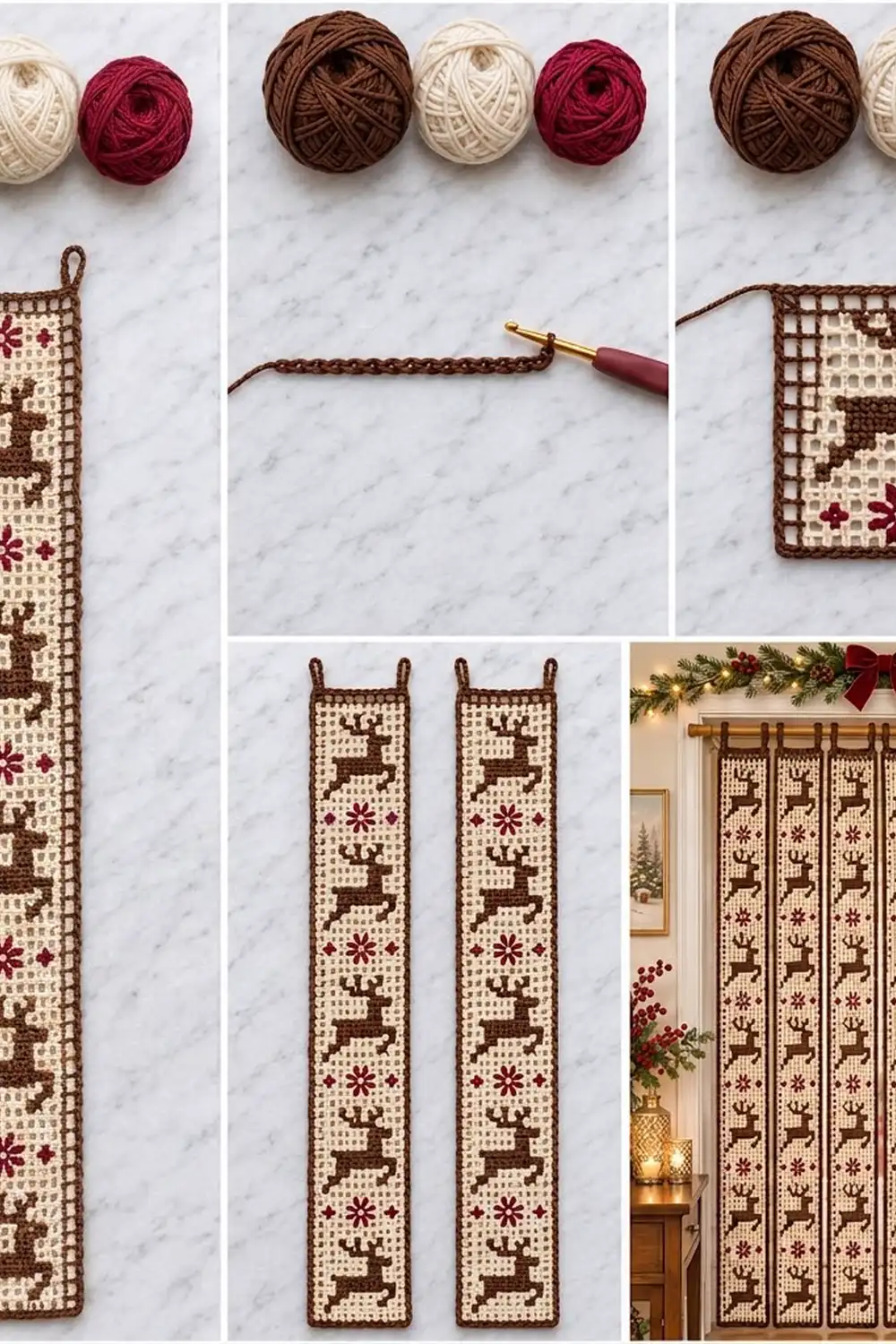
Main Pattern: Mesh Strip (Make 6)
Use cream for the whole mesh.
Foundation: Ch 34.
Row 1: Dc in the 6th ch from the hook. The 5 skipped chains count as the first dc post, a ch-1 sp and the base of the first cell. Then ch 1, sk 1 ch, dc in the next ch; repeat from * across. Turn.
(15 cells: 16 dc posts + 15 ch-1 sps = 31 sts.)
Row 2: Ch 4 (this counts as dc + ch 1). Sk the first ch-1 sp, then dc in the next dc. Ch 1, dc in the next dc; repeat from * across. Work the last dc in the 4th ch of the skipped ch-5. Turn.
(15 cells, 31 sts.)
Row 3: Ch 4 (counts as dc + ch 1). Sk the first ch-1 sp, then dc in the next dc. Ch 1, dc in the next dc; repeat from * across. Work the last dc in the 3rd ch of the turning ch-4. Turn.
(15 cells, 31 sts.)
Rows 4–180: Repeat Row 3.
(Every row has 15 cells and 31 sts. The strip measures 6 in x 72 in / 15.2 cm x 182.9 cm.)
Fasten off and weave in the ends. Row 1 is the bottom of the strip and Row 180 is the top.
Motif Placement
The strip holds 9 motif repeats of 20 rows each (9 x 20 = 180 rows). Each repeat is 8 in (20.3 cm) tall. Number the cell columns 1 to 15 from left to right, with the right side facing you and Row 1 at the bottom.
Within each 20-row repeat, counting from its bottom row:
- Repeat rows 1–2: Plain mesh
- Repeat rows 3–7: Snowflake band, in red
- Repeat rows 8–9: Plain mesh
- Repeat rows 10–18: Reindeer, in brown
- Repeat rows 19–20: Plain mesh
So the first repeat uses strip rows 1–20, the second uses rows 21–40, and so on up to rows 161–180.
Snowflake Band (Red)
The snowflake is 5 cells wide x 5 rows tall, about 2 in (5.1 cm) square. It sits in columns 6–10. In the grid below, X is a filled cell and . is an open cell. Read it top to bottom; the top line is repeat row 7.
Row 7:  X . X . X
Row 6:  . X X X .
Row 5:  X X X X X
Row 4:  . X X X .
Row 3:  X . X . X
That makes 17 cells. On repeat row 5, also fill the single cells in column 3 and column 13 to make the side dots. Each snowflake band uses 19 red cells in total.
Reindeer (Brown)
The reindeer is 12 cells wide x 9 rows tall, about 4.8 in x 3.6 in (12.2 cm x 9.1 cm). It occupies strip columns 2–13 and faces right. In the grid, columns are numbered 1–12 within the motif, so motif column 1 is strip column 2. The top line is repeat row 18.
Row 18: . . . . . . . X . . X .
Row 17: . . . . . . . . X . X .
Row 16: . . . . . . . . . X X .
Row 15: . . . . . . . . . X X X
Row 14: X X . . . . . . X X . .
Row 13: . X X X X X X X X . . .
Row 12: . . X X X X X X X . . .
Row 11: . X X . . . . . X X . .
Row 10: X . . . . . . . . . X .
Rows 16–18 form the branched antlers, Row 15 is the head and nose, and Row 14 shows the upturned tail and neck. Rows 12–13 are the body, and Rows 10–11 are the legs stretched forward and back. Each reindeer uses 34 brown cells.
Per strip, you will fill 9 reindeer x 34 = 306 brown cells and 9 bands x 19 = 171 red cells.
Embroidery tips: Work all the crosses in one motif with their top diagonals going the same direction. Carry the yarn on the wrong side only between neighbouring cells. Start each new motif with a fresh length of yarn. Keep the tension relaxed so the mesh stays square.
Make All Pieces
Make 6 identical strips. Each strip needs:
- 180 rows of cream mesh
- 9 brown reindeer and 9 red snowflake bands
- A 2-round brown border
- 2 brown hanging loops
Layout, viewed from the front with the strips hanging from the rod:
| S1 | S2 | S3 | S4 | S5 | S6 |
| 6.8" each, 40.8" (103.6 cm) total |
All the strips are identical and every reindeer faces right, so they all leap in the same direction across the doorway.
Hanging (No Joining)
The strips are not joined. Each one hangs on its own from two loops, so the curtain parts easily as people walk through. Because no seams join the strips, no stitches are added or lost between them.
Slide the strips onto the rod in order, with the right sides facing out. Let them hang for a day before judging the length. A cotton mesh may relax by about 0.5 to 1 in (1.3 to 2.5 cm).
Size check: Six strips need 40.8 in (103.6 cm) of rod. On a 36 in (91.4 cm) doorway, let the outer strips overlap the door frame slightly, or space the loops a little closer together on the rod.
Border
Work the border on each strip separately, in brown, with the right side facing you.
Border gauge: 5 sc per 1 in (2.5 cm). The mesh rows are 0.4 in (1.0 cm) tall, so 2 sc per row-end equals 5 sc per inch. Along the top and bottom, 31 sts sit across 6 in (15.2 cm), which is very close to that gauge. Both edges will lie flat.
Round 1: Join brown in the last dc of Row 180 (top-right corner). Work these 4 edges:
- Top edge: 3 sc in the corner dc, then sc in each of the next 29 sts (every ch-1 sp and dc), then 3 sc in the last st.
- Left long edge: 2 sc around each row-end post, for 180 rows x 2 = 360 sc.
- Bottom edge: Working into the base of the foundation, 3 sc in the corner st, then sc in each of the next 29 base sts, then 3 sc in the last base st.
- Right long edge: 2 sc around each row-end post, for 360 sc.
Join with a sl st to the first sc.
Counts, with the corner groups counted separately: top 29 + bottom 29 + 2 long sides x 360 + 4 corners x 3 = 790 sc.
Round 2: Ch 1. Sc in each sc around, working 3 sc in the center sc of each corner group. Join with a sl st.
Counts: each side between the corners gains the 2 outer sc of its neighbouring corner groups. Top 31 + bottom 31 + 2 x 362 + 4 x 3 = 798 sc.
Why the math works: The 31 sc along the top and bottom of Round 2 match the 31 mesh sts, and the 362 sc on each long side match the 360 row-end sc plus the 2 corner sts that turned the corner. Only the 3-sc corner groups add stitches, so the border lies flat. It adds 0.4 in (1.0 cm) to every edge: 6 + 0.8 = 6.8 in (17.3 cm) wide and 72 + 0.8 = 72.8 in (184.9 cm) long.
Hanging Loops
Left loop: Join brown with a sl st in the center sc of the top-left corner. Ch 20, which is about 4 in (10.2 cm). Sk the next 6 sts (1 corner sc and 5 top sc), then sl st in the next sc. Turn. Work 24 sc over the ch-20 loop, covering the chain completely, then sl st in the corner sc. Fasten off.
Right loop: Make it the same way, starting in the center sc of the top-right corner and working toward the middle of the top edge.
Each loop stands about 1.75 in (4.4 cm) above the strip.
Final Blocking
- Weave in all ends along the wrong side of the filled cells or inside the border.
- Lay one strip flat, right side up, on a long surface. Work in sections if you need to.
- Spray it evenly until it is damp, not soaked.
- Pin the long edges straight at 6.8 in (17.3 cm) wide, checking every 8 in (20.3 cm).
- Line up the columns so the cells sit square. Nudge any skewed reindeer into shape.
- Pin the length to 72.8 in (184.9 cm). Don’t stretch it beyond that, because hanging will add a little more.
- Let it dry completely, then repeat for the other strips.
Final Quality-Control Checklist
- Every strip has 180 rows, 15 cells wide.
- There are 9 reindeer and 9 snowflake bands per strip, all in the same positions.
- All reindeer face right.
- Each snowflake has a red dot on both sides, in columns 3 and 13.
- Border Round 2 counts 798 sc.
- The corners are square and the long edges are not wavy.
- Both loops are the same size and sit at the corners.
- All six strips match in length to within 0.5 in (1.3 cm).
Troubleshooting
Long edges ruffle: You have too many sc per row-end. Rework at exactly 2 sc per row.
Long edges pull in: Your sc are too tight. Go up a hook size for the border only.
Cells look rectangular: Your dc are too tall or too short compared with the ch-1. Adjust your yarn-over height, or change the ch-1 to ch-2 with a smaller hook.
Reindeer looks blurry: Fill each cell with a second pass of cross-stitch, and keep the diagonals consistent.
Strips differ in length: Block them all together, or remove or add one row before working the border.
Strip leans or twists: Count the cells. A missing last dc narrows the row by one cell.
Care
Hand wash in cool water with mild detergent, roll in a towel and dry flat. Re-block if the strips lengthen after a season of hanging.

Final Notes
Here is the measurement chain at a glance:
- Cells: Each cell is 0.4 in (1.0 cm).
- Mesh strip: 15 cells x 180 rows = 6 in x 72 in (15.2 cm x 182.9 cm).
- Motif repeats: 9 repeats of 20 rows, each 8 in (20.3 cm) tall.
- Border: Adds 0.4 in (1.0 cm) per edge, for 6.8 in x 72.8 in (17.3 cm x 184.9 cm).
- Curtain: Six unjoined strips span 40.8 in (103.6 cm) of rod.
Check your gauge early, count your cells, and the reindeer will leap neatly down every strip.
Happy crocheting!