

This hanging holder stores three spare rolls on the back of a door, on a towel hook, or beside the tank. It is made from a long cream backing panel and three butter-yellow baskets sewn on in a neat vertical stack, and it hangs from a natural wooden ring.
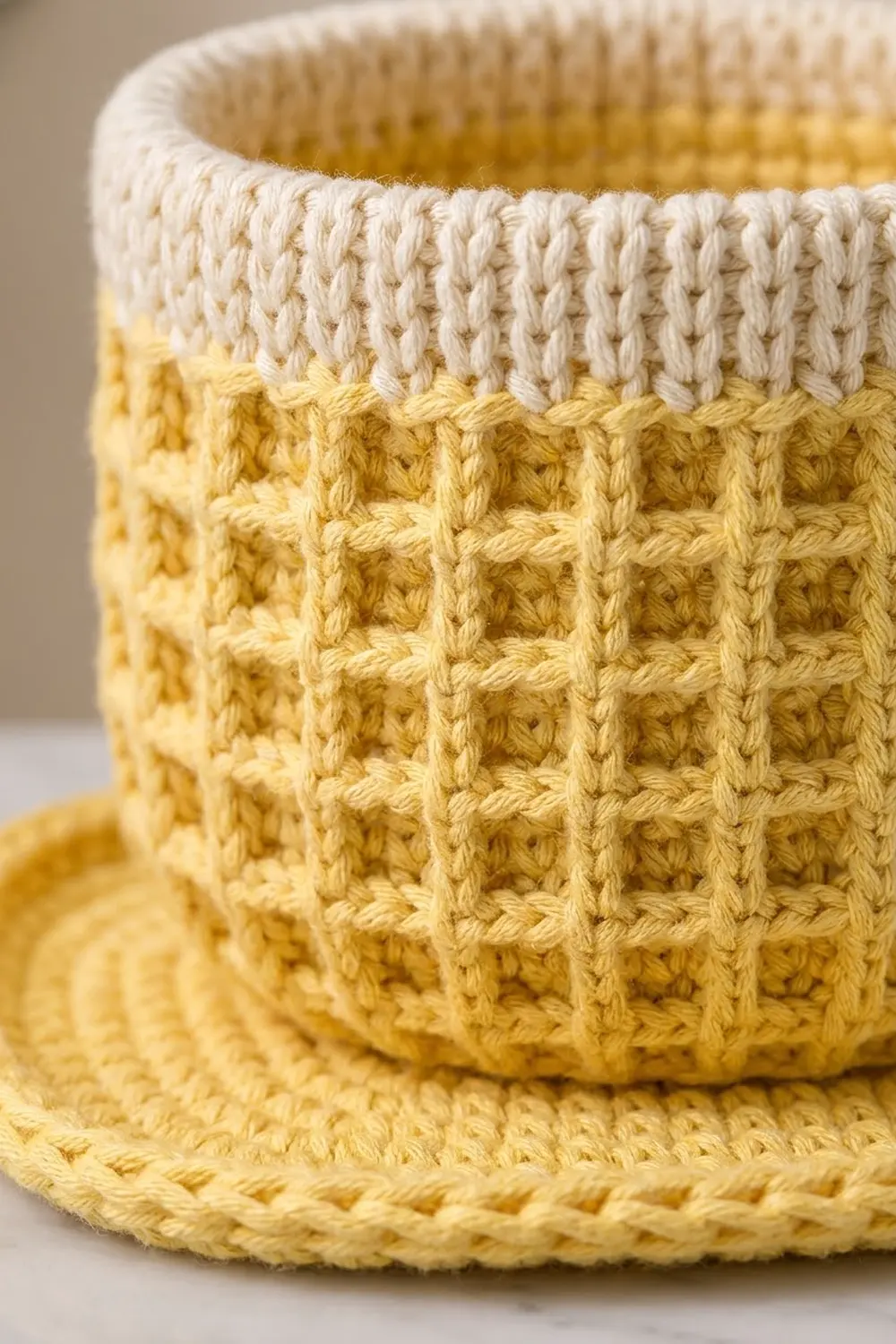
The baskets use waffle stitch, which makes a raised, chunky grid that keeps its shape and holds a roll firmly. A cream rim in knit-look single crochet finishes each basket, and the panel gets a rope-like yellow crab-stitch edge, so the two colors repeat across every piece.
The finished holder measures 8.25 in (21.0 cm) wide and 25 in (63.5 cm) long, not counting the strap and ring. With the ring it hangs about 28 in (71.1 cm) long. Each basket is about 6.25 in (15.9 cm) wide and 4 in (10.2 cm) tall. The pattern uses US crochet terms throughout.
Construction: crochet three baskets in joined rounds, from the base up. Work the panel in rows from the bottom to the tapered top, add a two-round border, and make a short strap. Then sew the strap around the ring and sew the baskets to the panel.
Finished Size and Construction
- Finished size: 8.25 in × 25 in (21.0 cm × 63.5 cm) panel; about 28 in (71.1 cm) including the ring
- Skill level: Intermediate (post stitches, crab stitch, sewing up)
- Terminology: US
- Yarn weight: Worsted (#4) cotton
- Hook: 5.0 mm (H-8)
- Number of pieces: 5 (1 panel, 3 baskets, 1 strap), plus a wooden ring
- Layout: 3 baskets in a single vertical column
- Basket size: 6.25 in (15.9 cm) square base, 4 in (10.2 cm) tall
- Panel size before border: 7.25 in × 24 in (18.4 cm × 61.0 cm)
- Border depth: 0.5 in (1.3 cm) on every edge
Materials
Use a smooth 100% cotton or cotton blend in worsted weight, about 170 m per 100 g. Cotton stays firm, so the baskets won’t sag under a roll, and it holds up in a damp bathroom. Acrylic will work, but the baskets will be softer.
- Butter yellow: 350 g (595 m) for baskets and border
- Cream: 160 g (272 m) for panel, rims, and strap
- 5.0 mm (H-8) crochet hook
- Wooden ring, 3 in (7.6 cm) outer diameter
- Tapestry needle
- 8 locking stitch markers
- Rust-proof pins
- Measuring tape
These amounts include about a 10% margin. Waffle stitch uses a lot of yarn, so buy the yellow from a single dye lot.
Abbreviations (US Terms)
- ch – chain
- sl st – slip stitch
- sc – single crochet
- dc – double crochet
- sc2tog – single crochet 2 together
- FPdc – front post double crochet: yo, insert hook from front to back to front around the post of the stitch, complete as a dc
- BLO – back loop only
- st(s) – stitch(es)
- rnd(s) – round(s)
Special stitch – knit stitch (ksc): Insert the hook between the two vertical legs of the sc below (through the “V,” not under the top loops), then yo, pull up a loop, yo and pull through both loops. Keep your loops loose. This stitch makes the stacked V columns on the rim.
Crab stitch (reverse sc): Work sc from left to right (right-handed) without turning, so the edge twists into a rope.
Gauge and Checkpoints
Sc gauge: 16 sts and 16 rows = 4 in (10.2 cm). The base rounds and the panel use this gauge.
Waffle gauge: 16 sts and 9 rnds = 4 in (10.2 cm).
Make one basket first and use it as your gauge swatch. Check these measurements as you go:
- After base Rnd 4 (32 sts): 2 in (5.1 cm) square
- After base Rnd 8 (64 sts): 4 in (10.2 cm) square
- After base Rnd 12 (96 sts): 6.25 in (15.9 cm) square, lying flat
- After Rnd 20: wall is about 3.25 in (8.3 cm) tall
- Finished basket: 4 in (10.2 cm) tall
If your base comes out bigger, switch to a 4.5 mm hook. If it comes out smaller, use a 5.5 mm hook. The panel must have the same gauge, because the baskets are sewn to it stitch for stitch.
Basket (Make 3)
Base
Use yellow.
Rnd 1: Make a magic ring, ch 1, work 8 sc in the ring, then join with sl st to the first sc. (8)
Rnd 2: Ch 1, [sc in next st, 3 sc in next st] 4 times, join. (16) The middle sc of each 3-sc group is a corner center. Mark all 4.
Rnds 3–12: Ch 1, sc in each st around, working 3 sc in each corner center, join. Move the markers up to the new corner centers on every round.
| Rnd | Total sts |
|---|---|
| 3 | 24 |
| 4 | 32 |
| 5 | 40 |
| 6 | 48 |
| 7 | 56 |
| 8 | 64 |
| 9 | 72 |
| 10 | 80 |
| 11 | 88 |
| 12 | 96 |
After Rnd 12 there are 23 sts between each pair of corner centers, so 4 corners + (4 × 23) = 96. Counting both corner centers, one side is 25 sts.
Walls
Rnd 13: Ch 1, sc in BLO of each st around, join. (96) The front loops you skip leave a ridge that turns the edge up into a wall.
Rnd 14: Ch 2 (doesn’t count as a st), dc in each st around, join to the first dc. (96)
Rnd 15 (Waffle A): Ch 2, [FPdc around next st, dc in next 2 sts] 32 times, join. (96)
Rnd 16 (Waffle B): Ch 2, [dc in next st, FPdc around each of next 2 sts] 32 times, join. (96)
Rnds 17–20: Repeat Rnds 15 and 16 twice more. (96 on each rnd) On the last step of Rnd 20, switch to cream and fasten off the yellow.
This gives six waffle rounds. Each FPdc wraps the dc below it, so the posts build up into the raised grid and the dc fill in the recessed squares.
Rim
Use cream.
Rnd 21: Ch 1, sc in each st around, join. (96)
Rnds 22–23: Ch 1, ksc in each st around, join. (96 on each rnd)
Fasten off and leave a 24 in (61.0 cm) tail for sewing. The basket should stand on its own, about 4 in (10.2 cm) tall.
Backing Panel
Use cream and work in rows. Start every row with ch 1 and turn. The ch 1 doesn’t count as a stitch.
Row 1: Ch 24, sc in 2nd ch from hook and in each ch across. (23)
Row 2: 2 sc in first st, sc in next 21, 2 sc in last st. (25)
Row 3: 2 sc in first st, sc in next 23, 2 sc in last st. (27)
Row 4: 2 sc in first st, sc in next 25, 2 sc in last st. (29)
Rows 1–4 make the rounded bottom. Checkpoint: 7.25 in (18.4 cm) wide and 1 in (2.5 cm) tall.
Rows 5–76: Sc in each st across. (29)
Checkpoint: the panel is 19 in (48.3 cm) long.
Taper
Row 77: Sc2tog, sc in next 25, sc2tog. (27)
Row 78: Sc in each st across. (27)
Rows 79–96: Keep alternating a decrease row (sc2tog, sc to the last 2 sts, sc2tog) with a plain row. The decrease rows give these counts:
- Row 79: 25
- Row 81: 23
- Row 83: 21
- Row 85: 19
- Row 87: 17
- Row 89: 15
- Row 91: 13
- Row 93: 11
- Row 95: 9
Each plain row keeps the count from the row before it, and Row 96 ends with 9 sts. Do not fasten off.
Checkpoint: the panel is 24 in (61.0 cm) long, and the top is 2.25 in (5.7 cm) wide. The taper is 5 in (12.7 cm) long.
Strap
Use cream.
Row 1: Ch 10, sc in 2nd ch from hook and in each ch across. (9)
Rows 2–24: Ch 1, turn, sc in each st across. (9)
Fasten off and leave a 16 in (40.6 cm) tail. The strap measures 2.25 in × 6 in (5.7 cm × 15.2 cm), the same width as the top of the panel.
Make All Pieces
- Yellow: 3 basket bases and walls (Rnds 1–20), plus the panel border
- Cream: 3 basket rims (Rnds 21–23), 1 panel, 1 strap
The baskets are placed by panel row (rows are counted from the bottom):
          ( ring )
          [strap ]
         /  taper  \     Rows 77–96
        |  plain    |    Rows 69–76
        | BASKET 3  |    Rows 53–68
        |   gap     |    Rows 45–52
        | BASKET 2  |    Rows 29–44
        |   gap     |    Rows 21–28
        | BASKET 1  |    Rows 5–20
         \ curve   /     Rows 1–4
Each basket covers 16 rows, or 4 in (10.2 cm). The 8-row gaps are 2 in (5.1 cm), which leaves room to tip a roll out.
Border
Use yellow. Attach the border before sewing anything to the panel.
Border gauge: Work 1 sc in each row end. The sc gauge is 16 sts and 16 rows to 4 in (10.2 cm), so a row end is the same width as one stitch, and 1 sc per row end lies flat along the sides.
Rnd 1: With the right side facing, join yellow in the first st of Row 96.
- Top: 3 sc in first st, sc in next 7, 3 sc in last st. That’s 9 sts worked 1 per st + 4 corner extras = 13.
- Side: 1 sc in the end of each row from Row 95 down to Row 2 = 94.
- Bottom: Working into the foundation ch, 2 sc in first ch, sc in next 21, 2 sc in last ch. That’s 23 sts worked 1 per ch + 2 extras = 25.
- Side: 1 sc in the end of each row from Row 2 up to Row 95 = 94.
Join to the first sc. Total: 13 + 94 + 25 + 94 = 226.
Rnd 2: Ch 1, crab stitch in each st around, join. (226) Fasten off.
Why the math works: Each side gets exactly 1 sc per row, and the gauge is square, so the edge neither flares nor pulls in. The top uses the 3-sc corners because they turn a sharp corner. The rounded bottom only needs 1 extra stitch at each end. Crab stitch adds no stitches, just a twisted edge. The border is 0.5 in (1.3 cm) deep, so the panel grows from 7.25 in × 24 in (18.4 cm × 61.0 cm) to 8.25 in × 25 in (21.0 cm × 63.5 cm). The baskets are not part of the border, so none of their stitches count toward these totals.
Joining
Strap: Loop the strap through the wooden ring. Lay 1.5 in (3.8 cm) of one end, which is 6 rows, over the front of the panel’s top 9 sts, and the same length of the other end over the back. That leaves a 3 in (7.6 cm) loop around the ring. Whipstitch each strap end down, matching 9 strap sts to the 9 panel sts, then sew the sides.
Baskets: Lay the panel right side up. Place Basket 1 with one flat side against the panel, so its base ridge (the unworked front loops of Rnd 12) sits along Row 5.
- Pin the 25 sts of that side, from corner center to corner center, to panel sts 3 through 27. This leaves 2 panel sts free on each edge.
- Whipstitch with the cream tail, 1 basket st to 1 panel st. That’s 25 stitches across, with no skipped or doubled stitches.
- Run the needle up through the inside of the back wall and whipstitch the 25 rim sts of Rnd 23 along Row 20 the same way, sts 3 through 27.
- Tack each back corner of the wall to the panel every 4 rows, so the back stays flat.
Repeat with Basket 2 (base on Row 29, rim on Row 44) and Basket 3 (base on Row 53, rim on Row 68).
Tension: Pull each whipstitch snug, but don’t let it pucker the panel. If the panel ripples between pins, your stitches are too tight.
Size checkpoint: When it’s assembled, the bottom of Basket 1 should be 1.5 in (3.8 cm) above the bottom edge of the border, and each basket should be 2 in (5.1 cm) away from the next one.
Final Blocking
- Wet the holder with cool water and gently squeeze it out in a towel. Don’t wring it.
- Pin the panel flat to 8.25 in × 25 in (21.0 cm × 63.5 cm), keeping the baskets standing up.
- Fill each basket with a roll wrapped in a plastic bag, or a rolled-up hand towel, so the walls dry square.
- Straighten the crab-stitch edge with your fingers.
- Let it dry completely, which takes 24–48 hours for cotton.
Final Quality-Control Checklist
- Each basket has 96 sts and is 6.25 in (15.9 cm) across at the base
- All baskets are the same height, about 4 in (10.2 cm)
- The waffle grid is clear and lines up all the way around
- The panel has 96 rows and is 29 sts wide before the taper
- The border has 226 sts on both rounds
- The baskets are centered, with 2 panel sts free on each side
- The strap is firmly sewn on both the front and the back
- All ends are woven in at least 2 in (5.1 cm)
Troubleshooting
Base ruffles: You’ve added too many stitches. Count each round against the table.
Base cups before Rnd 13: Your tension is tight. Go up a hook size for the base only.
Waffle grid slants: Make sure each round starts directly above the previous round’s start, and that the ch 2 isn’t counted as a stitch.
Basket flares at the top: Work the ksc rounds more tightly, or swap Rnd 23 for plain sc.
Panel edge waves: You’ve worked more than 1 sc into some row ends. Pull out the border and recount 94 per side.
Basket droops: The rim isn’t sewn down tightly enough. Add a second line of whipstitches along the rim row.
Care
Hand wash in cool water and lay flat to dry, reshaping the baskets around rolls. Never tumble dry, because cotton waffle stitch shrinks and goes out of shape.
Final Notes
The sizes build on each other. Matching 16 sts and 16 rows to 4 in (10.2 cm) gives a 96-st, 6.25 in (15.9 cm) base. That base takes waffle walls 4 in (10.2 cm) tall. Each basket covers 16 panel rows and 25 panel sts, so it fits a 29-st, 96-row panel that measures 7.25 in × 24 in (18.4 cm × 61.0 cm). A 226-st border brings the panel to 8.25 in × 25 in (21.0 cm × 63.5 cm). If you check each stage, the last step comes out right.
Happy crocheting!