

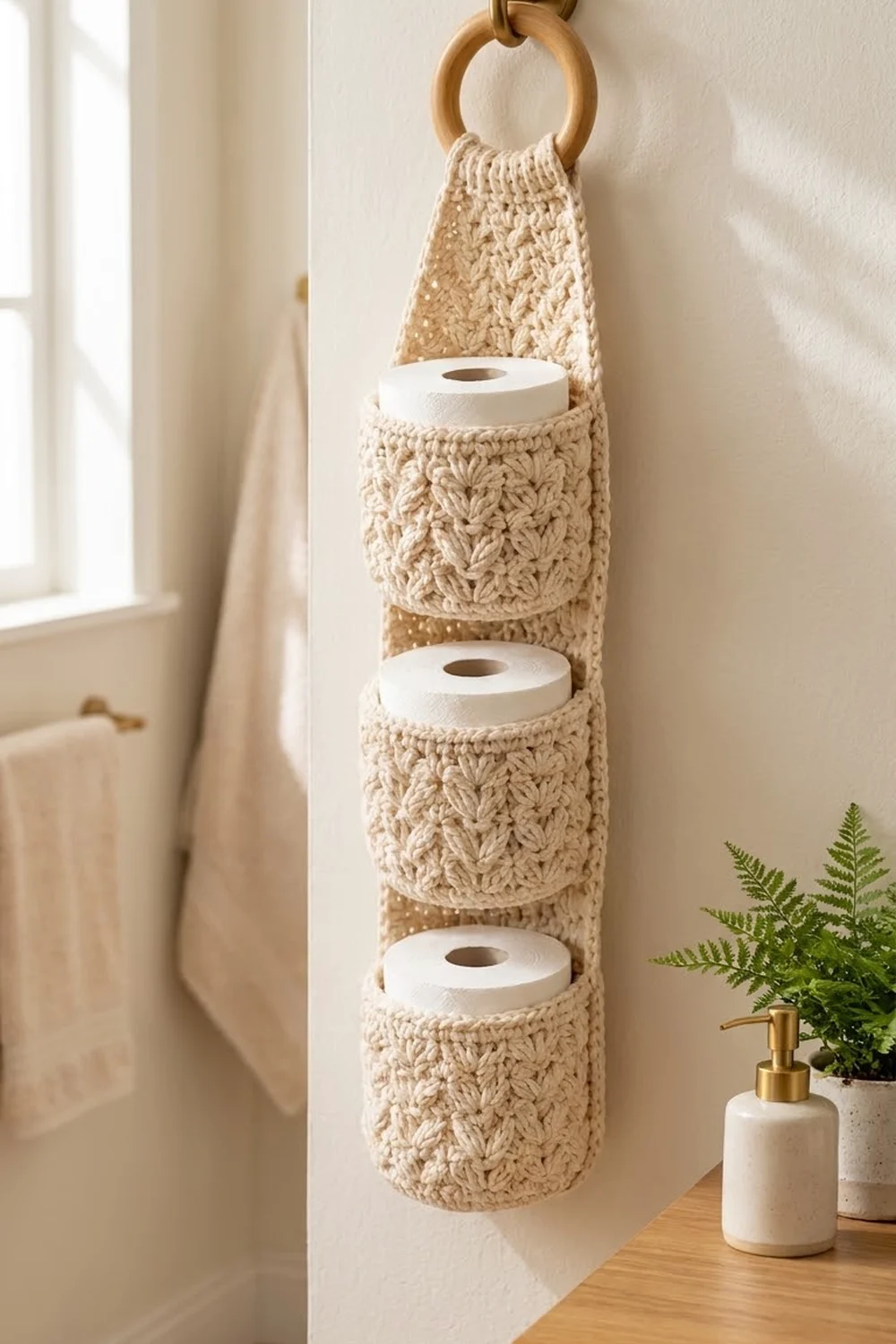
The Linen Fan Holder is a tidy way to keep three spare rolls within reach without using floor or shelf space. A long textured back panel hangs from a wooden ring, and three round-bottomed pockets are sewn down its front, one above the other.
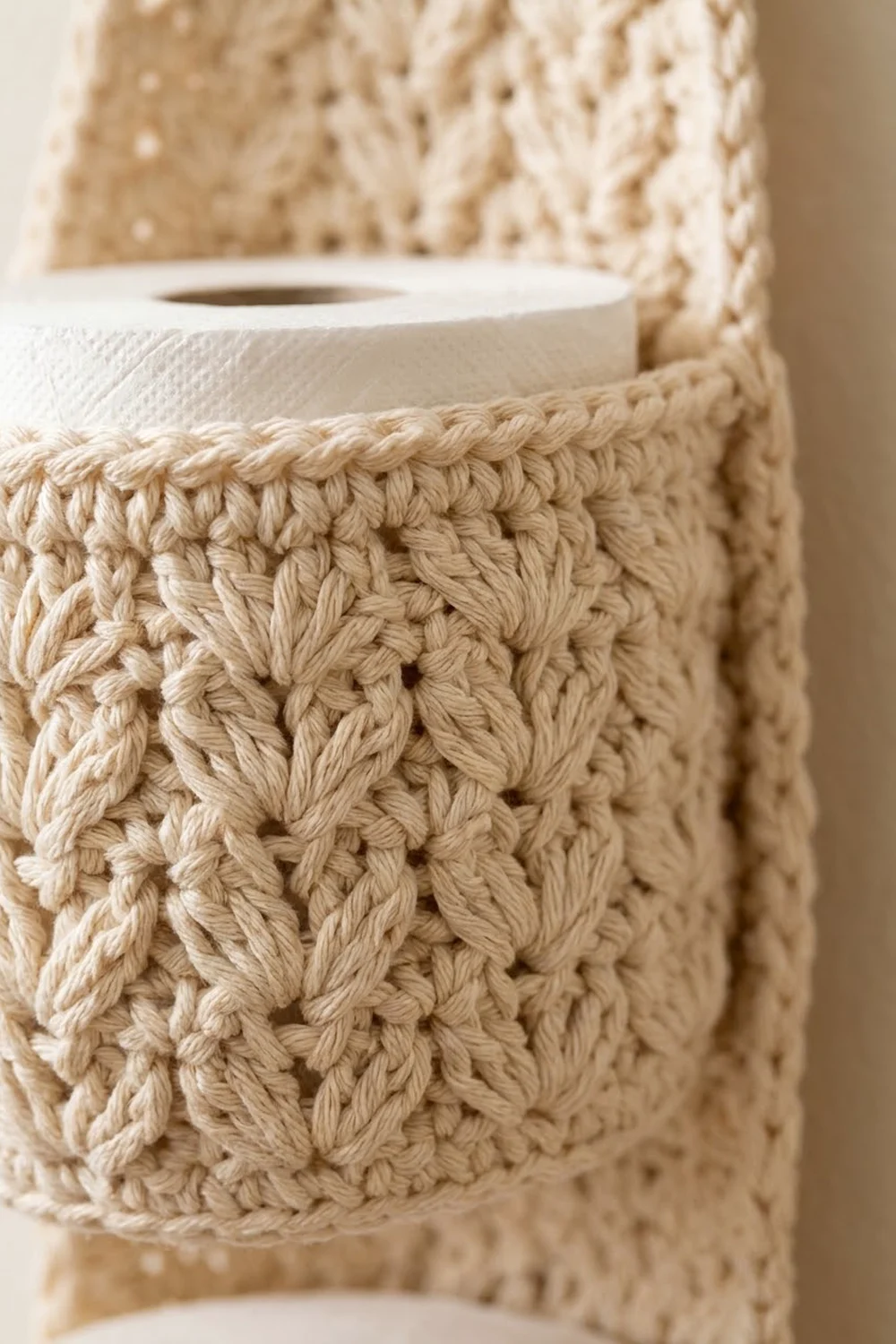
The whole piece is worked in one warm cream cotton. Columns of stacked 3-double-crochet fans give it a woven look, and a two-round single-crochet border frames the panel. Each pocket has a rolled rim, so the edges stay crisp and strong.
This pattern uses US crochet terms. The finished holder is 7.25 in (18.4 cm) wide and hangs about 24 in (61.0 cm) below the ring. Each pocket is 4.75 in (12.1 cm) across and 4.25 in (10.8 cm) tall.
You will make four crocheted pieces. The back panel is worked flat in rows, from the bottom edge up through a tapered top and strap. Each pocket is worked in joined rounds: a flat circle for the base, then fan rounds up the walls. After the border goes around the panel, you sew on the pockets and fold the strap over the ring.
Finished Size and Construction
- Finished size: 7.25 in (18.4 cm) wide × about 24 in (61.0 cm) hanging length
- Skill level: Intermediate (easy stitches, careful counting)
- Terminology: US
- Yarn weight: Worsted (#4) cotton
- Hook: 5.0 mm (H-8)
- Number of pieces: 4 (1 back panel + 3 pockets), plus 1 wooden ring
- Layout: 1 column × 3 pockets, stacked vertically
- Panel body before border: 6.25 in (15.9 cm) wide × 20 in (50.8 cm) tall
- Pocket size: 4.75 in (12.1 cm) diameter × 4.25 in (10.8 cm) tall
- Border depth: 0.5 in (1.3 cm) on each edge (2 rounds)
Materials
Yarn: Use a smooth, firm worsted-weight cotton or cotton blend. Cotton holds its shape in a bathroom and keeps the fans crisp. Avoid fuzzy or very stretchy yarns, because the pockets may sag under the weight of the rolls.
- Cream: 250 g, about 425 m (465 yd)
The quantity above includes a margin of roughly 20 percent for your gauge swatch, sewing tails, and small differences in tension.
Tools:
– 5.0 mm (H-8) crochet hook
– One wooden ring, 3 in (7.6 cm) outer diameter, about 2.25 in (5.7 cm) inner diameter
– Tapestry needle
– 6 locking stitch markers
– Scissors
– Measuring tape
– Rust-proof pins and a blocking mat
Abbreviations (US Terms)
- ch – chain
- sl st – slip stitch
- sc – single crochet
- dc – double crochet
- inc – 2 sc in the same stitch
- sc2tog – single crochet 2 together
- BLO – back loop only
- MR – magic ring
- st(s) – stitch(es)
- RS / WS – right side / wrong side
Special stitch – Fan: Work 3 dc in the stitch indicated. A fan takes up 3 sts in the count.
Fan pattern logic: On A rows or rounds, each fan is worked into an sc. On B rows or rounds, a new sc goes into the center dc of each fan. This keeps every fan sitting directly above the one below, which builds the vertical columns you see in the photo.
Gauge and Checkpoints
Gauge in fan pattern: 16 sts and 8 rows = 4 in (10.2 cm).
Gauge in sc: 16 sts and 16 rows = 4 in (10.2 cm).
Make one pocket first. It is the fastest way to test your gauge, and it should fit a standard roll.
- Checkpoint 1: After pocket Rnd 10, the base measures 4.75 in (12.1 cm) across. Up to 5 in (12.7 cm) is fine.
- Checkpoint 2: After pocket Rnd 20, the wall is 4.25 in (10.8 cm) tall and a roll slides in snugly.
- Checkpoint 3: After panel Row 40, the panel is 6.25 in (15.9 cm) wide and 20 in (50.8 cm) tall.
- Checkpoint 4: After the border, the panel is 7.25 in (18.4 cm) wide.
If your piece is too big, go down 0.5 mm in hook size. If it is too small, go up 0.5 mm. Don’t change the stitch counts, because all of the placement math depends on them.
Back Panel
The panel is worked flat in rows. Turn at the end of every row. A ch-1 turning chain never counts as a stitch. A ch-3 turning chain counts as a dc.
Ch 26.
Row 1 (set-up): Sc in 2nd ch from hook and in each ch across. Turn. (25 sts)
Row 2 (A, fan row): Ch 1, sc in first st. Skip 1 st, fan in next st, skip 1 st, sc in next st. Repeat from * 5 more times. Turn. (25 sts: 6 fans + 7 sc)
Row 3 (B): Ch 3 (counts as dc). Ch 1, skip next dc, sc in center dc of fan, ch 1, skip next dc, dc in next sc. Repeat from * 5 more times. Turn. (25 sts: 7 dc + 6 sc + 12 ch)
Row 4 (A): Ch 1, sc in first dc. Skip ch-1, fan in next sc, skip ch-1, sc in next dc. Repeat from * 5 more times; the last sc goes into the top of the ch-3. Turn. (25 sts)
Rows 5–40: Repeat Rows 3 and 4. Odd rows are B rows and even rows are A rows. You will end on Row 40, which is an A row. (25 sts)
Checkpoint: The panel should be 6.25 in (15.9 cm) × 20 in (50.8 cm).
Taper
The taper is worked in sc and loses 2 sts every row.
Row 41: Ch 1, sc2tog, sc in each st across to last 2 sts, sc2tog. Turn. (23 sts)
Rows 42–48: Repeat Row 41. (Row 42: 21, Row 43: 19, Row 44: 17, Row 45: 15, Row 46: 13, Row 47: 11, Row 48: 9 sts)
The taper adds 8 rows, or 2 in (5.1 cm).
Strap
Rows 49–60: Ch 1, sc in each st across. Turn. (9 sts)
The strap is 3 in (7.6 cm) long. Do not fasten off. Go straight on to the border.
Pockets (Make 3)
Work in joined rounds and do not turn. At the end of every round, join with a sl st to the first st. A starting ch-1 does not count as a stitch.
Base
Rnd 1: 6 sc in MR. (6)
Rnd 2: Inc in each st around. (12)
Rnd 3: Sc 1, inc. Repeat around. (18)
Rnd 4: Sc 2, inc. Repeat around. (24)
Rnd 5: Sc 3, inc. Repeat around. (30)
Rnd 6: Sc 4, inc. Repeat around. (36)
Rnd 7: Sc 5, inc. Repeat around. (42)
Rnd 8: Sc 6, inc. Repeat around. (48)
Rnd 9: Sc 7, inc. Repeat around. (54)
Rnd 10: Sc 8, inc. Repeat around. (60)
Checkpoint: The base is 4.75 in (12.1 cm) across and lies flat.
Walls
Rnd 11 (base edge): Ch 1, sc in BLO of each st around. (60 sc: 60 worked 1-per-stitch + 0 added)
The unused front loops form a ridge that turns the corner from base to wall.
Rnd 12 (A): Ch 1, sc in first st. Skip 1, fan in next, skip 1. Sc in next, skip 1, fan in next, skip 1. Repeat from * 13 more times. (60 sts: 15 fans + 15 sc)
Rnd 13 (B): Ch 4 (counts as dc + ch 1), skip next dc, sc in center dc, ch 1, skip next dc. Dc in next sc, ch 1, skip next dc, sc in center dc, ch 1, skip next dc. Repeat from * 13 more times. Join to 3rd ch of ch-4. (60 sts)
Rnd 14 (A): Ch 1, sc in same st. Skip ch-1, fan in next sc, skip ch-1. Sc in next dc, skip ch-1, fan in next sc, skip ch-1. Repeat from * 13 more times. (60 sts)
Rnds 15–18: Repeat Rnds 13 and 14 twice. (60 sts)
Rim
Rnd 19 (trim): Ch 1, sc in each st and each ch-1 sp around. (60 sc: 60 worked 1-per-stitch + 0 added)
Rnd 20 (trim): Ch 1, sc in each st around. (60 sc: 60 worked 1-per-stitch + 0 added)
Fasten off, leaving a 40 in (101.6 cm) tail for sewing.
Checkpoint: The wall is 4.25 in (10.8 cm) tall: 0.25 in (0.6 cm) for Rnd 11, 3.5 in (8.9 cm) for the fan rounds, and 0.5 in (1.3 cm) for the rim.
Make All Pieces
- Back panel: 1, in Cream
- Pockets: 3, in Cream
Layout (front view, top to bottom):
     [ RING ]
    [ STRAP ]
     \TAPER/
  |   panel   |   Rows 34–40
  | POCKET 3  |   base Row 25 / rim Row 33
  |   gap     |   Rows 23–24
  | POCKET 2  |   base Row 14 / rim Row 22
  |   gap     |   Rows 12–13
  | POCKET 1  |   base Row 3  / rim Row 11
  |   panel   |   Rows 1–2
Border
Work the border after the panel is finished and before you attach the pockets.
Border gauge: Work 2 sc into the end of each pattern row (Rows 2–40) and 1 sc into the end of each sc row (Row 1 and Rows 41–60). Both give 4 sc per inch, which matches the 16 sts = 4 in gauge, so the edges lie flat.
Round 1 (RS): Continue from the strap. Ch 1 and work down one long edge, then across the bottom, up the other long edge, and across the top of the strap:
- Long edge: 12 sc for the strap rows + 8 sc for the taper rows + 78 sc for Rows 40–2 + 1 sc for Row 1 = 99 sc
- Bottom edge: working into the free loops of the foundation chain, 3 sc in the first ch, sc in the next 23, 3 sc in the last ch = 29 sc
- Second long edge: the same as the first, in reverse = 99 sc
- Strap top: 3 sc in the first st, sc in the next 7, 3 sc in the last st = 13 sc
Join with a sl st. (240 sc)
The bottom and strap-top counts include their corner groups. The two long-edge counts are row-end stitches only, worked between the corners, so no corner is counted twice. The total is 99 + 29 + 99 + 13 = 240.
Round 2: Ch 1. Sc in each st around, working 3 sc in the center st of each of the 4 corner groups. Join. (248 sc: 240 worked 1-per-stitch + 8 added at the corners)
- Per side: 99 + 33 + 99 + 17 = 248
Why the math works: The bottom edge has 25 base sts plus 2 extra at each corner, which makes 29. Round 2 adds 2 more at each of those corners for 33. The long edges never gain stitches because they follow the row ends at a ratio that matches your gauge. The two rounds add 0.5 in (1.3 cm) per edge, so the body grows from 6.25 in (15.9 cm) to 7.25 in (18.4 cm) wide.
Fasten off and weave in the ends.
Joining the Pockets
Use a whipstitch with the pocket’s own tail. Count panel stitches across a row from the right edge, not counting the border. The center stitch is st 13.
- Mark the back of each pocket. On Rnd 20, place a marker on the join stitch and 8 sts on either side of it, for 17 sts in all. Mark the same 17 sts on Rnd 11. This puts the round seam at the back, where it is hidden.
- Mark the panel. For each pocket, mark sts 5–21 at the top of its base row and its rim row. Pocket 1 uses Rows 3 and 11, Pocket 2 uses Rows 14 and 22, and Pocket 3 uses Rows 25 and 33.
- Sew the base. Match the 17 marked Rnd 11 sts to panel sts 5–21 at the base row, one stitch to one stitch. Whipstitch through both layers.
- Sew the rim. Match the 17 marked Rnd 20 sts to panel sts 5–21 at the rim row, again one to one.
- Tack the sides. Add 2–3 small stitches at each side of the wall to hold the flattened back against the panel.
The rim and base sit 8 rows, or 4 in (10.2 cm), apart. The wall is 4.25 in (10.8 cm) tall, so the extra 0.25 in (0.6 cm) lets the front of the pocket curve out slightly and hug the roll.
Tension: Keep your sewing stitches snug but not tight. If you pull them hard, the panel will pucker.
Checkpoint: The panel still measures 7.25 in (18.4 cm) wide at each pocket, and the three pockets are centered and level.
Attaching the Ring
- Pass the strap from front to back through the wooden ring.
- Fold the strap down over the WS so that its top edge meets the top of the taper (Row 48).
- Whipstitch the strap top edge to Row 48 across all 17 border sts.
The strap gathers inside the ring, just as in the photo. The holder now hangs about 24 in (61.0 cm) below the ring.
Final Blocking
- Wet the finished holder in cool water. Press the water out gently; don’t wring it.
- Roll it in a towel to remove the excess water.
- Lay the panel flat and pin it to 7.25 in (18.4 cm) wide. Keep the long edges straight.
- Stuff each pocket with a paper roll wrapped in plastic, or a jar of the same size, so it dries round.
- Let it dry completely, which takes 24–48 hours.
- Remove the pins and fillers, then hang it.
Final Quality-Control Checklist
- [ ] The panel has 25 sts in every body row and 9 sts in every strap row.
- [ ] The fans line up in 6 straight vertical columns.
- [ ] Border Round 2 totals 248 sts, with sharp, even corners.
- [ ] Each pocket has 60 sts in every round from Rnd 10 to Rnd 20.
- [ ] Each base is 4.75 in (12.1 cm) across and each wall is 4.25 in (10.8 cm) tall.
- [ ] The pockets are centered on sts 5–21 and the gaps between them are equal.
- [ ] The round seams are hidden at the back of each pocket.
- [ ] The strap is secure and the ring does not slip.
- [ ] All ends are woven in.
Troubleshooting
The fans lean or drift sideways. On B rows, make sure the sc goes into the center dc of each fan, not into the first dc.
The panel edges ripple. You are working too many sc into the row ends. Use 2 per pattern row and 1 per sc row.
The border corners cup. Check that you worked 3 sc into the center corner stitch on Round 2.
The pocket base ruffles. Your tension is loose. Go down a hook size or rework Rnds 8–10 more snugly.
The roll is too tight. Add one fan round to the wall height, or go up 0.5 mm in hook size for the walls only.
The pocket sags forward. Add more tacking stitches along the sides of the wall.
Care
Hand wash in cool water and lay flat to dry, reshaping the pockets around a roll. Don’t tumble dry, because cotton can shrink and the fans will lose their definition.
Final Notes
Everything in this holder follows one measurement chain. The 25-stitch panel is 6.25 in (15.9 cm) wide, and the border brings it to 7.25 in (18.4 cm). Forty rows give 20 in (50.8 cm) of body, the taper and strap add 5 in (12.7 cm), and the folded strap gives a hanging length of about 24 in (61.0 cm). Each pocket has 60 stitches, which makes a 4.75 in (12.1 cm) cup that is 4.25 in (10.8 cm) tall. Each one is sewn on stitch to stitch across 17 center stitches. If you check gauge on your first pocket, every later piece will fall into place.
Happy crocheting!