

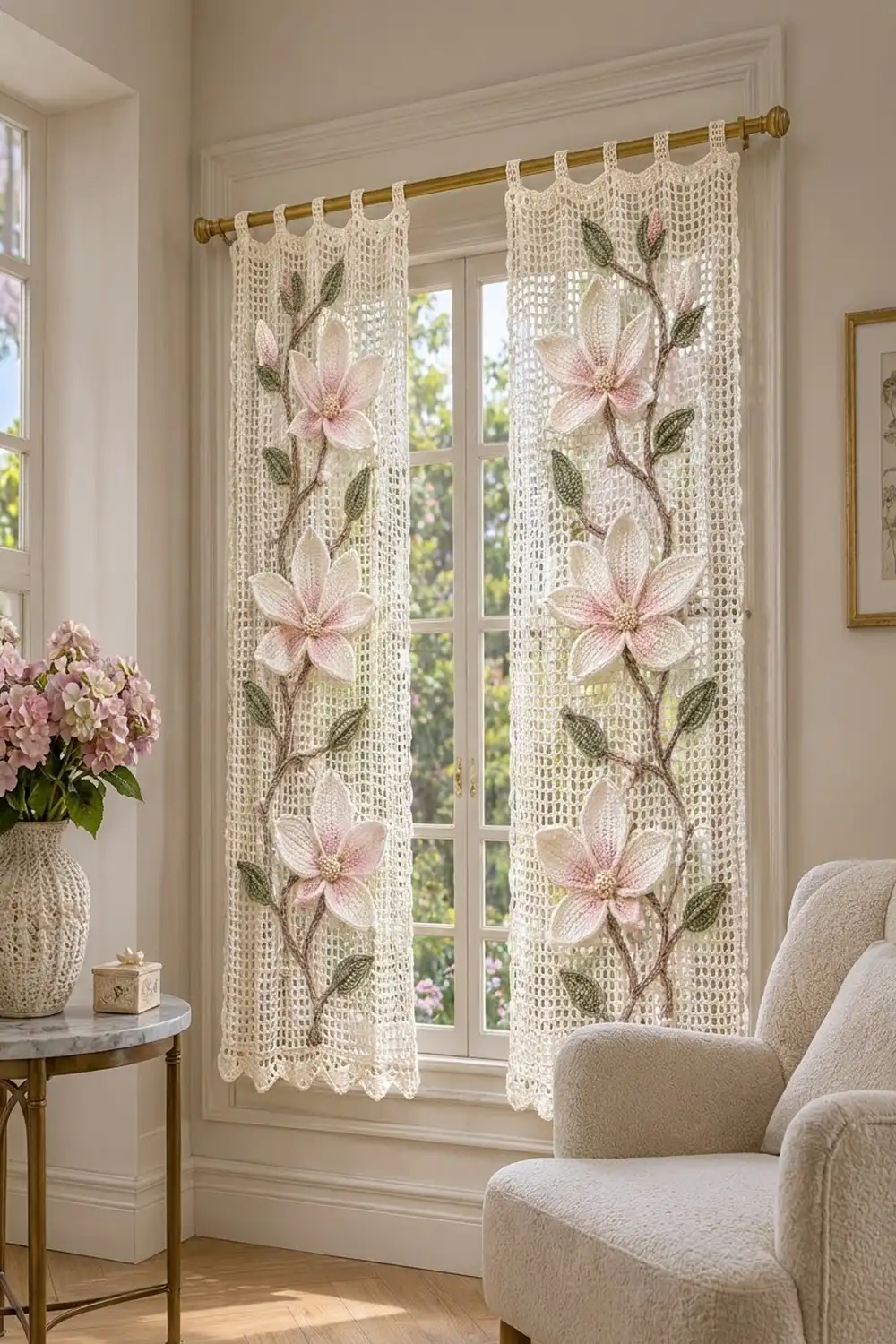
These curtain panels pair an airy cream filet mesh with dimensional magnolia-style flowers climbing a twisting vine. Light comes through the open squares, and the raised blooms give the panels a soft cottage-garden look.
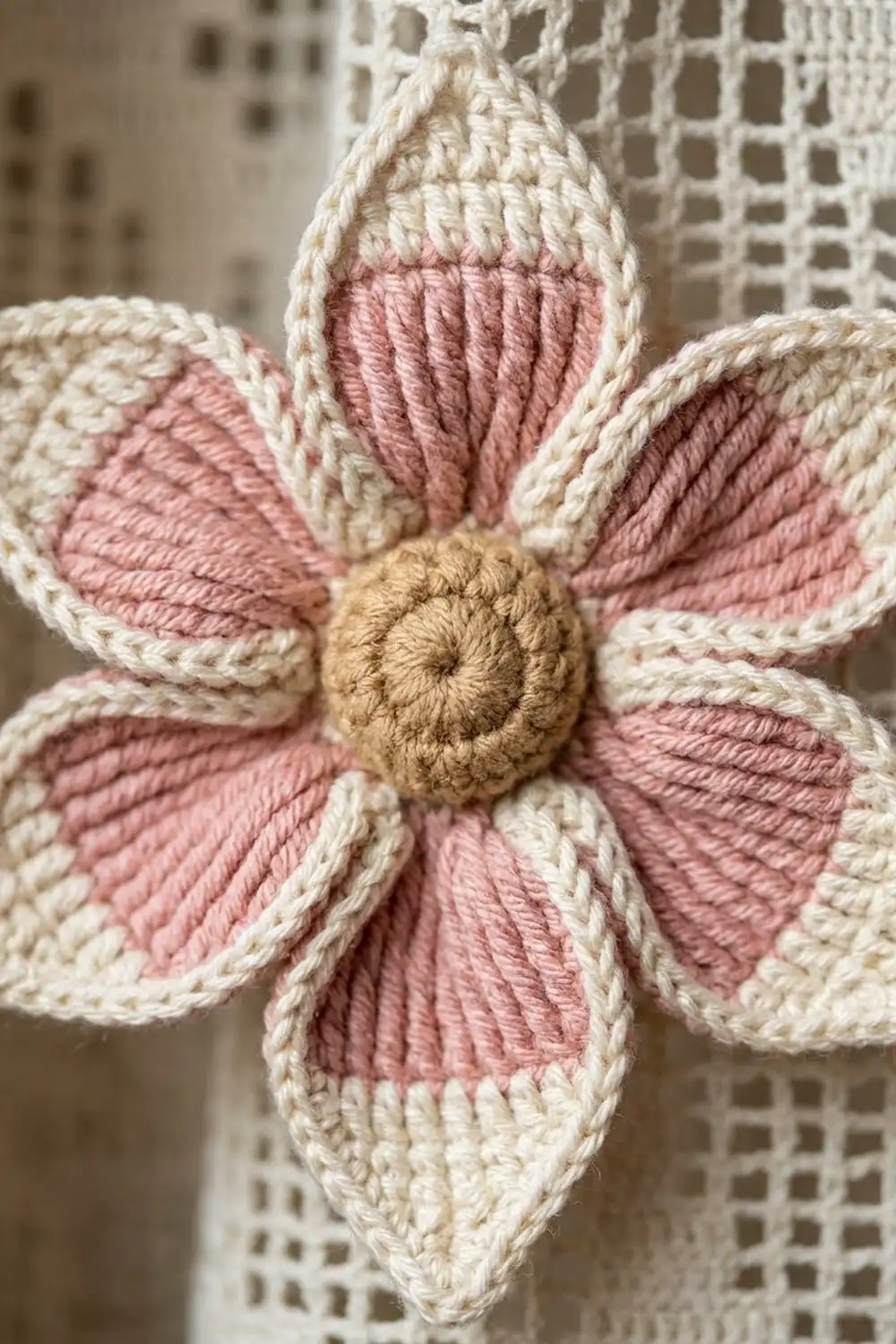
The colors are cream mesh and petal tips, blush pink petal bases, tan bobble centers, sage green leaves and a taupe vine. Each panel has tab loops at the top and a scalloped bottom edge.
This pattern uses US crochet terms. Each panel measures 25 in (63.5 cm) wide and 57 in (144.8 cm) long, or 60 in (152.4 cm) including the tab loops.
You work each panel bottom-up in filet mesh, then add tabs and a two-row border. The flowers, leaves, buds and vines are made separately and sewn on. The two panels are not joined; they hang side by side as a mirrored pair.
Finished Size and Construction
- Finished size (each panel): 25 in x 57 in (63.5 cm x 144.8 cm), plus 3 in (7.6 cm) tab loops
- Skill level: Intermediate
- Terminology: US
- Yarn weight: Worsted (#4) cotton
- Hook: 5.0 mm (H-8)
- Number of pieces: 2 separate panels. Each panel has:
- 1 mesh body with tabs
- 3 flowers (3 centers and 18 petals)
- 2 buds and 12 leaves
- 1 main vine and 4 branch vines
- Layout: Two panels side by side. Panel B mirrors Panel A.
- Size before border: 24 in x 56 in (61.0 cm x 142.2 cm), which is 30 meshes x 70 rows
- Border depth: 0.5 in (1.3 cm) on each side and 1 in (2.5 cm) at the bottom
- Flower size: 8 in (20.3 cm) across
Materials
Choose a smooth combed or mercerized cotton. It gives crisp squares, holds the petal shape and washes well. The amounts below assume about 180 m per 100 g and cover both panels.
- Cream: 950 g / 1,710 m
- Blush pink: 80 g / 144 m
- Tan: 30 g / 54 m
- Sage green: 80 g / 144 m
- Taupe: 100 g / 180 m (used with 2 strands held together)
Tools:
– 5.0 mm (H-8) hook
– Tapestry needle
– Rust-proof pins
– Stitch markers
– Measuring tape
– Blocking mats
– Spray bottle
All quantities include a margin of about 10% for swatching and sewing.
Abbreviations (US Terms)
- ch: chain
- sl st: slip stitch
- sc: single crochet
- hdc: half double crochet
- dc: double crochet
- sc2tog / sc3tog: single crochet 2 (or 3) together
- sp: space
- st(s): stitch(es)
- RS / WS: right side / wrong side
Bobble: Work this all in the same stitch:
1. Yarn over, insert hook and pull up a loop, yarn over and pull through 2 loops.
2. Repeat from * 4 more times (6 loops on hook).
3. Yarn over and pull through all 6 loops.
Mesh: 1 dc + ch 2. A row of 30 meshes has 31 dc posts and 30 ch-2 sps, which equals 91 sts.
Gauge and Checkpoints
- Filet gauge: 5 meshes and 5 rows = 4 in (10.2 cm). One mesh is 0.8 in (2.0 cm) square.
- Sc gauge: 15 sc and 16 rows = 4 in (10.2 cm)
Test one petal and a 6-mesh swatch first. Both gauges use 15 sts per 4 in (10.2 cm), so the mesh and the sc border match in width.
Checkpoints:
- After Row 10: 24 in (61.0 cm) wide x 8 in (20.3 cm) long
- After Row 35: 28 in (71.1 cm) long
- After Row 70: 56 in (142.2 cm) long
- Each petal: 3.5 in x 2.75 in (8.9 cm x 7.0 cm)
- Each flower: 8 in (20.3 cm) across
If it’s off:
– Too big: go down one hook size.
– Too small: go up one hook size.
– Width is right but rows are too short or too tall: change how high you pull up the first loop of each dc.
Mesh Body (Make 2)
With cream, ch 93.
Row 1 (RS): Dc in 4th ch from hook and in each ch across. Turn. (91 sts; the skipped ch-3 counts as 1 dc)
Row 2:
1. Ch 5 (counts as dc + ch 2), skip 2 dc, dc in next dc.
2. Ch 2, skip 2 dc, dc in next dc. Repeat from * across. Work the last dc in the top of the turning ch.
3. Turn. (31 dc + 30 ch-2 sps = 91 sts, 30 meshes)
Rows 3–69:
1. Ch 5 (counts as dc + ch 2), dc in next dc.
2. Ch 2, dc in next dc. Repeat from * across. Work the last dc in the 3rd ch of the turning ch.
3. Turn. (30 meshes)
Row 70: Ch 3 (counts as dc). 2 dc in next ch-2 sp, dc in next dc. Repeat from * across. Turn. (31 dc on posts + 60 dc in sps = 91 sts)
Size check: That’s 70 rows at 0.8 in (2.0 cm) each, so the body is 56 in (142.2 cm) long and 24 in (61.0 cm) wide.
Tabs
You’ll place 7 tabs of 7 sts each on Row 70:
– Tab positions: sts 1–7, 15–21, 29–35, 43–49, 57–63, 71–77 and 85–91
– Gaps between tabs: 7 sts each
– Check: 7 x 7 + 6 x 7 = 91
Each tab: With RS facing, join cream in the tab’s first st.
- Row 1: Ch 1, sc in same st and next 6 sts. Turn. (7 sc)
- Rows 2–24: Ch 1, sc across. Turn. (7 sc)
Fasten off and leave a 12 in (30.5 cm) tail. Each tab is 6 in (15.2 cm) long and about 1.9 in (4.8 cm) wide.
Fold each tab to the WS and whipstitch Row 24 to the back of Row 70. This makes a 3 in (7.6 cm) loop that fits rods up to 1.25 in (3.2 cm) in diameter.
Flower Center (Make 6)
With tan, make a magic ring.
- Rnd 1: Ch 1, 6 sc in ring. Sl st to first sc. (6 sts)
- Rnd 2: Ch 1, (sc, bobble) in each st. Sl st to first sc. (12 sts: 6 sc + 6 bobbles)
- Rnd 3: Ch 1. (Bobble, sc) in next sc, sc in next bobble. Repeat from * around. Sl st to first bobble. (18 sts: 6 bobbles + 12 sc)
Push the bobbles to the RS so they form a dome. Fasten off and leave a long tail. The center is 1.5 in (3.8 cm) across.
Petal (Make 36)
You work each petal in rows from the base to the tip.
With pink, ch 4.
- Row 1: Sc in 2nd ch from hook and each ch across. Turn. (3 sc)
- Row 2: Ch 1, 2 sc in first st, sc in next st, 2 sc in last st. Turn. (5 sc)
- Row 3: Ch 1, sc across. Turn. (5 sc)
- Row 4: Ch 1, 2 sc in first st, sc in next 3 sts, 2 sc in last st. Turn. (7 sc)
- Row 5: Ch 1, sc across. Change to cream on the final yarn over, but don’t cut the pink. Turn. (7 sc)
- Row 6 (blend): Ch 1, 2 sc in first st, sc in next 5 sts, 2 sc in last st. Alternate cream and pink every stitch, carrying the unused color. Turn. (9 sc) Cut pink.
- Rows 7–8: With cream, ch 1, sc across. Turn. (9 sc)
- Row 9: Ch 1, sc2tog, sc in next 5 sts, sc2tog. Turn. (7 sc)
- Row 10: Ch 1, sc across. Turn. (7 sc)
- Row 11: Ch 1, sc2tog, sc in next st, sc2tog. Turn. (5 sc)
- Row 12: Ch 1, sc2tog, sc in next st, sc2tog. Turn. (3 sc)
- Row 13: Ch 1, sc3tog. (1 st)
Edging: Without fastening off, continue with cream:
1. Work 13 sc down the side (1 per row end).
2. Work 3 sc across the base in the foundation ch loops.
3. Work 13 sc up the other side.
4. Work 3 sc in the tip st.
5. Sl st to the first sc.
That gives 32 sc. Fasten off and leave a 10 in (25.4 cm) tail. The result is a raised cream rim around a pink-to-cream petal.
Assemble Each Flower
- Tuck 0.25 in (0.6 cm) of each petal base behind the center. Each petal backs 3 sts of Rnd 3 (6 x 3 = 18).
- Whipstitch the petals to the back of Rnds 2–3.
- Tack each petal to its neighbors where they touch.
The flower measures 1.5 + 3.25 + 3.25 = 8 in (20.3 cm) across.
Bud (Make 4)
With pink, ch 5.
- Row 1: Sc in 2nd ch from hook and each ch across. Turn. (4 sc)
- Row 2: Ch 1, 2 sc in first st, sc in next 2 sts, 2 sc in last st. Turn. (6 sc)
- Row 3: Ch 1, sc across. Turn. (6 sc)
- Row 4: Ch 1, sc2tog, sc in next 2 sts, sc2tog. Turn. (4 sc)
- Row 5: Ch 1, sc2tog twice. Turn. (2 sc)
- Row 6: Ch 1, sc2tog. (1 st)
Fasten off. Fold the long edges slightly to the back and tack them, making a closed teardrop 1.5 in (3.8 cm) long.
Leaf (Make 24)
With sage, ch 11.
Rnd 1:
1. Starting in 2nd ch from hook, work 1 st in each of the next 9 ch: sl st, sc, hdc, dc, dc, dc, hdc, sc, sc.
2. Work 3 sc in the last ch.
3. Along the other side of the chain, work: sc, sc, hdc, dc, dc, dc, hdc, sc, sl st. (21 sts)
Rnd 2:
1. Sl st in each st around.
2. At the tip, ch 2 and sl st in 2nd ch from hook to make a point.
3. Sl st to join. (21 sl sts + 1 point)
The foundation chain forms the center vein. Each leaf is about 3 in (7.6 cm) long and 1.25 in (3.2 cm) wide.
Vines
Hold 2 strands of taupe together. Gauge is 4 ch per inch.
- Main vine (1 per panel): Ch 200. Sl st in the back bump of the 2nd ch from hook and of each ch across. (199 sl sts, 50 in / 127.0 cm)
- Branch vine (4 per panel): Ch 24. Sl st in the back bump of each ch the same way. (23 sl sts, 6 in / 15.2 cm)
The cord twists naturally into a bark-like texture.
Make All Pieces
Totals for both panels:
- Cream: 2 bodies with 14 tabs, plus the tips and edgings of 36 petals
- Pink: the bases of 36 petals, plus 4 buds
- Tan: 6 centers
- Sage: 24 leaves
- Taupe: 2 main vines and 8 branch vines
Layout grid, Panel A. Columns are numbered 1–30 from the left, and mesh rows 1–68 from the bottom.
Mesh row | cols 1-10 | cols 11-20     | cols 21-30
66       |           | Bud (col 20)   |
64       |           | Bud (col 13)   |
54       | leaf      | FLOWER 3 (col 19)
44       | leaf      | vine           | leaf
34       | FLOWER 2 (col 12)          | leaf
24       | leaf      | vine           | leaf
14       | leaf      | FLOWER 1 (col 19)
3        |           | vine start (col 15)
Panel B mirrors Panel A: new column = 31 − column.
– Flowers go at columns 12, 19 and 12.
– Buds go at columns 18 and 11.
Attaching the Appliqués
The panels themselves are never joined to each other. Here, “joining” means sewing the appliqués to the mesh.
- Pin the main vine in an S-curve from mesh row 3, column 15 up to the buds. It should pass behind all three flower positions.
- Tack the vine with taupe, once per mesh (every 0.8 in / 2.0 cm). For each tack, come up through a ch-2 sp, catch the cord’s back bump and go back down the same sp.
- Add the branch vines: 2 near Flower 2 and 2 near the buds.
- Sew the leaves in pairs along the vine. Stitch through the base and center vein only.
- Sew each flower through its center and petal bases only. Leave the outer half of each petal free.
- Sew the buds to the tips of the top branches.
Tension: Keep tacks snug but loose enough that no mesh square distorts.
Checkpoint: Lay the panel flat. It should still measure 24 in x 56 in (61.0 cm x 142.2 cm).
Border
Border gauge: 15 sc = 4 in (10.2 cm), which is 3.75 sc per inch.
– Sides: Each dc row end is 0.8 in (2.0 cm) tall, and 0.8 x 3.75 = 3 sc per row end.
– Bottom: The 91 foundation loops across 24 in (61.0 cm) give the same 3.75 sts per inch.
Border Row 1: With RS facing, join cream at the top of the left edge. Then work:
1. Left side: 3 sc in each of 70 row ends. (210 sc)
2. Ch 1 for the corner.
3. Bottom: sc in each of 91 foundation loops. (91 sc)
4. Ch 1 for the corner.
5. Right side: 3 sc in each of 70 row ends. (210 sc)
Fasten off. (511 sc + 2 corner ch-1 sps)
Border Row 2: With RS facing, rejoin at the top left. Then work:
1. Left side: sc in each of 210 sc, then sc in the corner sp. (211 sc, including the corner)
2. Bottom: sc in first sc. Skip 2 sc, 7 dc in next sc, skip 2 sc, sc in next sc. Work this repeat 15 times in total. (16 sc + 105 dc = 121 sts, 15 scallops)
3. Right side: sc in the corner sp, then sc in each of 210 sc. (211 sc, including the corner)
Fasten off. (211 + 121 + 211 = 543 sts)
Why the math works:
– Each scallop uses 6 sts, and 1 + 15 x 6 = 91, so the repeat ends exactly on the last bottom sc.
– Each corner sc is counted only in its side total.
– Two sc rows add 0.5 in (1.3 cm) per side: 24 + 0.5 + 0.5 = 25 in (63.5 cm).
– The sc row plus the 0.75 in (1.9 cm) scallops add 1 in (2.5 cm) at the bottom: 56 + 1 = 57 in (144.8 cm).
Final Blocking
- Weave in all ends along the dc posts or inside the appliqués.
- Lay the panel RS down on a towel over the mats.
- Pin the corners to 25 in x 57 in (63.5 cm x 144.8 cm).
- Pin the sides every 4 in (10.2 cm), then pin each scallop tip.
- Mist the panel until damp, but not soaked.
- Turn it RS up and shape the petals and leaves by hand.
- Let it dry completely, at least 24 hours.
- Block Panel B the same way. The two panels should match within 0.5 in (1.3 cm).
Final Quality-Control Checklist
- Every body row has 91 sts, and every mesh row has 30 meshes.
- Each body measures 24 in x 56 in (61.0 cm x 142.2 cm) before the border.
- There are 7 evenly spaced tabs per panel, each with a 3 in (7.6 cm) loop.
- Each flower has 6 petals, and each petal has a 32-sc edging.
- The bobbles sit on the RS of each center.
- Each panel has 12 leaves, 2 buds, 1 main vine and 4 branch vines.
- Panel B mirrors Panel A.
- There are 15 even scallops along the bottom.
- Each panel finishes at 25 in x 57 in (63.5 cm x 144.8 cm).
Troubleshooting
- Rectangular meshes: Adjust your dc height until the squares are square.
- Panel narrows: Count 31 posts on every row, and loosen your turning chains.
- Petals cup: Loosen your increases, and block the petals before assembly.
- Petals ruffle: Confirm Rows 6–8 have exactly 9 sts.
- Side border ripples: Use a smaller hook, but keep 3 sc per row end.
- Side border pulls in: Use a larger hook, but keep 3 sc per row end.
- Mesh sags under the flowers: Add more tacks along the vine and fewer under the flowers.
- Scallops don’t fit: Recount the bottom of Border Row 1. It must be exactly 91 sc.
Care
Hand wash in cool water with mild detergent, press out the water gently and dry flat, reshaping the flowers while damp. Don’t wring or tumble dry.
Final Notes
Here’s how the measurements build:
– 30 meshes at 0.8 in (2.0 cm) each give a 24 in (61.0 cm) width.
– 70 rows give a 56 in (142.2 cm) length.
– The border brings each panel to 25 in x 57 in (63.5 cm x 144.8 cm).
– The tab loops add 3 in (7.6 cm), for a 60 in (152.4 cm) hanging length.
– Each 8 in (20.3 cm) flower is a 1.5 in (3.8 cm) center with two 3.25 in (8.3 cm) petal lengths on either side.
Check every checkpoint and your pair will hang evenly.
Happy crocheting!