

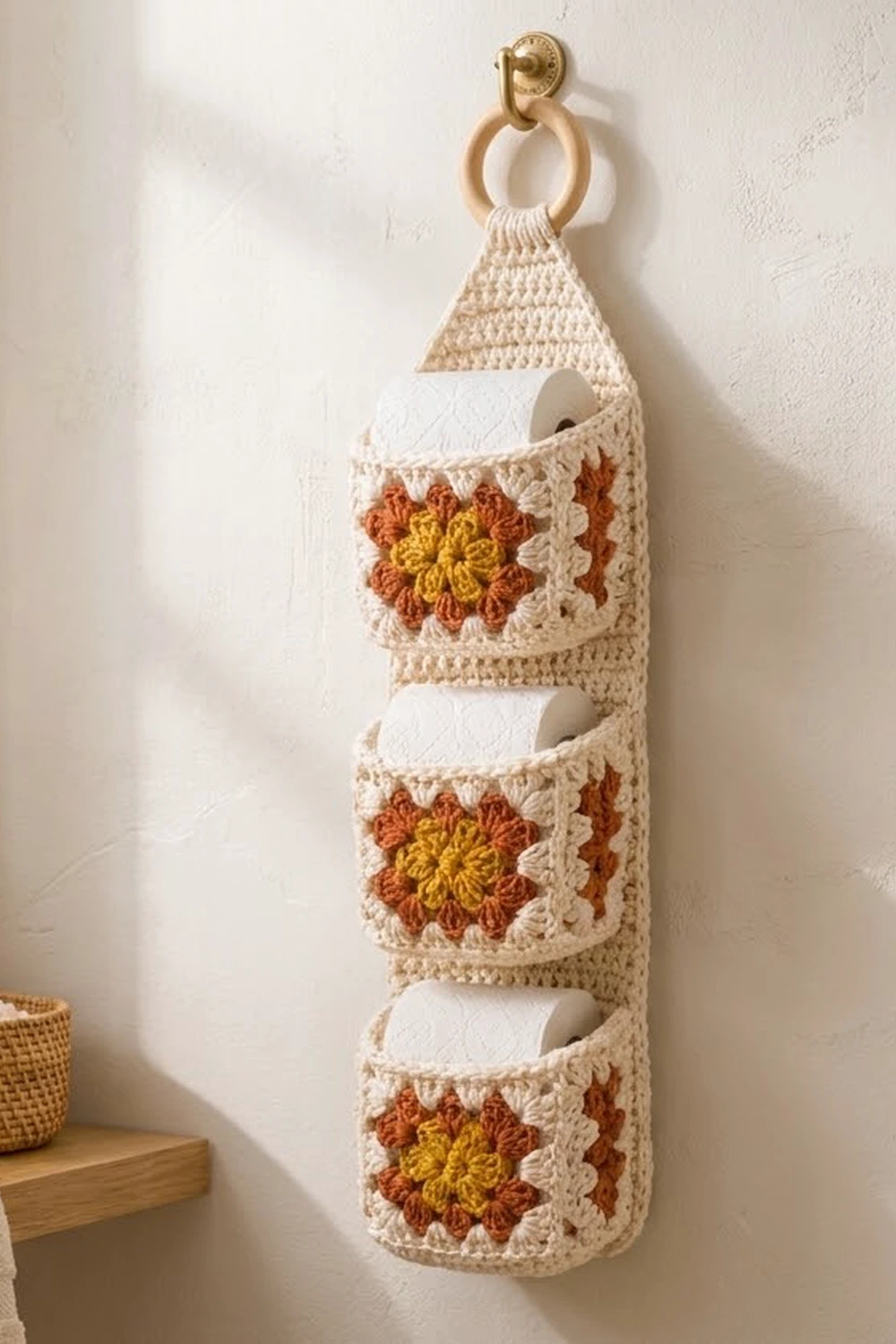
The Marigold Sunburst holder is a tall cream panel with three granny square pockets. It hangs from a wooden ring and holds three spare rolls on the back of a door or on a bathroom wall. Each pocket front is a sunburst granny square with a mustard center, a rust round of paired clusters, and a cream frame.
The style is warm, simple, and slightly vintage. The cream background keeps it calm, and the mustard and rust add autumn color. All instructions use US crochet terms.
The finished holder is about 6 in (15.2 cm) wide. It measures about 30 in (76.2 cm) from the top of the ring to the bottom edge. Each pocket sticks out about 3 in (7.6 cm) from the panel.
You will make one backing panel in single crochet rows, with a tapered top and a hanging strap. Then you will make three pockets: each is a granny square with a short top band and a single crochet gusset worked straight onto three of its edges. A border goes around the panel and along each pocket rim. Finally, you sew the pockets to the panel and fold the strap around the ring.
Finished Size and Construction
- Finished size: about 6 in (15.2 cm) wide x 30 in (76.2 cm) long, including the ring
- Skill level: Easy-intermediate
- Terminology: US
- Yarn weight: Worsted (#4), cotton recommended
- Hook: 5.0 mm (H-8)
- Number of pieces: 4 (1 panel, 3 pockets)
- Layout: 3 pockets stacked vertically on 1 panel
- Pocket square size: about 6 in (15.2 cm) square
- Pocket front height with band: 6.75 in (17.1 cm)
- Panel size before border: 21 sts wide, 116 rows long, about 5.5 in (14.0 cm) x 29 in (73.7 cm)
- Border depth: 1 round, about 0.25 in (0.6 cm)
Materials
Use a smooth worsted-weight cotton or cotton blend of about 170 m per 100 g. Cotton holds the pocket shape and handles bathroom humidity well. Acrylic also works, but the pockets will be softer.
- Cream: 250 g (425 m)
- Rust: 30 g (51 m)
- Mustard: 20 g (34 m)
All quantities include about a 15% margin for your gauge swatch and weaving in ends.
Tools:
– 5.0 mm (H-8) crochet hook
– 1 wooden ring, 2.5 in (6.4 cm) across
– Tapestry needle
– Stitch markers
– Locking pins or clips
– Measuring tape
– Scissors
Abbreviations (US Terms)
- ch: chain
- sl st: slip stitch
- sc: single crochet
- hdc: half double crochet
- dc: double crochet
- sc2tog: single crochet 2 together
- BLO: back loop only
- sp: space
- st(s): stitch(es)
- RS: right side
Cluster (cl): *Yo, insert hook in the stitch or space, yo, pull up a loop, yo, draw through 2 loops; repeat from * 2 more times (4 loops on hook), yo, draw through all 4 loops.
Beginning cluster (beg cl): Ch 2, then *yo, insert hook, yo, pull up a loop, yo, draw through 2 loops; repeat from * once more (3 loops on hook), yo, draw through all 3 loops.
Gauge and Checkpoints
Single crochet gauge: 15 sts and 16 rows = 4 in (10.2 cm).
Make one pocket square before starting anything else. It is the quickest way to check gauge, and it sets the size of every pocket. Check its width straight across the middle at each of these stages:
- After Round 1: about 1.75 in (4.4 cm) across
- After Round 2: about 2.75 in (7.0 cm)
- After Round 3: about 4 in (10.2 cm)
- After Round 4: about 4.75 in (12.1 cm)
- After Round 5: about 5.5 in (14.0 cm)
- After Round 6: about 6 in (15.2 cm)
Too big: go down to a 4.5 mm hook. Too small: go up to a 5.5 mm hook. Check the panel too: after Row 8 it should be about 5.5 in (14.0 cm) wide and 2 in (5.1 cm) tall.
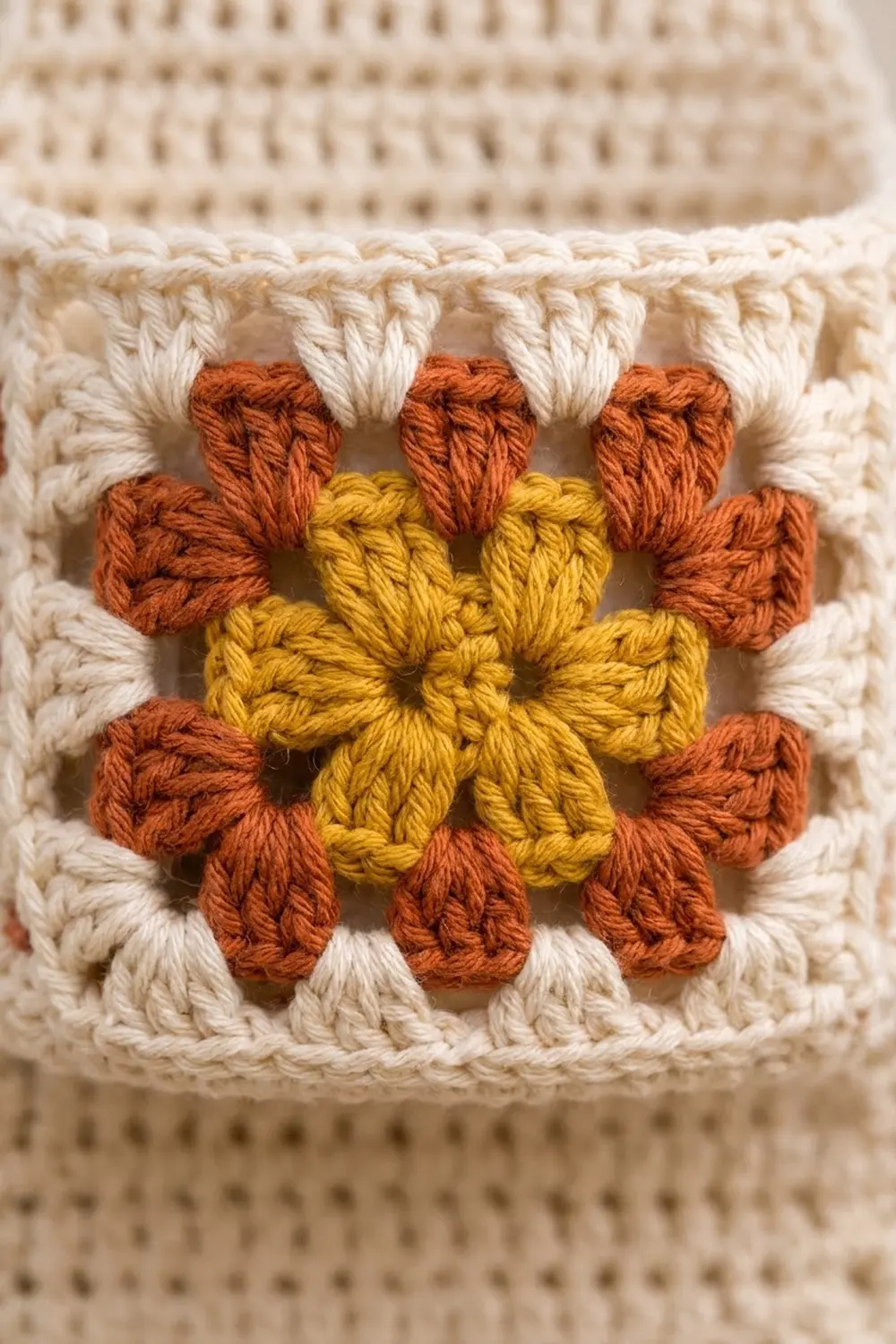
Pocket Square (Make 3)
Round 1 (Mustard): Make a magic ring. Ch 3 (counts as dc), work 15 dc in the ring, sl st to the top of the ch-3. (16 dc)
Round 2 (Mustard): Beg cl in the same st, ch 2, skip next st, cl in next st, ch 2, skip next st; repeat from * 6 more times. Sl st to the top of the beg cl and fasten off. (8 clusters, 8 ch-2 sps)*
Round 3 (Rust): Join in any ch-2 sp. Work (beg cl, ch 2, cl) in the same sp, ch 1, (cl, ch 2, cl) in next ch-2 sp, ch 1; repeat from * 6 more times. Sl st to the top of the beg cl and fasten off. (16 clusters, 8 ch-2 sps, 8 ch-1 sps)*
The clusters now sit in 8 pairs. Each pair has a ch-2 sp in its middle.
Round 4 (Cream, squaring round): Join in any ch-2 sp. Ch 3 (counts as dc), then work (2 dc, ch 2, 3 dc) in the same sp for the first corner. *3 hdc in next ch-1 sp, 3 sc in next ch-2 sp, 3 hdc in next ch-1 sp, (3 dc, ch 2, 3 dc) in next ch-2 sp for a corner; repeat from * 2 more times. Then work 3 hdc in next ch-1 sp, 3 sc in next ch-2 sp, 3 hdc in next ch-1 sp, and sl st to the top of the ch-3.
Each side has 3 dc + 3 hdc + 3 sc + 3 hdc + 3 dc. (15 sts per side, 60 sts total, plus 4 corner ch-2 sps)
The shorter stitches in the middle of each side flatten the round circle into a square. The cream groups sit in the gaps between the rust pairs and make the V-shaped wedges.
Round 5 (Cream): Sl st into the corner ch-2 sp. Ch 3 (counts as dc), work (1 dc, ch 2, 2 dc) in the same sp. *Dc in each of the next 15 sts, (2 dc, ch 2, 2 dc) in the corner sp; repeat from * 2 more times. Dc in each of the last 15 sts and sl st to the top of the ch-3.
Each side has 2 + 15 + 2 = 19 dc. (19 dc per side, 76 dc total, plus 4 corner ch-2 sps)
Round 6 (Cream): Ch 1. *Sc in each dc to the corner, 3 sc in the corner ch-2 sp; repeat around and sl st to the first sc. Do not fasten off.
Each side now has 21 sc between the corner centers: 1 corner-group sc, 19 sc, and 1 corner-group sc. (21 sts per side plus 4 corner-center sts = 88 sc total) Counting both corner centers, each side is 23 sts.
Pocket Band and Gusset
Top band: Sl st along to the next corner-center sc. This is now the top-right corner.
- Row 1: Ch 1, sc in the corner-center sc, sc in each of the next 21 sts, then sc in the next corner-center sc. Turn. (23 sc)
- Rows 2–3: Ch 1, sc in each st across. Turn. (23 sc)
Do not fasten off. The band adds 0.75 in (1.9 cm) of height, so the pocket front is now 6.75 in (17.1 cm) tall.
Gusset Row 1 (RS): Ch 1, then work down the left edge, along the bottom, and up the right edge:
- Left edge: 3 sc in the band row ends, then 21 sc in BLO down the side sts.
- Bottom: 1 sc in BLO of the bottom-left corner-center st, 21 sc in BLO across, then 1 sc in BLO of the bottom-right corner-center st.
- Right edge: 21 sc in BLO up the side sts, then 3 sc in the band row ends.
Turn. (24 + 23 + 24 = 71 sc)
Do not increase at the corners. Without increases, the gusset folds at 90 degrees and gives the pocket its rounded basket bottom. The unused front loops leave a neat ridge around the face of the square.
Gusset Rows 2–12: Ch 1, sc in each st across. Turn. (71 sc)
Fasten off and leave a 40 in (101.6 cm) tail for sewing. The gusset is now 3 in (7.6 cm) deep.
Pocket checkpoint: The front should measure 6 in (15.2 cm) wide x 6.75 in (17.1 cm) tall. The gusset should stand 3 in (7.6 cm) deep.
Backing Panel
With cream, ch 22.
- Row 1: Sc in the 2nd ch from the hook and in each ch across. Turn. (21 sc)
- Rows 2–88: Ch 1, sc in each st across. Turn. (21 sc)
Checkpoint: The rectangle should be 5.5 in (14.0 cm) wide x 22 in (55.9 cm) long.
Taper:
– Row 89: Ch 1, sc2tog, sc to the last 2 sts, sc2tog. Turn. (19 sc)
– Row 90: Ch 1, sc in each st across. Turn. (19 sc)
– Rows 91–104: Repeat Rows 89–90 seven more times. You will have 17, 15, 13, 11, 9, 7, and then 5 sc at the end of Row 103. Row 104 is a plain row. (5 sc)
The taper is 16 rows, which is 4 in (10.2 cm).
Strap:
– Rows 105–116: Ch 1, sc in each st across. Turn. (5 sc)
The strap is 12 rows, which is 3 in (7.6 cm). Do not fasten off; go straight on to the border.
Panel checkpoint before border: 5.5 in (14.0 cm) x 29 in (73.7 cm).
Make All Pieces
- Pocket squares: 3. Each one uses about 6 g of mustard and 10 g of rust; the cream rounds, band, and gusset use the rest of the cream allowance.
- Backing panel: 1, in cream only.
Layout, from top to bottom:
      [ ring ]
      [strap ]
     /  taper  \
    | (Rows 85–88 free) |
    | Pocket 3: Rows 58–84 |
    | gap: Row 57          |
    | Pocket 2: Rows 30–56 |
    | gap: Row 29          |
    | Pocket 1: Rows 2–28  |
    | Row 1                |
Border
Border gauge: Work 1 sc per stitch on finished edges and 1 sc per row end on the sides. Sc rows are 4 rows per 1 in (2.5 cm) and sc stitches are 3.75 per 1 in, so the row-end stitches lie flat without ruffling or pulling.
Panel Border (1 round)
Working from the strap end, ch 1 and turn the work to go down the first side. Work as follows:
- Strap side: 12 sc, 1 per row end.
- Taper edge: 16 sc, 1 per row end.
- Long side: 88 sc, 1 per row end.
- Bottom: working in the foundation ch loops, 3 sc in the first ch, 19 sc, then 3 sc in the last ch. (25 sc)
- Long side: 88 sc.
- Taper edge: 16 sc.
- Strap side: 12 sc.
- Strap top: 3 sc in the first st, 1 sc in each of the next 3 sts, then 3 sc in the last st. (9 sc)
Sl st to the first sc and fasten off.
Total: 12 + 16 + 88 + 25 + 88 + 16 + 12 + 9 = 266 sc
Why the math works: Each side count equals its row count (88, 16, 12), so the edges stay straight. The bottom keeps all 21 base stitches (1 + 19 + 1), with 2 extra sc at each corner to turn it. The panel is now 23 sts wide, about 6 in (15.2 cm). That matches the 23-st pocket front.
Pocket Rim (1 row per pocket)
With RS facing, join cream at the top of the left gusset end. Sc 12 across the gusset row ends, 23 across the band top, and 12 across the right gusset row ends. (47 sc)
Fasten off. The rim matches the 12 gusset rows and the 23 band stitches exactly, so the opening stays firm and round.
Joining
Method: Whipstitch with cream. Go through both loops of gusset Row 12 and the matching panel stitch.
Placement:
– Pocket 1: base along Row 2, sides along Rows 3–28.
– Pocket 2: base along Row 30, sides along Rows 31–56.
– Pocket 3: base along Row 58, sides along Rows 59–84.
Stitch-to-stitch logic:
– Bottom: Sew the 23 bottom gusset sts to the 21 sts of the base row plus the border sc at each end of that row. That is 23 to 23.
– Sides: Sew each 24-st gusset side to 26 border sts. Sew 1 gusset st to 1 panel st, but add one extra panel st after the 8th and 16th gusset sts. That is 24 to 26, with the easing spread evenly.
Pin all three pockets before sewing. Pull each stitch snug but not tight; the seam should lie as flat as the fabric around it. Weave the ends into the gusset.
Size checkpoint: Measured from the bottom edge of the border:
– Pocket 1 spans 0.5–7.25 in (1.3–18.4 cm).
– Pocket 2 spans 7.5–14.25 in (19.1–36.2 cm).
– Pocket 3 spans 14.5–21.25 in (36.8–54.0 cm).
Ring: Fold the strap over the wooden ring to the back, about 1.5 in (3.8 cm). Sew its end to the back of Row 104.
Final Blocking
- Lightly mist the whole holder with water.
- Lay it flat with the pockets facing up and pin the panel to 6 in (15.2 cm) wide.
- Shape each square to 6 in (15.2 cm), pushing the corners square.
- Stuff each pocket with a toilet roll or a rolled towel to set the basket shape.
- Let it dry completely, about 24 hours, then remove the pins.
Final Quality-Control Checklist
- Each square has 88 sc in Round 6 and 23 sts per side.
- Each gusset has 71 sts and 12 rows.
- The panel has 21 sts, 116 rows, and a 266-st border.
- The pockets line up with each other and with the panel edges.
- The rims have 47 sc and lie smooth.
- The ring is sewn securely and the strap does not twist.
- All ends are woven in.
Troubleshooting
- Square cups or ripples: Check Round 4. The sc in the middle of each side keeps it flat. Changing hook size also helps.
- Gusset flares at the corners: You probably increased. Rework Row 1 with no extra stitches at the corners.
- Pocket sags: Use cotton, a smaller hook, or make sure the sides are fully sewn.
- Panel edges are wavy: Your border used too many stitches. Keep it to 1 sc per row end.
- Panel leans: Re-check stitch counts on the taper rows.
Care
Hand wash in cool water and lay flat to dry, reshaping the pockets. Remove the wooden ring before washing.
Final Notes
The measurement chain is simple. Each 6 in (15.2 cm) square plus its 0.75 in (1.9 cm) band gives a 6.75 in (17.1 cm) pocket. Each 3 in (7.6 cm) gusset sews onto a panel bordered to 6 in (15.2 cm) wide, and the three pockets stack along 22 in (55.9 cm) of panel rows. The taper, strap, and ring finish the length at about 30 in (76.2 cm). If you match the gauge checkpoints, all the pieces will fit together.
Happy crocheting!