

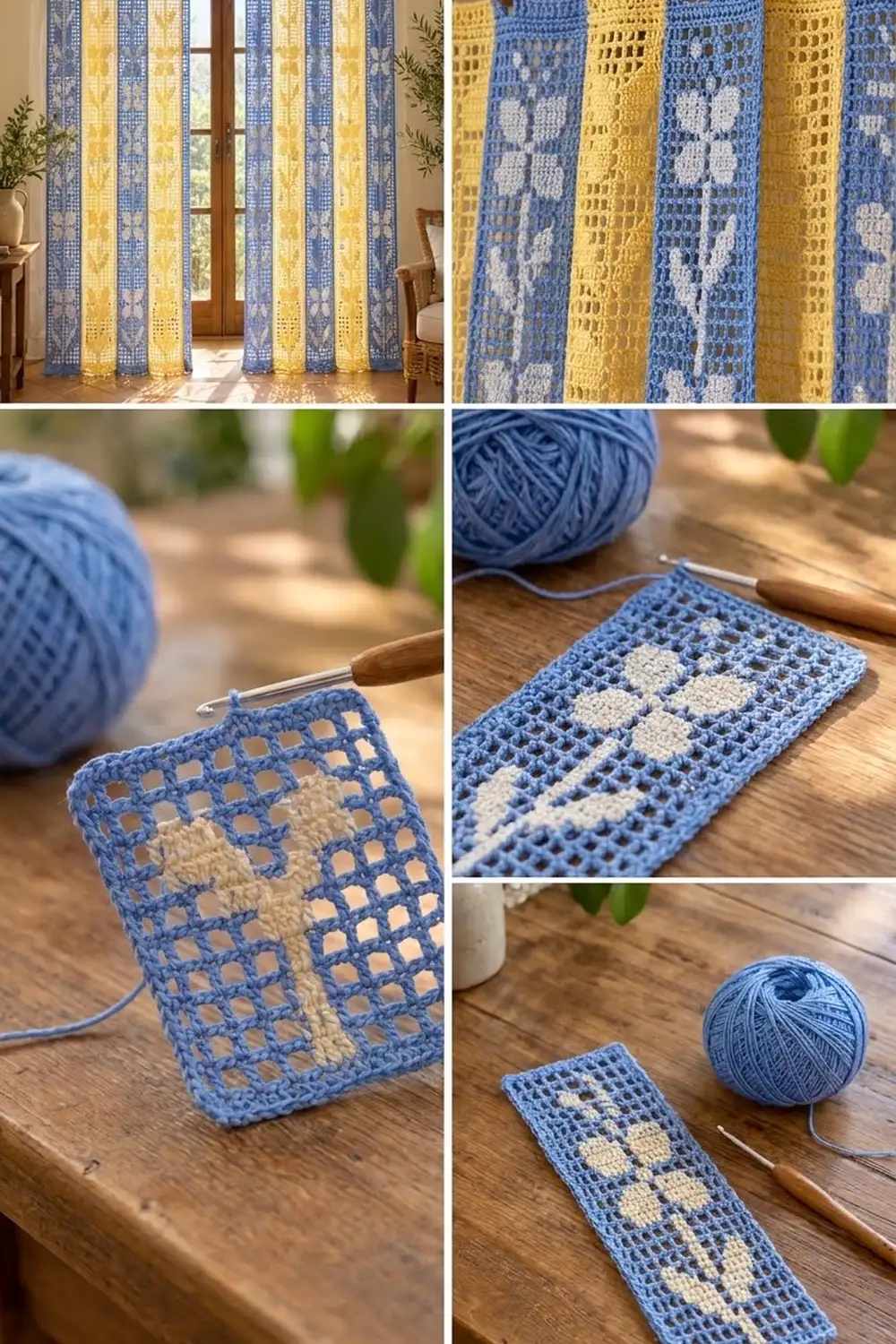
The Meadow Stem curtain is made of long, narrow filet crochet strips that hang side by side from a wooden rod. Each strip shows a column of simple flowers: a straight center stem, a pair of angled leaves, and a four-petal flower built from 2 x 2 blocks around a single center square.
Two colorways alternate across the window. Cornflower blue strips carry the motif in cream filled blocks. Buttery yellow strips carry the same motif in yellow blocks, so the flowers read as texture rather than contrast. Light passes through the open mesh, which keeps the curtain airy.
This pattern uses US crochet terms. One finished strip measures 9.0 in (22.9 cm) wide and 80.5 in (204.5 cm) long, plus a 1.5 in (3.8 cm) hanging loop.
You work each strip flat from the bottom up: a foundation double crochet row, 198 filet rows (11 repeats of an 18-row motif), and one solid top row. One round of single crochet finishes the edges, and a folded tab holds each strip on a curtain ring. The strips are never joined to each other.
Finished Size and Construction
- Finished strip size: 9.0 in x 80.5 in (22.9 cm x 204.5 cm), plus a 1.5 in (3.8 cm) loop
- Skill level: Intermediate
- Terminology: US
- Yarn weight: Sport (CYC 2) cotton
- Hook: 3.25 mm (US D-3)
- Number of pieces: 10 separate strips (6 blue, 4 yellow)
- Layout: two groups of 5 strips, hung on rings, not joined
- Strip width: 17 filet squares (52 stitches)
- Size before border: 8.5 in x 80.0 in (21.6 cm x 203.2 cm)
- Border depth: 0.25 in (0.6 cm), one round of sc
Materials
Choose a smooth mercerized or combed sport-weight cotton with about 150 m per 50 g. Cotton keeps the mesh crisp and the squares even. Avoid fuzzy or very stretchy yarns. They blur the blocks and let long strips sag.
- Blue (Color B): 90 g / 270 m per blue strip; 540 g / 1620 m for 6 strips
- Cream (Color C): 30 g / 90 m per blue strip; 180 g / 540 m for 6 strips
- Yellow (Color Y): 100 g / 300 m per yellow strip; 400 g / 1200 m for 4 strips
These quantities include a margin of about 15% for swatching, bobbin tails, and weaving in ends.
Tools:
- 3.25 mm (US D-3) crochet hook
- 3–4 small yarn bobbins for cream
- Tapestry needle and scissors
- Stitch markers
- Tape measure
- 10 curtain rings, about 2 in (5.1 cm) inner diameter, plus a curtain rod
- Blocking mats and rust-proof pins
Abbreviations (US Terms)
- ch – chain
- sc – single crochet
- dc – double crochet
- fdc – foundation double crochet
- sk – skip
- st(s) – stitch(es)
- sp – space (one open filet square)
- bl – block (one filled filet square)
- RS / WS – right side / wrong side
Foundation double crochet (fdc): Ch 3. Yo, insert the hook in the 3rd ch from the hook, yo and pull up a loop, yo and pull through 1 loop (this makes the “chain”), [yo and pull through 2 loops] twice. For each following fdc: yo, insert the hook in the “chain” at the base of the last fdc, and repeat the same steps. The ch-3 counts as the first stitch.
Filet squares: Each square uses 3 stitches. The last dc of each square also forms the left edge of the next square.
- Open sp: ch 2, sk 2 sts (or the next ch-2 sp), dc in next dc.
- Block over a sp: 2 dc in the ch-2 sp, dc in next dc.
- Block over a bl or a solid row: dc in each of the next 3 sts.
Each row = ch 3 (counts as the first dc) + 17 squares x 3 sts = 52 sts.
Gauge and Checkpoints
Gauge: 8 filet squares = 4 in (10.2 cm) wide and 10 filet rows = 4 in (10.2 cm) tall, after blocking.
Border gauge: 25 sc = 4 in (10.2 cm).
Test before you commit to 80 inches. Work Rows 1–12 of the strip exactly as written, then wet block and measure. The test piece should be 8.5 in (21.6 cm) wide and 4.8 in (12.2 cm) tall.
Checkpoints on the real strip:
- After Row 1: 52 fdc, 8.5 in (21.6 cm) wide
- After Row 19 (first repeat complete): 7.6 in (19.3 cm) tall
- After Row 100: 40.0 in (101.6 cm) tall
- After Row 200: 80.0 in (203.2 cm) tall
Too big: switch to a 3.0 mm hook, or work tighter ch-2 spaces. Too small: switch to a 3.5 mm hook. Row height matters most, because 200 rows multiply any error. If you are off by 0.2 in (0.5 cm) over 10 rows, the full strip will be off by 4.0 in (10.2 cm).
The Strip (Make 10)
Color work on blue strips
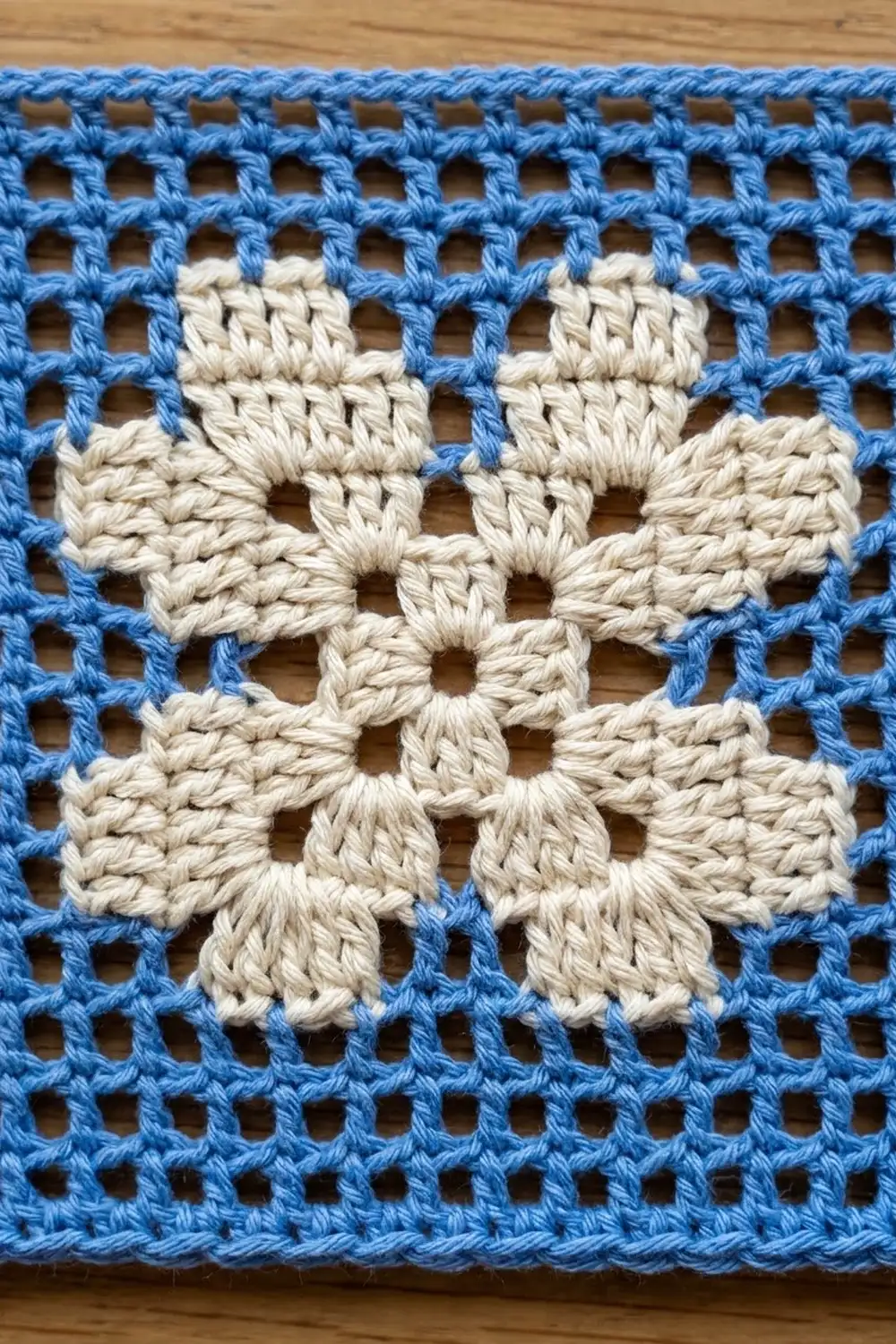
On blue strips, work every block in cream and every open sp in blue. Wind a small cream bobbin for each cream group in a row. You need up to 3 at once, in Motif Rows 3–4.
To change color: work the dc before the block in blue until 2 loops remain, then finish that dc with cream. Work the block in cream, laying the blue strand along the tops of the previous row so the cream stitches enclose it. Finish the block’s last dc with blue. Leave the cream bobbin hanging on the WS.
If a cream group in the next row starts more than 1 square away from its hanging bobbin, cut the cream, leaving a 4 in (10.2 cm) tail, and rejoin it where you need it. Weave all tails into cream blocks only.
Work yellow strips entirely in yellow, with no color changes.
Row 1 (solid base)
With B or Y, work 52 fdc. Turn. (52 sts)
Rows 2–199 (motif)
Work the 18-row motif 11 times (198 rows). Start each motif row with ch 3 (counts as dc), and end it with a dc in the top of the turning ch. The motif is symmetrical, so you read every row the same way on both RS and WS rows.
- Motif Rows 1–2: 8 sp, 1 bl, 8 sp.
- Motif Row 3: 4 sp, 2 bl, 2 sp, 1 bl, 2 sp, 2 bl, 4 sp.
- Motif Row 4: 5 sp, 2 bl, 1 sp, 1 bl, 1 sp, 2 bl, 5 sp.
- Motif Row 5: 7 sp, 3 bl, 7 sp.
- Motif Rows 6–7: 8 sp, 1 bl, 8 sp.
- Motif Rows 8–9: 6 sp, 2 bl, 1 sp, 2 bl, 6 sp.
- Motif Row 10: 8 sp, 1 bl, 8 sp.
- Motif Rows 11–12: 6 sp, 2 bl, 1 sp, 2 bl, 6 sp.
- Motif Rows 13–18: 8 sp, 1 bl, 8 sp.
Every motif row has 17 squares, which is 52 sts. Rows 3–4 form the stepped leaves, and Row 5 joins them to the stem. Rows 8–12 form four 2 x 2 petals around a single center block. Rows 13–18 carry the stem up into the next repeat.
Each repeat has 40 blocks, so each strip has 440 blocks in total.
Strip Rows 2–19 are repeat 1, Rows 20–37 are repeat 2, and so on. Rows 182–199 are repeat 11.
Row 200 (solid top)
Ch 3 (counts as dc). Over each sp, work 2 dc in the ch-2 sp and 1 dc in the next dc. Over each bl, work 1 dc in each of the next 3 dc. On blue strips, work this whole row in blue. (52 sts: 1 + 17 x 3)
Fasten off and weave in the ends. The strip should measure 8.5 in x 80.0 in (21.6 cm x 203.2 cm).
Make All Pieces
- Blue strips: 6, in B with a C motif
- Yellow strips: 4, all in Y
Here is the layout as seen from inside the room, with the window or door between the groups:
Left group:   B  Y  B  Y  B
              [ window / door ]
Right group:  B  Y  B  Y  B
Make and block one strip of each color before you start the rest, so you can confirm the length.
Hanging (No Joining)
The strips hang separately and are not stitched together. Each strip hangs from its own ring by a folded tab. The rings on the rod set the spacing. Leave a gap of about 0.5 in (1.3 cm) between strips so they move freely. Fold every tab the same way so the strip bottoms line up within 0.25 in (0.6 cm).
Size checkpoint: five strips at 9.0 in (22.9 cm) each plus four 0.5 in (1.3 cm) gaps make a group 47.0 in (119.4 cm) wide.
Border
Border gauge: 25 sc = 4 in (10.2 cm), which is 6.25 sc per inch.
Round 1 (RS): Join B or Y in the last st of Row 200 (the top right corner). Ch 1.
- Top edge: 3 sc in the corner st, 1 sc in each of the next 50 sts, 3 sc in the last st (top left corner). (56 sc)
- Left long edge: work into the row ends, alternating 2 sc in one row end and 3 sc in the next, across all 200 rows. (500 sc)
- Bottom edge: work into the base of Row 1: 3 sc in the corner st, 1 sc in each of the next 50 sts, 3 sc in the last st. (56 sc)
- Right long edge: work as for the left edge. (500 sc)
Join with a sl st to the first sc. (Total: 4 x 3 corner sc + 2 x 50 + 2 x 500 = 1,112 sc)
Why the math works: a long edge is 80.0 in (203.2 cm) x 6.25 sc = 500 sc, which is exactly 2.5 sc per row end. A short edge is 8.5 in (21.6 cm) x 6.25 = 53.1 sc. The 52 sc worked one per base stitch match that within one stitch, and the 2 extra sc in each corner group only turn the corner. As a result, every edge lies flat without ruffling. The round adds 0.25 in (0.6 cm) on every side, for a finished size of 9.0 in x 80.5 in (22.9 cm x 204.5 cm).
Hanging tab
The top edge has 50 sc between its two corner groups. Count 19 sc in from the right corner group, and join the yarn in the 20th sc.
Tab Row 1: Ch 1, sc in the same sc and in each of the next 11 sc. Turn. (12 sc)
Tab Rows 2–15: Ch 1, sc in each sc across. Turn. (12 sc)
That leaves 19 sc unworked on each side of the tab (19 + 12 + 19 = 50). The tab measures 1.9 in (4.8 cm) wide and 3.0 in (7.6 cm) long. Slip it through a curtain ring, fold it to the WS, and sew the last row to the back of the border. This forms a 1.5 in (3.8 cm) loop.
Final Blocking
- Weave in all ends before blocking, and bury cream tails inside cream blocks.
- Soak each strip for 15 minutes in cool water with a little wool wash.
- Roll the strip in a towel and press the water out. Do not wring it.
- Lay the strip flat and pin one 20 in (50.8 cm) section at a time.
- Pin the width to 9.0 in (22.9 cm), using a long ruler to keep the mesh columns straight.
- Check that the open squares are even rectangles and the blocks lie flat.
- Let each section dry before you move on to the next.
- Hang the strip for 48 hours, then measure again. Cotton filet can grow 1–2 in (2.5–5.1 cm). If it does, adjust the ring heights so all strips match.
Final Quality-Control Checklist
- Every row of every strip is 52 sts wide.
- Each strip has 198 motif rows plus a solid row at each end (200 rows).
- Each strip shows 11 complete flowers, with the stem in the center column.
- No cream shows in the blue mesh, and no blue shows through the cream blocks.
- The border has 1,112 sc and lies flat.
- Each tab is centered, with 19 sc on each side.
- Each strip measures 9.0 in x 80.5 in (22.9 cm x 204.5 cm).
- All ten strips hang level.
Troubleshooting
- Squares lean diagonally: the turning ch is too tight or too loose. Make your ch-3 the same height as a dc.
- Strip is too short: rows are under 0.4 in (1.0 cm) tall. Go up a hook size, or add whole repeats rather than partial ones.
- Strip grows when hung: the chains are loose, which is normal for cotton. Block it, hang it, then even out the ring heights.
- Cream blocks look streaky: the carried blue is showing. Keep it snug along the tops of the previous row.
- Border ruffles: there are too many sc. Work 2 sc instead of 3 in a few row ends.
- Border pulls in: there are too few sc. Work 3 sc instead of 2 in a few row ends.
- Tab twists: it is off-center. Recount and make sure there are 19 sc on each side.
Care
Hand wash in cool water, or machine wash on a gentle cycle in a mesh bag. Reshape and dry flat in sections, and never tumble dry, because that can shrink and distort the long strips.
Final Notes
Every measurement in this pattern links back to the gauge. Gauge is 8 squares and 10 rows = 4 in (10.2 cm). A 17-square strip is 52 sts and 8.5 in (21.6 cm) wide, and 200 rows make it 80.0 in (203.2 cm) long. The 1,112-sc border brings each strip to 9.0 in x 80.5 in (22.9 cm x 204.5 cm). Ten separate strips hang in two groups of five. Check each measurement as you go, and the curtain will hang straight and even.
Happy crocheting!