

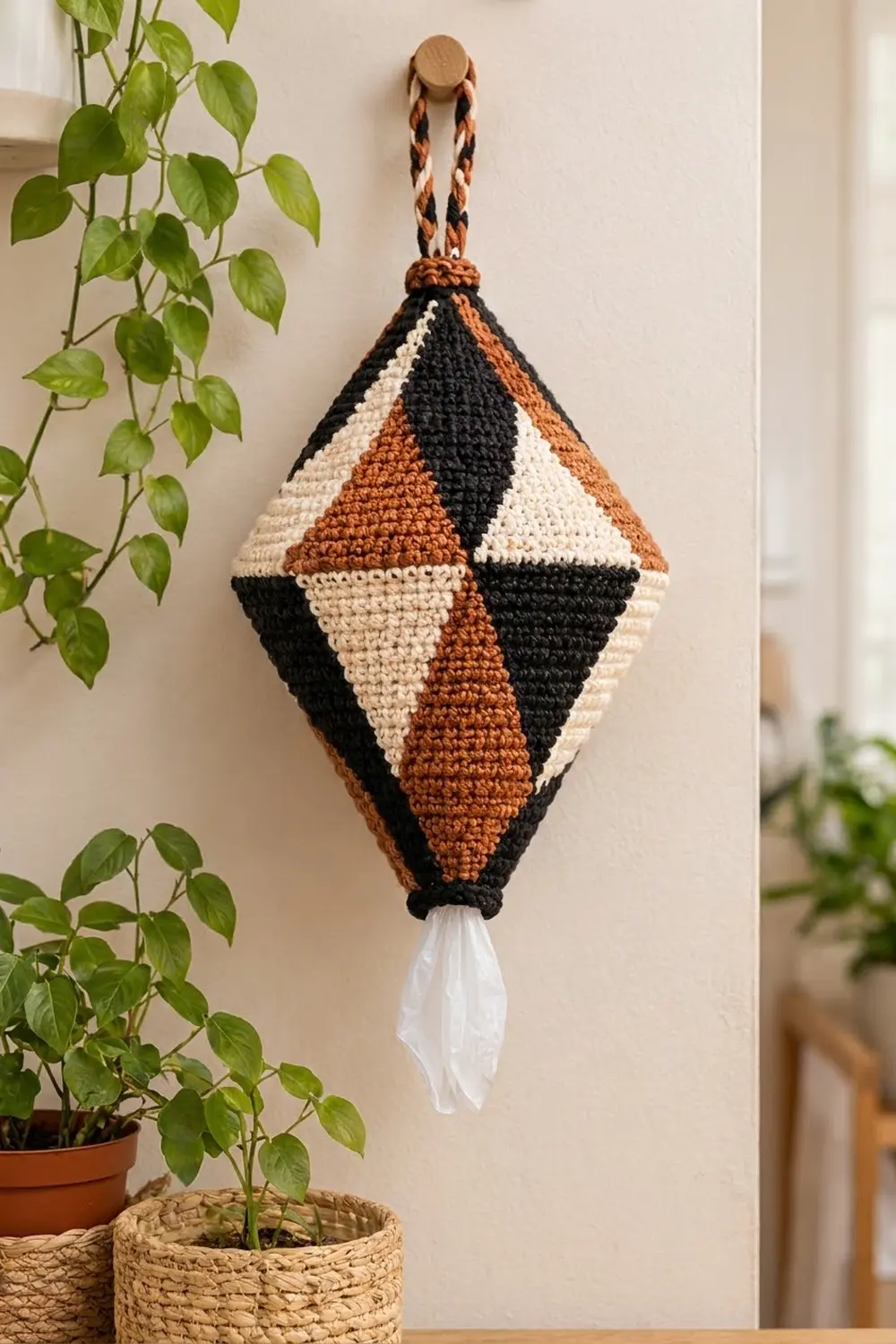
This hanging bag holder has a bold, earthy look: a tall double-cone body covered in tapestry-crochet diamonds and triangles in black, cream and rust. It hangs from a braided loop in all three colors. You stuff plastic bags in at the top and pull them out one at a time through the narrow black collar at the bottom.
The design is made of six repeating sections. Each section has one tall diamond, and each pair of neighboring diamonds is separated by small triangles in the third color. Near the widest point, the background triangles drop away and the six diamonds touch side by side. That gives the piece its graphic, kite-like silhouette.
The pattern uses US crochet terms. The finished body measures about 9 1/3 in (23.7 cm) across at the widest point when flat, and 16 in (40.6 cm) tall including both collars. The hanging loop rises about 4 in (10.2 cm) above the top.
You start with a chain ring at the top of the diamond band. The upper cone is worked in single crochet tapestry rounds, increasing out to the widest point, and the lower cone mirrors it as it decreases. Black collars are then worked onto both openings, and the braided loop is sewn inside the top collar.
Finished Size and Construction
- Finished size: 9 1/3 in (23.7 cm) wide flat x 16 in (40.6 cm) tall, plus a 4 in (10.2 cm) loop
- Skill level: Intermediate (tapestry crochet in the round)
- Terminology: US
- Yarn weight: Worsted (#4), cotton or cotton blend
- Hook: 4.0 mm (G-6)
- Number of pieces: 1 crocheted body + 1 braided loop
- Layout: 6 identical color sections around each round
- Section size: 6 sts at the top and bottom of the body, 14 sts at the widest point
- Size before collars: 8 in (20.3 cm) top opening circumference, 14.4 in (36.6 cm) tall
- Collar depth: 0.8 in (2.0 cm) each, top and bottom
Materials
Pick a smooth, firm cotton or cotton blend in worsted weight. Cotton holds the diamond shapes crisply and stands up to rough handling. Avoid fuzzy yarns because they blur the color edges.
- Color K (black): 50 g, about 100 m
- Color C (cream): 40 g, about 80 m
- Color R (rust): 40 g, about 80 m
These quantities include a margin of roughly 20% for the carried strands, your gauge swatch and the braided loop.
Tools:
– 4.0 mm (G-6) crochet hook
– Stitch marker
– Tapestry needle
– Scissors
– Measuring tape
– A rolled towel or a stack of plastic bags for blocking
Abbreviations (US Terms)
- ch – chain
- sl st – slip stitch
- sc – single crochet
- inc – 2 sc in the same stitch
- sc2tog – single crochet 2 together
- st(s) – stitch(es)
- bg – background triangle color
- D – diamond color
Tapestry color change: Work the last sc before a color change until 2 loops remain on the hook. Then yarn over with the new color and pull through. Carry the two unused colors along the top of the previous round and work over them so they stay hidden inside the stitches.
Gauge and Checkpoints
Gauge: 18 sc and 20 rounds = 4 in (10.2 cm) in tapestry sc worked in the round, with two strands carried.
Your first check is the work itself. Complete Rounds 1–15 of the upper cone before going further. Tapestry crochet often tightens up because of the carried strands, so measure here, not on a plain swatch.
Checkpoints:
– After Round 1: the ring is 8 in (20.3 cm) around and lies 4 in (10.2 cm) wide when flat.
– After Round 15: the work is 3 in (7.6 cm) tall.
– After Round 36: circumference is 18 2/3 in (47.4 cm), flat width is 9 1/3 in (23.7 cm), and height is 7.2 in (18.3 cm).
– After Round 72: height is 14.4 in (36.6 cm).
If your piece is too big, change to a 3.75 mm (F-5) hook. If it is too small, use a 4.5 mm (7) hook. Height matters as much as width here. If your rounds are short, work extra rounds at the widest point only, keeping the round count the same for the upper and lower cones.
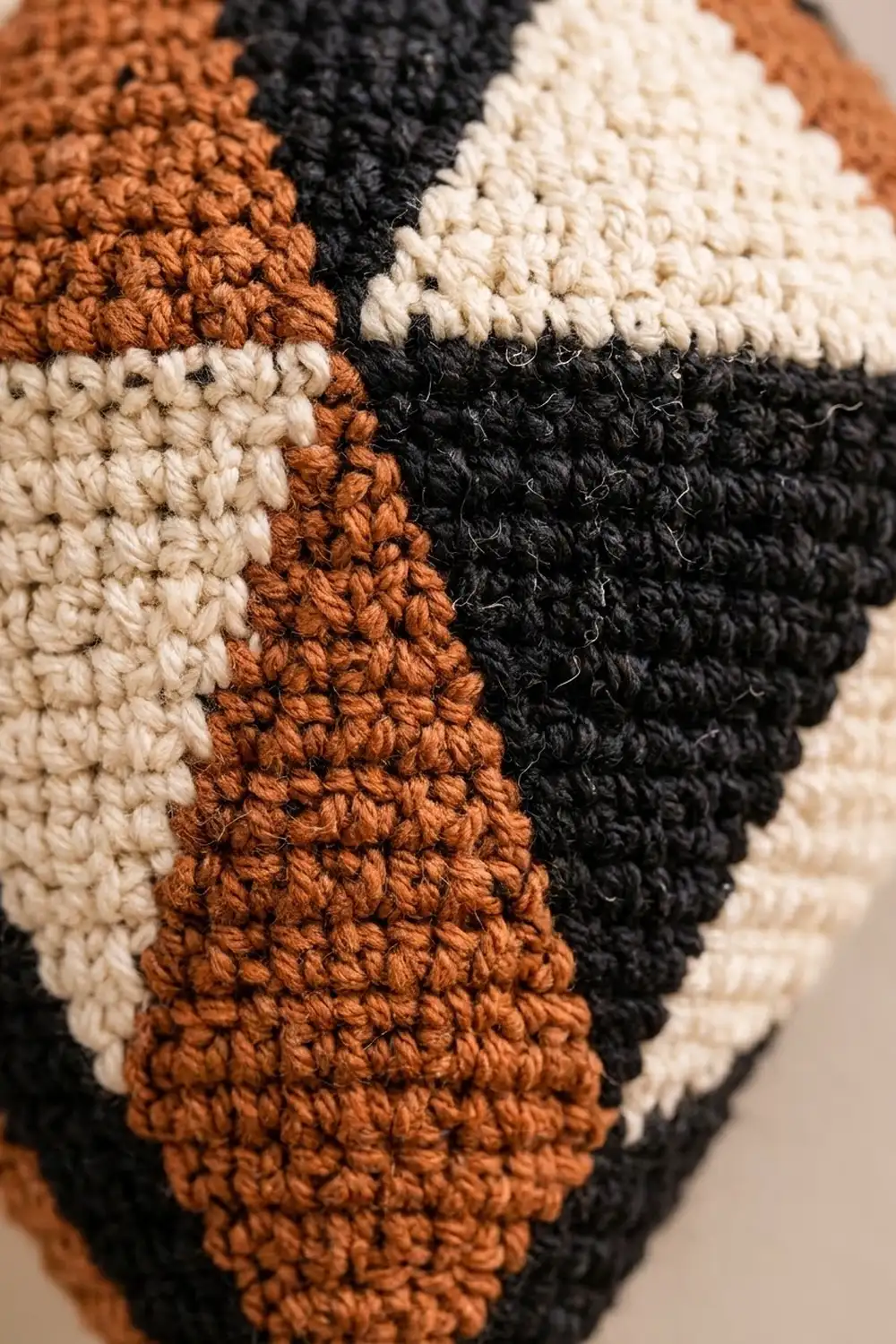
Section Color Layout
Every round is worked as six sections, in this order: S1, S2, S3, S1, S2, S3. Each section has a left background, a diamond and a right background:
- S1: C bg | R diamond | K bg
- S2: K bg | C diamond | R bg
- S3: R bg | K diamond | C bg
The right bg of one section and the left bg of the next are the same color. Together they form one symmetrical triangle centered between two diamonds.
In the instructions below, “2 bg, 2 D, 2 bg” means: 2 sc in that section’s left bg color, 2 sc in its D color, and 2 sc in its right bg color. Repeat across S1–S3 twice in every round. Place a marker in the first st of each round and move it up as you go.
Upper Cone
Foundation: Using K, ch 36. Join with a sl st to the first ch, making sure the chain is not twisted. Join C and R, then begin carrying them.
Rnds 1–3: 2 bg, 2 D, 2 bg 6 times. (36 sts)
Rnd 4: 2 bg, with D: sc 1, inc; 2 bg 6 times. (42 sts; diamond is 3 sts)
Rnds 5–7: 2 bg, 3 D, 2 bg 6 times. (42 sts)
Rnd 8: 2 bg, with D: sc 1, inc, sc 1; 2 bg 6 times. (48 sts; diamond is 4 sts)
Rnds 9–11: 2 bg, 4 D, 2 bg 6 times. (48 sts)
Rnd 12: 2 bg, with D: sc 2, inc, sc 1; 2 bg 6 times. (54 sts; diamond is 5 sts)
Rnds 13–15: 2 bg, 5 D, 2 bg 6 times. (54 sts)
Rnd 16 (triangles narrow): 1 bg, with D: sc 3, inc, sc 3; 1 bg 6 times. (60 sts; diamond is 8 sts)
The first and last D stitch in each section sit on top of old background stitches. That is what moves each triangle edge in by one stitch.
Rnds 17–19: 1 bg, 8 D, 1 bg 6 times. (60 sts)
Rnd 20: 1 bg, with D: sc 4, inc, sc 3; 1 bg 6 times. (66 sts; diamond is 9 sts)
Rnds 21–23: 1 bg, 9 D, 1 bg 6 times. (66 sts)
Rnd 24: 1 bg, with D: sc 4, inc, sc 4; 1 bg 6 times. (72 sts; diamond is 10 sts)
Rnds 25–27: 1 bg, 10 D, 1 bg 6 times. (72 sts)
Rnd 28: 1 bg, with D: sc 5, inc, sc 4; 1 bg 6 times. (78 sts; diamond is 11 sts)
Rnds 29–31: 1 bg, 11 D, 1 bg 6 times. (78 sts)
Rnd 32 (triangles close): With D: sc 6, inc, sc 6 6 times. (84 sts; diamond is 14 sts)
Rnds 33–36: 14 D 6 times. (84 sts)
Starting with Round 32, only the D color is worked in each section, so carry the other two strands inside the stitches all the way around. Check the work against the Round 36 checkpoint now.
Lower Cone
The lower cone mirrors the upper cone. Each decrease is placed in the middle of a diamond so the shapes stay centered.
Rnds 37–41: 14 D 6 times. (84 sts)
Rnd 42 (triangles reappear): 1 bg, with D: sc 5, sc2tog, sc 5; 1 bg 6 times. (78 sts; diamond is 11 sts)
Rnds 43–45: 1 bg, 11 D, 1 bg 6 times. (78 sts)
Rnd 46: 1 bg, with D: sc 4, sc2tog, sc 5; 1 bg 6 times. (72 sts; diamond is 10 sts)
Rnds 47–49: 1 bg, 10 D, 1 bg 6 times. (72 sts)
Rnd 50: 1 bg, with D: sc 4, sc2tog, sc 4; 1 bg 6 times. (66 sts; diamond is 9 sts)
Rnds 51–53: 1 bg, 9 D, 1 bg 6 times. (66 sts)
Rnd 54: 1 bg, with D: sc 3, sc2tog, sc 4; 1 bg 6 times. (60 sts; diamond is 8 sts)
Rnds 55–57: 1 bg, 8 D, 1 bg 6 times. (60 sts)
Rnd 58 (triangles widen): 2 bg, with D: sc 2, sc2tog, sc 2; 2 bg 6 times. (54 sts; diamond is 5 sts)
Rnds 59–61: 2 bg, 5 D, 2 bg 6 times. (54 sts)
Rnd 62: 2 bg, with D: sc 1, sc2tog, sc 2; 2 bg 6 times. (48 sts; diamond is 4 sts)
Rnds 63–65: 2 bg, 4 D, 2 bg 6 times. (48 sts)
Rnd 66: 2 bg, with D: sc 1, sc2tog, sc 1; 2 bg 6 times. (42 sts; diamond is 3 sts)
Rnds 67–69: 2 bg, 3 D, 2 bg 6 times. (42 sts)
Rnd 70: 2 bg, with D: sc2tog, sc 1; 2 bg 6 times. (36 sts; diamond is 2 sts)
Rnds 71–72: 2 bg, 2 D, 2 bg 6 times. (36 sts)
Fasten off C and R, leaving 4 in (10.2 cm) tails. Keep K attached.
Border (Top and Bottom Collars)
Border gauge: same as the body, 18 sc and 20 rounds = 4 in (10.2 cm). Both collars are worked in K only. Each collar is 4 rounds deep, which is 0.8 in (2.0 cm).
Bottom collar (dispensing opening): Keep working into Round 72.
- Rnd B1: sc 4, sc2tog 6 times. (30 sts; 5 per section)
- Rnd B2: sc 3, sc2tog 6 times. (24 sts; 4 per section)
- Rnds B3–B4: sc in each st around. (24 sts; 4 per section)
Sl st to the next st and fasten off.
Top collar (loading opening): Join K in the unused loop of any foundation ch at a section boundary.
- Rnd T1: sc 4, sc2tog 6 times. (30 sts; 5 per section)
- Rnd T2: sc 3, sc2tog 6 times. (24 sts; 4 per section)
- Rnds T3–T4: sc in each st around. (24 sts; 4 per section)
Sl st to the next st and fasten off.
Why the math works: each opening starts at 36 sts, or 6 per section. One decrease per section per round takes it to 30 and then 24 sts, so the collars shrink evenly and the diamond points stay centered. At 24 sts, each opening is 5 1/3 in (13.5 cm) around, which is about 2 2/3 in (6.8 cm) flat. That is snug enough to hold one bag at a time but easy to reach through.
Braided loop: Cut 2 strands each of K, C and R, each 16 in (40.6 cm) long. Knot all six together at one end and braid them in three 2-strand bundles to 12 in (30.5 cm). Knot the other end and trim the tails to 0.5 in (1.3 cm). Push 1 in (2.5 cm) of each end inside the top collar on opposite sides of the opening, lined up with the two R diamonds. Sew each end firmly through all 4 collar rounds. The remaining 10 in (25.4 cm) of braid arches about 4 in (10.2 cm) above the collar.
Final Blocking
- Weave in all ends on the wrong side, inside the stitches of their own color.
- Lightly spritz the whole piece with water until it is just damp.
- Stuff it firmly with a rolled towel or plastic bags to form the double cone.
- Square up the widest round so it measures 9 1/3 in (23.7 cm) flat.
- Pull the diamond points straight down from the top collar and straight up from the bottom collar.
- Hang the piece by its loop or stand it upright, and let it dry completely.
- Remove the stuffing.
Final Quality-Control Checklist
- Rounds 1–36 and 37–72 match: 36 rounds each.
- There are 6 diamonds, in the order rust, cream, black, rust, cream, black.
- Each background triangle is a different color from both diamonds next to it.
- Widest round: 84 sts, 9 1/3 in (23.7 cm) flat.
- Both collars: 24 sts, 0.8 in (2.0 cm) deep.
- Body height: 16 in (40.6 cm) including collars.
- No carried strands show on the right side.
- The loop is sewn through all collar rounds and holds the piece level.
Troubleshooting
- Carried strands peek through: Tighten your tension slightly and hold the carried strands snug along the top of the previous round.
- Diamonds lean to one side: Sc in the round naturally leans to the right. Blocking reduces the lean. For crisper columns, try the yarn-under sc variation.
- Piece is shorter than 14.4 in (36.6 cm): Add 1–2 rounds of 14 D at the widest point, then check that both cones still match.
- Colors tangle: Turn the work in one direction and the yarn balls in the other at the end of each round.
- Bags won’t come out: Rework the bottom collar without Rnd B2 to leave 30 sts.
- The holder tilts when hung: Re-sew the loop ends so they sit exactly opposite each other.
Care
Hand wash in cool water with mild soap, gently press out the excess water, and dry the piece flat or stuffed. Do not tumble dry because cotton tapestry fabric can shrink and distort.
Final Notes
Everything in this pattern follows one measurement chain. A gauge of 18 sc per 4 in (10.2 cm) turns the 36-st ring into an 8 in (20.3 cm) opening. Increasing by 6 per round, once per section, takes the body to 84 sts and 9 1/3 in (23.7 cm) flat at Round 36. The lower cone mirrors that over another 36 rounds, for 14.4 in (36.6 cm) of body. Two 0.8 in (2.0 cm) collars then bring the total height to 16 in (40.6 cm). Check each link in the chain and the diamonds will meet exactly where they should. For a new look, swap in any three high-contrast colors, keeping the same section order.
Happy crocheting!