

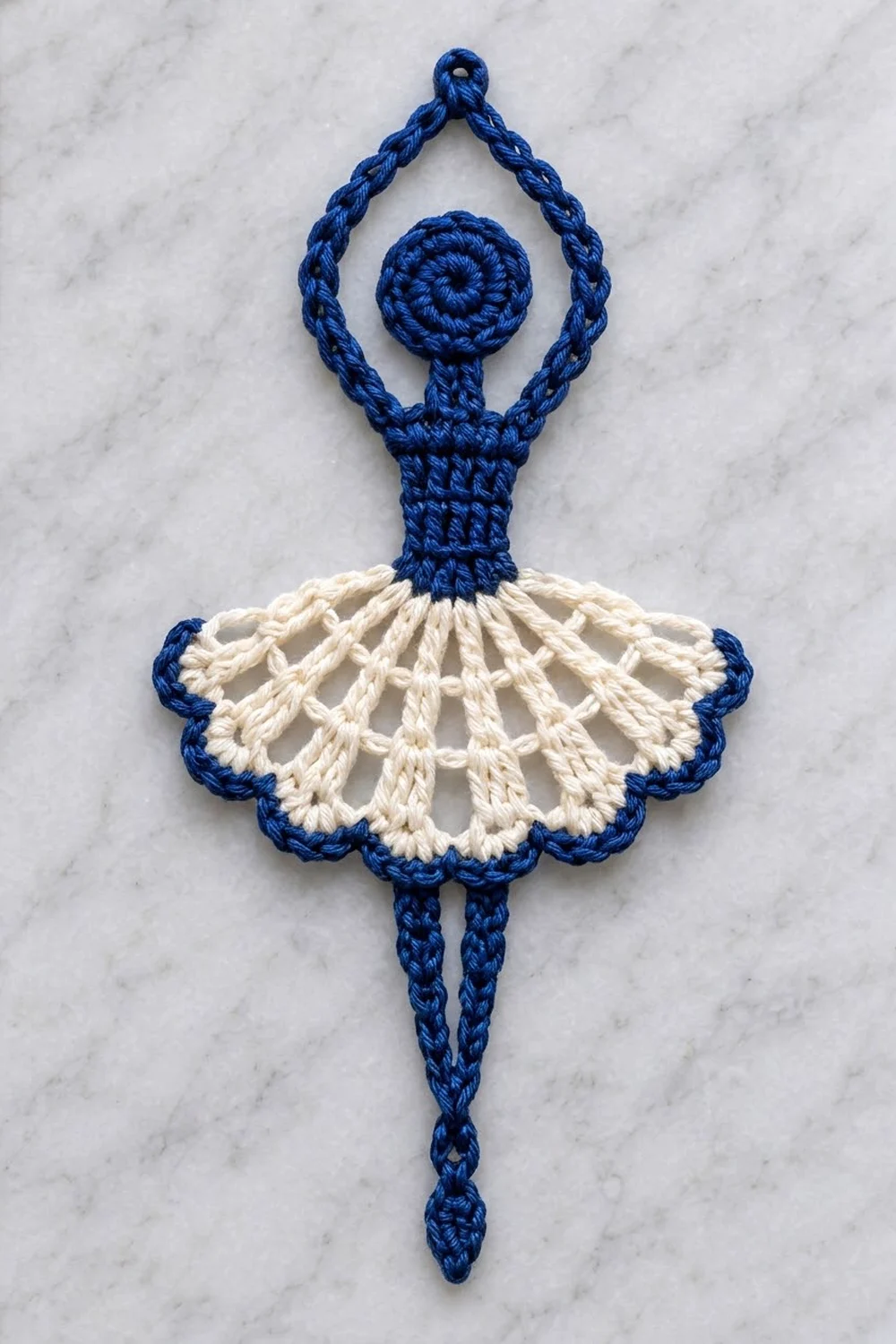
The Navy Pirouette Ballerina is a slim dancer motif. Her arms are raised above her head in a pointed loop, and she has a ridged navy bodice and a lacy cream tutu with a corded navy edge. Two corded legs drop below the skirt and meet in a neat pointed toe.
It uses just two colors: deep navy and soft cream. The contrast is easy to see from across a room, so the motif works as an ornament, a bag charm, a gift-tag topper, or a single hanging decoration in a window.
This pattern uses US crochet terms. The finished motif measures about 5 in (12.7 cm) wide across the tutu and 9.5 in (24.1 cm) tall from the top of the hanging loop to the tip of the toe.
The whole piece is worked flat. You crochet the head in a spiral, work the bodice in rows straight off the head, add the arms as a corded chain loop, and work the cream tutu downward from the waist. Then you edge the tutu in navy and finish with the corded legs.
Finished Size and Construction
- Finished size: 5 in (12.7 cm) wide × 9.5 in (24.1 cm) tall
- Skill level: Easy-intermediate
- Terminology: US crochet terms
- Yarn weight: DK / light (3), cotton
- Hook: 3.5 mm (E-4)
- Number of pieces: 1 single motif
- Layout: One vertical figure; no joining
- Piece size (head + bodice): head 1.5 in (3.8 cm) across; bodice 1.5 in (3.8 cm) wide × 1.6 in (4.1 cm) tall
- Size before border: tutu about 4.75 in (12.1 cm) wide
- Border depth: 2 rows, about 0.25 in (0.6 cm)
Materials
Choose a smooth mercerized or combed cotton in DK weight. Cotton shows each stitch clearly, holds the scallops open, and blocks flat. Avoid fuzzy or very stretchy yarns, because the corded arms and legs lose their braided look.
- Navy (Color A): about 8 g / 20 m
- Cream (Color B): about 4 g / 10 m
These amounts include about 25% extra for tails and testing. Leftover yarn from other projects is enough.
Tools:
- 3.5 mm (E-4) crochet hook
- Tapestry needle
- Scissors
- Stitch marker
- Rustproof pins and a foam blocking mat
- Spray bottle with water
- Ruler or tape measure
Abbreviations (US Terms)
- ch: chain
- sl st: slip stitch
- sc: single crochet
- hdc: half double crochet
- dc: double crochet
- BLO: back loop only
- FLO: front loop only
- sp: space
- st(s): stitch(es)
- rev sc: reverse single crochet
Special stitch: reverse single crochet (rev sc / crab stitch). Work from left to right (right to left if you crochet left-handed). Insert the hook into the next stitch to the right, yarn over, pull up a loop, yarn over, and pull through both loops. This makes a twisted, corded edge.
Gauge and Checkpoints
Gauge: 18 sc and 20 rows = 4 in (10.2 cm) in sc worked flat. At this gauge, 1 sc is about 0.22 in (0.6 cm) wide and 1 sc row is 0.2 in (0.5 cm) tall. One dc row is about 0.44 in (1.1 cm) tall.
Because this is a single motif, the head is your test piece. Make it first and measure it before going further.
Checkpoints:
- Head after Round 3: 1.5 in (3.8 cm) across.
- Bodice after Row 8: 1.5 in (3.8 cm) wide and 1.6 in (4.1 cm) tall.
- Tutu after Row 3: the outer arc measures about 5.5 in (14.0 cm) along the curve.
- Tutu after the border: 5 in (12.7 cm) wide, laid flat.
- Complete motif: 9.5 in (24.1 cm) tall.
If your head is too big (over 1.6 in / 4.1 cm), go down to a 3.25 mm hook. If it is too small (under 1.4 in / 3.6 cm), go up to a 3.75 mm hook. Remake the head before you continue, because every later section is sized from it.
Pattern
Head (Navy)
The head is worked in a continuous spiral. Do not join rounds. Place a marker in the first stitch of each round and move it up as you go.
Round 1: Make a magic ring, 8 sc in the ring. Pull the ring closed. (8 sts)
Round 2: 2 sc in each st around. (16 sts) Head measures about 1 in (2.5 cm).
Round 3: (sc in next st, 2 sc in next st) 8 times. (24 sts)
Sl st in the next st to smooth the end of the spiral. Do not fasten off.
Checkpoint: Head measures 1.5 in (3.8 cm) across and lies flat.
Neck and Bodice (Navy)
The bodice is worked in rows straight off the bottom of the head. Rows 1–3 form the narrow neck and shoulders. Rows 4–8 are worked in BLO, which creates the horizontal ridges on the bodice.
Row 1: Ch 1, sc in the same st as the sl st and in the next 4 sts of Round 3. Turn. (5 sts) This row is about 1.1 in (2.8 cm) wide.
Row 2: Ch 1, sc in each st across. Turn. (5 sts)
Row 3: Ch 1, 2 sc in first st, sc in next 3 sts, 2 sc in last st. Turn. (7 sts)
Rows 4–8: Ch 1, sc in BLO of each st across. Turn. (7 sts each row)
Fasten off after Row 8.
Checkpoint: Bodice is 1.5 in (3.8 cm) wide and 1.6 in (4.1 cm) tall (8 rows × 0.2 in / 0.5 cm). Rows 4–8 show a horizontal ridged texture.
Arms and Hanging Loop (Navy)
The arms are one chain. It leaves one shoulder, rises around the head to a point with an open hanging loop, and comes back to the other shoulder. A return row of sc thickens the chain into a cord.
Foundation: With the right side facing, join navy with a sl st in the right-hand row end of Row 4. Ch 15, ch 6, sl st in the 6th ch from the hook to form the hanging loop, ch 15. Sl st in the left-hand row end of Row 4.
Return row: Turn. Sc in each of the 15 arm ch. Sl st in the joining sl st at the base of the hanging loop, leaving the loop itself open. Sc in each of the next 15 arm ch. Sl st in the right-hand row end of Row 4. (30 sc + 1 sl st)
Fasten off.
Checkpoint: Each arm is about 3.3 in (8.4 cm) long. Shape the arm loop into a teardrop with the point centered above the head. The point sits about 0.4 in (1.0 cm) above the head, and the open loop adds 0.3 in (0.8 cm).
Tutu (Cream)
The tutu is worked downward in rows from the waist. Row 1 goes into the front loops of bodice Row 8, which leaves the back loops free for the legs.
Row 1: With the right side facing, join cream in FLO of the first st of Row 8. Ch 3 (counts as dc), dc in same st, dc in FLO of next 5 sts, 2 dc in FLO of last st. Turn. (9 dc) This dense row ruffles slightly at the waist.
Row 2: Ch 4 (counts as dc + ch 1), (dc in next dc, ch 1) 7 times, dc in top of turning ch. Turn. (9 dc and 8 ch-1 sps)
Row 3: Ch 5 (counts as dc + ch 2), (dc in next dc, ch 2) 7 times, dc in 3rd ch of turning ch. Turn. (9 dc and 8 ch-2 sps)
Rows 2 and 3 are the open rows that form the tall “spokes” of the skirt.
Row 4 (scallops): Ch 1, sc in first dc, (5 dc in next ch-2 sp, sc in next dc) 8 times. Work the last sc in the 3rd ch of the turning ch. (8 shells, 49 sts: 9 sc + 40 dc)
Fasten off.
Checkpoint: Row 3 measures about 5.5 in (14.0 cm) along its curved edge (25 stitch widths × 0.22 in / 0.6 cm). Laid flat, the tutu is about 4.75 in (12.1 cm) wide and about 1.8 in (4.6 cm) tall.
Legs and Toe (Navy)
The legs are one chain that drops from the waist, forms the toe, and comes back up. A sc row then turns it into a cord.
Foundation: Turn the motif to the wrong side. Join navy with a sl st in the free back loop of the 3rd st of Row 8. Ch 24, ch 6, sl st in the 6th ch from the hook to form the toe ring, ch 24. Sl st in the free back loop of the 5th st of Row 8.
Return row: Turn. Sc in each of the 24 leg ch. In the toe ring work (2 sc, hdc, ch 2, hdc, 2 sc). Sc in each of the next 24 leg ch. Sl st in the back loop of the 3rd st of Row 8. (48 sc on the legs + 6 sts and a ch-2 point in the toe)
Fasten off. With the tail, sew the last 4 sc of each leg together just above the toe so the legs meet in a narrow V.
Checkpoint: Each leg is about 5.3 in (13.5 cm) long. About 3.2 in (8.1 cm) of leg shows below the finished tutu, plus the toe at about 0.5 in (1.3 cm).
Border
The navy border runs down one side of the tutu, around all 8 scallops, and up the other side. It is worked only on the tutu; the waist edge stays open.
Border gauge: The border uses the main gauge, 18 sc = 4 in (10.2 cm), so each sc covers about 0.22 in (0.6 cm).
Border Row 1: With the right side facing, join navy at the right-hand waist corner of the tutu (the row end of tutu Row 1). Ch 1. Work 2 sc in each of the 3 dc row ends (Rows 1–3) down the side (6 sc). Working across Row 4, sc in each st (49 sc). Work 2 sc in each of the 3 dc row ends up the other side (6 sc). (61 sc total: 6 + 49 + 6)
Border Row 2: Ch 1, do not turn. Rev sc in each st back across. (61 rev sc) Fasten off.
Why the math works:
- Sides: The three dc rows stand about 1.3 in (3.3 cm) tall. Six sc at 0.22 in (0.6 cm) each cover the same 1.3 in (3.3 cm), so the sides neither pucker nor ripple.
- Scallops: Each shell sits on a base of about 0.7 in (1.8 cm) and curves outward like a half circle, so its outer arc is about 1.1 in (2.8 cm). Working 1 sc in each existing stitch (5 per shell, plus the sc between shells) matches that arc; adding extra sc would make the scallops ruffle. So the 49 sc are exactly 1 per Row 4 stitch, with nothing added.
- Rev sc: Row 2 is a 1-for-1 trim row (61 worked into 61), so it adds depth, not width. The border adds about 0.25 in (0.6 cm) of depth, bringing the tutu from 4.75 in (12.1 cm) to 5 in (12.7 cm).
Final Blocking
- Weave in all tails, hiding navy in navy and cream in cream.
- Lay the motif face down on the blocking mat.
- Mist it until damp but not dripping.
- Turn it face up. Pin the bodice square at 1.5 in (3.8 cm) wide.
- Shape the arm loop into an even teardrop and pin the hanging loop open at the top.
- Pin the tutu into a fan 5 in (12.7 cm) wide. Put one pin at the tip of each of the 8 scallops and one in each ch-2 space of Row 3 to open the spokes.
- Pin the legs into a narrow V and pin the toe point downward.
- Check that the total height is 9.5 in (24.1 cm).
- Let it dry completely, at least 12 hours, before unpinning.
For a firmer ornament, mist lightly with fabric stiffener before drying.
Final Quality-Control Checklist
- Head is flat, 1.5 in (3.8 cm) across, with a smooth spiral finish.
- Bodice has 7 sts across and a clear ridged texture in Rows 4–8.
- Arm loop is even on both sides; each side has 15 sc.
- Hanging loop is open and centered above the head.
- Tutu Row 3 has 9 dc spokes and 8 ch-2 spaces.
- Row 4 has 8 even shells.
- Border has 61 sts in each row, with no gaps at the waist corners.
- Legs are the same length; toe point faces down.
- Finished size: 5 in (12.7 cm) × 9.5 in (24.1 cm).
- No tails show on the front.
Troubleshooting
Head cups or ruffles: Cupping means your stitches are tight; ruffling means they are loose. Change your hook size and remake the head.
Bodice ridges look faint: Make sure you work only in the back loops in Rows 4–8. Working through both loops gives smooth fabric.
Arm loop is lopsided: Count both 15-ch sections before the return row. Even one extra chain shows.
Tutu curls upward: Row 1 is too tight. Rework it more loosely, or go up 0.25 mm for the cream rows only.
Scallops ruffle after the border: You added extra sc in the shells. Rework Border Row 1 with exactly 1 sc per Row 4 st.
Legs twist: Steam-block them flat and pin them straight while they dry.
Care
Hand wash in cool water with mild soap, roll in a towel to remove extra water, and dry flat, pinned to shape. Do not tumble dry.

Final Notes
Each part of the motif is sized from the one before it. A 24-st head 1.5 in (3.8 cm) across sets the 5-st neck and the 7-st bodice, 1.5 in (3.8 cm) wide. Those 7 sts become 9 dc spokes, which open to an arc 25 stitches wide and 5.5 in (14.0 cm) long. That arc carries 8 shells and 49 sts, and the 61-st border edges them into a 5 in (12.7 cm) tutu. Arms of 15 ch and legs of 24 ch complete a dancer 9.5 in (24.1 cm) tall.
Check each stage against its checkpoint, and your ballerina will come out even and true to size.
Happy crocheting!