

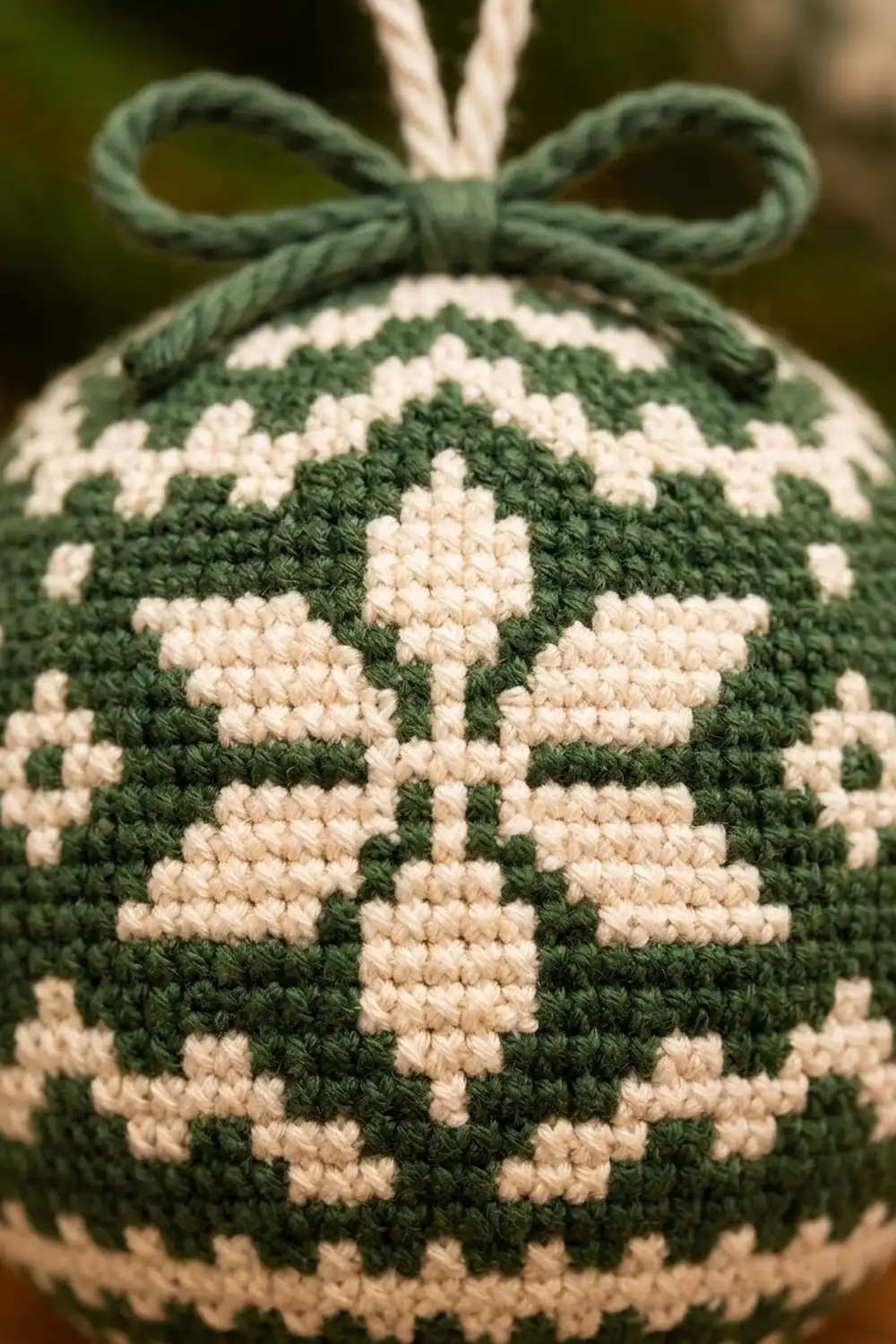
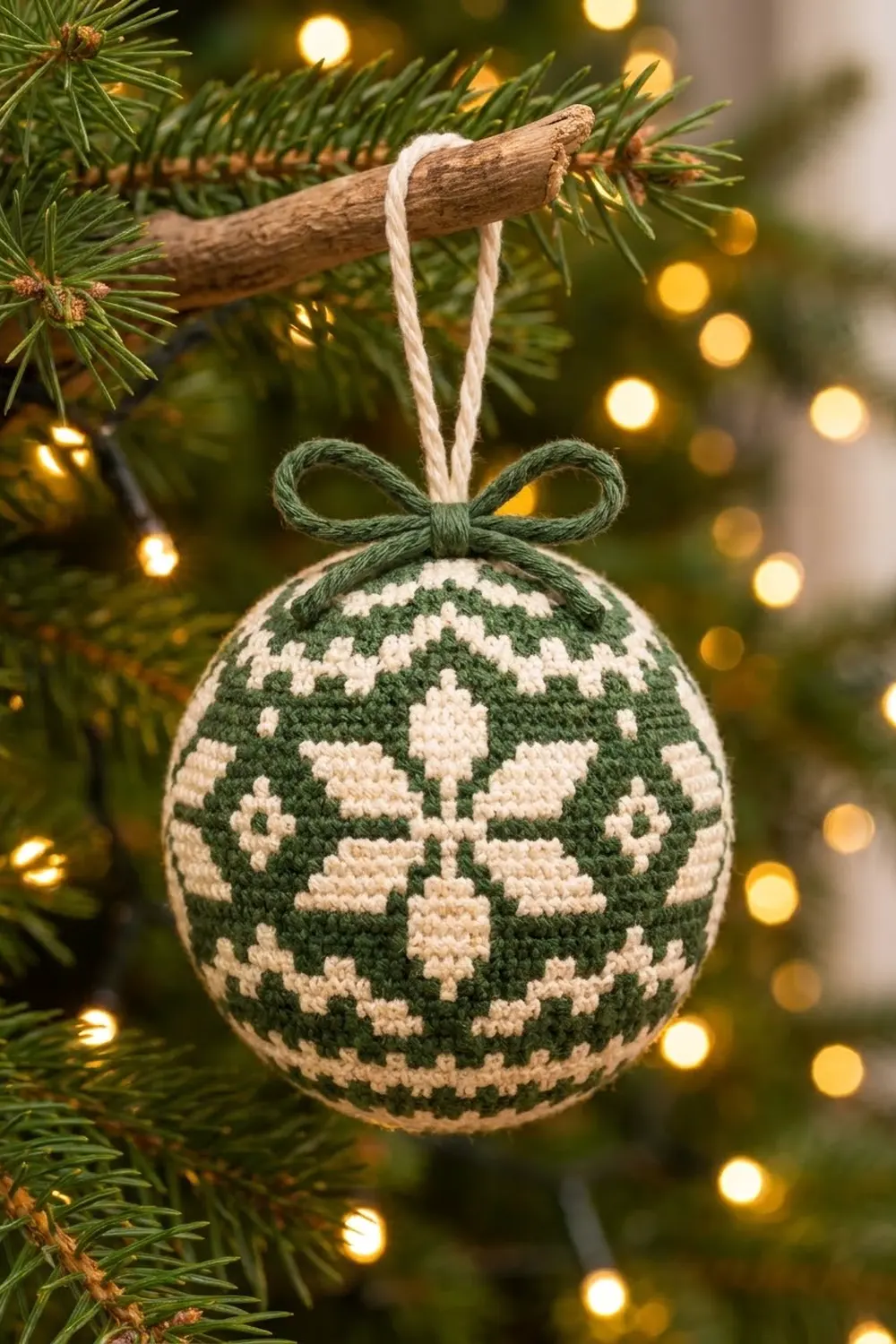
The Nordic Star Bauble is a round, stuffed Christmas ornament worked in tapestry crochet. A six-petal cream snowflake sits on a forest green background. Around it are a ring of cream diamonds, two dotted bands and a cream crown. A cream hanging loop and a small green bow finish the top.
The look is classic Fair Isle: two colors, crisp single crochet “pixels” and a tight, firm fabric that holds its shape. Green and cream are shown here, but burgundy, navy or rust with cream work just as well.
This pattern uses US crochet terms. The finished bauble is about 3.5 in (8.9 cm) across and 11 in (27.9 cm) around the widest round, not counting the loop and bow.
The ball is one seamless piece. You start with a flat snowflake disc, then work even rounds so it cups into a bowl. Then you decrease and stuff as you close the top. A slip-stitch cord loop and a slip-stitch bow are made separately and sewn on.
Finished Size and Construction
- Finished size: about 3.5 in (8.9 cm) diameter; 11 in (27.9 cm) circumference
- Skill level: Intermediate (tapestry color changes, spiral rounds)
- Terminology: US
- Yarn weight: sport (#2) cotton
- Hook: 2.5 mm (US B/1 or C/2)
- Number of pieces: 1 crocheted ball, plus 1 cord loop and 1 bow
- Layout: single sphere, worked bottom to top in continuous rounds
- Piece size: flat base disc 3.3 in (8.4 cm) across after Rnd 10
- Size before border: 11 in (27.9 cm) around at Rnds 11–22
- Border depth: no edge border; the top closes with a solid cream crown (Rnds 27–32)
Materials
Choose a smooth, mercerized cotton or cotton blend of about 155 m per 50 g. Cotton shows tapestry stitches clearly, and the carried strand hides well inside it. Avoid fuzzy yarn, which blurs the snowflake.
- Color G (green, main): 10 g / 31 m (includes the bow)
- Color C (cream, contrast): 10 g / 31 m (includes the hanging loop)
Quantities include a margin of about 30 percent for swatching, tails and the carried strand.
For other colorways, swap G for burgundy, navy or rust and keep C as cream. Pick a main color that is clearly darker than the contrast so the snowflake stands out.
Tools:
- 2.5 mm crochet hook
- Locking stitch marker
- Tapestry needle
- About 10 g polyester fiberfill
- Scissors
- Measuring tape
Abbreviations (US Terms)
- ch – chain
- sc – single crochet
- sl st – slip stitch
- inc – 2 sc in the same stitch
- sc2tog – single crochet 2 together (decrease)
- MR – magic ring
- rnd(s) – round(s)
- st(s) – stitch(es)
- G / C – green / cream
Tapestry sc (special technique): Work every sc over the color you are not using, laying it along the tops of the stitches so it is enclosed. To change color, work the last sc of the old color until 2 loops remain on the hook. Then yarn over with the new color and pull through. Keep both strands relaxed so the fabric does not pucker.
Reading the color lists: Each shaped round is written as one repeat that you work 6 times. The colors listed cover every stitch made in that repeat. In increase rounds, the last 2 colors listed are the 2 sc of the inc; change color between them when needed. In decrease rounds, the sc2tog counts as 1 stitch and takes the last color listed.
Gauge and Checkpoints
Gauge: 6 sc and 6 rnds = 1 in (2.5 cm) in tapestry sc.
Use the first 10 rounds as your gauge test. They form a flat disc, so they are easy to measure.
- After Rnd 4 (24 sts): about 1.3 in (3.3 cm) across
- After Rnd 10 (60 sts): about 3.3 in (8.4 cm) across, lying flat
- After Rnd 22 (66 sts): 11 in (27.9 cm) around the widest point
- After stuffing and closing: about 3.5 in (8.9 cm) diameter
Too big? Drop to a 2.25 mm hook, or carry the unused strand a little more snugly.
Too small or stiff? Move to a 2.75 mm hook. A slightly larger bauble still works, but it needs more stuffing.
Whatever hook you use, keep the fabric dense. If you can see fiberfill through the stitches, go down a hook size.
Ball Pattern
Work in continuous spiral rounds; do not join or turn. Place a marker in the first stitch of each round and move it up as you go.
Tapestry tips: Twist the two strands the same way each time you change color, then untwist them every few rounds. Keep the working ball on your right and the carried ball on your left so they don’t tangle. Check the right side often. It should show only clean blocks of color.
Base Snowflake (Rnds 1–10)
Rnd 1: With C, make a MR, 6 sc in ring. (6 sts)
Rnd 2: Inc in each st, all C. (12 sts)
Rnd 3: Sc, inc 6 times. Repeat colors: 2 C, 1 G. Join G here and carry it from now on. (18 sts)
Rnd 4: Sc 2, inc 6 times. Repeat colors: 3 C, 1 G. (24 sts)
Rnd 5: Sc 3, inc 6 times. Repeat colors: 3 C, 2 G. (30 sts)
Rnd 6: Sc 4, inc 6 times. Repeat colors: 3 C, 3 G. (36 sts)
Rnd 7: Sc 5, inc 6 times. Repeat colors: 2 C, 2 G, 1 C, 2 G. (42 sts)
Rnd 8: Sc 6, inc 6 times. Repeat colors: 1 C, 2 G, 3 C, 2 G. (48 sts)
Rnd 9: Sc 7, inc 6 times. Repeat colors: 4 G, 1 C, 4 G. (54 sts)
Rnd 10: Sc 8, inc 6 times, all G. (60 sts)
The cream columns from Rnds 3–8 build six pointed petals. They grow from the cream center, widen to 3 sts and taper to a 1-st tip. The cream stitches in Rnds 7–9 form a small diamond between each pair of petals. Petals lean slightly in your working direction, which is normal for spiral rounds.
Lower Dot Band (Rnds 11–12)
Rnd 11: Sc 9, inc 6 times. Ignore the repeat for color and alternate stitch by stitch: 1 C, 1 G around. (66 sts; 33 C, 33 G)
Rnd 12: Sc in each st, all G. (66 sts)
From here the sides rise and the disc begins to cup into a bowl.
Diamond Band (Rnds 13–21)
Each round has 66 sts, worked as 6 repeats of 11 sts.
Rnd 13: 5 G, 1 C, 5 G.
Rnd 14: 4 G, 3 C, 4 G.
Rnd 15: 3 G, 2 C, 1 G, 2 C, 3 G.
Rnd 16: 2 G, 2 C, 3 G, 2 C, 2 G.
Rnd 17: 1 G, 2 C, 2 G, 1 C, 2 G, 2 C, 1 G.
Rnd 18: Repeat Rnd 16.
Rnd 19: Repeat Rnd 15.
Rnd 20: Repeat Rnd 14.
Rnd 21: Repeat Rnd 13.
Each repeat makes one open cream diamond with a cream dot in its center. Each diamond is 9 sts wide at Rnd 17 and 9 rnds tall, and six of them circle the ball. After Rnd 17, check that every single cream dot sits directly above the tip of a cream diamond from the round below.
Upper Bands (Rnds 22–26)
Rnd 22: Sc in each st, all G. (66 sts)
Checkpoint: Measure around Rnd 22. It should be 11 in (27.9 cm).
Rnd 23: Sc 9, sc2tog 6 times. Alternate 1 C, 1 G around. (60 sts; 30 C, 30 G)
Rnd 24: Sc 8, sc2tog 6 times, all G. (54 sts)
Rnd 25: Sc 7, sc2tog 6 times. Repeat colors: 3 G, 1 C, 3 G, 1 C. (48 sts)
Rnd 26: Sc 6, sc2tog 6 times. Alternate 1 C, 1 G around. (42 sts; 21 C, 21 G)
Cut G after Rnd 26, leaving a 4 in (10.2 cm) tail on the inside. The dotted bands at Rnds 11 and 23 mirror each other on either side of the diamond band.
Border: Closing Crown and Trims
A sphere has no outer edge, so the “border” here is the solid cream crown that closes the top, plus the loop and bow. The crown uses the same 6-point spacing as the base, so the top mirrors the bottom.
Crown gauge: same as the ball, 6 sc and 6 rnds = 1 in (2.5 cm). Trim gauge: 6 ch = 1 in (2.5 cm).
Rnd 27: With C only, sc 5, sc2tog 6 times. (36 sts)
Rnd 28: Sc 4, sc2tog 6 times. (30 sts)
Weave the G tail into the inside now. Stuff firmly, pushing fiberfill out to the sides so the diamond band sits round, not flat.
Rnd 29: Sc 3, sc2tog 6 times. (24 sts)
Rnd 30: Sc 2, sc2tog 6 times. (18 sts) Add more stuffing.
Rnd 31: Sc, sc2tog 6 times. (12 sts)
Rnd 32: Sc2tog 6 times. (6 sts)
Fasten off, leaving a 6 in (15.2 cm) tail. Thread it through the front loops of the last 6 sts, pull closed and secure.
Why the math works: The base grows by exactly 6 sts per round, from 6 to 66, over Rnds 1–11. The crown loses exactly 6 sts per round, from 66 back to 6, over Rnds 23–32. Twelve rounds sit at 66 sts (Rnds 11–22). That makes 32 rnds in total, or about 5.3 in (13.5 cm) from the bottom center to the top center. Half the circumference of a 3.5 in (8.9 cm) ball is 5.5 in (14.0 cm), and firm stuffing stretches the fabric to close that small gap. At 66 sts and 6 sts per inch, the widest round is 11 in (27.9 cm), which matches the 3.5 in (8.9 cm) diameter.
Hanging Loop
With C, ch 30. Starting in the 2nd ch from hook, sl st in the back bump of each ch. (29 sl sts) The cord is about 5 in (12.7 cm) long. Fold it in half and sew both ends to the center of Rnd 32 so the loop stands about 2.5 in (6.4 cm) tall.
Bow
With G, ch 60. Starting in the 2nd ch from hook, sl st in the back bump of each ch. (59 sl sts) The cord is about 10 in (25.4 cm) long. Tie it into a bow about 2 in (5.1 cm) wide around the base of the loop. Tack the knot to the crown with G.
Final Blocking
- Weave in any remaining tails, running them under the carried strand inside the fabric.
- Roll the ball firmly between your palms for a minute to settle the stuffing.
- Hold a steam iron about 1 in (2.5 cm) above the surface and steam lightly all over. Do not press.
- While the ball is still warm, reshape it by hand so the diamond band is round and the snowflake is centered on the base.
- Shape the bow loops and tails, then let everything dry completely.
- Measure: 11 in (27.9 cm) around the middle and about 3.5 in (8.9 cm) across.
Final Quality-Control Checklist
- Stitch counts match at Rnds 10 (60), 11 (66), 22 (66), 26 (42) and 32 (6).
- Six cream petals and six small diamonds show clearly on the base.
- Six open diamonds circle the middle, evenly spaced.
- The carried strand doesn’t show through on the right side.
- Both dotted bands are tidy and mirror each other.
- The ball is firm and round, with no flat spots.
- The top closure is tight, and no stuffing shows.
- The loop is secure and the bow is centered on the crown.
Troubleshooting
Carried strand shows through: Tighten your tension slightly or use a smaller hook. Hold the carried strand flat along the stitch tops.
Fabric puckers: The carried strand is too tight. Spread the stitches along the hook every few stitches to give it slack.
Petals or diamonds look slanted: Spiral rounds lean naturally. To reduce the lean, work the color rounds in tapestry sc through the back loop only, or accept a gentle swirl.
Colors bleed at the change: Make the switch on the final yarn over of the previous stitch, not at the start of the new one.
Hole at the center: Pull the magic ring tail tight again before weaving it in.
Base disc ruffles: Your stitches are loose. Go down a hook size and start again.
Ball looks like a lemon: Add stuffing at the sides before Rnd 29, not at the top and bottom.
Count is off: Use the 6-repeat structure to find the error. Every repeat in a shaped round has the same stitch count.
Care
Spot clean with cool water and mild soap, then reshape and dry flat. Store wrapped in tissue so the bow and loop keep their shape.
Final Notes
The measurement chain is simple. If you get 6 sc and 6 rnds = 1 in (2.5 cm), the base disc reaches 3.3 in (8.4 cm) at Rnd 10. The ball then measures 11 in (27.9 cm) around at Rnd 22 and finishes at about 3.5 in (8.9 cm) once stuffed and closed. Check your counts at each stage. Make one in green, then try burgundy, navy or rust with cream for a matching set on the tree.
Happy crocheting!