

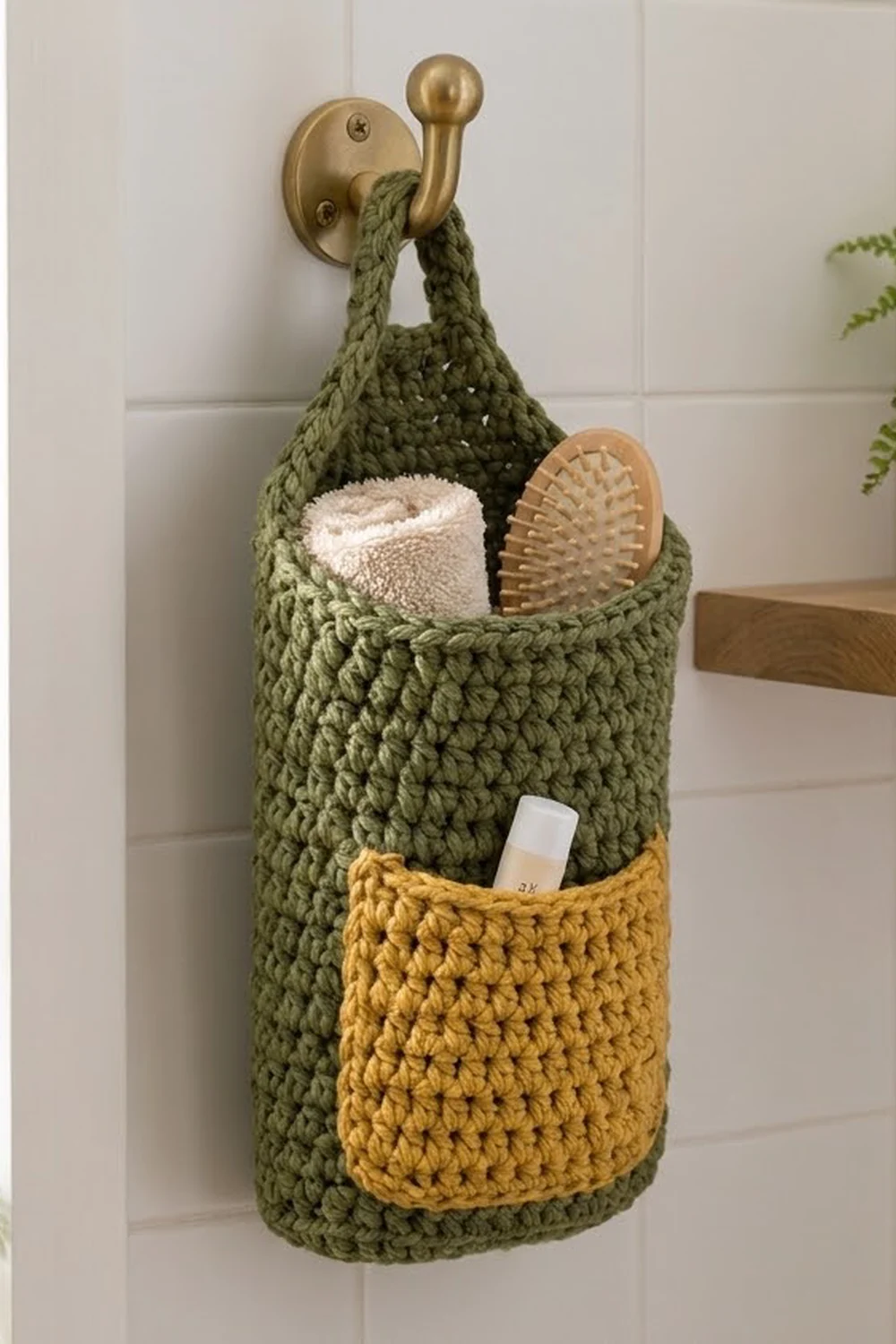
The Olive Grove Hanging Wall Basket is a tall, soft-sided wall organizer. It has an oval base, straight sides, a back tab that narrows into a hanging loop, and a mustard pocket on the front. It works well beside a bed, in a bathroom, or by the door, holding a rolled washcloth, a hairbrush, and small items in the pocket.
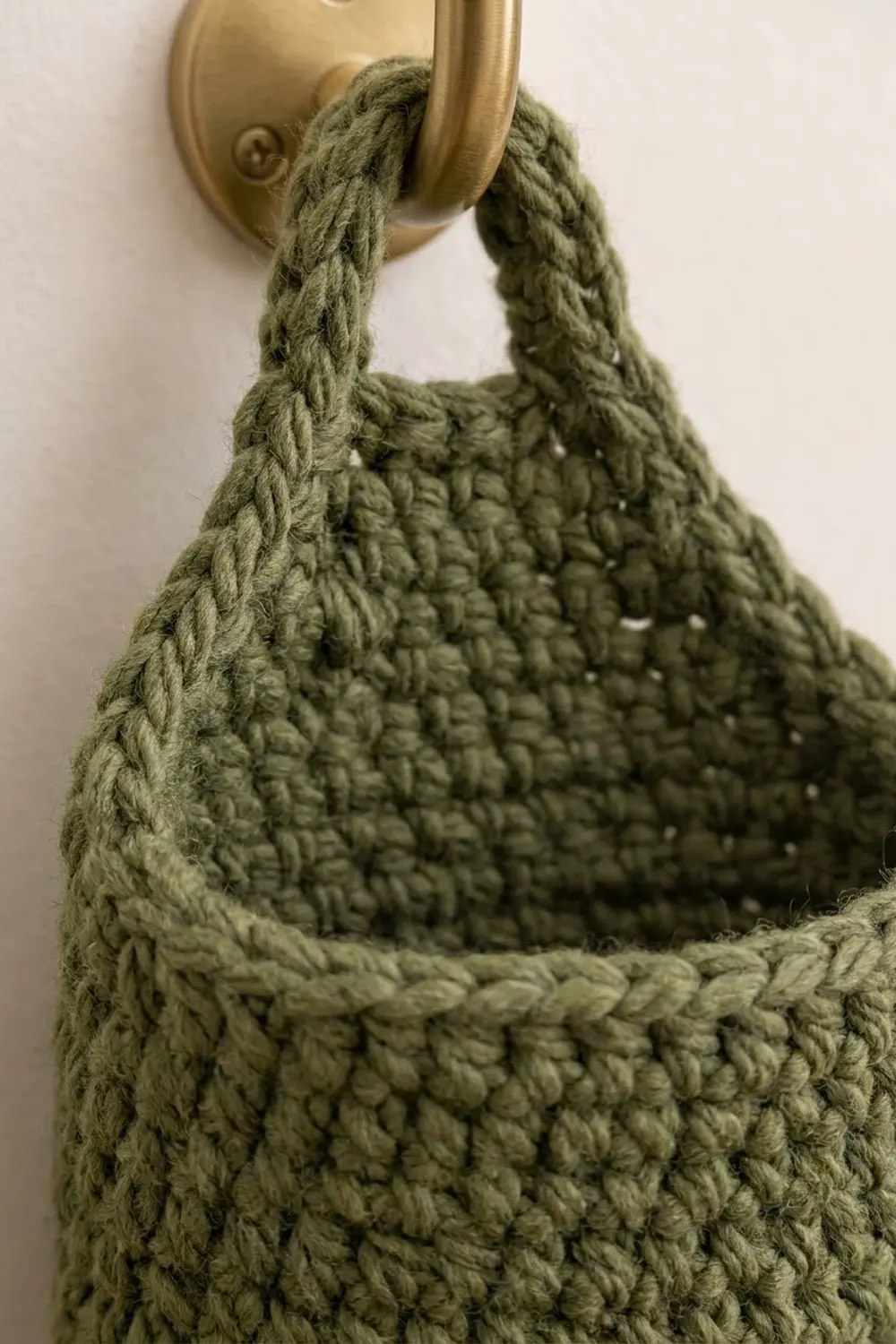
The basket is olive green and the pocket is warm mustard yellow. Both are worked in single crochet in a bulky cotton-blend yarn, so the fabric is dense and chunky. The look is simple and modern, and the basket keeps its shape when full.
This pattern uses US crochet terms. The finished basket is about 6.3 in (16.0 cm) wide when flattened and 8.3 in (21.1 cm) tall at the front rim. With the tab and loop it hangs about 12.5 in (31.8 cm) tall. The pocket measures 5.0 in (12.7 cm) wide by 4.1 in (10.4 cm) tall.
You start with a flat oval base and work the body in spiral rounds. Next you work a tab in rows across the center back and narrow it into a strap. One edging round finishes the rim, tab, and strap. Then you fold the strap into a loop, crochet the pocket as a separate flat rectangle, and sew it to the front.
Finished Size and Construction
- Finished size: 6.3 in (16.0 cm) wide flat × 8.3 in (21.1 cm) front height; 12.5 in (31.8 cm) total hanging height
- Skill level: Easy
- Terminology: US crochet terms
- Yarn weight: Bulky (#5)
- Hook: 6.0 mm (US J-10)
- Number of pieces: 2 (one basket body, one pocket)
- Layout: Pocket centered on the front, 1 in (2.5 cm) above the base fold
- Body circumference: 38 sts = 12.7 in (32.3 cm)
- Body height before edging: 8.0 in (20.3 cm)
- Pocket size before edging: 4.3 in (10.9 cm) wide × 3.4 in (8.6 cm) tall
- Pocket size after edging: 5.0 in (12.7 cm) × 4.1 in (10.4 cm)
- Edging depth: 1 round of sc, about 0.3 in (0.8 cm)
Materials
Use a smooth, firm bulky cotton or cotton-blend yarn. Cotton gives crisp stitches and holds its shape better than acrylic. A soft, loosely spun yarn will make a basket that slumps.
- Olive green (Color A): 120 g / 180 m (197 yd)
- Mustard yellow (Color B): 30 g / 45 m (49 yd)
These amounts assume a yarn of about 150 m per 100 g. They include a margin for your gauge check and for sewing.
Tools:
- 6.0 mm (US J-10) crochet hook
- 1 locking stitch marker for the spiral, plus 4 extra for placement
- Tapestry needle
- Scissors
- Measuring tape
- Rust-proof pins and a rolled towel for blocking
Abbreviations (US Terms)
- ch – chain
- sc – single crochet
- sc2tog – single crochet 2 together: insert hook in next st and pull up a loop, insert hook in the following st and pull up a loop, then yarn over and draw through all 3 loops
- inc – 2 sc in the same stitch
- sl st – slip stitch
- BLO – back loop only
- st(s) – stitch(es)
- rnd(s) – round(s)
- [ ] – repeat the steps in brackets as many times as stated
Special note: Work the body in a continuous spiral without joining. Move the marker up to the first stitch of each new round.
Gauge and Checkpoints
Gauge: 12 sc and 13 rows/rnds = 4 in (10.2 cm) with a 6.0 mm hook.
Treat the base as your test piece. It sets the circumference of the whole body, so check it before you go on.
Checkpoints:
- After Rnd 4 (base): The oval is about 5 in (12.7 cm) long and 2.5 in (6.4 cm) wide, with 38 sts.
- After Rnd 15: The body stands about 3.4 in (8.6 cm) tall above the base ridge and is 6.3 in (16.0 cm) across when flattened.
- After Rnd 30: The body is 8.0 in (20.3 cm) tall.
- After the edging: The front rim height is 8.3 in (21.1 cm).
- Pocket before edging: 4.3 in (10.9 cm) × 3.4 in (8.6 cm).
If your base is too big, start again with a 5.5 mm hook. If it’s too small, try a 6.5 mm hook. Change the hook rather than the stitch counts, because the tab and edging counts depend on 38 sts.
Basket Body
Oval Base
With Color A, ch 10.
Rnd 1: Sc in 2nd ch from hook, sc in next 7 ch, 3 sc in last ch. Rotate to work along the other side of the chain: sc in next 7 ch, 2 sc in the last ch (the same ch as the first sc). Place a marker in the first st. (20 sts)
Rnd 2: Inc in first st, sc in next 7 sts, inc in each of next 3 sts, sc in next 7 sts, inc in each of last 2 sts. (26 sts)
Rnd 3: Sc in first st, inc in next st, sc in next 7 sts, [sc in next st, inc in next st] 3 times, sc in next 7 sts, [sc in next st, inc in next st] 2 times. (32 sts)
Rnd 4: Sc in next 2 sts, inc in next st, sc in next 7 sts, [sc in next 2 sts, inc in next st] 3 times, sc in next 7 sts, [sc in next 2 sts, inc in next st] 2 times. (38 sts)
Each round adds 3 sts at each curved end, and the two long sides stay at 7 sts. The base should lie flat. If it cups, your tension is too tight. If it ruffles, it’s too loose.
Body
Rnd 5: Sc in BLO of each st around. (38 sts)
The unused front loops leave a ridge that gives the basket a crisp bottom edge.
Rnds 6–30: Sc in each st around. (38 sts each rnd)
The sides go straight up with no increases. At the end of Rnd 30, sl st in the next st to smooth out the spiral step. Don’t fasten off. Rnds 5–30 are 26 rounds, which makes the body 8.0 in (20.3 cm) tall.
Finding the Center Back
Flatten the basket so the end of Rnd 30 sits at one side fold. That puts 19 rim sts on the front and 19 on the back. Count the middle 12 sts on the back and mark the first and last of them. The other 26 rim sts stay open for the edging.
Hanging Tab
Join Color A in the first marked back st. If your working yarn is close by, you can carry it over inside the basket instead. Work in rows.
Row 1: Ch 1, sc in each of the 12 marked sts, turn. (12 sts)
Row 2: Ch 1, sc2tog, sc in next 8 sts, sc2tog, turn. (10 sts)
Row 3: Ch 1, sc in each st across, turn. (10 sts)
Row 4: Ch 1, sc2tog, sc in next 6 sts, sc2tog, turn. (8 sts)
Row 5: Ch 1, sc2tog, sc in next 4 sts, sc2tog, turn. (6 sts)
Row 6: Ch 1, sc in each st across, turn. (6 sts)
Row 7: Ch 1, sc2tog, sc in next 2 sts, sc2tog, turn. (4 sts)
The tab is now 2.2 in (5.6 cm) tall. It narrows from 4 in (10.2 cm) wide at the rim to the strap.
Strap
Rows 8–21: Ch 1, sc in each st across, turn. (4 sts each row)
These 14 rows make a strap 4.3 in (10.9 cm) long. Don’t fasten off. Go straight into the basket edging.
With Color B, ch 14.
Row 1: Sc in 2nd ch from hook and in each ch across, turn. (13 sts)
Rows 2–11: Ch 1, sc in each st across, turn. (13 sts each row)
The pocket now measures 4.3 in (10.9 cm) × 3.4 in (8.6 cm). Don’t fasten off. Work the pocket edging (see Border), then attach the pocket as described under Joining.
Make All Pieces
You need 2 pieces in total:
- Color A: 1 basket body with tab and strap
- Color B: 1 pocket
Front layout (flattened, seen from the front):
        [ loop ]
      [  tab   ]
+----------------------+   <- rim edging
|                      |
|   +--------------+   |
|   |    POCKET    |   |   <- top edge open
|   |   (Color B)  |   |
|   +--------------+   |
|                      |   <- 1 in (2.5 cm) gap
+----------------------+   <- base fold (Rnd 5 ridge)
Joining (Attaching the Pocket)
Method: Whipstitch with Color B and a tapestry needle.
- Flatten the basket with the tab centered at the back.
- Center the pocket on the front with its last row at the top. Place the bottom edge 1 in (2.5 cm) above the base ridge. This leaves about 0.6 in (1.5 cm) of olive showing on each side.
- Pin all four corners and mark the center of the bottom edge.
- Using an 18 in (45.7 cm) length of Color B, start at one top corner. Whipstitch down the side, across the bottom, and up the other side.
Stitch-to-stitch logic: For each pocket edging stitch, pass the needle through its outer loop, then under one strand of the olive stitch directly behind it. Make 1 whipstitch per edging stitch.
Tension: Keep the stitches snug but not tight, or the body will pucker. Keep one hand inside the basket so you don’t sew through the back wall.
Leave the top edge open. Checkpoint: The front should still lie flat at 6.3 in (16.0 cm) wide, with no ripples around the pocket.
Border
Border gauge: Same as the main fabric, 12 sc = 4 in (10.2 cm). Work 1 sc per stitch and 1 sc per row-end.
Basket Edging (Color A)
Continue from the end of Strap Row 21.
Edging Rnd: Ch 1. Work 4 sc across Row 21. Rotate and work 14 sc down the strap row-ends (Rows 21–8), then 7 sc down the tab row-ends (Rows 7–1). Sc in each of the 26 open rim sts across the front. Work 7 sc up the other tab side and 14 sc up the other strap side. Sl st to the first sc. (72 sts)
Why the math works:
- Strap top: 4
- Strap sides: 14 + 14 = 28
- Tab sides: 7 + 7 = 14
- Open rim: 26
That gives 4 + 28 + 14 + 26 = 72 sts. The 26 open sts plus the 12 tab sts add up to the full 38-st rim, so nothing is added or lost along the opening.
Form the loop: Fold the strap toward the inside of the basket and line up its top edge with Row 7 of the tab. Sew it down securely with a 12 in (30.5 cm) tail. This makes a loop about 2 in (5.1 cm) deep that fits a wall hook up to 1.5 in (3.8 cm) wide.
Pocket Edging (Color B)
Continue from the end of Row 11.
Edging Rnd: Ch 1.
- 3 sc in the first st (corner), sc in next 11 sts, 3 sc in the last st (corner).
- Working down the side, sc in the row-ends of Rows 10 through 2. (9 sts)
- 3 sc in the first foundation ch (corner), sc in next 11 ch, 3 sc in the last ch (corner).
- Working up the other side, sc in the row-ends of Rows 2 through 10. (9 sts)
- Sl st to the first sc. (52 sts)
Why the math works: The top and bottom each have 11 sts between corners, each side has 9, and each of the 4 corners has 3. That gives 11 + 11 + 9 + 9 + 12 = 52 sts. The edging adds one stitch’s depth to every edge, so the 13-st width grows to 15 sts, or 5.0 in (12.7 cm). The height grows to 4.1 in (10.4 cm). In bulky yarn, the 3-sc corners block into soft curves.
Final Blocking
- Weave in all ends on the inside, through stitches of the same color.
- Lightly mist the whole basket with cool water.
- Stuff it firmly with a rolled towel so the sides stand straight and the base sits flat.
- Smooth the pocket against the front and pin its corners.
- Stand the tab upright and shape the loop around a pen or dowel.
- Let it dry completely, for at least 24 hours.
- Take out the towel and pins, then measure again.
Final Quality-Control Checklist
- The base is an even oval with 38 sts and a clean Rnd 5 ridge.
- Every body round has 38 sts, and the body is 8.0 in (20.3 cm) tall before edging.
- The flattened width is 6.3 in (16.0 cm), within ±0.25 in (0.6 cm).
- The tab is centered on the back, with 12 sts in Row 1.
- The edging has 72 sts and lies flat.
- The loop is sewn securely and doesn’t twist.
- The pocket edging has 52 sts, and the pocket measures 5.0 in × 4.1 in (12.7 cm × 10.4 cm).
- The pocket sits 1 in (2.5 cm) above the base, and its top edge is open.
- No sewing shows on the inside back wall.
Troubleshooting
The body leans or spirals. This is normal for spiral rounds, and blocking over a towel straightens it. On your next basket, you can work joined rounds instead.
The base curls up. Your tension is too tight. Use a hook one size larger for the base only.
The tab is off-center. Undo the tab, count the back stitches again from the side folds, and rework it.
The pocket puckers the front. The whipstitches are too tight. Take them out and sew again more loosely.
The loop stretches. Sew the fold down twice, through both layers. Avoid stretchy yarns.
You run short of Color A. Join the new ball at a side fold, where the join will be hidden.
Care
Hand wash in cool water with mild soap, roll in a towel to remove the water, and stuff the basket to dry. Don’t tumble dry, because heat can shrink cotton and distort the shape.
Final Notes
Here is the measurement chain. A 38-st base at 12 sc per 4 in (10.2 cm) gives a 12.7 in (32.3 cm) circumference, which lies flat at 6.3 in (16.0 cm). Twenty-six body rounds make the body 8.0 in (20.3 cm) tall, and the edging brings the front to 8.3 in (21.1 cm). Twelve back stitches form the tab, which narrows into a strap that folds into a 2 in (5.1 cm) loop. The 72-st edging finishes the opening. The pocket grows from 13 to 15 sts, or 5.0 in (12.7 cm) wide, and is sewn 1 in (2.5 cm) above the base. If your gauge matches, the rest of the measurements will follow.
Happy crocheting!