

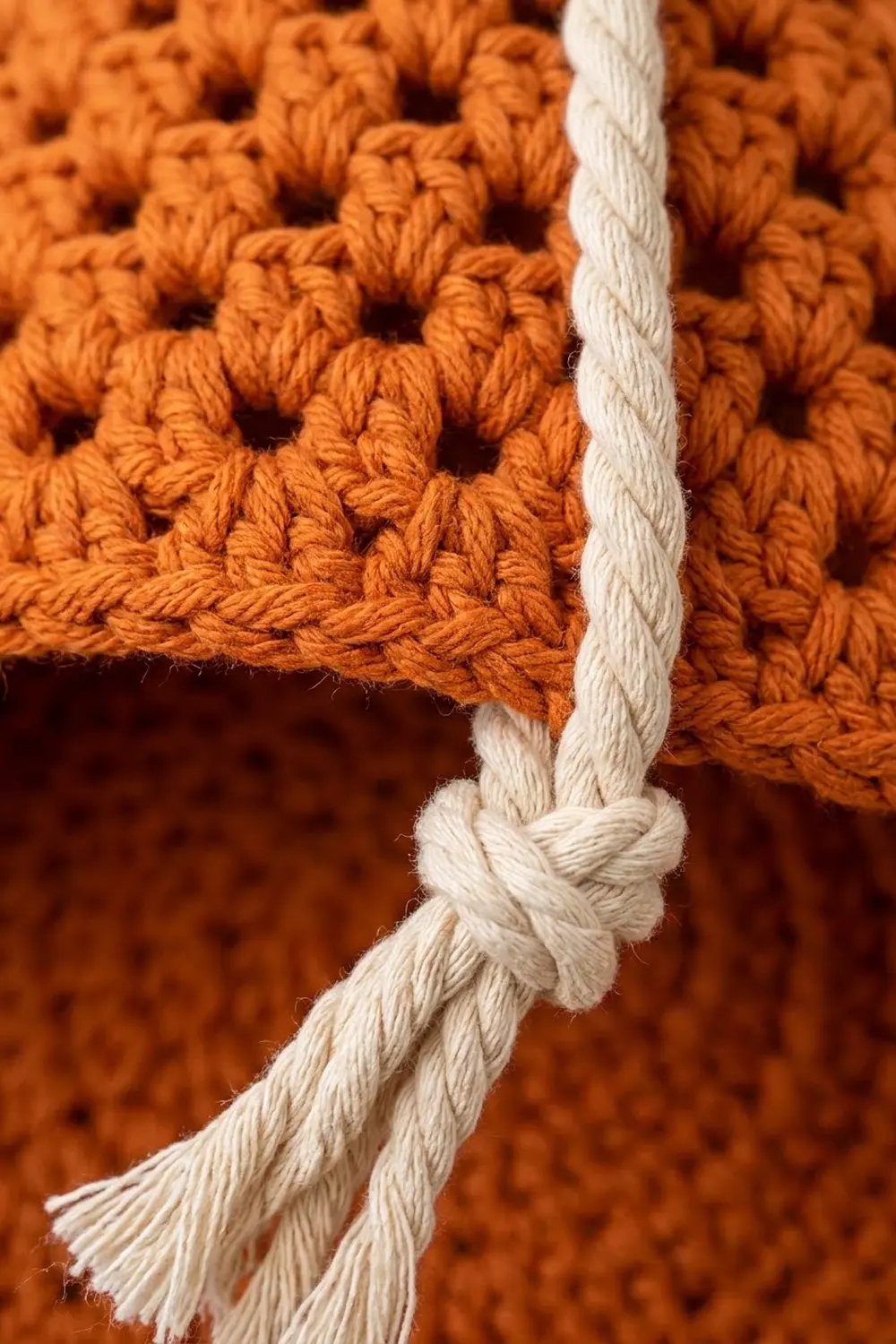
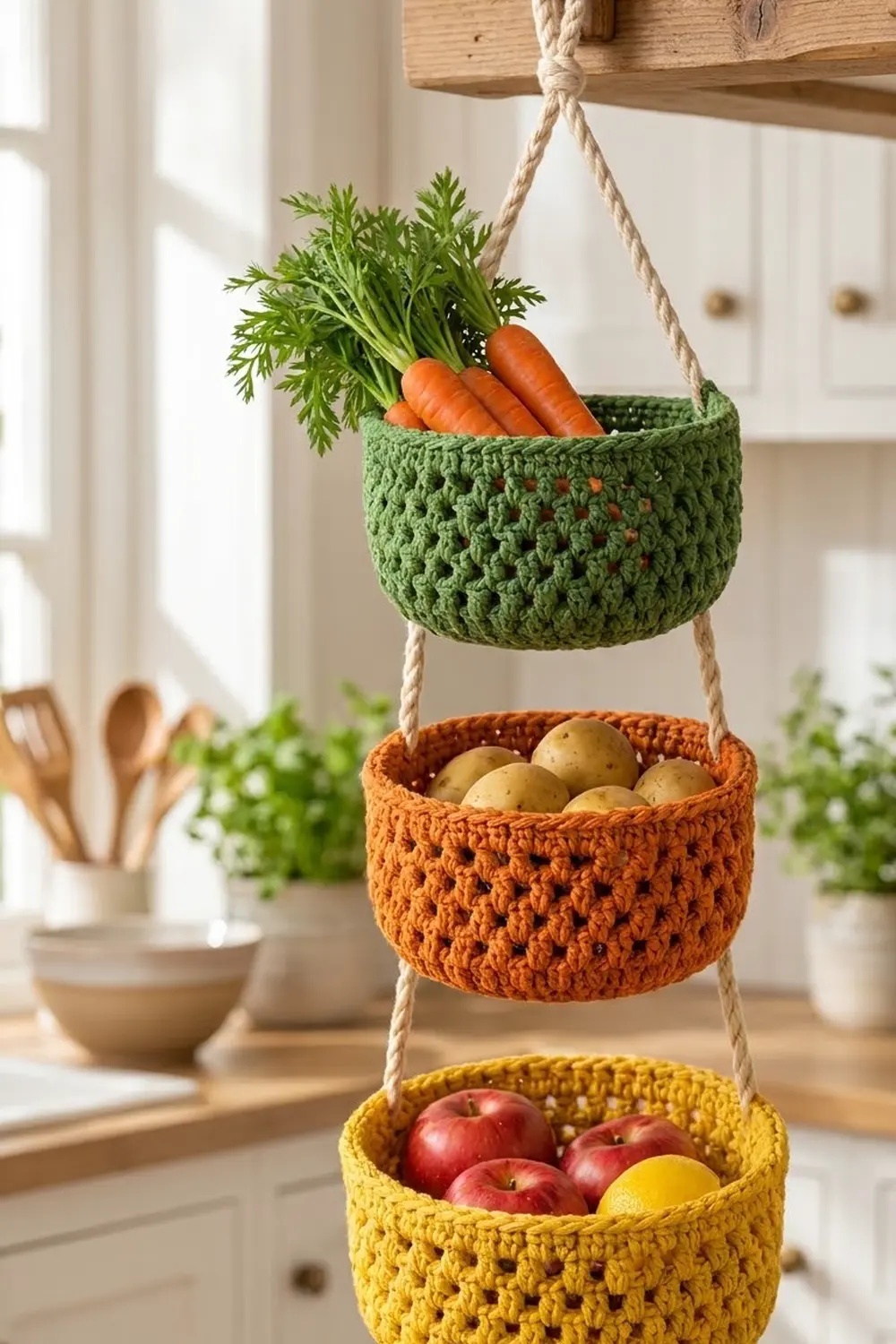
The Orchard Tier is a three-level hanging basket set: three round, open-work crochet baskets stacked on a cream cotton rope hanger. Each basket has a solid single crochet base, granny-cluster walls with little windows for airflow, and a firm single crochet rim. It is designed for kitchen produce such as carrots, potatoes, apples, and lemons.
The colors are a warm harvest trio. The top basket is leaf green, the middle is pumpkin orange, and the bottom is sunflower yellow. The natural rope keeps the look clean, a little farmhouse and a little macramé.
This pattern uses US crochet terms. Each finished basket measures about 7.6 in (19.3 cm) across and 4.5 in (11.4 cm) tall. The hung set measures about 39.5 in (100.3 cm) from the top of the hanging loop to the base of the bottom basket.
Construction is simple. You crochet three identical baskets, each worked from the center of the base outward in joined rounds and then straight up the sides. Then you thread three rope strands through the walls and tie support knots under each basket to set the spacing.
Finished Size and Construction
- Basket size: 7.6 in (19.3 cm) diameter x 4.5 in (11.4 cm) tall
- Hung length: about 39.5 in (100.3 cm), loop included
- Skill level: Easy+ (confident beginner)
- Terminology: US
- Yarn weight: Bulky (#5) cotton or cotton blend
- Hook: 6.0 mm (US J-10)
- Number of pieces: 3 baskets plus 1 rope hanger
- Layout: vertical stack, 1 basket wide x 3 baskets tall
- Base circumference: 72 stitches = 24 in (61.0 cm)
- Wall height before rim: 3.6 in (9.1 cm)
- Rim depth: 0.9 in (2.3 cm)
Materials
Pick a bulky cotton or cotton-blend yarn with a firm twist. Cotton keeps its shape when loaded, doesn’t stretch much under the weight of potatoes, and washes well. Avoid soft acrylic here, because it sags.
- Green (Basket 1): 150 g, about 165 m (180 yd)
- Orange (Basket 2): 150 g, about 165 m (180 yd)
- Yellow (Basket 3): 150 g, about 165 m (180 yd)
- Rope: 8 yd (7.3 m) of 5 mm (0.2 in) natural cotton macramé cord
Tools:
- 6.0 mm (US J-10) hook
- Stitch marker
- Tapestry needle
- Scissors
- Measuring tape
- Masking tape (for rope ends)
Each basket uses about 120 g. The quantities above include a margin for your gauge swatch and small tension differences.
Abbreviations (US Terms)
- ch – chain
- sl st – slip stitch
- sc – single crochet
- dc – double crochet
- inc – 2 sc in the same stitch
- BLO – back loop only
- MR – magic ring
- sp – space
- st(s) – stitch(es)
- rep – repeat
Special stitch – Cluster (cl): 3 dc worked into the same stitch or the same space. One cluster sits over 3 stitches of the round below, so a round of 24 clusters holds 72 dc.
Gauge and Checkpoints
Gauge: 12 sc and 13 rounds = 4 in (10.2 cm). In the cluster section, 1 cluster round = 0.5 in (1.3 cm) tall.
Make one complete basket before you start the other two. Measure at each checkpoint:
- After Round 6 (36 sts): base diameter 3.8 in (9.7 cm)
- After Round 9 (54 sts): base diameter 5.7 in (14.5 cm)
- After Round 12 (72 sts): base diameter 7.6 in (19.3 cm)
- After Round 14: wall height 0.6 in (1.5 cm)
- After Round 20: wall height 3.6 in (9.1 cm)
- After Round 23: full height 4.5 in (11.4 cm)
If your base comes out bigger, change to a 5.5 mm hook. If it’s smaller, change to a 6.5 mm hook. Don’t add or remove base rounds. The wall needs exactly 72 stitches for the cluster repeat to work.
If the base cups upward, your stitches are too tight for the increases. Go up a hook size. If it ruffles, go down one size.
Basket Pattern (Make 3)
Every round is joined with a sl st to the first st. The ch 1 at the start of each sc round does not count as a stitch. Place a marker in the first st of each round.
Base
Round 1: Make a MR, ch 1, 6 sc in ring, join. Pull the ring closed. (6 sts)
Round 2: Ch 1, inc in each st around, join. (12 sts)
Round 3: Ch 1, *sc in next st, inc in next st; rep from * 6 times, join. (18 sts)
Round 4: Ch 1, sc in first st, inc in next st, *sc in next 2 sts, inc in next st; rep from * 4 more times, sc in last st, join. (24 sts)
Round 5: Ch 1, *sc in next 3 sts, inc in next st; rep from * 6 times, join. (30 sts)
Round 6: Ch 1, sc in next 2 sts, inc in next st, *sc in next 4 sts, inc in next st; rep from * 4 more times, sc in last 2 sts, join. (36 sts)
Round 7: Ch 1, *sc in next 5 sts, inc in next st; rep from * 6 times, join. (42 sts)
Round 8: Ch 1, sc in next 3 sts, inc in next st, *sc in next 6 sts, inc in next st; rep from * 4 more times, sc in last 3 sts, join. (48 sts)
Round 9: Ch 1, *sc in next 7 sts, inc in next st; rep from * 6 times, join. (54 sts)
Round 10: Ch 1, sc in next 4 sts, inc in next st, *sc in next 8 sts, inc in next st; rep from * 4 more times, sc in last 4 sts, join. (60 sts)
Round 11: Ch 1, *sc in next 9 sts, inc in next st; rep from * 6 times, join. (66 sts)
Round 12: Ch 1, sc in next 5 sts, inc in next st, *sc in next 10 sts, inc in next st; rep from * 4 more times, sc in last 5 sts, join. (72 sts)
On even rounds, the increases are offset. That keeps the base round instead of hexagonal. Check now that the diameter is 7.6 in (19.3 cm).
Walls
Round 13 (turning round): Ch 1, sc in BLO of each st around, join. (72 sts)
The unworked front loops make a crisp ridge, and the wall turns upward here.
Round 14: Ch 1, sc in each st around, join. (72 sts)
Round 15 (cluster set-up): Ch 3 (counts as first dc), 2 dc in same st as join, skip next 2 sts, *cl in next st, skip next 2 sts; rep from * 22 more times, join with sl st to top of beginning ch-3. (24 clusters, 72 dc)
Round 16: Sl st in next 2 dc and into the sp between this cluster and the next. Ch 3 (counts as dc), 2 dc in same sp, then work cl in each remaining sp between clusters around, join to top of ch-3. (24 clusters, 72 dc)
Rounds 17–20: Rep Round 16 four times. (24 clusters, 72 dc in each round)
You now have 6 cluster rounds. Each new round sits in the gaps of the round below, so the clusters stagger like brickwork and leave small open windows between them. Wall height should be 3.6 in (9.1 cm).
Make All Pieces
Make three identical baskets, one in each color:
- Green: 1 basket (top)
- Orange: 1 basket (middle)
- Yellow: 1 basket (bottom)
Finish every basket through Round 23 (see the Rim section below) before you start the rope hanger. Weave in all ends on the inside.
Layout, top to bottom:
        [ hanging loop ]
              |  11 in (27.9 cm)
        [    GREEN     ]   Basket 1
              |  6 in (15.2 cm)
        [    ORANGE    ]   Basket 2
              |  6 in (15.2 cm)
        [    YELLOW    ]   Basket 3
Joining (Rope Hanger)
The baskets are joined by three rope strands, not by stitching. Each strand passes through the same column of the wall on all three baskets. An overhand knot under each basket takes the weight.
Mark the rope points. On each basket, count the 24 sps between clusters on Round 20. Mark sp 1, sp 9, and sp 17. That puts 8 clusters (24 dc) between each pair of marks, so the three strands sit exactly 120 degrees apart.
Prepare the rope. Cut 3 strands, each 84 in (213.4 cm) long. Wrap each end with masking tape to stop fraying while you thread.
Top loop. Hold the three strands together with the ends even. Tie an overhand loop knot so the loop is 3 in (7.6 cm) long. This uses about 10 in (25.4 cm) of each strand.
Basket 1 (green). Take one strand. From the outside, pass it into a marked sp on Round 20. Bring it back out through the nearest sp on Round 17, then let it run down the outside of the wall. Repeat with the other two strands at the other two marks. Measure 15.5 in (39.4 cm) down each strand from the top loop knot and tie an overhand knot. Slide the basket down until its base sits on the three knots.
Basket 2 (orange). Thread the same way. Tie the support knots 26 in (66.0 cm) below the top loop knot.
Basket 3 (yellow). Thread the same way. Tie the support knots 36.5 in (92.7 cm) below the top loop knot.
Tension. The strands should run straight and taut along the walls without pinching the rim inward. If a rim tilts, one knot is low. Untie it and tighten it so all three knots sit level, then check with the measuring tape.
Size checkpoint. The gap from the base of one basket to the rim of the next should be 6 in (15.2 cm). The overall hung length should be about 39.5 in (100.3 cm). Trim the tails to 3 in (7.6 cm) below the last knots and unravel the ends for a small fringe.
Rim (Border)
Work the rim on each basket straight after Round 20. It is listed here so it reads alongside the rope layout, but it has to be finished before joining.
Rim gauge: 12 sc = 4 in (10.2 cm), the same as the base. That means 72 sts = 24 in (61.0 cm).
Round 21: Ch 1, sc in same st as join, sc in each dc around, join. (72 sts; 24 sts in each of the three sections between rope marks)
Round 22: Ch 1, sc in each st around, join. (72 sts; 24 per section)
Round 23: Sl st loosely in each st around. (72 sl sts; 24 per section) Fasten off and weave in the end.
Why the math works: The base ends at 72 sts. Each cluster replaces exactly 3 sts, and 24 x 3 = 72. The rim takes 1 sc per dc, so it’s back at 72. Because the circumference stays at 72 sts from Round 12 to Round 23, the walls rise straight with no flare. Since 72 divides evenly by 3, the three rope points always land at equal 24-st sections. Rim depth is 0.9 in (2.3 cm), which brings the total to 0.6 + 3.0 + 0.9 = 4.5 in (11.4 cm).
Final Blocking
- Lightly mist each basket with water, or steam it from 1 in (2.5 cm) above.
- Stuff it firmly with a towel or slip it over a round container about 7.6 in (19.3 cm) across.
- Press the base flat and push the Round 13 ridge out into a crisp edge.
- Smooth the walls upright and nudge each cluster window open.
- Let it dry completely, at least 12 hours.
- Block the baskets before threading the rope.
Final Quality-Control Checklist
- Each basket measures 7.6 in (19.3 cm) across and 4.5 in (11.4 cm) tall.
- Every cluster round has 24 clusters.
- Rim rounds have 72 sts.
- The base lies flat with no cupping or ruffling.
- The rope marks sit at sps 1, 9, and 17 on every basket.
- All three support knots under each basket sit level.
- Gaps between baskets are 6 in (15.2 cm).
- Ends are woven in on the inside, and the rope tails are trimmed evenly.
Troubleshooting
Base is wavy: You have too many stitches for your tension. Go down a hook size, or check that you have 6 increases per round, not more.
Base cups like a bowl: Your stitches are too tight. Go up a hook size and relax your grip.
Cluster count is off: You probably skipped 1 st instead of 2 on Round 15. Recount to 72 on Round 14 and redo the round.
Walls flare outward: Your dc are looser than your sc. Use a hook 0.5 mm smaller for Rounds 15–20 only.
Basket tilts when hung: One support knot is lower than the others. Re-tie it to match.
Rope slips through the knot: Tie a double overhand knot instead.
Care
Remove the produce and hand wash the baskets in cool water with mild soap. Reshape them and dry flat, and spot-clean the rope only.
Final Notes
Everything follows one measurement chain. A gauge of 12 sc = 4 in (10.2 cm) gives a 72-st base that is 7.6 in (19.3 cm) across. That carries into 24 straight clusters and a 72-st rim, for a 4.5 in (11.4 cm) basket. Three equal 24-st sections set the rope points, and the 11 in, 6 in, and 6 in (27.9, 15.2, and 15.2 cm) drops give the 39.5 in (100.3 cm) hanger. If you check each link as you go, all three baskets will hang straight and level.
Happy crocheting!