
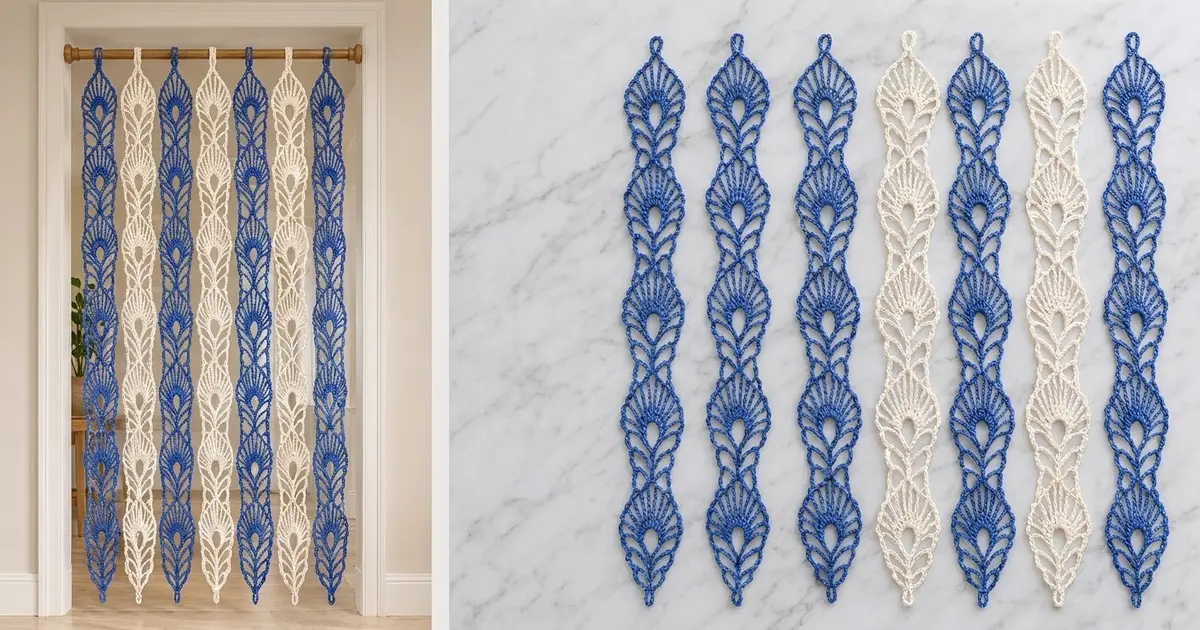
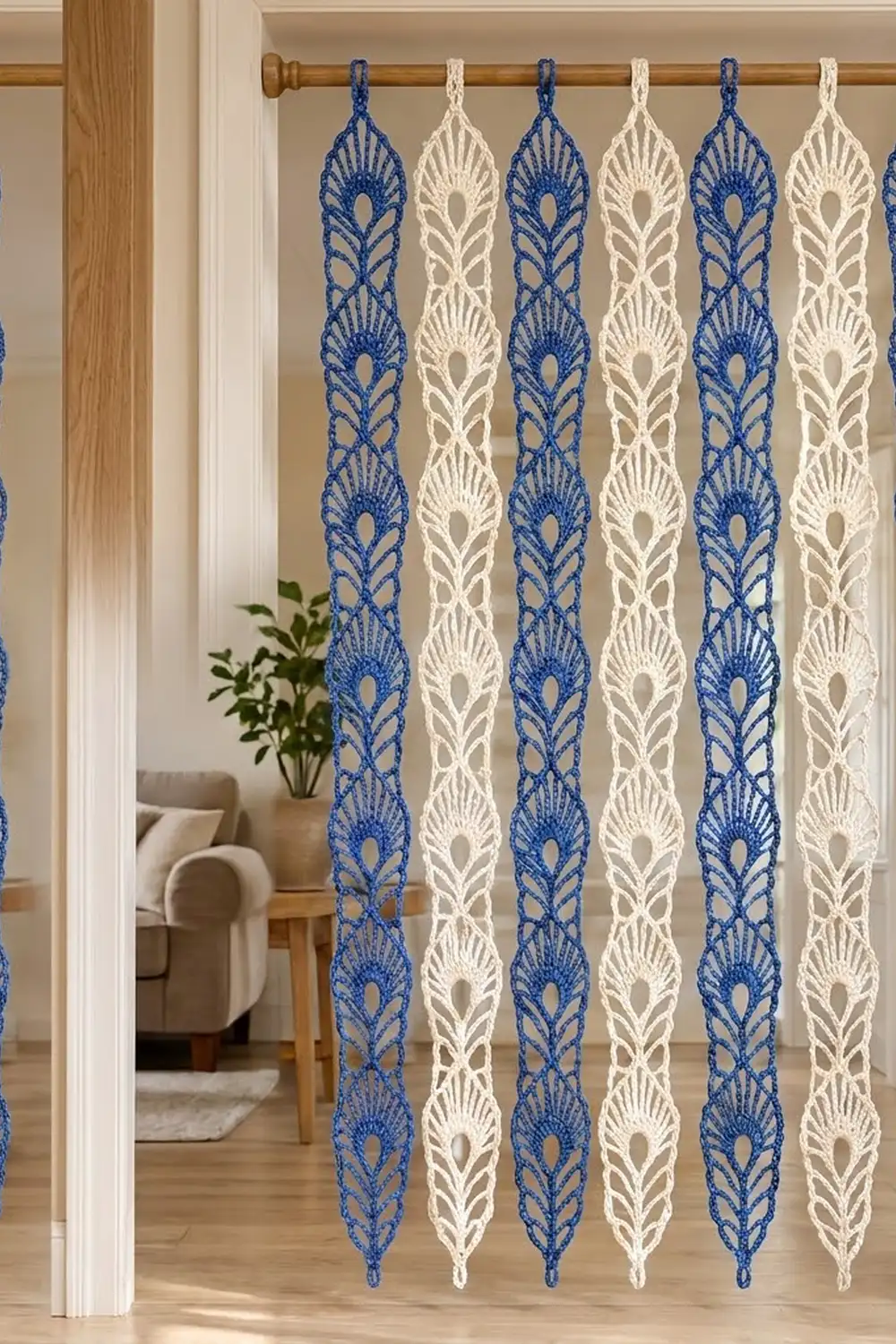
This curtain is made of seven airy strands of peacock feathers. Each strand is a chain of seven elongated feather motifs. Every motif has a dense open “eye”, a fan of long spokes, and a slim herringbone tail that runs down into the next feather. Hung across a doorway, the strands move with every breeze and still let light through.
The sample alternates cobalt blue and cream: four blue strands and three cream strands, starting and ending with blue. Mercerized cotton gives crisp stitch definition and a slight sheen, which suits the feather shapes. The style is open, lacy, and graphic.
The pattern uses US crochet terms. Each strand is 4.5 in (11.4 cm) wide and 79 in (200.7 cm) long, including the hanging loop. The full curtain covers about 31.5 in (80.0 cm) of rod.
Each motif is worked in three rounds around a small ring. You then chain a herringbone tail down from the bottom point. Motifs are joined as you go: the top center arc of each new feather is slip-stitched into the tip ring of the feather above it. Each strand hangs independently from its own loop.
Finished Size and Construction
- Finished curtain: 31.5 in (80.0 cm) wide × 79 in (200.7 cm) long
- Skill level: Intermediate
- Terminology: US
- Yarn weight: #4 worsted, mercerized cotton
- Hook: 5.0 mm (H-8)
- Number of pieces: 49 motifs, joined into 7 strands
- Layout: 7 strands side by side, each 1 motif wide × 7 motifs long
- Motif size: 4.5 in (11.4 cm) wide × 11 in (27.9 cm) long
- Size before edge finish: Same as above. The edge is built into Round 3 and the tail, so nothing is added afterward.
- Border depth: 0 in (0 cm) added. The scalloped arcs form the edge.
Materials
Yarn: Use a worsted-weight mercerized cotton (about 90 m per 50 g). Cotton holds the open shapes and doesn’t stretch much when the strands hang. Avoid acrylic: long strands of it can sag over time.
- Cobalt blue: 250 g / 450 m (4 strands, 28 motifs)
- Cream: 200 g / 360 m (3 strands, 21 motifs)
Each motif uses about 7 g (12.5 m). The quantities above include a margin of roughly 25–35% for your gauge test, the hanging loops, and weaving in ends.
Tools:
– 5.0 mm (H-8) crochet hook
– Tapestry needle
– Scissors
– Stitch markers
– Rust-proof pins and a blocking board
– Spray bottle
– Curtain rod up to 1.25 in (3.2 cm) in diameter
Abbreviations (US Terms)
- ch – chain
- sl st – slip stitch
- sc – single crochet
- dc – double crochet
- tr – treble crochet
- sp – space
- st(s) – stitch(es)
- rnd – round
Leaf pair (special stitch): Ch 14, sl st in 9th ch from hook. This leaves a ch-8 loop sitting on a 6-ch spine segment. Then ch 8 and sl st in the same ch as the last sl st. You now have two ch-8 loops coming out of one point of the spine, one pointing left and one pointing right.
Gauge and Checkpoints
Chain gauge: 10 ch = 3 in (7.6 cm), measured without stretching.
Make one complete motif and measure it before you start a full strand. Check it at each stage:
- After Rnd 1: eye section about 1.75 in (4.4 cm) across
- After Rnd 2: about 3.75 in (9.5 cm) across the spokes
- After Rnd 3: 4.5 in (11.4 cm) wide. The fan is 4 in (10.2 cm) from the top arc to the bottom point.
- Each leaf pair: adds 1.8 in (4.6 cm) of length
- Tip stem and ring: add 1.6 in (4.1 cm)
- Full motif: 4 + 5.4 + 1.6 = 11 in (27.9 cm), measured lightly stretched
If the motif is too big, go down to a 4.5 mm hook. If it is too small, go up to a 5.5 mm hook. A difference of 0.5 in (1.3 cm) per motif adds up to 3.5 in (8.9 cm) over a strand, so get the gauge right before you go further.
Feather Motif (Make 49)
Work with the right side facing throughout. Do not turn.
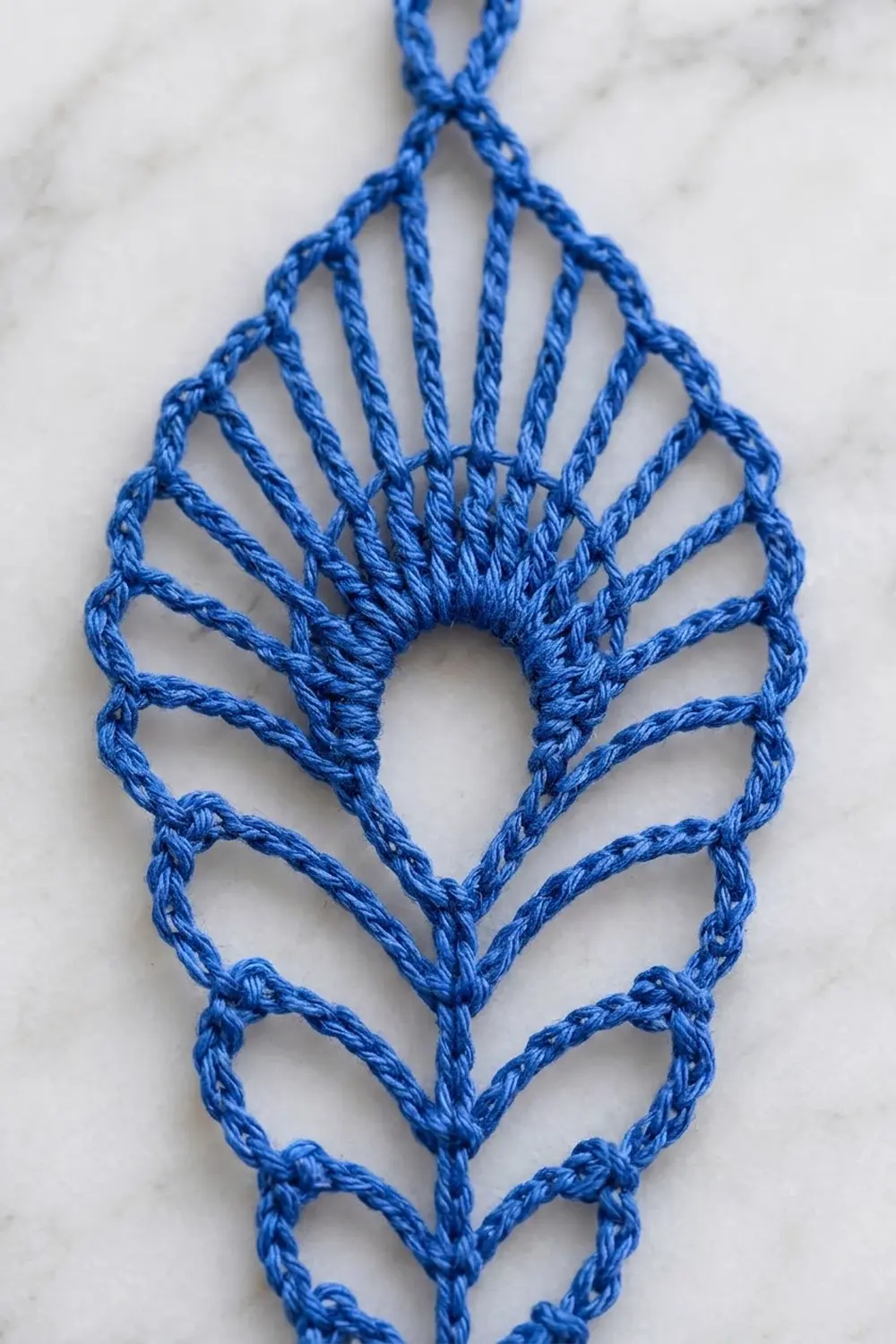
Ring: Ch 10, sl st in first ch to form a ring. This is the eye.
Rnd 1: Ch 10 (counts as dc + ch-7 point), 19 dc in ring, sl st in 3rd ch of beg ch-10.
(20 dc, 1 ch-7 point)
Push the dc together toward the top of the ring. The ch-7 hangs below the ring and pulls the eye into a teardrop.
Rnd 2 (spokes): Sl st in ch-7 point sp, ch 1, sc in same sp, ch 2. [Tr in next dc, ch 2] 19 times. Tr in 3rd ch of beg ch-10, ch 2, sl st in first sc.
(20 tr, 1 sc, 21 ch-2 sps)
Rnd 3 (scalloped fan edge): Ch 1, sc in same sc. Ch 9, sc in next tr. [Ch 4, sc in next tr] 19 times. Ch 9, sl st in first sc.
(21 sc, 19 ch-4 arcs, 2 ch-9 side arcs)
The ch-4 arcs skip over the ch-2 spaces and sit on top of the tr, which forms the rounded scallops. The two ch-9 arcs run down the sides of the motif to the point.
The 10th ch-4 arc is the top center arc, with 9 arcs on each side of it. On Motif 1 of each strand, and on every joined motif, you work this arc differently (see Joining). On a gauge swatch, work it as a plain ch-4.
Tail: Working from the point sc:
- Work 1 leaf pair (ch 14, sl st in 9th ch from hook, ch 8, sl st in same ch).
- Repeat the leaf pair 2 more times, starting each new one from the last sl st.
(3 leaf pairs: 6 ch-8 leaf loops, 18 spine ch)
Tip: Ch 9, sl st in 5th ch from hook. This makes a 4-ch stem and a ch-4 tip ring. Fasten off, leaving a 4 in (10.2 cm) tail.
After blocking, the leaf loops angle downward and outward from each knot on the spine. This creates the herringbone V shapes below the eye.
Make All Pieces
- Cobalt blue: 28 motifs (4 strands × 7)
- Cream: 21 motifs (3 strands × 7)
Make the motifs strand by strand. That way each finished strand can be checked against the length checkpoint before you move on.
Layout (front view, left to right, 7 motifs down each strand):
B  C  B  C  B  C  B
B  C  B  C  B  C  B
B  C  B  C  B  C  B
B  C  B  C  B  C  B
B  C  B  C  B  C  B
B  C  B  C  B  C  B
B  C  B  C  B  C  B
B = cobalt blue, C = cream. Each column is one strand.
Joining
Method: Join as you go in Rnd 3, at the top center (10th) arc. Strands are never joined to each other.
Motif 1 of each strand (hanging loop): Work Rnd 3 as written until you reach the 10th arc. Work it as: ch 2, ch 14, sl st in first of those 14 ch, ch 2. Then sc in the next tr and finish the round.
The ch-14 loop is about 4.2 in (10.7 cm) around. That fits a rod up to 1.25 in (3.2 cm) in diameter and adds 2 in (5.1 cm) to the strand.
Motifs 2–7: Hold the strand finished so far with its last tip ring pointing toward the new motif, both with right sides facing you. Work Rnd 3 of the new motif to the 10th arc. Work it as: ch 2, sl st in the ch-4 tip ring of the previous motif, ch 2. Then sc in the next tr and finish the round, tail, and tip.
Stitch-to-stitch logic: The join replaces one ch-4 arc with ch 2 + sl st + ch 2. That’s still 4 chains, so every motif keeps exactly 19 arcs and the fan doesn’t pucker. Each join sits inside the tip ring, so it adds no length.
Tension: Keep the joining sl st loose. A tight join pulls the scallops into a point and twists the next motif.
Size checkpoint: A finished strand is 2 in (5.1 cm) + 7 × 11 in (27.9 cm) = 79 in (200.7 cm). Check after Motif 4: from the top of the loop it should be 2 + 44 = 46 in (116.8 cm).
Edge Finish (Built-In Border)
The curtain has no added border. Rnd 3 and the leaf loops form a finished scalloped edge on every motif, so this section confirms the counts.
Edge gauge: Each ch-4 arc spans about 0.6 in (1.5 cm) along the curved fan.
Edge count per motif:
- Top fan: 19 ch-4 arcs (9 left + 1 center + 9 right)
- Each side: 9 fan arcs + 1 ch-9 side arc + 3 leaf loops = 13 edge loops
- Bottom: 1 ch-4 tip ring
Edge count per strand side: 7 motifs × 13 loops = 91 edge loops. No stitches are added at the joins, because each join happens inside a center arc that isn’t counted as a side loop.
Why the math works: 20 tr leave 19 gaps, so Rnd 3 makes 19 arcs. An odd number of arcs always has one true center arc, so each motif hangs straight below the one above it. The 2 ch-9 arcs connect the outer tr to the point sc, which closes the round evenly at 21 sc.
Final Blocking
- Weave in all ends along the chain spine or inside the dc of Rnd 1 before you wet anything.
- Soak each strand in cool water for 10 minutes. Press out the water in a towel; don’t wring.
- Pin one motif at a time to 4.5 in (11.4 cm) wide, placing a pin in every ch-4 arc.
- Pin the eye open into a teardrop shape.
- Pin the leaf loops so they angle down and outward, with each pair making a V.
- Pin the strand straight, measuring it to 79 in (200.7 cm).
- Let it dry completely, at least 24 hours, before unpinning.
Final Quality-Control Checklist
- Every motif has 20 dc, 20 tr, 19 ch-4 arcs, 2 ch-9 arcs, and 3 leaf pairs.
- Each strand has 7 motifs, joined through the center arc.
- Each motif measures 4.5 × 11 in (11.4 × 27.9 cm).
- Each strand measures 79 in (200.7 cm), and all seven are within 0.5 in (1.3 cm) of each other.
- The colors run B, C, B, C, B, C, B.
- The hanging loops fit over the rod.
- All ends are secure and hidden.
Troubleshooting
- The fan cups or ruffles: Your tr are too tall or the arcs too long. Go down a hook size, or check that you’re working ch 4, not ch 5.
- The eye closes up: The dc in Rnd 1 are too tight. Work them more loosely, or make the ring ch 11.
- Motifs twist on the strand: You joined in the wrong arc. Count 9 arcs on each side of the join.
- Strands are different lengths: Your tension drifted on the spine chains. Block the shorter strands a little longer, or redo that tail.
- Leaf loops flop flat: Block them again with a pin in each loop and let them dry fully.
Care
Hand wash in cool water with mild soap and dry flat, pinned to shape. Take the strands off the rod before washing so their weight doesn’t stretch them.
Final Notes
The measurement chain:
- 10 ch = 3 in (7.6 cm)
- Fan = 4.5 × 4 in (11.4 × 10.2 cm)
- Three leaf pairs + tip = 7 in (17.8 cm)
- One motif = 11 in (27.9 cm)
- Seven motifs + loop = 79 in (200.7 cm)
- Seven strands = 31.5 in (80.0 cm) of rod
Check each link in that chain and the whole curtain will hang evenly. Happy crocheting!