

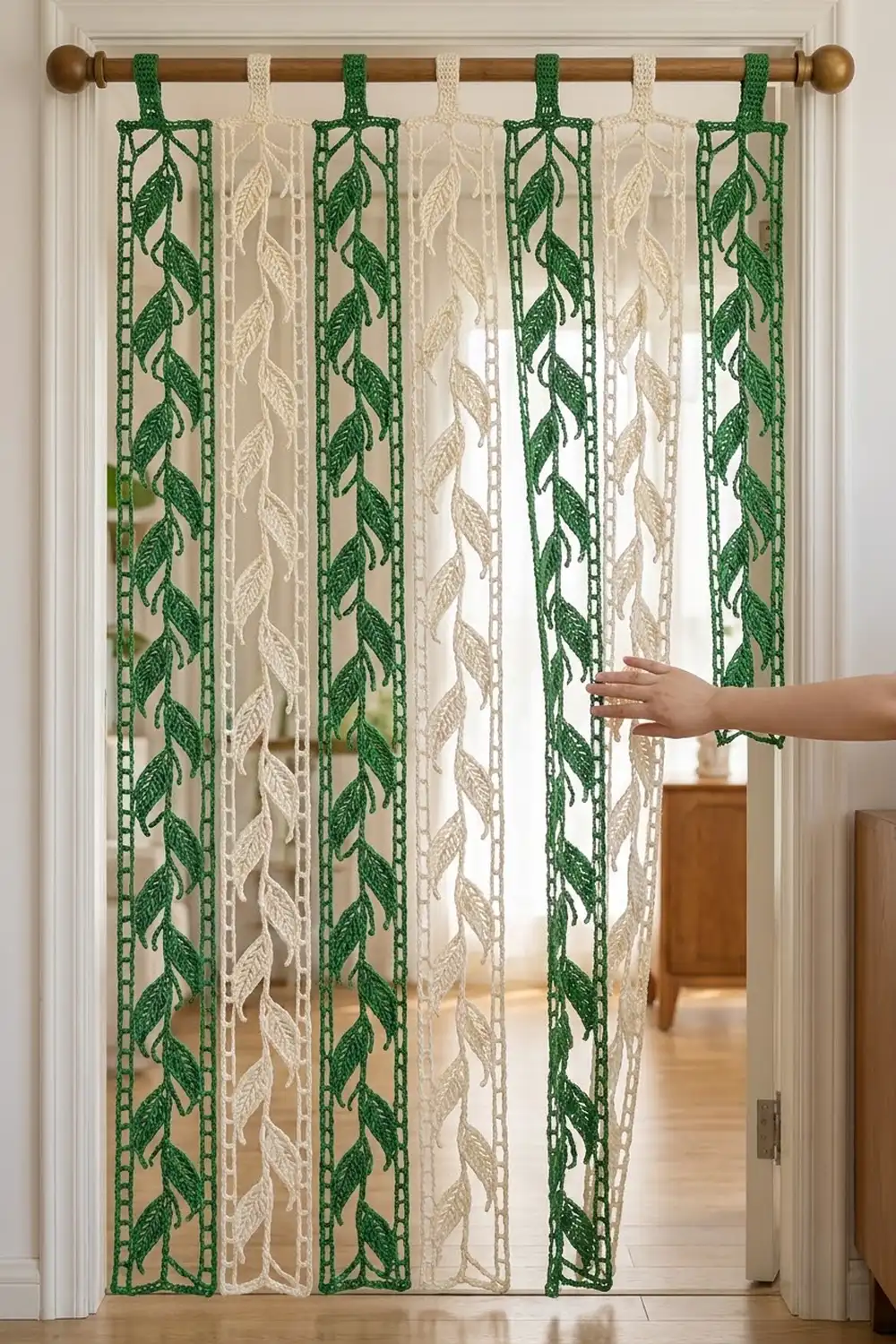
This doorway curtain is made of seven long, narrow strips. Each strip has a ladder rail along both edges, an open center channel, and a slim chain vine running down the middle with solid leaves that alternate left and right and point upward. The strips hang side by side from a wooden rod on small loop tabs. They are not sewn to each other, so you can walk through the curtain and push strips aside by hand.
The sample alternates two colors: four strips in a rich kelly green and three in a soft cream, in the order green, cream, green, cream, green, cream, green. The look is airy and botanical, a little vintage, and works well in a doorway, a closet opening, or over a sunny window.
This pattern uses US crochet terms. Each strip measures 4 in (10.2 cm) wide and 73 in (185.4 cm) long, plus a 1.75 in (4.4 cm) hanging tab. With 1 in (2.5 cm) gaps, the seven strips cover 34 in (86.4 cm).
Here is how each strip goes together. You make two ladder rails, one chain vine, and 17 leaves. A short sc edging at the top and bottom joins the rails and vine, and a tab is worked off the top edging. Then you sew the leaves to the vine and tack each leaf tip to a rail.
Finished Size and Construction
- Finished strip size: 4 in x 73 in (10.2 cm x 185.4 cm), plus tab
- Skill level: Intermediate (simple stitches, long repeats, careful assembly)
- Terminology: US crochet terms
- Yarn weight: Worsted (weight 4) cotton
- Hook: 5 mm (US H-8)
- Number of pieces: 7 separate strips (4 green, 3 cream)
- Layout: 7 strips in one row, hung 1 in (2.5 cm) apart, not joined
- Pieces per strip: 2 rails, 1 vine, 17 leaves, 1 tab
- Strip size before edging: 4 in x 72 in (10.2 cm x 182.9 cm)
- Edging depth: 0.5 in (1.3 cm) at the top and at the bottom
- Total curtain width: 34 in (86.4 cm)
Materials
Use a smooth, mercerized or matte worsted cotton. Cotton hangs straight, holds the leaf shapes, and won’t stretch over time the way acrylic can under its own weight. Avoid fuzzy yarns, because they hide the ladder rungs.
- Color A, kelly green: about 400 g / 620 m (680 yd), for 4 strips
- Color B, cream: about 300 g / 465 m (509 yd), for 3 strips
One strip uses about 124 m (136 yd). The quantities above include a margin of about 25% for gauge differences, swatching, and long sewing tails.
Tools:
- 5 mm (US H-8) crochet hook
- Tapestry needle
- Stitch markers (at least 10)
- Measuring tape
- Rust-proof pins and a long blocking surface or clean floor towels
- Curtain rod at least 36 in (91.4 cm) long, up to 1.25 in (3.2 cm) in diameter
Abbreviations (US Terms)
- ch – chain
- sl st – slip stitch
- sc – single crochet
- hdc – half double crochet
- dc – double crochet
- tr – treble crochet
- sk – skip
- sp – space
- st(s) – stitch(es)
- RS – right side
Special technique – back-bump slip stitch: Turn the chain over. Each chain has a small bump on its back. Insert the hook under this bump only and work a sl st. This gives a firm, round cord with a neat chain on the front.
Gauge and Checkpoints
- Chain gauge: 4 ch = 1 in (2.5 cm)
- Ladder gauge: 4 ladder spaces (dc, ch 2) = 3 in (7.6 cm); one ladder row is 0.75 in (1.9 cm) tall
- Sc gauge: 4 sc and 4 rows = 1 in (2.5 cm)
- Leaf: 2.75 in x 1.25 in (7.0 cm x 3.2 cm), not counting the stem
Test piece first. Ch 38 and work the rail pattern below. You get 12 rungs and 11 spaces, and the row should measure 8.25 in (21.0 cm) long. Also make one leaf. Keep both swatches, because they show you the finished texture.
Checkpoints:
- Test rail: 8.25 in (21.0 cm) long, 0.75 in (1.9 cm) wide.
- Full rail after 24 spaces: 18 in (45.7 cm). After 48 spaces: 36 in (91.4 cm). Finished: 72 in (182.9 cm).
- Vine: 70.5 in (179.1 cm).
- Edging Row B: 19 sc, lying flat along the V.
- Finished strip: 73 in (185.4 cm).
If your piece is too big, go down a hook size (4.5 mm). If it is too small, go up to 5.5 mm. The length matters most, because the curtain will hang. The rail and vine have to match each other, so always check them against each other.
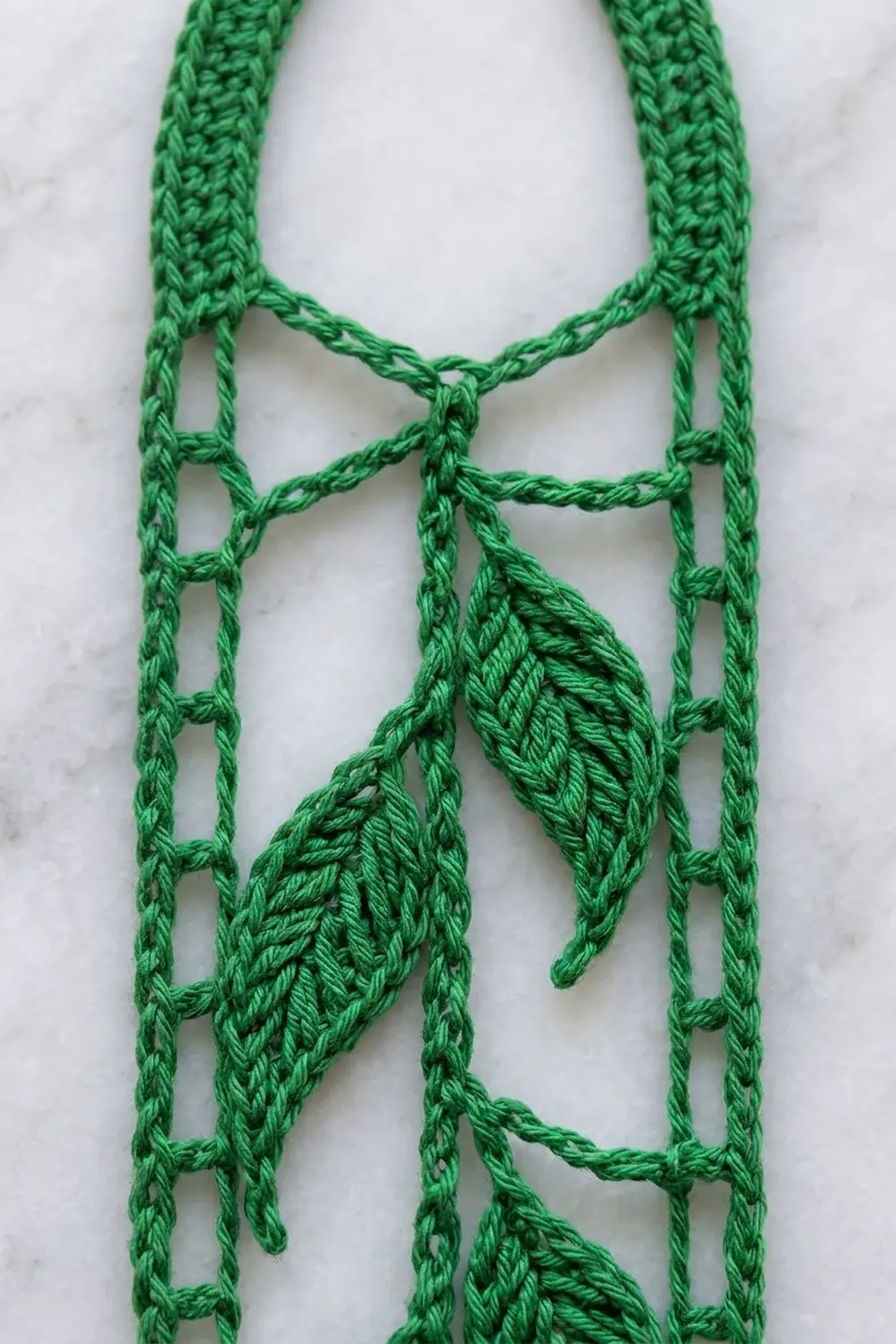
Rails (Make 2 per Strip)
The rail is one ladder row worked along a foundation chain. The foundation chain is one edge of the ladder, the tops of the dc and ch-2 spaces are the other edge, and the dc posts are the rungs.
Row 1: Ch 293.
Row 2: Dc in 8th ch from hook (skipped chs count as dc, ch 2). *Ch 2, sk 2 ch, dc in next ch; rep from * across. Fasten off. (97 rungs, counting the turning ch as a rung; 96 ch-2 spaces.)
Check the math: the first dc uses 8 chains. Each of the 95 repeats uses 3 more, so 8 + (95 x 3) = 293. 96 spaces x 0.75 in = 72 in (182.9 cm).
Make a second rail the same way. Before joining, place the rails side by side, then turn the second rail 180° so its foundation chain is on the outside edge. Now both foundation chains are on the outer edges of the strip and both dc-top edges face the center. Leave 2.5 in (6.4 cm) of open space between the rails. Total width: 0.75 + 2.5 + 0.75 = 4 in (10.2 cm).
Vine (Make 1 per Strip)
Row 1: Ch 283.
Row 2: Back-bump sl st in 2nd ch from hook and in each ch across. Fasten off and leave a 6 in (15.2 cm) tail at each end. (282 sl sts.)
The vine should measure 70.5 in (179.1 cm). It is 1.5 in (3.8 cm) shorter than the rails, so the top and bottom edgings can dip 0.75 in (1.9 cm) to meet it. That dip makes the shallow V at each end of the strip. If your sl sts tighten the cord, add chains until the length matches.
Leaves (Make 17 per Strip)
Each leaf is worked around both sides of a short chain. Taller stitches in the middle make it wide, and it narrows to a point at the tip.
Foundation: Ch 11.
Rnd 1: Sc in 2nd ch from hook, hdc in next ch, dc in next 2 ch, tr in next 2 ch, dc in next 2 ch, hdc in next ch, 3 sc in last ch (tip). Rotate and work along the free loops of the foundation: hdc in next ch, dc in next 2 ch, tr in next 2 ch, dc in next 2 ch, hdc in next ch, sc in same ch as first sc. Do not join. (21 sts: 9 on each side + 3 at the tip.)
Rnd 2 (edging): Working in back loops only, sc in next 10 sts. (Sc, ch 2, sc) in center tip sc. Sc in next 10 sts. (22 sc and a ch-2 tip.)
Stem: Ch 5, sl st in 2nd ch from hook and in next 3 ch, sl st into base of leaf. Fasten off and leave an 8 in (20.3 cm) tail.
The back-loop edging leaves a raised ridge around the leaf. Twist the stem slightly so it curls, like the leaves in the photo. Each leaf should measure 2.75 in x 1.25 in (7.0 cm x 3.2 cm).
Make All Pieces
For the whole curtain:
- Green (4 strips): 8 rails, 4 vines, 68 leaves
- Cream (3 strips): 6 rails, 3 vines, 51 leaves
- Total: 7 strips, 119 leaves
Layout (front view, left to right):
| G | C | G | C | G | C | G |
  1   2   3   4   5   6   7
G = green strip, C = cream strip. Each letter is one complete 4 in x 73 in (10.2 cm x 185.4 cm) strip.
Tip: make leaves in batches of ten and keep each color in its own bag.
Joining (Hanging the Strips)
The strips are never joined to each other. Each one is assembled and edged on its own (see Border below), then hung on the rod by its tab. With nothing stitched between strips, there are no extra seam stitches to count and each strip keeps its own 19-st edging.
Method:
- Slide the tabs onto the rod in the layout order.
- Space the strips 1 in (2.5 cm) apart. Seven strips at 4 in plus six gaps at 1 in: 28 + 6 = 34 in (86.4 cm).
- For a wider doorway, increase each gap evenly rather than stretching the strips.
Tension advice: Let each strip hang for 24 hours before final spacing. Cotton relaxes a little. If one strip ends up more than 0.5 in (1.3 cm) longer than the others, re-block it (see below).
Size checkpoint: All seven strips should hang at 73 in (185.4 cm) ± 0.5 in (1.3 cm), measured from the base of the tab.
Border (Top and Bottom Edging, Plus Tab)
The long edges of each strip don’t get a border. The foundation chains of the rails already make clean outer edges. The edging is worked only across the two short ends, and it joins the rails and vine into one piece.
Border gauge: 4 sc = 1 in (2.5 cm).
Top Edging
Lay out the rails and vine. Put the vine in the center and its top end 0.75 in (1.9 cm) below the top ends of the rails. Pin it in place.
Row A (RS): Join yarn at the outer top corner of the left rail. Ch 1, work 3 sc evenly across the end of the rail. Ch 6, sc through the end chain of the vine, ch 6. Work 3 sc evenly across the end of the right rail. Turn. (7 sc, 2 ch-6 sps.)
Row B: Ch 1, sc in first 3 sc, 6 sc in ch-6 sp, sc in vine sc, 6 sc in ch-6 sp, sc in last 3 sc. Do not fasten off. (19 sc: 3 + 6 + 1 + 6 + 3.)
Why the math works: each rail end is one ladder row tall, 0.75 in (1.9 cm), so 3 sc fit at 4 sc per inch. Each ch-6 is 1.5 in (3.8 cm) long. That covers a diagonal running 1.25 in (3.2 cm) across and 0.75 in (1.9 cm) down. Together they form the V. Along the edging, the 19 sc measure 4.75 in (12.1 cm). Straight across, the strip is still 4 in (10.2 cm) wide, because the V uses up the difference. The edging lies flat with no ruffling or pulling.
Tab
Row 1: Turn. Sl st across the first 7 sc. Ch 1, sc in next 5 sc (sts 8–12, centered on the vine sc). (5 sc.)
Rows 2–14: Ch 1, turn, sc in each sc across. (5 sc.)
Fasten off with a 10 in (25.4 cm) tail. The tab is 3.5 in (8.9 cm) long. Fold it to the back and whipstitch Row 14 to the back of Row B, sts 8–12. The loop is 1.75 in (4.4 cm) tall and 1.25 in (3.2 cm) wide, so it fits a rod up to 1.25 in (3.2 cm) across.
Bottom Edging
Pin the bottom end of the vine 0.75 in (1.9 cm) above the bottom ends of the rails. Work Rows A and B exactly as for the top, starting at the outer bottom corner of the right rail. (19 sc.) Fasten off. This makes a V at the bottom that points up toward the vine, as in the photo.
Each edging adds 0.5 in (1.3 cm), so the strip is 72 + 0.5 + 0.5 = 73 in (185.4 cm).
Attaching the Leaves
Measure along the vine from the top V point and place a marker every 4 in (10.2 cm). That gives 17 markers, at 4 in through 68 in (172.7 cm). The last leaf sits 2.5 in (6.4 cm) above the bottom V point.
Sew the leaves on so they alternate, starting on the left. Leaves at odd markers go on the left (9 leaves). Leaves at even markers go on the right (8 leaves). Sew each stem end to the vine. Point the leaf upward and outward, and tack its tip to the nearest rung on the inner edge of the rail. Those tacks keep the rails 2.5 in (6.4 cm) apart along the whole strip.
Final Blocking
- Weave in all ends, running each one along a rail or through a leaf.
- Soak each strip in cool water for 10 minutes, then gently press out the water. Don’t wring.
- Lay the strip flat on towels. Measure: 4 in (10.2 cm) wide, 73 in (185.4 cm) long.
- Pin the rails straight and parallel, with the channel 2.5 in (6.4 cm) wide.
- Pin the V edgings so they lie flat, and pin each leaf flat with its tip at the rail.
- Let the strip dry completely. Then hang it for 24 hours before you set the final spacing.
Final Quality-Control Checklist
- Each rail has 97 rungs and 96 spaces.
- Each vine is 70.5 in (179.1 cm) long.
- Each strip has 17 leaves: 9 on the left, 8 on the right.
- The top and bottom edgings each have 19 sc.
- Each tab has 14 rows and is securely sewn down.
- Each strip measures 4 in x 73 in (10.2 cm x 185.4 cm).
- The strips are in order G-C-G-C-G-C-G.
- No loose ends show on the front.
Troubleshooting
- Rail twists into a spiral: Your foundation chain is tighter than your dc row. Work the chain with a hook one size larger.
- Vine sags in the middle: It is too long. Undo a few sl sts at one end and take out chains.
- Edging ruffles: Work 5 sc in each ch-6 sp instead of 6 (17 sc), then center the tab over sts 7–11.
- Leaves curl too much: Block them firmly, or work Rnd 2 in both loops.
- Strips hang at different lengths: Re-wet the longer strip and pin it to 73 in (185.4 cm).
- Tab is too tight for the rod: Add 2 rows to the tab before folding.
Care
Hand wash in cool water with mild soap and dry flat. Re-block if needed. Don’t tumble dry, because heat can shorten cotton strips unevenly.
Final Notes
The whole curtain depends on a short chain of measurements. Four ladder spaces measure 3 in (7.6 cm), so 96 spaces make a 72 in (182.9 cm) rail. The vine is 70.5 in (179.1 cm) to leave room for the 0.75 in (1.9 cm) V at each end. The 19-st edging adds 0.5 in (1.3 cm) to each end, for a strip 4 in x 73 in (10.2 cm x 185.4 cm). Seven strips with 1 in (2.5 cm) gaps fill 34 in (86.4 cm). If your test rail matches, the full curtain will too.
Happy crocheting!