

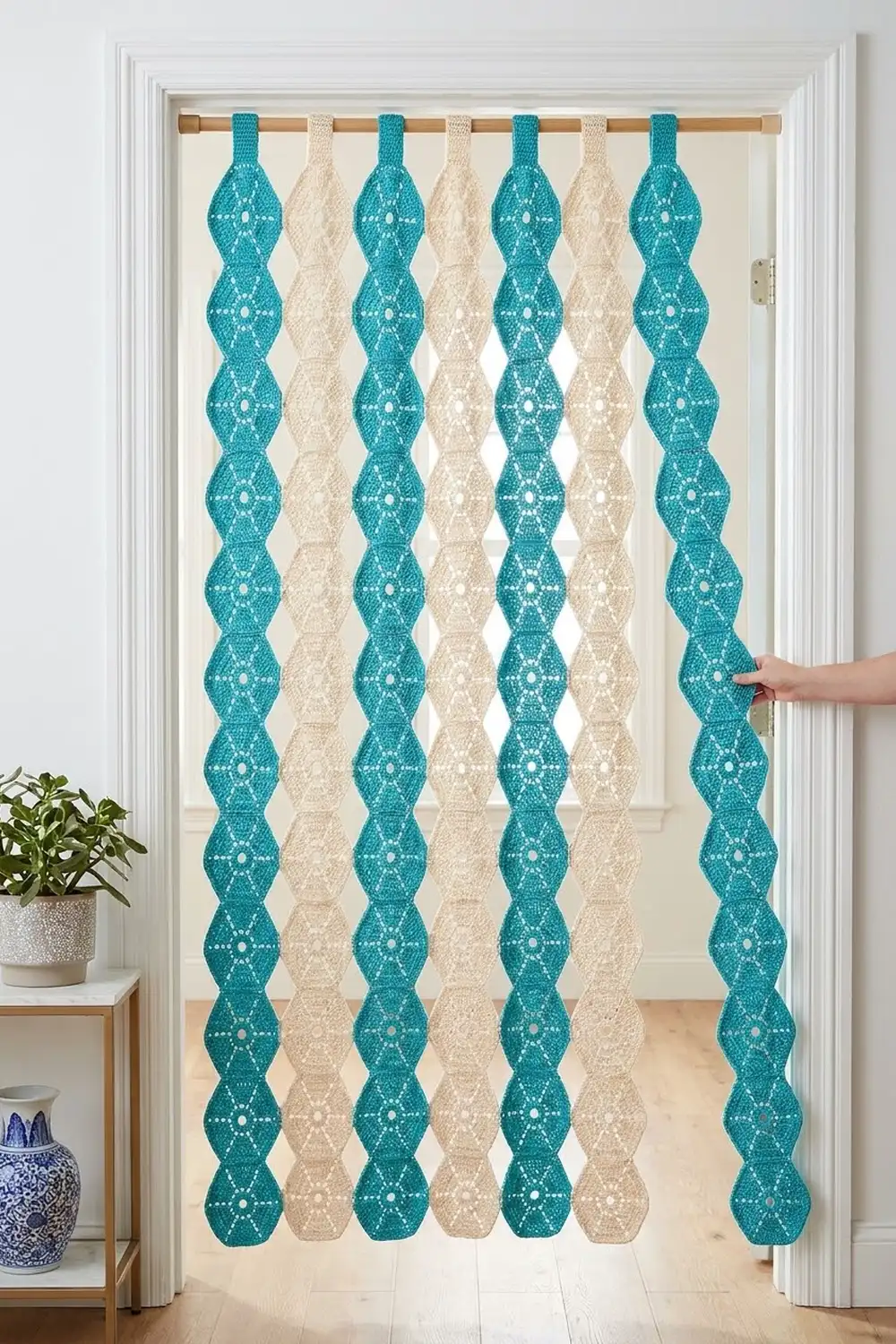
This door curtain is made of seven long, lacy strips of hexagon motifs that hang side by side from a rod. Each hexagon has a small open ring in the center, six slim chain spokes, and six small treble fans that point into the corners. A solid round of double crochet outlines each hexagon. A raised single crochet ridge joins each motif to the next, so every strip looks like a chain of openwork stars.
The colorway alternates bright teal and soft cream: four teal strips and three cream strips, starting and ending with teal. The curtain lets light and air through a doorway, and the strips part easily when you walk through.
This pattern uses US crochet terms. One blocked hexagon measures 5 in (12.7 cm) point to point and 4.3 in (10.9 cm) from one flat side to the opposite flat side. Each finished strip is 5.5 in (14.0 cm) wide and 72.3 in (183.6 cm) long, plus a hanging tab.
Construction is simple. You make 112 identical four-round hexagons and join them flat side to flat side into seven strips of 16. Then you work one round of single crochet border around each strip and add a folded tab at the top for the rod.
Finished Size and Construction
- Finished strip size: 5.5 in x 72.3 in (14.0 cm x 183.6 cm), not including the tab
- Curtain width: about 41.5 in (105.4 cm) with 0.5 in (1.3 cm) gaps between strips
- Skill level: Easy (advanced beginner)
- Terminology: US
- Yarn weight: DK (#3), cotton or cotton blend
- Hook: 4.0 mm (G/6)
- Number of pieces: 112 hexagons (64 teal, 48 cream)
- Layout: 7 vertical strips of 16 hexagons each, joined flat side to flat side
- Piece size: 5 in (12.7 cm) point to point, 4.3 in (10.9 cm) flat to flat, 2.5 in (6.4 cm) per side
- Strip size before border: 5 in x 71.8 in (12.7 cm x 182.4 cm)
- Border depth: 0.25 in (0.6 cm), one round of single crochet
Materials
Choose a smooth DK-weight cotton. Cotton gives crisp stitch definition, holds the hexagon shape, and doesn’t pill against door frames. Avoid fuzzy yarns, which hide the open spokes.
- Teal: 300 g, about 678 m (741 yd), which is six 50 g balls of 113 m (124 yd)
- Cream: 250 g, about 565 m (618 yd), which is five 50 g balls of 113 m (124 yd)
Each strip uses about 150 m (164 yd). Quantities include a margin of about 10 percent for gauge differences and swatching.
Tools:
- 4.0 mm (G/6) crochet hook
- Tapestry needle
- Scissors
- Stitch markers
- Tape measure
- Blocking mats and rust-proof pins
- Curtain rod, up to 1 in (2.5 cm) in diameter
Abbreviations (US Terms)
- ch: chain
- sl st: slip stitch
- sc: single crochet
- dc: double crochet
- tr: treble crochet
- sp(s): space(s)
- st(s): stitch(es)
- rep: repeat
Special stitch, Fan: (2 tr, ch 2, 2 tr) all worked into the same chain arch. The ch-2 at the top of each fan becomes a hexagon corner.
Gauge and Checkpoints
Make one complete hexagon first and block it. This motif is your gauge swatch.
Target gauge: one blocked hexagon is 5 in (12.7 cm) point to point and 4.3 in (10.9 cm) flat to flat. Each side is 2.5 in (6.4 cm) between corner chain spaces, which works out to about 19 dc per 4 in (10.2 cm).
Checkpoints while working:
- After Round 1: the ring is about 0.75 in (1.9 cm) across
- After Round 2: about 2.25 in (5.7 cm) across the arches
- After Round 3: about 3.75 in (9.5 cm) from fan tip to fan tip
- After Round 4: 5 in (12.7 cm) point to point
If your hexagon is too big, go down to a 3.75 mm (F/5) hook. If it is too small, go up to a 4.5 mm (7) hook. Being off by only 0.25 in (0.6 cm) per hexagon adds up to 4 in (10.2 cm) over a 16-motif strip, so match gauge before you go on.
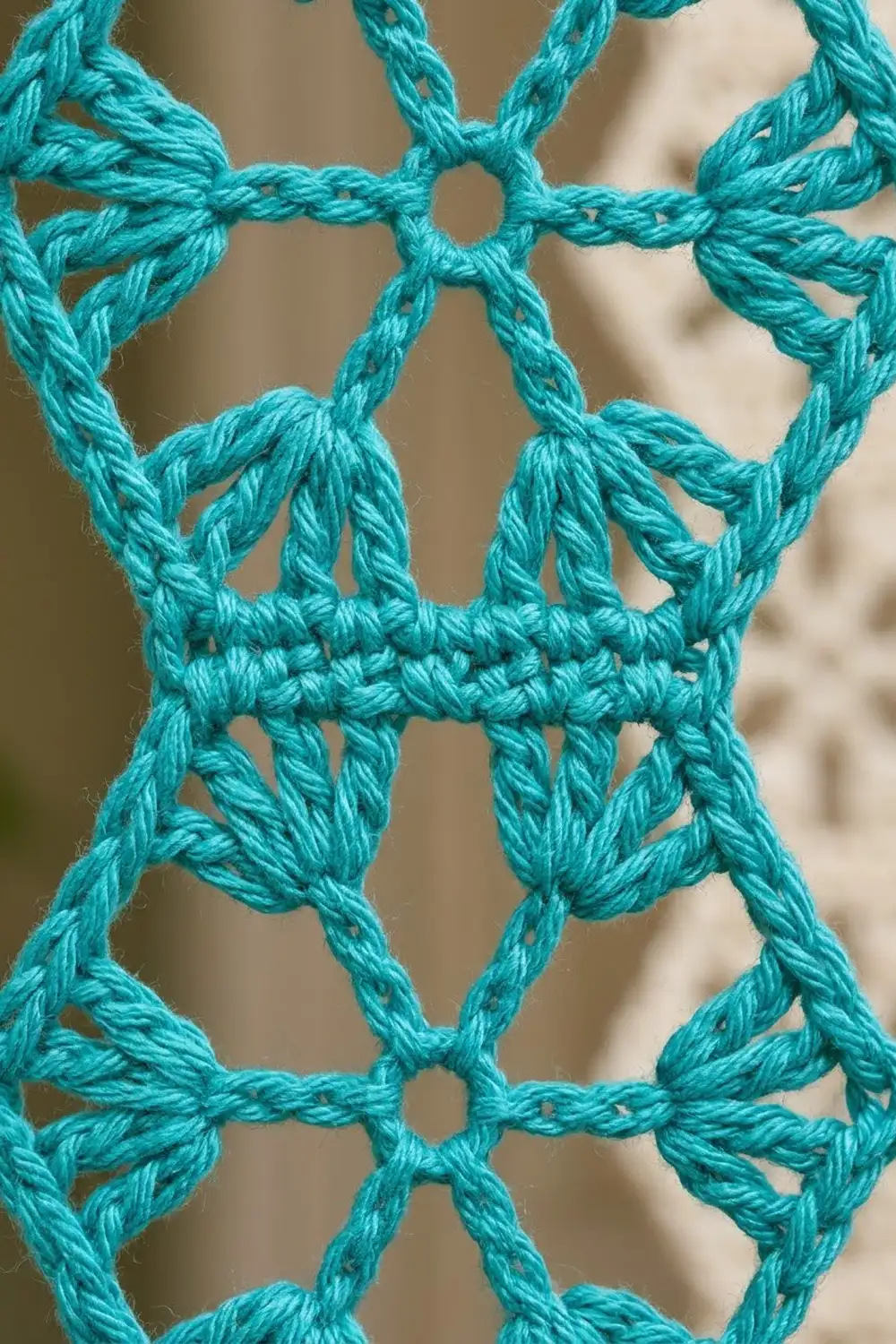
Hexagon Motif
Make 64 in teal and 48 in cream. Leave an 8 in (20.3 cm) tail at the start and end of each motif.
Round 1: Ch 4, sl st in first ch to form a ring. Ch 1, 12 sc in ring, sl st in first sc to join. (12 sc)
This makes the small open center ring.
Round 2: Ch 1, sc in first sc, ch 6, skip next sc, sc in next sc, ch 6, skip next sc; rep from * 4 more times, sl st in first sc to join. (6 sc, 6 ch-6 arches)*
These six arches become the chain spokes. When Round 3 pulls each arch’s peak outward, the arch stretches into a slim spoke that runs from the ring to a corner.
Round 3: Sl st in each of the next 3 ch to reach the peak of the first arch. Ch 4 (counts as first tr), tr in same arch, ch 2, 2 tr in same arch (first Fan made), ch 3. Fan in next ch-6 arch, ch 3; rep from * 4 more times, sl st in top of beginning ch-4 to join. (24 tr, 6 ch-2 corner sps, 6 ch-3 side sps)*
Each fan points toward one corner. The ch-3 spaces between fans leave open triangles between the spokes.
Round 4: Sl st in next tr and in next ch-2 sp. Ch 3 (counts as first dc), (dc, ch 2, 2 dc) in same sp. Dc in next 2 tr, 3 dc in next ch-3 sp, dc in next 2 tr, (2 dc, ch 2, 2 dc) in next ch-2 sp; rep from * 4 more times. Dc in next 2 tr, 3 dc in next ch-3 sp, dc in next 2 tr, sl st in top of beginning ch-3 to join. (66 dc, 6 ch-2 corner sps)*
Per side: 2 dc from one corner + 2 dc + 3 dc + 2 dc + 2 dc from the next corner = 11 dc per side, counted between corner ch-2 sps. Six sides x 11 dc = 66 dc, which matches the round total. The 11 already includes the corner dc at both ends of the side.
Fasten off and weave in the ends.
Make All Pieces
- Teal: 64 hexagons (4 strips x 16)
- Cream: 48 hexagons (3 strips x 16)
- Total: 112 hexagons
Layout grid (front view, 7 strips, 16 hexagons tall):
Strip:   1   2   3   4   5   6   7
Hex 1    T   C   T   C   T   C   T
Hex 2    T   C   T   C   T   C   T
 ...    ... ... ... ... ... ... ...
Hex 16   T   C   T   C   T   C   T
T = teal, C = cream. Each strip is one solid color. Every hexagon sits with its flat sides at the top and bottom and its points facing left and right.
Joining
Join each strip with yarn that matches its hexagons.
Method: a single crochet seam worked on the right side, so it forms the raised bar you can see between motifs.
- Place hexagon A above hexagon B, wrong sides together, with A’s bottom flat side lined up with B’s top flat side.
- Join yarn through both matching corner ch-2 sps at the right end and sc.
- Sc through both loops of the next 11 pairs of dc, matching one dc from A to one dc from B.
- Sc in the pair of corner ch-2 sps at the left end. (13 sc per seam)
- Fasten off.
Stitch-to-stitch logic: each flat side has exactly 11 dc, so the seam matches stitch for stitch, with 2 extra sc to anchor the corners. Never skip a stitch or double one up.
Tension: work the seam at the same tension as your dc rounds. A tight seam puckers and shortens the strip. A loose seam lets the hexagons sag apart under their own weight.
Size checkpoints:
- 2 hexagons joined: 8.8 in (22.4 cm) long
- 8 hexagons joined: 35.8 in (90.9 cm) long
- 16 hexagons joined: 71.8 in (182.4 cm) long
Each motif adds 4.3 in (10.9 cm), and each seam adds about 0.2 in (0.5 cm).
Border
Work one border round around each strip in the strip’s own color.
Border gauge: one sc per dc. That’s about 4.4 sc per inch (2.5 cm), the same as the dc tops, so the edge won’t stretch or ruffle.
Orientation: hexagon 1 is at the top. Each long edge zigzags. For every hexagon there is an upper slanted side, an outer point, and a lower slanted side. Between hexagons there is an inward valley at each seam.
Border Round: Join yarn in the top-left corner ch-2 sp of hexagon 1.
- Top-left corner: (sc, ch 2, sc) in corner sp
- Top edge: sc in each of the 11 dc (11 sc)
- Top-right corner: (sc, ch 2, sc) in corner sp
- Right long edge, for each hexagon: sc in each of the 11 dc of the upper slanted side, (sc, ch 2, sc) in the point ch-2 sp, then sc in each of the 11 dc of the lower slanted side (24 sc per hexagon)
- Each valley: after every hexagon except the last, sc in the end sc of the seam (1 sc per valley)
- Bottom-right corner: (sc, ch 2, sc) in the corner sp of hexagon 16
- Bottom edge: sc in each of the 11 dc (11 sc)
- Bottom-left corner: (sc, ch 2, sc) in corner sp
- Left long edge: work as for the right edge, moving upward
- Sl st in first sc to join. Fasten off.
Counts per side:
- Each long edge: 16 hexagons x 24 sc = 384 sc, plus 15 valley sc = 399 sc
- Each short edge: 11 sc
- Strip end corners: 4 corners x 2 sc = 8 sc
- Round total: 399 + 399 + 11 + 11 + 8 = 828 sc, plus 36 ch-2 sps (32 at the points and 4 at the strip corners)
Why the math works: each slanted side has 11 dc and gets exactly one sc per dc, so the edge length doesn’t change. The 2 sc at each point are new stitches worked into the corner space, not repeats of the corner dc, and the ch-2 lets the edge turn the outward corner. The single valley sc fills the small gap at each seam without pulling the inner corner closed. The border adds 0.25 in (0.6 cm) on every side, so the strip becomes 5.5 in (14.0 cm) wide and 72.3 in (183.6 cm) long.
Hanging Tab
Row 1: With the right side facing, join yarn in the 4th sc of the top edge. Ch 1, sc in the same st and in the next 4 sc. (5 sc)
Rows 2–14: Ch 1, turn, sc in each sc across. (5 sc)
The tab is about 3.5 in (8.9 cm) long. After blocking, fold it to the back and whipstitch Row 14 to the back of hexagon 1, just below the border. This fits a rod up to 1 in (2.5 cm) in diameter. For a thicker rod, add rows in pairs; every 2 rows add about 0.5 in (1.3 cm).
Final Blocking
- Weave in the remaining ends along the dc outline, where they hide best.
- Soak each strip in cool water for 15 minutes.
- Roll the strip in a towel to press out the water. Don’t wring it.
- Lay the strip flat on blocking mats, in sections if needed.
- Pin the top and bottom edges straight, then pin every outer point so the strip is 5.5 in (14.0 cm) wide.
- Check that each hexagon is 4.3 in (10.9 cm) flat to flat and the whole strip is 72.3 in (183.6 cm) long.
- Open the ring, spokes, and fans evenly with your fingertips.
- Let the strip dry completely, then sew the tab.
Final Quality-Control Checklist
- Every hexagon has 66 dc and 6 corner ch-2 sps
- Every flat side has 11 dc
- Every seam has 13 sc and forms a raised ridge on the front
- Each strip has 16 hexagons in one color
- The strip order is teal, cream, teal, cream, teal, cream, teal
- Each border round has 828 sc
- Each strip is 5.5 in x 72.3 in (14.0 cm x 183.6 cm)
- All seven tabs are the same length, so the bottoms line up
Troubleshooting
Hexagon cups: The Round 2 arches are too short or the trebles are too tight. Try ch-7 arches or loosen up on Round 3.
Hexagon ruffles: The chains are too loose. Use a smaller hook for Rounds 2 and 3 only.
Fans sit off-center: Make sure you sl st to the peak of the first arch before starting Round 3.
Seam is crooked: Recount the dc on both sides. If a side has 10 or 12 dc, the corners won’t meet.
Strips differ in length: Measure the hexagons. If they are off by more than 0.1 in (0.3 cm), adjust the hook for the next batch.
Strip stretches after hanging: Cotton grows a little under its own weight. Let the strips hang for 2 days, then adjust the tabs so the bottoms line up.
Care
Hand wash in cool water and lay flat to dry, reshaping the hexagons. Don’t hang the strips while they’re wet, because wet cotton stretches.
Final Notes
Every measurement in this curtain builds on the one before. Match one hexagon to 5 in (12.7 cm) point to point and 4.3 in (10.9 cm) flat to flat, with 11 dc per side. Join 16 hexagons with 13-sc seams to reach 71.8 in (182.4 cm). Add the 828-stitch border to finish at 5.5 in x 72.3 in (14.0 cm x 183.6 cm). Make seven strips, add equal tabs, and hang them in teal and cream order for a curtain about 41.5 in (105.4 cm) wide.
Happy crocheting!