

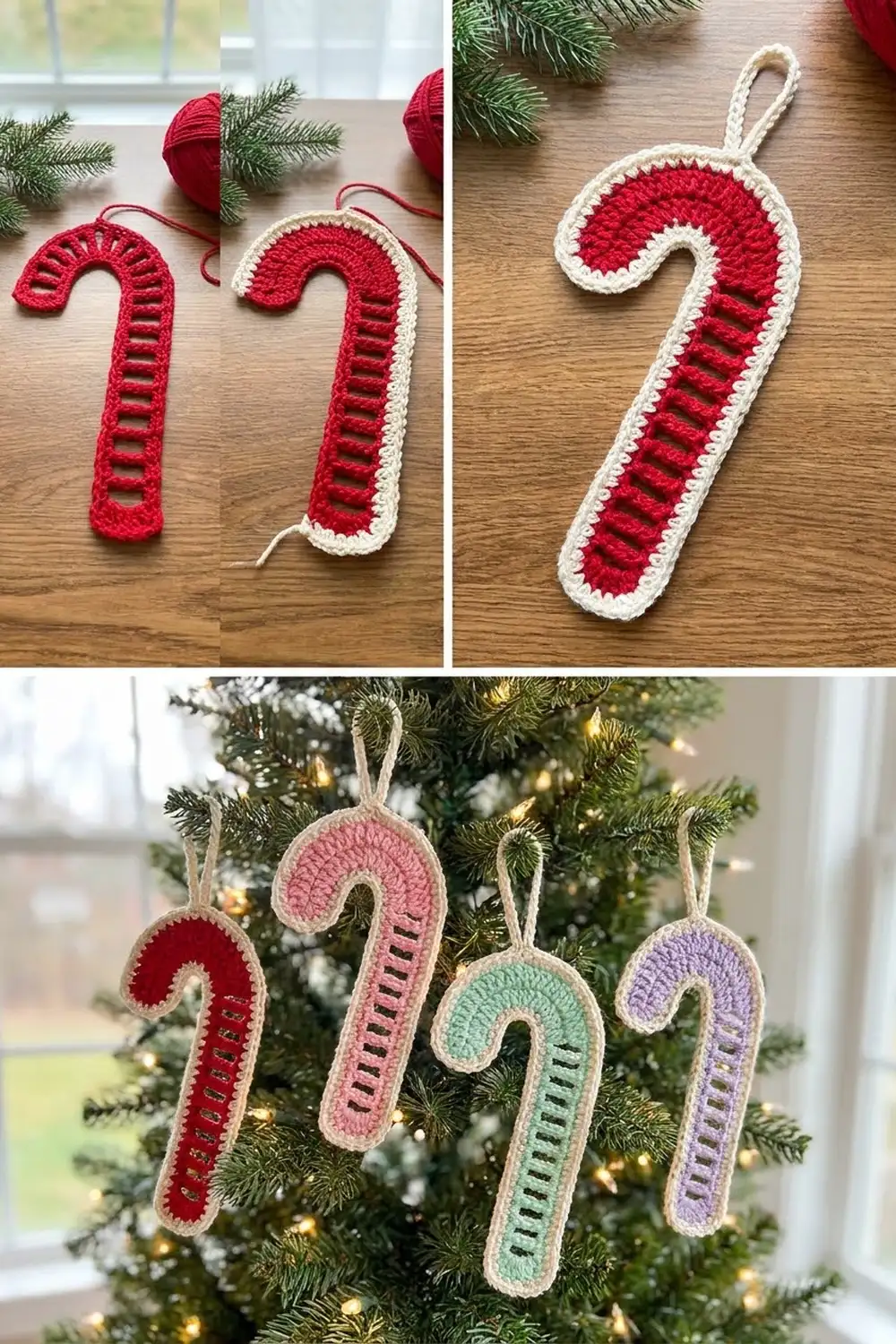
The Peppermint Ladder Candy Cane is a small, airy ornament built like a ladder. Short rungs run down the straight shaft and fan out around the curved hook, and a smooth cream outline holds the shape. The open spaces let tree lights glow through, so it looks lighter on the branch than a solid cane would.
The classic version uses red and cream. The hook rungs are all red, and the shaft alternates cream and red bands like a peppermint stripe. It also works well in pink, mint or lavender with cream. Every version is the same single piece; only the rung colors change.
This pattern uses US crochet terms. The finished ornament measures about 5¼ in tall × 2¼ in wide (13.3 cm × 5.7 cm), not counting the hanging loop, which adds about 1½ in (3.8 cm).
Construction is quick. You crochet one foundation chain (the inner edge), then one row of double crochet rungs that changes color in bands. A single round of cream single crochet then outlines the whole cane, and you finish with a chain hanging loop.
Finished Size and Construction
- Finished size: 5¼ in × 2¼ in (13.3 cm × 5.7 cm), excluding loop
- Hanging loop: about 1½ in (3.8 cm)
- Skill level: Easy / advanced beginner
- Terminology: US crochet terms
- Yarn weight: Sport (#2), cotton or cotton blend
- Hook: 3.0 mm
- Number of pieces: 1 (single piece, no joining)
- Layout: One candy cane shape, hook at top left, shaft on the right
- Size before border: about 5 in × 2 in (12.7 cm × 5.1 cm); shaft about 0.55 in (1.4 cm) wide
- Border depth: about ⅛ in (0.3 cm) on every edge
- Shaft width after border: about 0.8 in (2.0 cm)
Materials
Yarn: Choose a smooth sport-weight mercerized cotton or a cotton blend. Cotton shows clear stitches, blocks crisply and holds the open ladder shape better than fuzzy acrylic. Pick a strong, saturated red and a warm cream. Bright white can look harsh next to red.
- Color A – Red: 4 g (about 12 m)
- Color B – Cream: 4 g (about 12 m)
These quantities are for one ornament and include a margin for the gauge swatch, carried strands and weaving in. One 50 g ball of each color makes a large batch.
Tools:
– 3.0 mm crochet hook
– Tapestry needle
– Scissors
– Rustproof pins and a foam blocking mat
– Spray bottle with water
– Optional: fabric stiffener or a light starch spray
Abbreviations (US Terms)
- ch – chain
- sl st – slip stitch
- sc – single crochet
- dc – double crochet
- sp – space
- st(s) – stitch(es)
- rep – repeat
Special technique – Color change in dc: Work the dc until 2 loops are left on the hook. Drop the old color, yarn over with the new color and pull through both loops. The next stitch starts in the new color.
Carrying color: Don’t cut the unused color. Lay it along the top of the foundation chain and enclose it inside each dc base as you work. The cream border hides it later.
Gauge and Checkpoints
Gauge matters because the hook’s fan shape depends on the ratio between chain width and dc height.
- Chain gauge: 12 ch = 2 in (5.1 cm), worked relaxed
- Single crochet gauge: 6 sc = 1 in (2.5 cm)
- Rung height: 1 dc ≈ 0.45 in (1.1 cm) tall
Make one test cane first. It takes about 30 minutes and tells you more than a flat swatch.
Checkpoints:
1. After Row 1: The 36-ch foundation should measure about 6 in (15.2 cm), laid flat and not stretched.
2. After Row 2: The straight shaft section (the last 24 ch of the foundation) should measure about 4 in (10.2 cm). The piece should be about 5 in × 2 in (12.7 cm × 5.1 cm).
3. After the border: The piece should be 5¼ in × 2¼ in (13.3 cm × 5.7 cm), within ¼ in (0.6 cm).
Too big? Go down to a 2.75 mm hook, or tighten your foundation chain. Too small or cupping? Go up to a 3.25 mm hook and chain more loosely. A tight foundation chain is the most common cause of a hook that curls instead of lying flat.
Pattern
Row 1 – Foundation (Inner Rail)
With Red, ch 36.
Count: 36 ch. Chains are numbered from the hook. Ch 1–4 become the first rung, ch 5–12 form the inner curve of the hook, and ch 13–36 form the inner edge of the shaft. Ch 36 (the first chain you made) is the bottom of the cane.
Row 2 – Rungs
Work every rung into the bottom loop of the foundation chain. The rest of the chain stays free for the border.
Hook section (rungs 1–9, all Red):
Dc in 5th ch from hook. The 4 skipped ch count as rung 1 (a dc) plus a ch-1 sp, and this dc is rung 2.
[Ch 1, dc in next ch] 7 times. These are rungs 3–9, worked into ch 6–12.
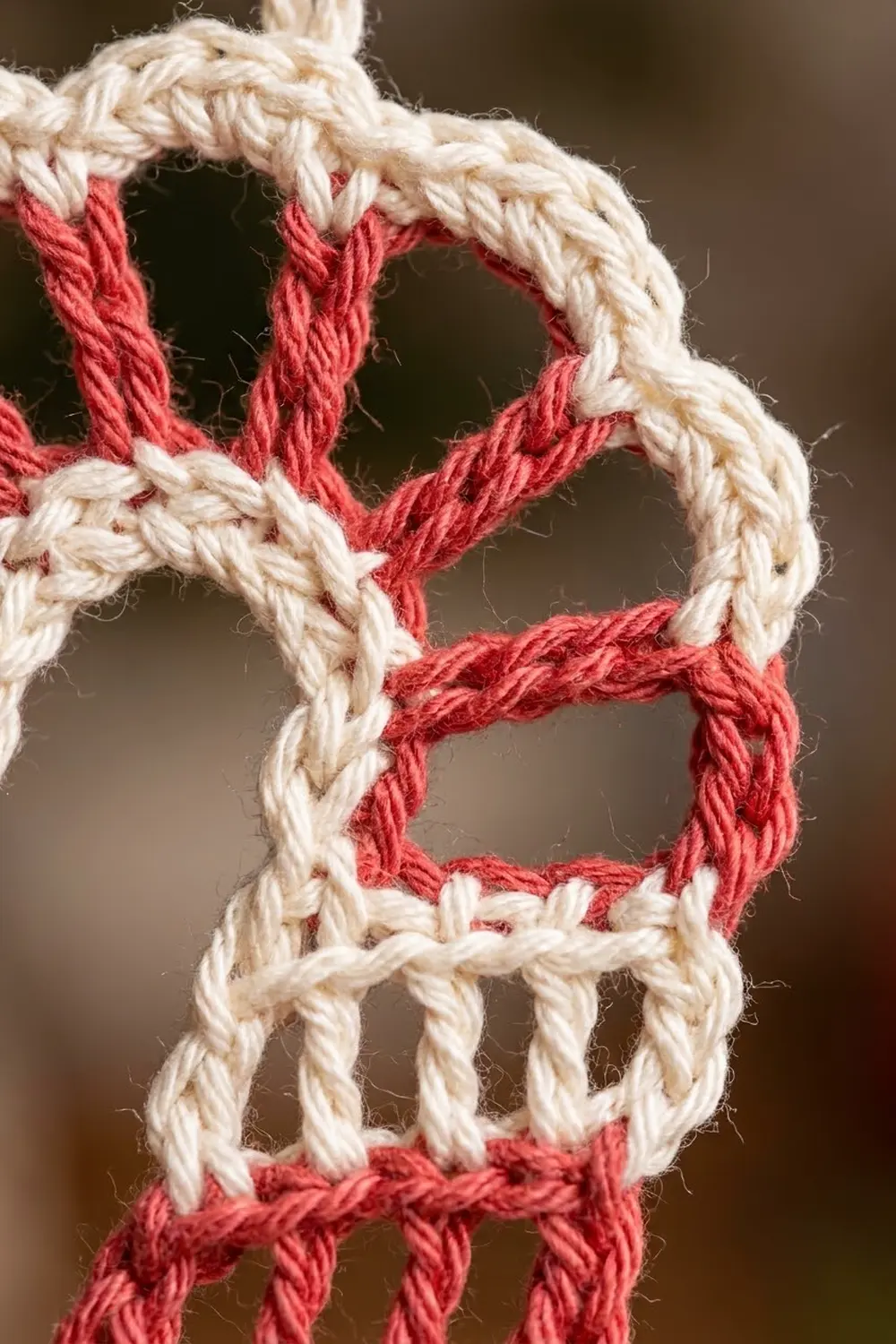
Rungs 1–9 sit on neighboring chains at the base, but each top is 1 ch apart. That small difference makes them fan out into the hook’s curve.
Shaft section (rungs 10–21): Each repeat is “ch 1, skip 1 ch, dc in next ch.” Skipping a chain makes the bases the same distance apart as the tops, so the rungs run parallel.
- Rungs 10–11 (Cream): Change to Cream in the last yarn over of rung 9. [Ch 1, skip 1 ch, dc in next ch] 2 times.
- Rungs 12–14 (Red): Change to Red in rung 11. [Ch 1, skip 1 ch, dc in next ch] 3 times.
- Rungs 15–16 (Cream): Change to Cream in rung 14. [Ch 1, skip 1 ch, dc in next ch] 2 times.
- Rungs 17–19 (Red): Change to Red in rung 16. [Ch 1, skip 1 ch, dc in next ch] 3 times.
- Rungs 20–21 (Cream): Change to Cream in rung 19. [Ch 1, skip 1 ch, dc in next ch] 2 times. The last dc goes into ch 36.
Chain check: 8 ch for rungs 2–9, plus 12 repeats of 2 ch (24 ch), plus the 4 skipped = 36 ✓
Count: 21 rungs (dc) and 20 ch-1 sps.
Shaft bands: 2 Cream + 3 Red + 2 Cream + 3 Red + 2 Cream = 12 rungs ✓
Cut Red and leave a 4 in (10.2 cm) tail. Keep Cream attached.
Checkpoint: Lay the piece flat. The hook should curve into a half circle with the rungs spread like spokes, and the shaft should be about 4 in (10.2 cm) long.
Border
Border gauge: 6 sc = 1 in (2.5 cm). This matches the chain gauge, so the border doesn’t pull or ruffle.
Round 1 (Cream)
Keep using the attached Cream. You are at the top of rung 21, the bottom outer corner.
- Bottom outer corner: Ch 1, 3 sc in top of rung 21. (3 sc)
- Outer edge, going up the shaft and around the hook: [Sc in next ch-1 sp, sc in next dc] 19 times, which takes you through rung 2. Then sc in the ch-1 sp made by the beginning chain. (39 sc)
- Hook tip, top corner: 3 sc in top of rung 1 (the 4th ch of the beginning chain). (3 sc)
- Hook tip, side: 2 sc evenly down the post of rung 1. (2 sc)
- Hook tip, inner corner: 3 sc in the base of rung 1, worked into the same ch as rung 2. (3 sc)
- Inner edge: Sc in each remaining free foundation ch (ch 6–35). (30 sc)
- Bottom inner corner: 3 sc in ch 36. (3 sc)
- Bottom end: 2 sc evenly up the post of rung 21. (2 sc)
Join with a sl st to the first sc.
Round 1 total: 3 + 39 + 3 + 2 + 3 + 30 + 3 + 2 = 85 sc
Section breakdown:
– Outer shaft and transition: Rungs 20–10 and the 11 spaces before them = 22 sc. Then the space before rung 9 = 1 sc.
– Outer hook: Rungs 9–2 and the 7 spaces between them = 15 sc. Then the space before rung 1 = 1 sc. Total outer: 22 + 1 + 15 + 1 = 39 ✓
– Inner hook: ch 6–12 = 7 sc
– Inner shaft: ch 13–35 = 23 sc. Total inner: 7 + 23 = 30 ✓
Why the Math Works
- Straight shaft: Each rung spacing gets 2 sc on the outer edge (1 in the space, 1 in the dc) and 2 sc on the inner edge (1 in each of 2 chains). Equal counts on both sides keep the shaft straight.
- Curved hook: Each spacing gets 2 sc on the outer edge but only 1 sc on the inner edge. The longer outer edge holds the half-circle open, and the shorter inner edge keeps it snug.
- Corners: The 3-sc corners turn sharply without puckering. The corner sc are counted once, in their own steps, and are not included in the edge runs.
Checkpoint: The ornament should measure 5¼ in × 2¼ in (13.3 cm × 5.7 cm), with a shaft about 0.8 in (2.0 cm) wide.
Hanging Loop
Do not fasten off. Sl st along the outer edge to the sc worked in the top of rung 5, the center rung at the peak of the hook.
Ch 18, which is about 3 in (7.6 cm) of chain. Sl st in the same sc to make a loop about 1½ in (3.8 cm) long. Fasten off, leaving a 4 in (10.2 cm) tail.
Weave all ends into the border round, where Cream hides them best. Weave each Red tail into a Red section only.
Final Blocking
- Mist or dampen. Spray the ornament until it is evenly damp, or soak it briefly and press it gently in a towel.
- Pin the shaft. Pin both shaft edges straight and about 0.8 in (2.0 cm) apart. Check that the shaft is 4 in (10.2 cm) long from the bottom edge to the start of the hook curve.
- Set the diagonal stripes. With a pin tip, nudge each shaft rung to a slight diagonal, lower on the left and higher on the right. Keep all rungs at the same angle so the bands look like a twisted peppermint stripe.
- Shape the hook. Pin the outer curve into a smooth half circle. Then place one pin in each open space between the hook rungs so the spokes fan out evenly.
- Straighten the loop. Pin the hanging loop straight up from the peak.
- Optional stiffening. Brush on a diluted fabric stiffener or spray a light starch.
- Dry fully. Leave it pinned until completely dry, usually 6–12 hours.
- Final measure. Unpin the ornament and check that it is 5¼ in × 2¼ in (13.3 cm × 5.7 cm).
Final Quality-Control Checklist
- [ ] 21 rungs total: 9 Red in the hook, then 12 in the shaft (2 Cream, 3 Red, 2 Cream, 3 Red, 2 Cream)
- [ ] 20 ch-1 spaces between rungs
- [ ] Border has exactly 85 sc plus the joining sl st
- [ ] Hook rungs fan out evenly and the shaft rungs are parallel
- [ ] Shaft is straight and about 0.8 in (2.0 cm) wide
- [ ] Carried strands are hidden under the border
- [ ] Hanging loop is centered at the hook peak, about 1½ in (3.8 cm) long
- [ ] Finished size is 5¼ in × 2¼ in (13.3 cm × 5.7 cm), within ¼ in (0.6 cm)
- [ ] All ends are woven in securely and invisibly
Troubleshooting
The hook curls or cups. The foundation chain is too tight. Remake it more loosely or use a larger hook just for the chain.
The hook won’t curve and stays flat and straight. You may have skipped chains in the hook section. Rungs 2–9 must go into neighboring chains.
The shaft bends. Check that every shaft repeat skips exactly 1 ch, and that the border has 1 sc per chain on the inner edge.
The border ruffles. Your sc are too loose for your chains. Go down 0.25 mm for the border only.
The carried yarn shows through the gaps. Keep it pressed against the foundation chain and enclose it in every dc base. The border sc will cover it.
The stripes look uneven. Recount the color bands against the Row 2 list. A single extra rung throws off the rhythm.
The loop is off-center. Count the rungs from the hook tip and attach the loop over rung 5.
Care
Hand wash in cool water with mild soap, press in a towel and reshape. Dry flat or pinned. If you used stiffener, re-block after washing.
Final Notes
The measurement chain is simple. A relaxed 36-ch foundation at 6 in (15.2 cm) gives a 4 in (10.2 cm) shaft. The 21 rungs build a ladder of about 5 in × 2 in (12.7 cm × 5.1 cm). An 85-sc cream border adds ⅛ in (0.3 cm) on every edge, for a finished ornament of 5¼ in × 2¼ in (13.3 cm × 5.7 cm), topped with a 1½ in (3.8 cm) loop. If your foundation chain matches gauge, the rest of the shape follows. Make a full set in red, pink, mint and lavender for a bright, lacy tree.
Happy crocheting!