

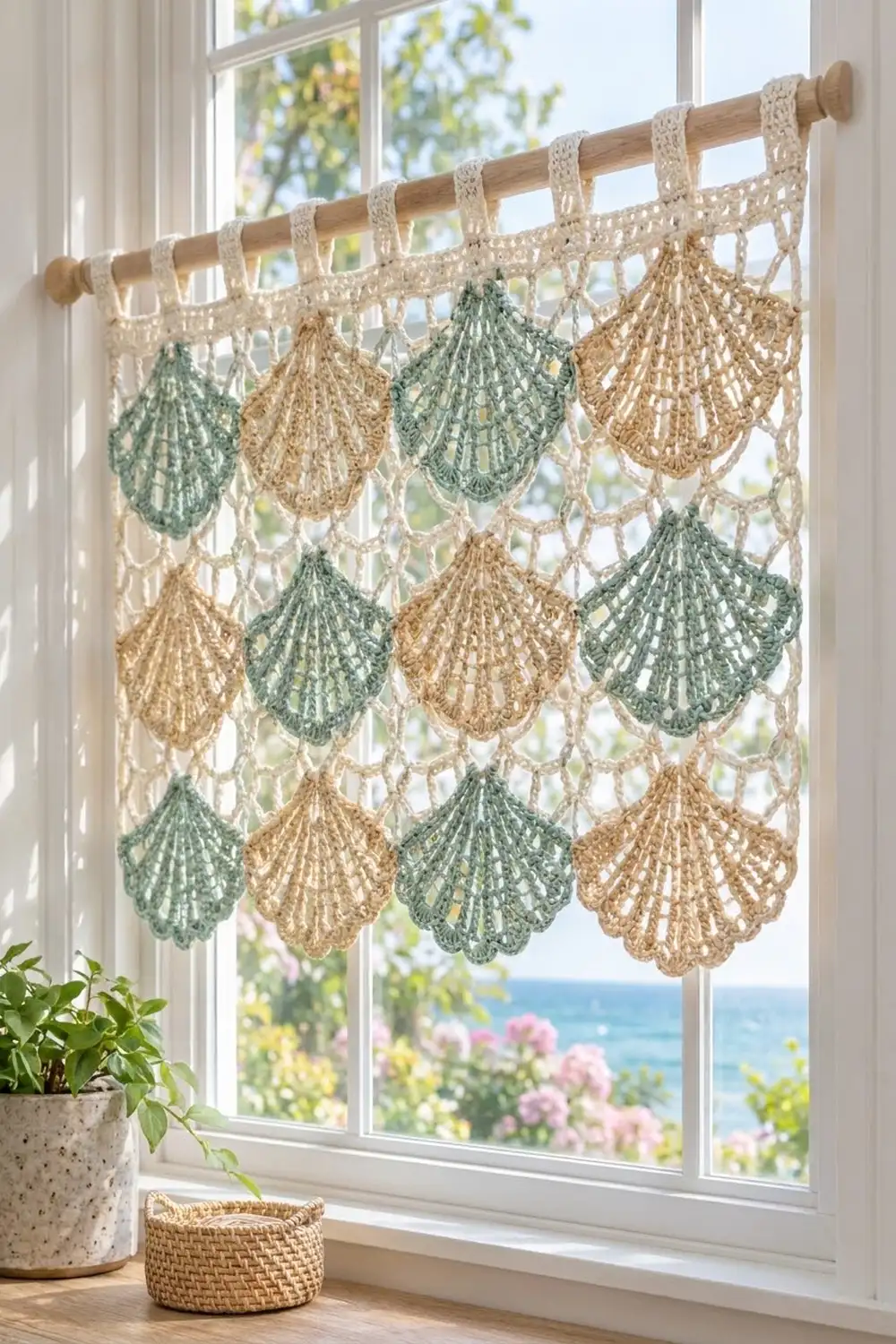
The Tidewater Shell Café Curtain brings the beach to your kitchen or bathroom window. Twelve fan-shaped seashells hang in neat rows, each one ribbed and scalloped, all floating in a light cream net that lets the sun come through.
The palette is sage green and warm sand on a cream background, set in a checkerboard so no two shells of the same color touch side by side. It has a relaxed, coastal-cottage style that works with white trim, linen, and natural wood.
This pattern uses US crochet terms. The finished curtain measures 31.4 in (79.8 cm) wide by 19.0 in (48.3 cm) tall. With the tab loops it’s 20.5 in (52.1 cm) tall.
The construction is modular. You crochet each shell flat in rows, frame it with three cream mesh rounds to make a rectangular block, and join the blocks as you go on the last round. A two-round border, a half double crochet header, and 8 rod tabs finish the panel.
Finished Size and Construction
- Finished size: 31.4 in × 19.0 in (79.8 cm × 48.3 cm), plus 1.5 in (3.8 cm) tab loops
- Skill level: Intermediate
- Terminology: US
- Yarn weight: DK (light, #3) cotton
- Hook: 4.0 mm (G-6)
- Number of pieces: 12 shell blocks
- Layout: 4 blocks across × 3 blocks down
- Shell size: 6 in × 3 in (15.2 cm × 7.6 cm)
- Framed block size: 7.6 in × 5.6 in (19.3 cm × 14.2 cm)
- Size before border: 30.4 in × 16.8 in (77.2 cm × 42.7 cm)
- Border depth: 0.5 in (1.3 cm) on all sides, plus a 1.2 in (3.0 cm) header band
Materials
Choose a smooth mercerized or combed cotton in DK weight, about 225 m per 100 g. Cotton keeps the ribs crisp and blocks flat, and it handles window sun well.
- Color A, Sage: 70 g / 158 m
- Color B, Sand: 70 g / 158 m
- Color C, Cream: 220 g / 495 m
These quantities include a margin of about 20% for gauge swatches and differences in tension.
Tools:
– 4.0 mm (G-6) crochet hook
– Tapestry needle
– Stitch markers
– Blocking mats, rust-proof pins, and a spray bottle
– Measuring tape
– Curtain rod up to 1 in (2.5 cm) in diameter
Abbreviations (US Terms)
- ch: chain
- sl st: slip stitch
- sc: single crochet
- hdc: half double crochet
- dc: double crochet
- tr: treble crochet (yo twice)
- dtr: double treble crochet (yo 3 times)
- sp: space
- RS / WS: right side / wrong side
- Picot: ch 3, sl st in 3rd ch from hook.
- Scallop: (sc, hdc, 3 dc, hdc, sc) all in the same space. The scallop tip is the center dc of the 3 dc.
Gauge and Checkpoints
Border gauge: 5 sc = 1 in (2.5 cm).
Mesh gauge: one ch-5 loop in Frame Round 3 spans 1 in (2.5 cm) when blocked.
Make one complete framed block before starting the others, and check it at each stage:
- After Shell Row 1, the fan is 1.5 in (3.8 cm) wide.
- After Shell Row 3, the fan is 3.5 in (8.9 cm) wide.
- After Shell Row 5, the fan is 5.5 in (14.0 cm) wide.
- After the edging (Row 6), the shell is 6 in × 3 in (15.2 cm × 7.6 cm).
- After Frame Round 3, the block is 7.6 in × 5.6 in (19.3 cm × 14.2 cm) when pinned.
If your piece is too big: go down 0.5 mm in hook size, or work each frame chain one stitch tighter.
If your piece is too small: go up 0.5 mm in hook size.
A difference of 0.25 in (0.6 cm) per block grows to 1 in (2.5 cm) across the curtain, so fix it now.

Shell Motif (Make 12)
Work 6 shells in Sage and 6 in Sand. The shell is worked in turned rows from the hanging point outward.
Row 1 (RS): Make a magic ring. Ch 4 (counts as dc and ch 1), [dc, ch 1] 7 times into the ring, dc into the ring. Pull the tail until the stitches fan into a half circle. Do not join. Turn.
Count: 9 dc, 8 ch-1 sps.
Row 2 (growth row): Ch 3 (counts as dc), dc in the same st, [ch 1, skip ch-1 sp, 2 dc in next dc] 8 times. Turn.
Count: 18 dc (9 ribs of 2 dc), 8 ch-1 sps.
Row 3: Ch 3 (counts as dc), dc in next dc, [ch 2, dc in each of next 2 dc] 8 times. Turn.
Count: 18 dc, 8 ch-2 sps.
Row 4: Ch 3, dc in next dc, [ch 3, dc in each of next 2 dc] 8 times. Turn.
Count: 18 dc, 8 ch-3 sps.
Row 5: Ch 3, dc in next dc, [ch 4, dc in each of next 2 dc] 8 times. Turn.
Count: 18 dc, 8 ch-4 sps.
The 2-dc columns form the 9 raised ribs. The chains between them form the open arcs across the shell.
Row 6 (edging, conversion row): Ch 1, sc in each of the first 2 dc, [scallop in next ch-4 sp, sc in each of next 2 dc] 8 times. Fasten off and weave in the ends.
Count: 18 sc (1 per dc) + 8 scallops × 7 sts (56) = 74 sts.
The straight top edge of the shell is made of the row ends on each side of the ring. The first and last sc of Row 6 are the shell’s two corners.
Cream Frame (Every Block)
The frame turns the half-round shell into a rectangle. Hold the shell with the straight edge at the top and the RS facing you.
Frame Round 1: Join Cream with sc through the center of the closed ring at the top. Work these steps in order:
- Ch 5, sc in the end of Row 2.
- Ch 5, sc in the end of Row 4.
- Ch 5, sc in the corner sc.
- Ch 5, sc in the first scallop tip.
- [Ch 5, sc in next scallop tip] 7 times.
- Ch 5, sc in the other corner sc.
- Ch 5, sc in the end of Row 4.
- Ch 5, sc in the end of Row 2.
- Ch 5, sl st to the first sc.
Count: 15 ch-5 loops (3 along each half of the top edge and 9 along the curve).
For Round 2, name the loops in working order: top loops T1–T3, curve loops B1–B9, then top loops T4–T6.
Frame Round 2 (squaring round): Sl st into the center of T1. Ch 1 and work each anchor below in the named loop, with ch 5 between every two anchors:
- T1, T2, T3: sc in each.
- B1: 2 sc.
- B2: dc.
- B3: 2 dtr.
- B4: dc.
- B5: 2 sc.
- B6: dc.
- B7: 2 dtr.
- B8: dc.
- B9: 2 sc.
- T4, T5, T6: sc in each.
Finish with ch 5 and a sl st to the first sc.
Count: 20 anchors and 20 ch-5 loops. The loops between paired dtr anchors and around the shell’s corners are the 4 corner loops. Between the corners, there are 5 loops across the top, 5 across the bottom, and 3 on each side.
The dtr anchors reach out to the empty bottom corners, and the sc anchors stay close to the shell.
Frame Round 3: Sl st to the center of the first loop. Ch 1, then:
- In each side loop: sc, ch 5.
- In each corner loop: (sc, ch 7, sc), ch 5.
Finish by joining with a sl st to the first sc.
Count: 20 ch-5 loops + 4 ch-7 corner loops = 24 loops.
Per-side counts (including both corner loops):
– Top and bottom: 6 ch-5 loops + 2 corner loops = 8 loops each.
– Each side: 4 ch-5 loops + 2 corner loops = 6 loops each.
Each corner loop is counted on both sides that meet there, so 8 + 8 + 6 + 6 = 28, which is 24 loops + 4.
Checkpoint: the block measures 7.6 in × 5.6 in (19.3 cm × 14.2 cm).
Make All Pieces
- Sage: 6 shells
- Sand: 6 shells
- Cream: a frame on all 12 blocks (complete Round 3 only on the first block; the rest are joined on Round 3)
All shells hang point-up. S = Sage and A = Sand:
Row 1 (top):    S  A  S  A
Row 2:          A  S  A  S
Row 3 (bottom): S  A  S  A
Joining
Join as you go on Frame Round 3. Complete Round 3 on the top-left block. For each later block, work Round 3 normally until you reach a side shared with a finished block.
On a shared side loop: ch 2, sl st into the middle of the matching loop on the finished block, ch 2. The 2 + 1 + 2 still makes a 5-stitch loop.
On a shared corner loop: ch 3, sl st into the matching corner loop, ch 3.
Where four blocks meet: sl st into the same joining point used by the first corner join, so all four corners meet at one spot.
The loops always match one to one: 8 loops on a top edge meet 8 loops on a bottom edge, and 6 side loops meet 6 side loops. No extra loops are added at the seams.
Tension: keep the joining sl sts loose. A tight join puckers the mesh and pulls the loop lengths away from 1 in (2.5 cm).
Checkpoint: after all 12 blocks are joined, the panel measures 30.4 in × 16.8 in (77.2 cm × 42.7 cm).
Border
Border gauge: 5 sc = 1 in (2.5 cm). Each ch-5 loop gets 5 sc. Each corner loop takes up 0.8 in (2.0 cm) of an edge, so it gets 4 sc.
Starting loop counts:
– Top and bottom: 4 blocks × 8 loops = 32 loops each.
– Each side: 3 blocks × 6 loops = 18 loops each.
Border Round 1: Join Cream at the top-right corner loop.
- Along each edge, work 5 sc in each ch-5 loop and 4 sc in each corner loop that sits on that edge.
- At the four outer corners, work 4 sc for the first edge, ch 2, then 4 sc for the next edge, all in the same corner loop.
- Join with a sl st.
In this border, the per-side counts are the sc between the ch-2 corner spaces:
- Top and bottom: each block gives 6 loops × 5 sc + 2 corners × 4 sc = 38 sc. 4 blocks × 38 = 152 sc per edge.
- Each side: each block gives 4 loops × 5 sc + 2 corners × 4 sc = 28 sc. 3 blocks × 28 = 84 sc per side.
Total: 472 sc + 4 ch-2 corner sps.
Why the math works: at 5 sc per inch, 152 sc = 30.4 in (77.2 cm) and 84 sc = 16.8 in (42.7 cm). These match the joined panel exactly, so the edges won’t ruffle or draw in.
Border Round 2: Ch 1.
- Top: sc in each sc.
- Each corner ch-2 sp: (sc, ch 2, sc).
- Sides: between the corner sc, [sc in each of next 4 sc, picot] 21 times. This covers all 84 sc.
- Bottom: between the corner sc, [sc in each of next 4 sc, picot] 38 times. This covers all 152 sc.
- Join with a sl st and fasten off.
Count (152 or 84 sc worked once each + 2 new corner sc): top 154 sc, bottom 154 sc, each side 86 sc, for 480 sc in total. Picots are not counted as stitches.
Header Band: With the RS facing, join Cream in the top-right corner sc.
- Row 1: Ch 2 (does not count as a st), hdc in each of the 154 top sc. Turn.
- Rows 2–4: Ch 2, hdc in each hdc across. Turn.
Count: 154 hdc per row. The band measures 1.2 in (3.0 cm) deep.
Tabs (make 8): Each tab is 7 sts wide. Place the tabs over these stitches of Header Row 4: 1–7, 22–28, 43–49, 64–70, 85–91, 106–112, 127–133, and 148–154.
The math: 8 tabs × 7 sts + 7 gaps × 14 sts = 154 sts.
- Row 1: Join Cream, sc in each of the 7 sts.
- Rows 2–12: Ch 1, turn, sc in each of the 7 sc.
Each tab is 1.4 in (3.6 cm) wide and 3 in (7.6 cm) long. Fold it to the WS and sew the last row to the back of Header Row 1, which makes a 1.5 in (3.8 cm) loop.
Final Blocking
- Weave in all ends along the dc ribs or inside the sc border.
- Soak the curtain in cool water for 15 minutes, then press out the water in a towel. Don’t wring it.
- Pin it flat to 31.4 in × 19.0 in (79.8 cm × 48.3 cm), squaring the corners first.
- Pin each shell’s ribs so they spread evenly, and open every scallop.
- Pull each mesh loop gently to 1 in (2.5 cm).
- Pin out every picot along the sides and bottom.
- Let it dry completely, at least 24 hours, before you hang it.
Final Quality-Control Checklist
- 12 shells: 6 Sage and 6 Sand, in a checkerboard
- Every shell hangs point-up and has 9 ribs and 8 scallops
- Every block has 24 loops on Round 3 (8 on the top and bottom, 6 on each side, corners included)
- All joins are flat and four-way corners meet at one point
- Border Round 1 has 152 / 84 / 152 / 84 sc
- Border Round 2 has 154 / 86 / 154 / 86 sc, with 21 picots on each side and 38 on the bottom
- The header has 154 hdc in each of 4 rows
- 8 tabs are evenly spaced and securely sewn
- The finished size is 31.4 in × 19.0 in (79.8 cm × 48.3 cm)
Troubleshooting
- The shell cups instead of lying flat: your chains between ribs are too tight. Go up a hook size for Rows 4–6.
- The shell ruffles: the chains are too loose. Work them with the working yarn held snug.
- The block isn’t rectangular: check that the dtr anchors in Frame Round 2 went into loops B3 and B7.
- The panel is narrower than expected: the joining sl sts are too tight. Redo them with a looser hand.
- The border waves: recount to 5 sc per ch-5 loop and 4 sc per corner loop.
- The tabs lean: count the stitch positions again and make sure each tab is exactly 7 sts.
Care
Hand wash in cool water with a mild detergent, then dry flat and re-pin to size. To keep the colors bright, avoid long periods of harsh direct sun.
Final Notes
The measurements build on each other: a 6 in × 3 in (15.2 cm × 7.6 cm) shell becomes a 7.6 in × 5.6 in (19.3 cm × 14.2 cm) block. Twelve blocks join into a 30.4 in × 16.8 in (77.2 cm × 42.7 cm) panel. The border and header bring it to 31.4 in × 19.0 in (79.8 cm × 48.3 cm). If you check each stage, the curtain will hang straight and true.
Happy crocheting!