

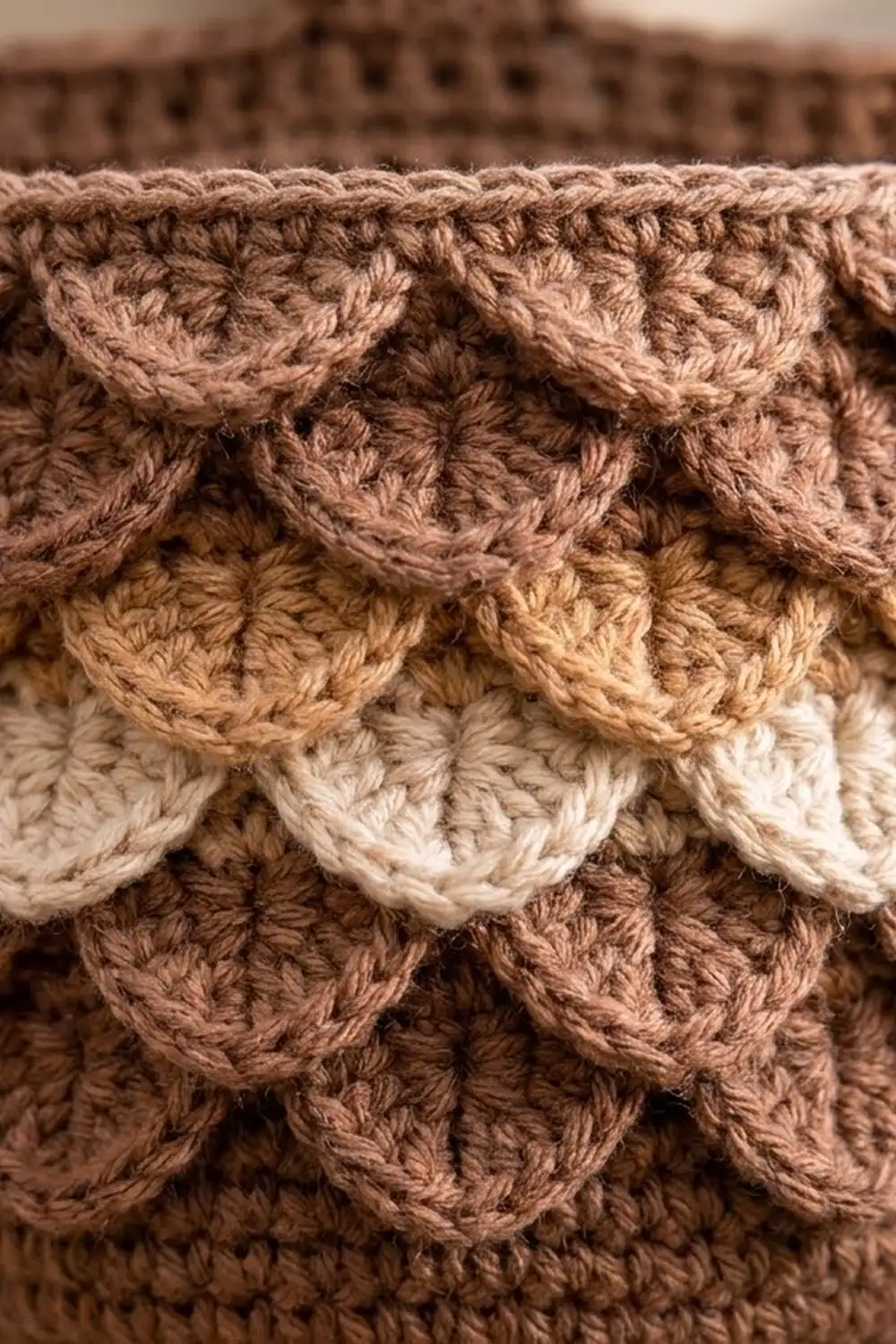
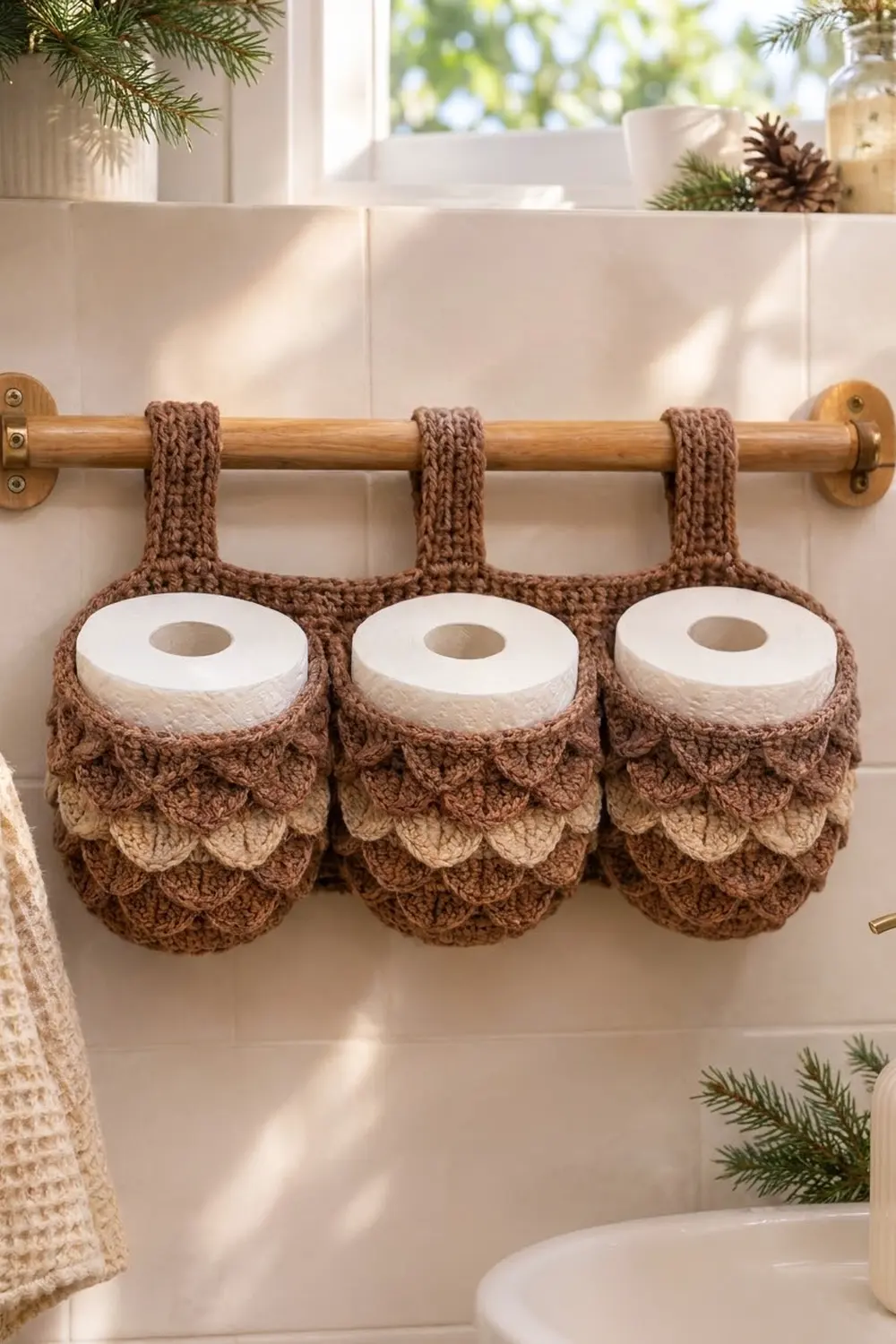
This hanging holder stores three spare toilet rolls on a towel bar. It has a solid chestnut-brown back panel, three narrow loops that go over the rod, and three round pockets sewn side by side along the front. Each pocket is covered in overlapping crocodile-stitch scales, so it looks a bit like a pinecone.
The colors are warm and natural. Chestnut brown is the main color, and the scale tiers are caramel and cream. From the bottom up, the tiers go chestnut, cream, caramel, chestnut, so the lighter shades fall in the middle of each pocket.
The pattern uses US crochet terms. The finished holder is about 17 in (43.2 cm) wide and 8.75 in (22.2 cm) tall from the top of the loops to the bottom of the pockets. Each pocket is about 4.9 in (12.4 cm) across and 4.5 in (11.4 cm) deep, which fits a standard roll.
You will make seven pieces: one flat panel worked in rows, three short straps, and three pockets worked in the round from the base up. Sew the pockets and straps to the panel, then finish the panel with a two-round border.
Finished Size and Construction
- Finished size: 17 in x 6 in (43.2 cm x 15.2 cm) panel; 8.75 in (22.2 cm) total height including loops
- Skill level: Intermediate (crocodile stitch, sewing)
- Terminology: US
- Yarn weight: Worsted (#4 medium)
- Hook: 5.0 mm (US H-8)
- Number of pieces: 7 (1 panel, 3 straps, 3 pockets)
- Layout: 3 pockets in a single row across the panel, one loop centered above each
- Piece size: pocket 4.9 in (12.4 cm) diameter x 4.5 in (11.4 cm) deep; strap 1.7 in x 7 in (4.3 cm x 17.8 cm)
- Panel size before border: 16 in x 5 in (40.6 cm x 12.7 cm)
- Border depth: 0.5 in (1.3 cm) on each side
Materials
Choose a smooth worsted cotton or a cotton blend. Cotton holds its shape better in a damp bathroom, and the scales show up more clearly in a firm, matte yarn. The amounts below assume about 2 m per gram, which is typical of worsted cotton.
- Color A, Chestnut Brown: 150 g (300 m)
- Color B, Caramel: 30 g (60 m)
- Color C, Cream: 30 g (60 m)
These amounts include a margin of about 20%. Crocodile stitch uses a lot of yarn, so don’t cut it close.
Tools:
– 5.0 mm (US H-8) hook
– Tapestry needle
– 6 or more locking stitch markers
– Rust-proof pins
– Measuring tape
– Scissors
Abbreviations (US Terms)
- ch – chain
- sl st – slip stitch
- sc – single crochet
- dc – double crochet
- inc – 2 sc in the same stitch
- BLO – back loop only
- st(s) – stitch(es)
- MR – magic ring
Special stitch: Scale. Work this over one dc pair, meaning 2 dc made in the same stitch. Without turning, work 5 dc around the post of the first dc, going from top to bottom. Ch 1. Then work 5 dc around the post of the second dc, going from bottom to top. Each scale has 10 dc and 1 ch, and it hangs down over the round below.
Gauge and Checkpoints
Gauge: 14 sc and 16 rows = 4 in (10.2 cm) in sc. That works out to 3.5 sts and 4 rows per inch (2.5 cm).
Make one pocket before you start anything else, because the pocket is what has to fit the roll. Check it at these points:
- After Round 9 (base): about 4.75 in (12.1 cm) across, lying flat
- After Round 14: sides are 1.25 in (3.2 cm) tall
- After Round 22 (all scale tiers): sides are 3.25 in (8.3 cm) tall
- After Round 28: sides are 4.5 in (11.4 cm) tall, and a roll slides in with a little room to spare
If the base measures more than 5 in (12.7 cm), go down one hook size. If it is under 4.5 in (11.4 cm), go up one size. Make the panel and straps with the same hook so the whole holder has the same tension.
Pocket (Make 3)
Join each round with a sl st to the first st. The beginning ch 1 does not count as a stitch. Do not turn.
Base (Color A)
- Round 1: Work 6 sc in MR. (6)
- Round 2: Inc in each st around. (12)
- Round 3: (Sc 1, inc) 6 times. (18)
- Round 4: (Sc 2, inc) 6 times. (24)
- Round 5: (Sc 3, inc) 6 times. (30)
- Round 6: (Sc 4, inc) 6 times. (36)
- Round 7: (Sc 5, inc) 6 times. (42)
- Round 8: (Sc 6, inc) 6 times. (48)
- Round 9: (Sc 7, inc) 6 times. (54)
Lower sides (Color A)
- Round 10: Sc in BLO of each st around. (54) This makes a ridge that turns the wall upward.
- Rounds 11–14: Sc in each st around. (54)
Scale tiers
Each tier takes two rounds: a base round of dc pairs, then a scale round. Work both rounds of a tier in the same color. To change color, fasten off at the end of a scale round and join the new color in the last sl st.
- Round 15 (Color A, base round): Ch 3 (counts as dc), dc in the same st. *Skip 2 sts, 2 dc in next st; repeat from * 16 more times. Skip the last 2 sts and join to the top of the ch-3. (18 dc pairs, 36 dc)
- Round 16 (Color A, scale round): Make a Scale over the first pair, using the ch-3 as the first post. *Skip the next pair and sl st between its 2 dc. Make a Scale over the next pair; repeat from * 7 more times. Skip the last pair and sl st between its 2 dc. (9 scales, 9 sl sts)
- Round 17 (Color C, base round): Join C in the last sl st. Ch 3 (counts as dc), dc in the same sl st. *Working behind the scales, 2 dc in the center top of the next scale, between the 2 dc of its original pair. 2 dc in the next sl st; repeat from * 7 more times. 2 dc in the center top of the last scale and join. (18 dc pairs, 36 dc)
- Round 18 (Color C, scale round): Repeat Round 16. (9 scales, 9 sl sts) These scales sit on the pairs worked into sl sts, so they are offset half a scale from the tier below.
- Round 19 (Color B): Repeat Round 17. (18 pairs)
- Round 20 (Color B): Repeat Round 16. (9 scales)
- Round 21 (Color A): Repeat Round 17. (18 pairs)
- Round 22 (Color A): Repeat Round 16. (9 scales)
Upper sides and rim (Color A, continue without fastening off)
- Round 23 (conversion round): Ch 1. Working behind the scales, 3 sc in the same sl st and 3 sc in the center top of the next scale. *3 sc in the next sl st, 3 sc in the center top of the next scale; repeat from * 7 more times and join. That gives 18 attachment points with 1 sc each, plus 2 extra sc at each point: 18 + 36 = 54 sc.
- Rounds 24–27: Sc in each st around. (54)
- Round 28: Sl st loosely in each st around. (54 sl sts)
Fasten off and leave an 18 in (45.7 cm) tail for sewing. The pocket is 4.5 in (11.4 cm) deep: 1.25 in (3.2 cm) of plain sides, 2 in (5.1 cm) of scale tiers, and 1.25 in (3.2 cm) of rim.
Straps (Make 3)
Use Color A.
- Foundation: Ch 7.
- Row 1: Sc in the 2nd ch from the hook and in each ch across. (6)
- Rows 2–28: Ch 1, turn, sc in each st across. (6)
Fasten off and leave a 12 in (30.5 cm) tail. Each strap is 1.7 in x 7 in (4.3 cm x 17.8 cm).
Back Panel (Make 1)
Use Color A. Rows are numbered from the bottom up, so Row 1 is the bottom edge.
- Foundation: Ch 57.
- Row 1: Sc in the 2nd ch from the hook and in each ch across. (56)
- Rows 2–20: Ch 1, turn, sc in each st across. (56)
Fasten off. Checkpoint: 16 in x 5 in (40.6 cm x 12.7 cm).
Make All Pieces
- Color A: 1 panel, 3 straps, 3 pocket bases and walls, and 2 scale tiers on each pocket
- Color B: 1 scale tier on each pocket (Rounds 19–20)
- Color C: 1 scale tier on each pocket (Rounds 17–18)
Layout of the panel’s Row 15 stitches (st 1 to st 56, front facing):
st:   1 | 2 ........ 19 | 20 ....... 37 | 38 ....... 55 | 56
          [Pocket 1]      [Pocket 2]      [Pocket 3]
loop:     sts 8–13        sts 26–31       sts 44–49
Joining
Pockets to panel. Flatten one pocket so the round’s join is at the center back. Count 9 rim sts to each side of the join and mark both ends. Those 18 sts are the back of the pocket. On the panel, mark sts 2 and 19 of Row 15. Hold the back of the pocket rim against that row.
Whipstitch one pocket stitch to one panel stitch. Each time, go under the Round 27 sc (just below the sl st edge) and under both loops of the panel stitch. That joins 18 pocket stitches to 18 panel stitches, so the back of the pocket lies flat against the panel and the front bulges out. Sew Pocket 2 to sts 20–37 and Pocket 3 to sts 38–55. The pockets will just touch each other, and panel sts 1 and 56 stay free.
Straps. Turn the panel wrong side up. Fold one strap into a ring, then stack Rows 1–4 and Rows 25–28 on top of each other. Lay the stacked ends over panel Rows 17–20 at sts 8–13, so 6 strap stitches cover 6 panel stitches. Sew around all four edges of the overlap, going through every layer. Sew the other straps at sts 26–31 and sts 44–49. The free part of each loop is 20 rows, or 5 in (12.7 cm), so it rises about 2.5 in (6.4 cm) above the panel.
Tension. Pull each whipstitch just snug. If you pull too hard, the panel puckers. If you sew too loosely, the full pockets will sag.
Checkpoint: the panel still measures 16 in x 5 in (40.6 cm x 12.7 cm), the pocket rims sit 1.25 in (3.2 cm) below the top edge, and the loops stand up evenly.
Border
The border goes around the panel only, in Color A. Fold the pockets upward so you can reach the bottom edge.
Border gauge: match the body, at about 3.5 sc per inch (2.5 cm). Corners are worked as ch-2 spaces. The side counts below do not include the ch-2 corner spaces.
- Round 1: With the right side facing, join A in the top right corner st. Ch 1. Sc in each st across the top. (56) Ch 2 at the corner. Along the side, sc in each of the next 9 row ends, skip 1 row end, then sc in each of the next 9 row ends and skip the last row end. (18) Ch 2. Sc in the free loop of each foundation ch along the bottom. (56) Ch 2. Work the other side the same way. (18) Ch 2 and join. Total: 56 + 18 + 56 + 18 = 148 sc and 4 ch-2 corners.
- Round 2: Ch 1. Sc in each sc. At each corner, work (sc, ch 2, sc) in the ch-2 space. That adds 1 sc to each end of every side: 58 sc across the top and bottom and 20 sc along each side. Total: 58 + 20 + 58 + 20 = 156 sc and 4 ch-2 corners.
Fasten off.
Why the math works: the top and bottom take 1 sc per panel stitch, so they match the body gauge exactly. The sides have 20 rows over 5 in (12.7 cm), which is 4 rows per inch. If you put an sc in every row end, the sides would ruffle. Working 18 sc there gives 3.6 sc per inch, which is close to the 3.5 stitch gauge, so the edges lie flat. Two rounds add about 0.5 in (1.3 cm) on every side, so 16 in x 5 in (40.6 cm x 12.7 cm) becomes 17 in x 6 in (43.2 cm x 15.2 cm).
Last, tack the lowest point of each pocket’s back wall to the bottom border with 3 or 4 small stitches. This stops the pockets from swinging.
Final Blocking
- Put a roll in each pocket, or a rolled towel of the same size.
- Lay the holder face up on a blocking mat.
- Pin the panel to 17 in x 6 in (43.2 cm x 15.2 cm) and check that the corners are square.
- Smooth each scale so it points straight down and overlaps the tier below.
- Mist everything evenly with water, or hover a steam iron over it without touching the yarn.
- Stand each loop up to 2.5 in (6.4 cm) and pin it there.
- Leave it to dry completely, then take out the pins and the rolls.
Final Quality-Control Checklist
- Each pocket has 4 tiers of 9 scales, colored chestnut, cream, caramel, chestnut from the bottom up
- The scales in each tier are offset half a scale from the tier below
- Each pocket is 4.5 in (11.4 cm) deep and holds a roll easily
- The pockets are sewn to Row 15 at sts 2–19, 20–37, and 38–55
- The loops are centered over the pockets and are all the same height
- The panel measures 17 in x 6 in (43.2 cm x 15.2 cm) with the border
- All tails are woven into solid sc areas
Troubleshooting
- The scales flare or cup: your dc are too tight around the posts. Use a hook one size larger for the scale rounds only.
- Scales don’t alternate: in base rounds, the first pair has to go in a sl st.
- The pocket is too tight for the roll: remake the base with a larger hook.
- The panel puckers under the pockets: unpick the whipstitches and sew again more gently.
- The border ruffles along the sides: skip one more row end on each side.
Care
Hand wash in cool water, press out the water in a towel, and dry flat with the pockets filled so they keep their shape. Do not tumble dry.
Final Notes
Each measurement here builds on the one before. A 54-stitch base that is 4.75 in (12.1 cm) across makes a pocket 4.9 in (12.4 cm) wide. Sewing 18 rim stitches of each pocket to 18 panel stitches places all three pockets across 54 of the panel’s 56 stitches. The panel measures 16 in x 5 in (40.6 cm x 12.7 cm), and the two-round border brings it to 17 in x 6 in (43.2 cm x 15.2 cm). If you check gauge at each checkpoint, the finished holder will fit your rolls and your towel bar.
Happy crocheting!