

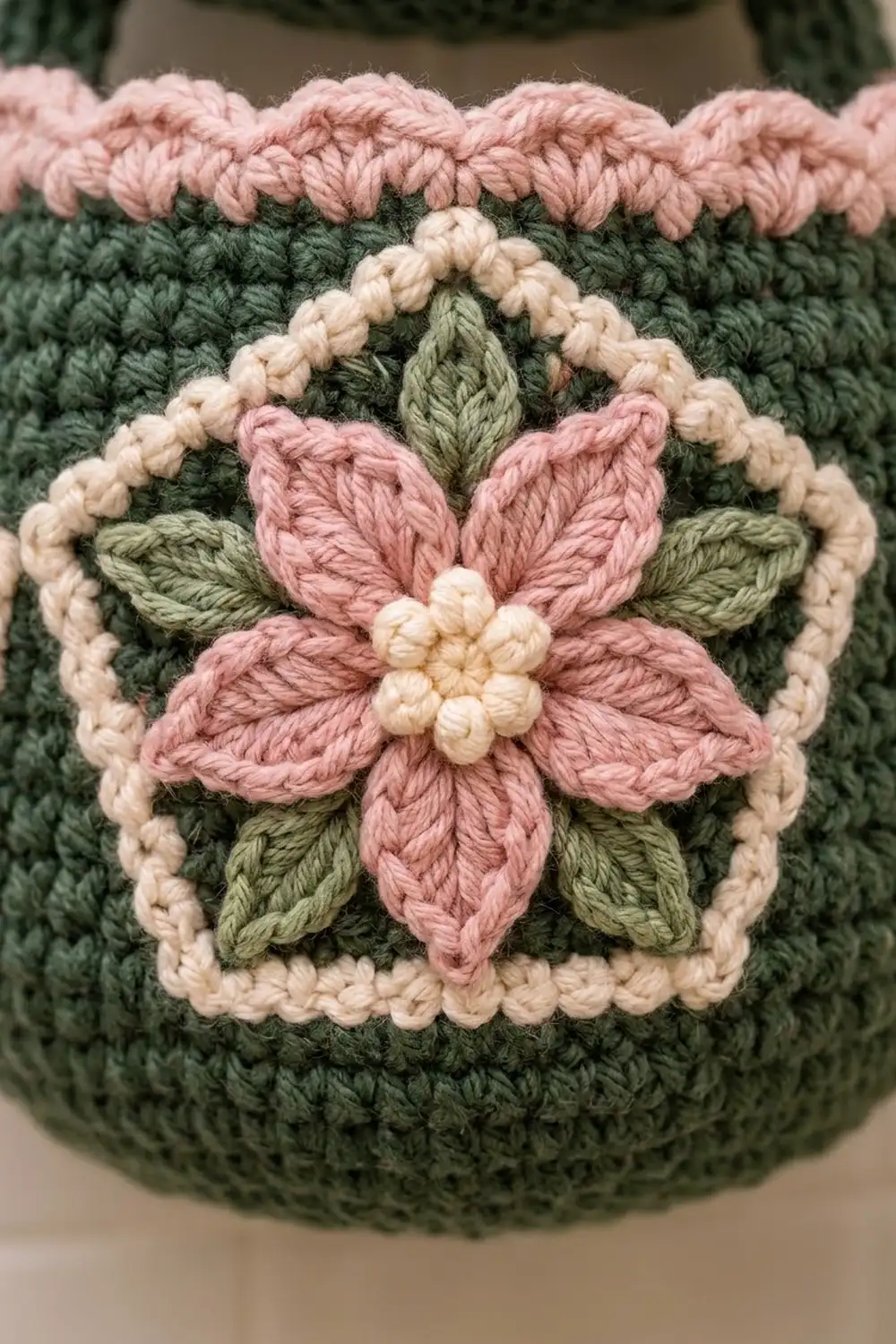
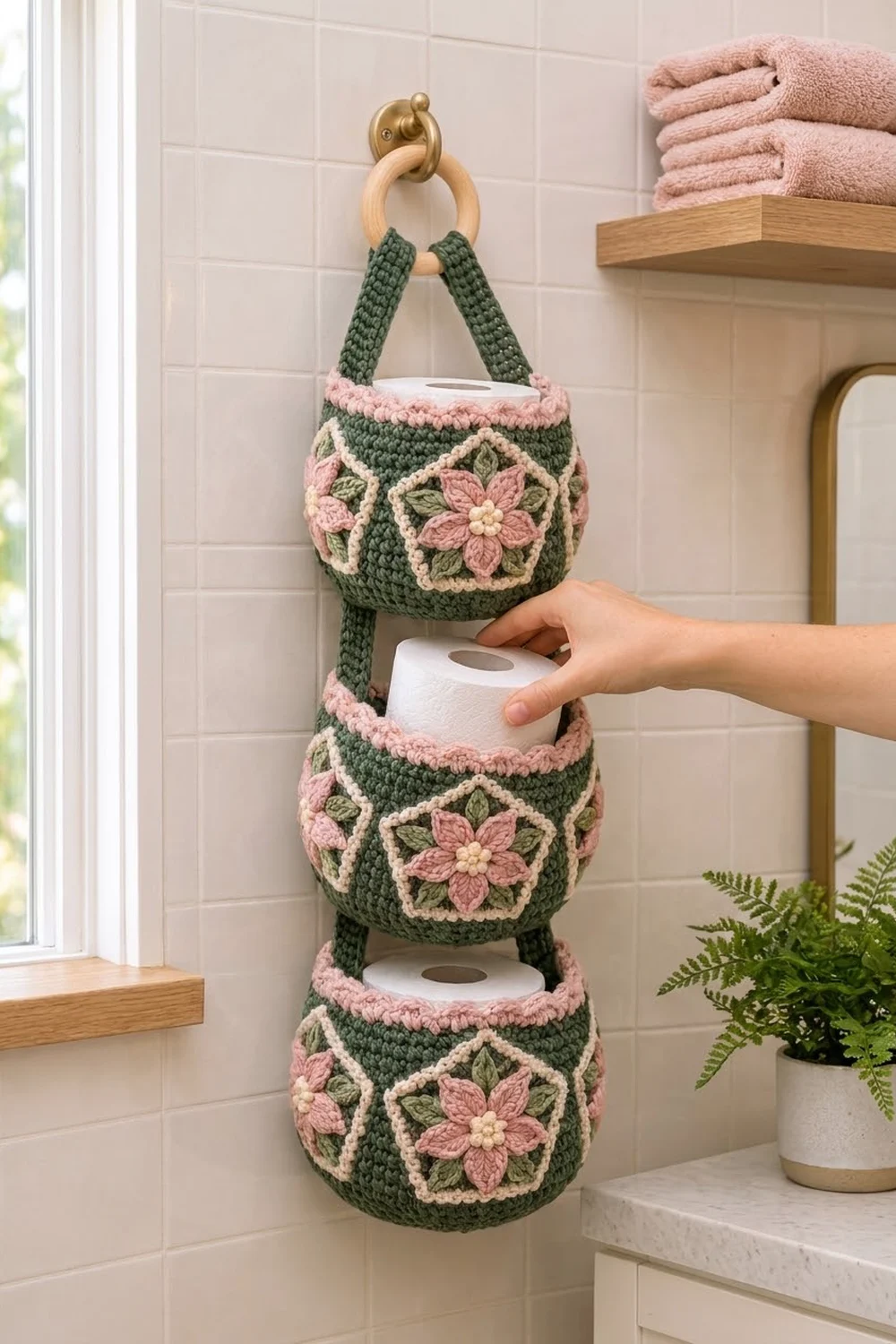
This hanging holder stores three toilet rolls in a neat vertical stack. Each round pocket is dense dark green single crochet, wrapped with pentagon appliqués that carry a soft pink poinsettia-style flower.
The palette is forest green, dusty pink, cream, and sage green. Pink petals and a cream bobble center sit on a green pentagon framed in cream, with sage leaves peeking out toward the corners. A scalloped pink rim with a corded edge finishes each pocket.
The pattern uses US crochet terms. Each pocket measures about 6.25 in (15.9 cm) across at its widest and 4.6 in (11.7 cm) tall. The full holder hangs about 24.5 in (62.2 cm) from the top of the ring to the base of the lowest pocket.
Construction is simple: crochet three pockets from the base up, make the pentagons, flowers, and leaves, stack and sew the appliqués, add the pink rims, then sew two long straps down the sides of all three pockets and loop them over a wooden ring.
Finished Size and Construction
- Finished size: each pocket 6.25 in (15.9 cm) wide x 4.6 in (11.7 cm) tall; overall length about 24.5 in (62.2 cm)
- Skill level: Intermediate
- Terminology: US crochet terms
- Yarn weight: worsted (#4)
- Hook: 4.0 mm (G-6)
- Number of pieces: 3 pocket bodies, 15 pentagons, 15 flowers, 75 leaves, 2 straps
- Layout: 3 pockets stacked vertically, 1.5 in (3.8 cm) apart; 5 pentagons around each pocket
- Piece size: pentagon 3.25 in (8.3 cm) point to flat edge, 3.4 in (8.6 cm) wide
- Size before border: pocket body 4.0 in (10.2 cm) tall from base fold to top
- Border depth: pink rim 0.6 in (1.5 cm)
Materials
Choose a smooth worsted-weight cotton or cotton blend. Cotton keeps the pockets firm and holds the round shape when a roll is lifted out. Acrylic works too, but the pockets will be a little softer.
- Dark green: 220 g, about 430 m (pocket bodies, pentagon centers, straps)
- Dusty pink: 60 g, about 120 m (petals, rims)
- Cream: 70 g, about 140 m (pentagon outlines, flower centers)
- Sage green: 30 g, about 55 m (leaves)
Tools:
- 4.0 mm (G-6) crochet hook
- Wooden ring, 3 in (7.6 cm) outer diameter
- Tapestry needle
- Stitch markers (at least 6)
- Rustproof pins
- Measuring tape and scissors
All quantities include a margin of roughly 20 percent for gauge swatches and differences in tension.
Abbreviations (US Terms)
- ch – chain
- sl st – slip stitch
- sc – single crochet
- hdc – half double crochet
- dc – double crochet
- tr – treble crochet
- sc2tog – single crochet 2 together
- BLO – back loop only
- MR – magic ring
- rev sc – reverse single crochet (crab stitch): sc worked from left to right
- st(s) – stitch(es); sp – space
Bobble: (yarn over, insert hook, yarn over, pull up a loop, yarn over, pull through 2 loops) 3 times in the same place; yarn over and pull through all 4 loops on hook.
Picot: ch 3, sl st in 3rd ch from hook.
Gauge and Checkpoints
Gauge: 16 sc and 18 rounds = 4 in (10.2 cm) in sc worked in the round, with the 4.0 mm hook.
Test one pocket base and one pentagon before making the rest. Checkpoints:
- Base after Rnd 6 (36 sts): about 2.9 in (7.4 cm) across.
- Base after Rnd 12 (72 sts): about 5.75 in (14.6 cm) across.
- Body after Rnd 30: 4.0 in (10.2 cm) tall from the base fold; 20 in (50.8 cm) around at the widest round.
- Pentagon after Rnd 3: 2.6 in (6.6 cm) from top point to bottom flat edge.
- Pentagon after Rnd 5: 3.25 in (8.3 cm) point to flat edge.
If your base is too big, go down a hook size; if too small, go up. Keep the stitches tight. A standard roll is about 4.5 in (11.4 cm) wide and needs to slide in with a little room.
Pocket Body (make 3, dark green)
Work in a continuous spiral. Move a marker up to the first st of each round.
Rnd 1: 6 sc in MR. (6)
Rnd 2: 2 sc in each st. (12)
Rnd 3: (sc in next st, 2 sc in next st) 6 times. (18)
Rnds 4–12: In each round, work (sc in each of the next sts, 2 sc in next st) 6 times, with one more plain sc per repeat than in the round before. Rnd 4 = 24, Rnd 5 = 30, Rnd 6 = 36, Rnd 7 = 42, Rnd 8 = 48, Rnd 9 = 54, Rnd 10 = 60, Rnd 11 = 66, Rnd 12 = 72.
The base should be flat and measure 5.75 in (14.6 cm).
Rnd 13: Sc in BLO of each st. (72) This makes a clean fold line between base and sides.
Rnds 14–15: Sc in each st. (72)
Rnd 16: (Sc in next 8 sts, 2 sc in next st) 8 times. (80)
Rnds 17–26: Sc in each st. (80)
Rnd 27: (Sc in next 8 sts, sc2tog) 8 times. (72)
Rnds 28–30: Sc in each st. (72) Sl st in next st and fasten off.
Rnds 13–30 are 18 rounds, so the body is 4.0 in (10.2 cm) tall. The 80-stitch rounds give the gentle bulge.
Pentagon (make 15)
Rnd 1 (dark green): MR, ch 3 (counts as dc), 2 dc in ring, ch 2, (3 dc, ch 2) 4 times in ring; sl st to top of ch 3. (15 dc, 5 ch-2 sps)
Rnd 2: Sl st in next 2 dc and into ch-2 sp, ch 3 (counts as dc), (dc, ch 2, 2 dc) in same sp, dc in next 3 dc, (2 dc, ch 2, 2 dc) in next ch-2 sp; repeat from * 3 more times, dc in next 3 dc; sl st to top of ch 3. (35 dc: 7 per side)
Rnd 3: Sl st in next dc and into ch-2 sp, ch 3, (dc, ch 2, 2 dc) in same sp, dc in next 7 dc, (2 dc, ch 2, 2 dc) in next ch-2 sp; repeat from * 3 more times, dc in next 7 dc; sl st to join. (55 dc: 11 per side) Fasten off.
Rnd 4 (cream): Join in any ch-2 sp. Ch 1, 3 sc in each ch-2 sp and sc in each dc. Count: 55 sc worked one per existing dc + 15 sc added in corners = 70 (11 sc per side + 3 sc per corner, 5 x 14 = 70).
Rnd 5: Sc in each st, working 3 sc in the center sc of each corner. Count: 70 sc worked one per existing st + 10 extra (2 per corner) = 80 (13 sc per side + 3 sc per corner, 5 x 16 = 80). Sl st to join, fasten off and leave a 16 in (40.6 cm) tail for sewing.
Flower (make 15)
Rnd 1 (cream): MR, ch 2 (does not count), (bobble in ring, ch 1) 6 times; sl st to top of first bobble. (6 bobbles, 6 ch-1 sps) Pull the ring tight. The center measures about 0.75 in (1.9 cm). Fasten off.
Rnd 2 (pink): Join in any ch-1 sp, ch 1, (sc, ch 3) in each ch-1 sp; sl st to first sc. (6 sc, 6 ch-3 sps)
Rnd 3 (petals): In each ch-3 sp work (sl st, ch 3, dc, tr, picot, tr, dc, ch 3, sl st). (6 pointed petals) Fasten off, leaving a 12 in (30.5 cm) tail.
The flower measures about 2.75 in (7.0 cm) from petal tip to petal tip.
Leaf (make 75, sage green)
Ch 7. Starting in 2nd ch from hook: sc, hdc, dc, dc, hdc, 3 sc in last ch. Working along the other side of the chain: hdc, dc, dc, hdc, sc. Ch 2, sl st in first sc to make the point. (13 sts plus tip) Fasten off with a 6 in (15.2 cm) tail.
Each leaf is about 1.25 in (3.2 cm) long.
Strap (make 2, dark green)
Ch 6.
Row 1: Sc in 2nd ch from hook and each ch across. (5)
Rows 2–108: Ch 1, turn, sc in each st. (5)
At 4.5 rows per inch, 108 rows make 24 in (61.0 cm). The strap is 1.25 in (3.2 cm) wide. Fasten off with a long tail.
Make All Pieces
For three pockets you need:
- Dark green: 3 pocket bodies, 15 pentagon centers (Rnds 1–3), 2 straps
- Cream: 15 pentagon outlines (Rnds 4–5), 15 flower centers
- Pink: 15 flowers (Rnds 2–3), 3 rims
- Sage green: 75 leaves
Layout of one pocket, seen from above, at Rnd 21 (80 sts):
          [P1 front, st 1]
  [P5, st 65]          [P2, st 17]
   STRAP st 57        STRAP st 25
     [P4, st 49]    [P3, st 33]
             (back, toward wall)
Vertical stack:
      ( ring )
      /      \
  [ Pocket 3 ]  top
  [ Pocket 2 ]  middle
  [ Pocket 1 ]  bottom
Joining
Build the appliqués. Place 5 leaves on a pentagon, one pointing toward each corner, with their bases near the center. Lay the flower on top so the petals cover the leaf bases. Sew the flower down with the pink tail, stitching through the base of each petal and the leaf bases below. Tack each leaf tip with a single stitch.
Mark the body. On Rnd 21 of each pocket, place markers in sts 1, 17, 33, 49, and 65. These are 16 sts apart (80 ÷ 5 = 16), so the pentagons are evenly spaced.
Sew the pentagons. Center each pentagon on a marker with one point facing up and the flat edge toward the base. Pin it down. Whipstitch through the outer loops of cream Rnd 5 into the body stitches underneath. Stitch around each side in turn: 13 side sts plus the corners. Keep the stitches snug but not tight. If the body puckers, loosen up. The pentagons are 3.4 in (8.6 cm) wide on a 20 in (50.8 cm) round, so a gap of about 0.6 in (1.5 cm) of green stays between them.
Next, work the Border below on all three pockets, then come back for the straps.
Attach the straps. The strap positions on Rnd 21 are sts 25 and 57, in the gaps behind P2 and P5. This puts the straps 32 sts apart across the back and 48 sts apart across the front. The front pentagon sits centered, and the straps fall slightly toward the wall.
Rows of each strap, counted from Row 1:
- Rows 1–21: bottom pocket, base fold to rim top (about 4.6 in / 11.7 cm)
- Rows 22–28: gap, 1.5 in (3.8 cm)
- Rows 29–49: middle pocket
- Rows 50–56: gap
- Rows 57–77: top pocket
- Rows 78–100: free strap, about 5.1 in (13.0 cm)
- Rows 101–108: wrap around ring, about 1.8 in (4.6 cm)
Whipstitch both long edges of each strap onto the body column by column, keeping the strap straight up and down. Then fold Rows 101–108 over the ring to the back and sew them down to Rows 93–100.
Size checkpoint: lay the holder flat. From the base of the bottom pocket to the top of the top rim should be 16.8 in (42.7 cm).
Border (Pink Rim, make 3)
Border gauge matches the body: 16 sts = 4 in (10.2 cm). The rim is circular, so counts are given per repeat and per round, not per side.
Rnd 31: Join pink in any st of Rnd 30. Ch 1, sc in each st. (72)
Rnd 32: Sc in next st, skip 1 st, 3 hdc in next st, skip 1 st; repeat from * 17 more times. (18 scallops: 18 sc + 54 hdc = 72)
Rnd 33:* Ch 1, rev sc in each st. (72) Sl st to join and fasten off.
Why the math works: each scallop uses 4 sts of the round below and makes 4 sts (1 sc + 3 hdc). With 72 ÷ 4 = 18 repeats, the rim neither flares nor pulls in. The reverse single crochet keeps all 72 sts and adds the corded edge. The three rounds add 0.6 in (1.5 cm), bringing the pocket to 4.6 in (11.7 cm).
Final Blocking
- Lightly mist each pocket with water.
- Stuff it firmly with a toilet roll or a rolled towel to hold the round shape.
- Press each pentagon flat against the body with your fingers and shape the petal and leaf tips into points.
- Pin the scallops of the rim so they stand evenly.
- Hold a steam iron above, not on, the straps to straighten them.
- Let everything dry completely before hanging.
Final Quality-Control Checklist
- Each base is flat and 5.75 in (14.6 cm) across.
- Each body is 4.0 in (10.2 cm) tall before the rim and 4.6 in (11.7 cm) after.
- Every pentagon has 80 sts in Rnd 5 and measures 3.25 in (8.3 cm).
- Each pocket has 5 pentagons, 16 sts apart, points up.
- Each flower has 6 petals and 5 leaves.
- Each rim has 18 scallops.
- Gaps between pockets are 1.5 in (3.8 cm) on both straps.
- The holder hangs level, with no twisting.
- All ends are woven in.
Troubleshooting
- Base curls up like a bowl: you are working too tightly; go up a hook size for the base only.
- Base ripples: too loose, or an extra increase snuck in; recount each round.
- Roll won’t fit: check the 72-st count at Rnd 12 and gauge.
- Pentagon cups: loosen the corner chains or block flat before sewing.
- Pentagon ruffles: check the dc count per side (7, then 11).
- Rim flares: make sure you skip 1 st on each side of every 3-hdc group.
- Holder tilts forward: sew strap edges all the way down to the base fold.
- Pockets hang at different heights: count strap rows, not inches, when pinning.
Care
Hand wash in cool water with mild soap and lay flat to dry over a rolled towel. Do not tumble dry, since heat can loosen the appliqué stitching.
Final Notes
The measurement chain is: gauge 16 sc and 18 rounds = 4 in (10.2 cm); a 72-st base of 5.75 in (14.6 cm); an 18-round body of 4.0 in (10.2 cm); a 0.6 in (1.5 cm) rim making a 4.6 in (11.7 cm) pocket; five 3.25 in (8.3 cm) pentagons per pocket, 16 sts apart; and 108-row straps of 24 in (61.0 cm) that stack the pockets 1.5 in (3.8 cm) apart for a finished length of about 24.5 in (62.2 cm). Check each link, and the holder will come together just like the original.
Happy crocheting!