

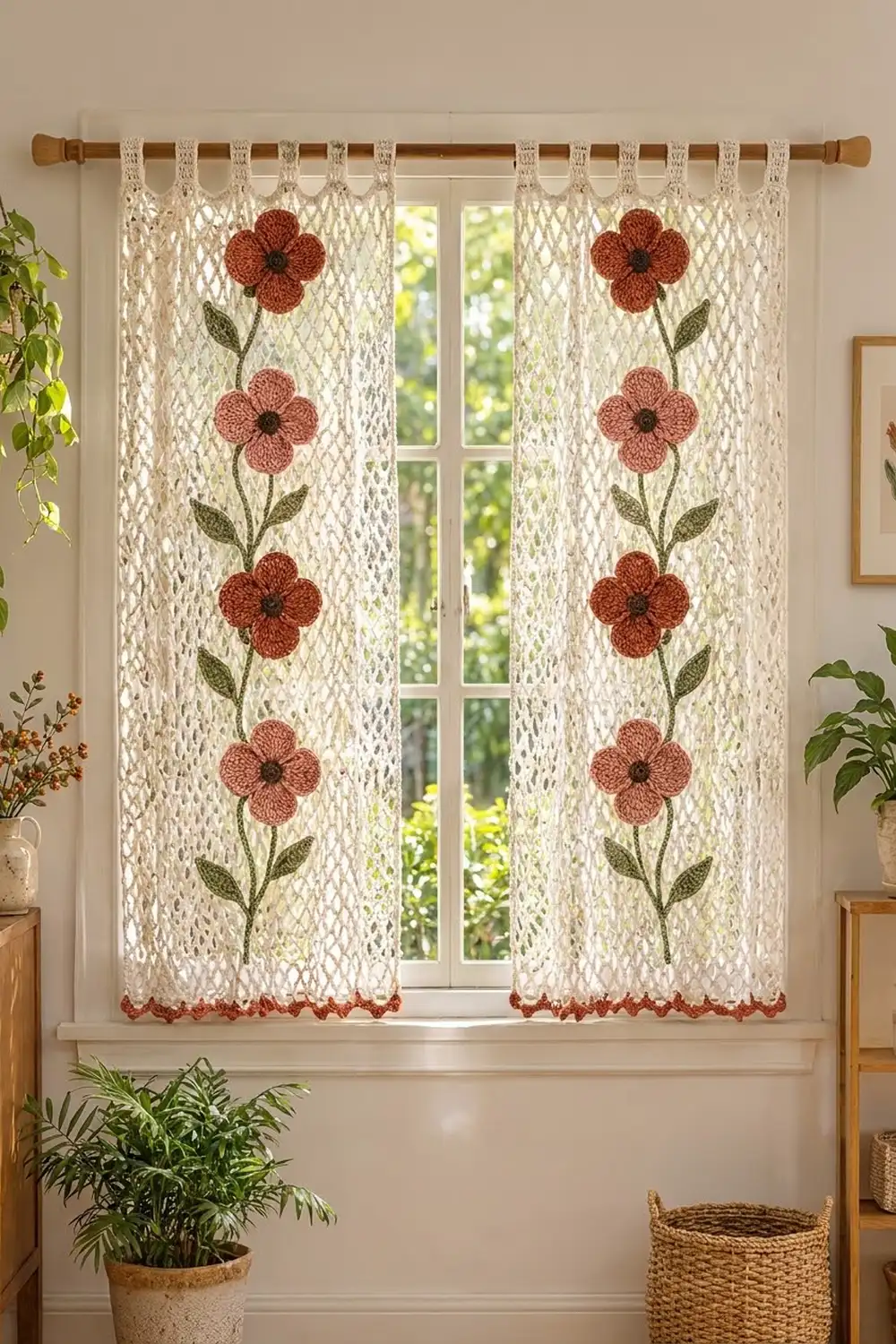
This is a pair of airy cream mesh curtain panels. A single flowering vine climbs the center of each one. Rust and dusty pink five-petal flowers with dark brown centers sit along a sage-green stem with pointed leaves. A row of small rust scallops finishes the bottom edge.
The style is cottage-garden and relaxed. The open diamond net lets daylight through, and the flat flowers add color without blocking the view. All instructions use US crochet terms.
Each finished panel measures 25.5 in (64.8 cm) wide by 51.25 in (130.2 cm) long, or 53.25 in (135.3 cm) including the hanging tabs. You make two separate panels. They are not joined.
Each panel is built in four steps. First, crochet the mesh in rows. Second, crochet the flowers, leaves, and stem separately and sew them onto the mesh in a fixed layout. Third, work a border all the way around. Last, add scallops along the bottom and tabs along the top.
Finished Size and Construction
- Finished size (per panel): 25.5 x 51.25 in (64.8 x 130.2 cm); 53.25 in (135.3 cm) long including tabs
- Skill level: Intermediate
- Terminology: US crochet terms
- Yarn weight: Worsted (#4) cotton
- Hooks: 5.0 mm (H-8) for the mesh and border; 4.0 mm (G-6) for the appliqués
- Number of pieces: 2 panels. Each panel has 1 mesh body, 4 flowers, 8 leaves, and 1 stem (14 pieces).
- Layout: 1 vertical vine, centered on each panel
- Mesh size before border: 25 x 50 in (63.5 x 127.0 cm)
- Flower size: 4 in (10.2 cm) across
- Border depth: 0.25 in (0.6 cm) at the top and sides; 1 in (2.5 cm) at the bottom, including scallops
Materials
Use a smooth, mercerized or matte worsted cotton. Cotton blocks well, stays flat in a window, and won’t stretch much over time. Avoid fuzzy yarns, because they blur the mesh.
Quantities below are for the pair of panels. They assume about 1.7 m of yarn per gram.
- Cream (mesh, border, tabs): 400 g, about 680 m
- Rust (4 flowers, bottom scallops): 50 g, about 85 m
- Dusty pink (4 flowers): 50 g, about 85 m
- Dark brown (8 flower centers): 20 g, about 34 m
- Sage green (2 stems, 16 leaves): 50 g, about 85 m
Tools: 5.0 mm (H-8) and 4.0 mm (G-6) hooks, tapestry needle, stitch markers, measuring tape, rustproof pins, a blocking surface, and a spray bottle.
All quantities include a margin of about 15% for swatches and small differences in gauge.
Abbreviations (US Terms)
- ch – chain
- sl st – slip stitch
- sc – single crochet
- hdc – half double crochet
- dc – double crochet
- tr – treble crochet
- BLO – back loop only
- sp(s) – space(s)
- st(s) – stitch(es)
- rep – repeat
Special stitch – back-bump slip stitch cord: Insert the hook under the bump on the back of the chain only, then work a sl st. This makes a firm, rounded cord that doesn’t twist.
Gauge and Checkpoints
Before you start a full panel, make one flower and one small mesh swatch.
Mesh gauge (5.0 mm hook): 4 ch-5 loops = 5 in (12.7 cm) wide, and 8 rows = 5 in (12.7 cm) tall. Each loop is 1.25 in (3.2 cm) wide, and each row is 0.625 in (1.6 cm) tall.
Swatch: Ch 22. Work Row 1 as given below (5 loops), then work Row 2 seven times, for 8 rows in total. The swatch should measure 6.25 in (15.9 cm) wide by 5 in (12.7 cm) tall, laid flat and not stretched.
Appliqué gauge (4.0 mm hook): Flower Rounds 1–2 = 1 in (2.5 cm) across. A finished flower = 4 in (10.2 cm) across.
Checkpoints:
– After Mesh Row 8: 25 in (63.5 cm) wide, 5 in (12.7 cm) tall
– After Mesh Row 40: 25 in (63.5 cm) tall
– After Mesh Row 80: 50 in (127.0 cm) tall
– Leaf: 2.5 in (6.4 cm) long
– Stem cord: 40 in (101.6 cm) long
If your piece is too big, go down half a hook size. If it is too small, go up half a size. In the mesh, length matters more than width, but check both.
Mesh Panel (make 2)
Use cream and the 5.0 mm hook. The foundation chain becomes the top of the panel.
Foundation: Ch 82. (This is a multiple of 4, plus 2.)
Row 1: Sc in 6th ch from hook. Ch 5, sk 3 ch, sc in next ch; rep from * 18 more times. Turn. (20 loops: the first arch plus 19 ch-5 loops)*
Row 2: Ch 5, sc in first ch-5 loop. Ch 5, sc in next loop; rep from * across, ending with sc in the last loop of the row below. Turn. (20 loops)*
Rows 3–80: Rep Row 2. (20 loops in every row)
Each sc sits in the center of a loop from the row below. This staggering forms the diamond net. Don’t fasten off. Place a marker in the working loop and set the panel aside while you make the appliqués.
Checkpoint: Lay the mesh flat without stretching it. It should measure 25 x 50 in (63.5 x 127.0 cm).
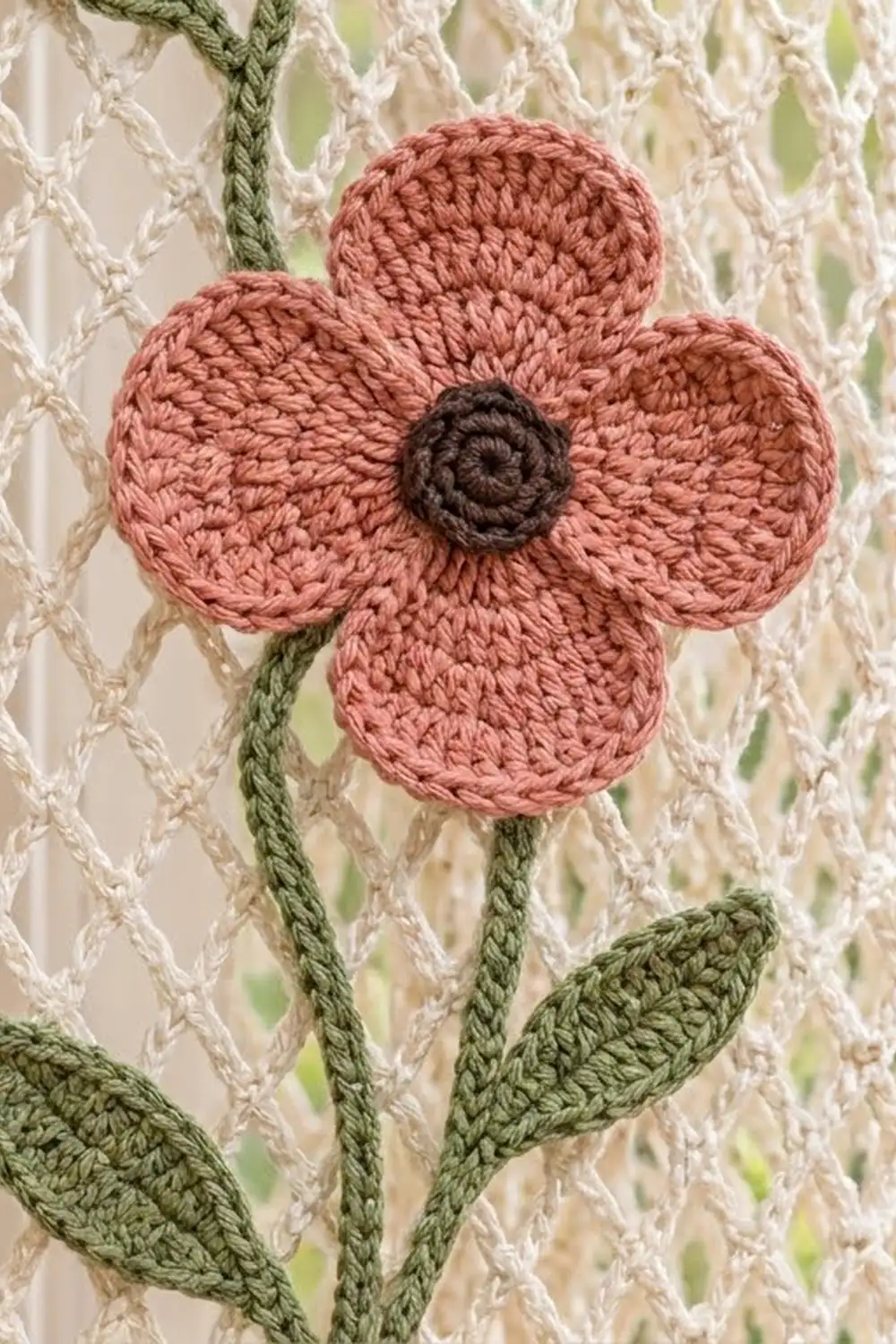
Flowers (make 4 rust and 4 dusty pink)
Use the 4.0 mm hook. Begin with dark brown.
Round 1: Magic ring, ch 1, 10 sc in ring. Join with a sl st to the first sc. (10 sc)
Round 2: Ch 1, 2 sc in each st around. Join. (20 sc) Fasten off brown.
Round 3: Join the petal color in the BLO of any st. Ch 1, sc in BLO of each st around. Join. (20 sc) The unused brown front loops form the raised ridge around the center.
Round 4 (petals): Each petal is worked over 4 sts. Work (sc, hdc) in next st, (2 dc, tr) in next st, (tr, 2 dc) in next st, (hdc, sc) in next st; rep from * 4 more times. Join. (5 petals of 10 sts each: 50 sts)*
Round 5 (rim): For each petal: Sl st in sc, sc in hdc, 2 sc in each of next 6 sts (dc, dc, tr, tr, dc, dc), sc in hdc, sl st in sc; rep from * 4 more times. Join. (16 sts per petal: 80 sts in total, which is 70 sc plus 10 sl st)*
The doubled sc around each petal rounds it and forms the slight rim. The sl sts pull in between petals and mark where each petal starts. Fasten off and leave a 12 in (30.5 cm) tail for sewing.
Checkpoint: 4 in (10.2 cm) across, measured from a petal tip to the opposite petal edge.
Leaves (make 16, sage green)
Foundation: Ch 10.
Round 1: Sl st in 2nd ch from hook. Sc in next ch, hdc in next ch, dc in next 3 ch, hdc in next ch, sc in next ch. Work (sc, ch 2, sc) in the last ch for the tip. Rotate and work along the opposite side of the foundation: sc in next ch, hdc in next ch, dc in next 3 ch, hdc in next ch, sc in next ch, sl st in last ch. Join to the first sl st. (18 sts plus the ch-2 tip)
The foundation chain shows as a center vein, and the ch-2 makes the pointed tip. Fasten off and leave a 10 in (25.4 cm) tail.
Checkpoint: 2.5 in (6.4 cm) long and about 1 in (2.5 cm) wide.
Stem (make 2, sage green)
Ch 161. Work a back-bump sl st in the 2nd ch from hook and in each ch across. (160 sl st) Fasten off and leave a long tail at both ends.
Checkpoint: 40 in (101.6 cm). To adjust the length, add or remove chains in groups of 4 (1 in, 2.5 cm).
Make All Pieces
For the pair:
– Cream: 2 mesh panels
– Rust: 4 flowers (2 per panel)
– Dusty pink: 4 flowers (2 per panel)
– Dark brown: 8 centers (worked into the flowers)
– Sage green: 2 stems and 16 leaves (8 per panel)
Layout per panel. Measurements run down from the top edge of the mesh. The vine is centered 12.5 in (31.8 cm) from either side edge.
 6 in (15.2 cm)   [ RUST FLOWER ]   stem starts
11 in (27.9 cm)   leaf  |  leaf
16 in (40.6 cm)   [ PINK FLOWER ]
21 in (53.3 cm)   leaf  |  leaf
26 in (66.0 cm)   [ RUST FLOWER ]
31 in (78.7 cm)   leaf  |  leaf
36 in (91.4 cm)   [ PINK FLOWER ]
41 in (104.1 cm)  leaf  |  leaf
46 in (116.8 cm)        |           stem ends
Attaching the Appliqués
The appliqués are sewn on, not crocheted in. Sewing keeps the mesh flat and lets you adjust the placement.
- Pin the stem. Lay the mesh flat at 25 x 50 in (63.5 x 127.0 cm). Pin the stem down the center from 6 in to 46 in (15.2 cm to 116.8 cm).
- Sew the stem. Use a stem tail to whipstitch the stem to every mesh sc node it crosses, about one every 0.625 in (1.6 cm). Catch only the back of the cord so the stitches stay hidden.
- Sew the leaves. Angle each leaf upward at about 45 degrees, with its base touching the stem. Tack the base, the tip, and one point on each side.
- Sew the flowers. Center each flower over the stem at its mark. Tack the BLO ridge of Round 3 at 5 points, then tack each petal tip through the Round 5 rim.
Tension: Keep the mesh relaxed. If a stitch pulls a diamond out of shape, loosen it. Keep a flat hand under the work while you sew.
Checkpoint: After sewing, the mesh should still measure 25 x 50 in (63.5 x 127.0 cm), and the vine should hang straight.
Border
Border gauge: 4 sc = 1.25 in (3.2 cm) along every edge. That means 4 sc per mesh loop along the top and bottom, and 2 sc per row end along the sides. With the same density on all four sides, the edges don’t ruffle or pull in.
Round 1 (cream, 5.0 mm hook): Return the working loop to your hook. Ch 1 and turn. Work along the bottom: 4 sc in each of the 20 loops of Row 80 (80 sc). Ch 2 for the corner. Work along the side: 2 sc per row end (80 rows x 2 = 160 sc). Ch 2. Work along the top: 4 sc into each of the 20 foundation spaces (80 sc). Ch 2. Work along the second side: 2 sc per row end (160 sc). Ch 2 and join to the first sc.
Round 1 total: 480 sc (80 + 160 + 80 + 160). The ch-2 corners aren’t counted. Fasten off.
Bottom scallops (rust): Join rust with a sc in the corner ch-2 sp at the start of the bottom edge. Sk 1 st, 5 dc in next st, sk 1 st, sc in next st; rep from * 19 more times. The last sc lands in the 80th sc. Fasten off. (20 scallops, 21 sc)*
Each repeat uses 4 sts, so 20 repeats use exactly 80 sts. Each scallop sits under one mesh loop.
Top tabs (cream): Each tab is worked in rows over 8 sts of the top edge, with 4-st gaps between tabs. (7 tabs x 8 sts + 6 gaps x 4 sts = 80)
For each tab: Join cream in the first st of the tab. Row 1: ch 1, sc in each of 8 sts. Rows 2–16: ch 1, turn, sc in each of 8 sts. Fasten off and leave a long tail.
Work the first tab over sts 1–8, then skip 4 sts. Work the next tab over the next 8 sts, and continue the same way. The seventh tab ends on st 80.
Fold each tab to the back and whipstitch its last row to the base of the tab. This makes a 2 in (5.1 cm) loop that fits a rod up to 1.25 in (3.2 cm) across.
Why the math works: The top and bottom each have 20 loops x 4 = 80 sts. That divides evenly into 20 scallops of 4 sts, and into 7 tabs plus 6 gaps with nothing left over. Each side is 50 in (127.0 cm) at 3.2 sc per in, which is exactly 160 sc.
Final Blocking
- Weave in all ends along the mesh chains, where they stay hidden.
- Soak each panel in cool water for 10 minutes, then press out the water. Don’t wring it.
- Roll each panel in a towel to remove excess moisture.
- Lay it flat on the blocking surface and pin the border to 25.5 x 51.25 in (64.8 x 130.2 cm).
- Pin every fourth bottom scallop into shape, and smooth each petal flat.
- Let it dry completely, which can take up to 24 hours.
Final Quality-Control Checklist
- 20 loops in every mesh row, and 80 rows in total
- Mesh is 25 x 50 in (63.5 x 127.0 cm) before the border
- Border Round 1 is 80 / 160 / 80 / 160 sc
- 20 rust scallops, evenly spaced
- 7 tabs, each 16 rows, folded and secured
- 4 flowers per panel, in the order rust, pink, rust, pink
- 8 leaves per panel, in 4 pairs
- Stem is straight and centered 12.5 in (31.8 cm) from each side
- Both panels match in length to within 0.5 in (1.3 cm)
Troubleshooting
- Mesh slants to one side: Make sure every row starts with ch 5 and ends with a sc in the last loop.
- Panel gets longer after hanging: Cotton can drop. Re-block it and let it dry flat, not hanging.
- Petals cup: Round 5 is too tight. Use a 4.5 mm (7) hook for that round only.
- Petals ruffle: Round 5 is too loose. Use a 3.75 mm (F-5) hook for that round only.
- Edges are wavy: Recount the side sc. You need exactly 160 per side.
- Scallops are uneven: Check that each 5-dc group sits in every fourth st.
- Mesh puckers behind the flowers: The tacking is too tight. Snip it and sew again more loosely.
Care
Hand wash in cool water with mild soap, and dry flat. Don’t tumble dry, because the mesh can stretch out of shape.
Final Notes
All the measurements in this pattern build on each other. A mesh loop is 1.25 in (3.2 cm) wide and a row is 0.625 in (1.6 cm) tall. Twenty loops and 80 rows give a 25 x 50 in (63.5 x 127.0 cm) mesh. The border adds 0.25 in (0.6 cm) at the top and sides and 1 in (2.5 cm) at the bottom, for 25.5 x 51.25 in (64.8 x 130.2 cm). The tabs bring the length to 53.25 in (135.3 cm).
If you check your gauge at each checkpoint, your vines will hang straight and both panels will match.
Happy crocheting!